

N.B. Once again, my thanks to Drs Greg Dubord (mostly!) and Paul Conte for co-authoring this blog.
CHIEF COMPLAINT
Chronic member disconnection. By the patient’s own account, “some” physicians have felt disconnected, but investigation reveals this is very widespread. Self-Management (a column, a newsletter, a podcast and poorly attended town halls) failed.
HISTORY OF PRESENT ILLNESS
In January 2022 the CFPC (“the patient”) surveyed its members and found that only 39% felt the College listened to them, and only 25% considered their fees worth the money. No satisfaction survey since. That same month it proposed a mandatory third year of residency, PGY3, without consulting the people who would deliver it.
At the November 2023 AGM, members voted 91% to stop PGY3 and review how it came about. 95% asked for access to Board minutes. The patient withdrew the proposal and promised “a comprehensive, independent review process.” In July 2024 the patient declined to release minutes and recorded “no further need for an analysis of this direction.” Asked about PGY3 this year, the President said: “We learned a lot from that… But we have moved past that.”
PAST MEDICAL HISTORY
- 2013 to 2016: Merged its certification exam with the Medical Council of Canada’s, then unmerged it.
- 2019 The Board decides each year which “skills, experience and perspectives” it wants, its committee screens applicants for them, and the Board sets the final list of nominees “in its sole discretion.” Members then vote, but only among the names the Board has already chosen, and for the officer positions there is exactly one name each.
- October 2023: Data breach, with members not told the details until more than five months later.
- November 2023: Proposed a 7% fee increase. 83.86% of members rejected it.
- 2024 to 2025: Went to court to validate its own by-laws retroactively after, by its own affidavit, more than a decade of non-compliance with the federal Act. (Ontario Superior Court of Justice, court file CV-24-00096601)
- March 2025-February 2026: Adopted a Member Code of Conduct binding on all 46,000 members, then added suspension or revocation of membership as penalties, with appeals decided by a panel the Board Chair designates and declared “final.” Never put to the members.
- November 2025: Proposed a by-law allowing automatic annual fee increases tied to inflation, citing financial strain. Members defeated it. Surplus that fiscal year: $7.5 million.
- March 2026: Fifteen member proposals for governance reform disqualified for arriving outside the 60-day window.
EXAMINATION
Vital signs.
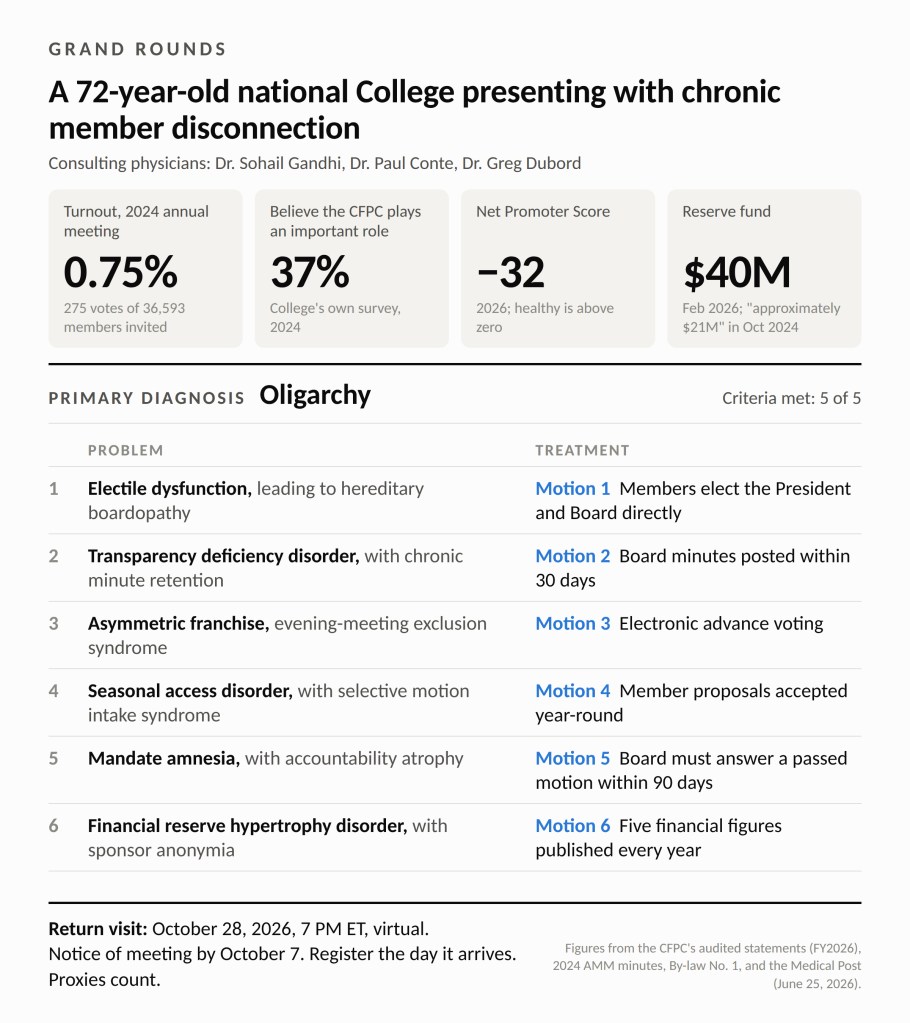
Pulse: Between 85-140 Members (out of 35,000+) attend AGMs.
Approval: 37% of Members feel CFPC plays important role.
Intake: Member input allowed on only 60 days of the year.
Mental status: Pleasant and well groomed. Defensive thought processes noted:
- Minimization (“some physicians have felt disconnected”)
- Rationalization (minutes withheld on legal advice)
- Displacement (a 37% approval rating is a problem of “how we’re portraying that information”)
- Reaction formation (“We really welcome divergent perspectives and voices”)
- Compartmentalization (accreditor and vendor of CPD described as two different departments behind a “firewall”)
- Cognitive distortions: Catastrophizing (a projected $5.4 million deficit, “not sustainable to continue long term”; the year closed with a $5.1 million surplus
- All-or-nothing thinking (either full minutes with “sensitive material” or two-page summaries; redaction, which is how every other body that publishes minutes handles sensitive material, does not occur to the patient)
- Labeling (a 95% member vote becomes “advisory”; an unseen by-law package becomes “corrective”)
- Risk to self: low. Risk to members: ongoing.
INVESTIGATIONS
Bloodwork (audited statements, year ended February 28, 2026): Revenue $59.5 million; dues $30.0 million (compulsory for anyone keeping the CCFP); surplus $7.5 million, after $5.1 million the year before; reserve fund $40.0 million; cash $11.6 million, up from $4.2 million; the Office of the CEO’s budget line (shared only with non-FMF meetings) up 41%, from $2.8 million to $3.9 million. Sponsors named: none. Legal fees: no subtotal, not itemized, somewhere inside $7.0 million of “corporate services.” [14]
Imaging (the College’s governing by-law, read in full): Section 5.2: The Board sets the list of nominees “in its sole discretion.” Section 5.3: The President “will be acclaimed.”
Records review: Board minutes not available to members. A 95% vote in 2023 asked for them; the Board declined in July 2024 and offers two-page summaries instead.
ASSESSMENT AND PLAN
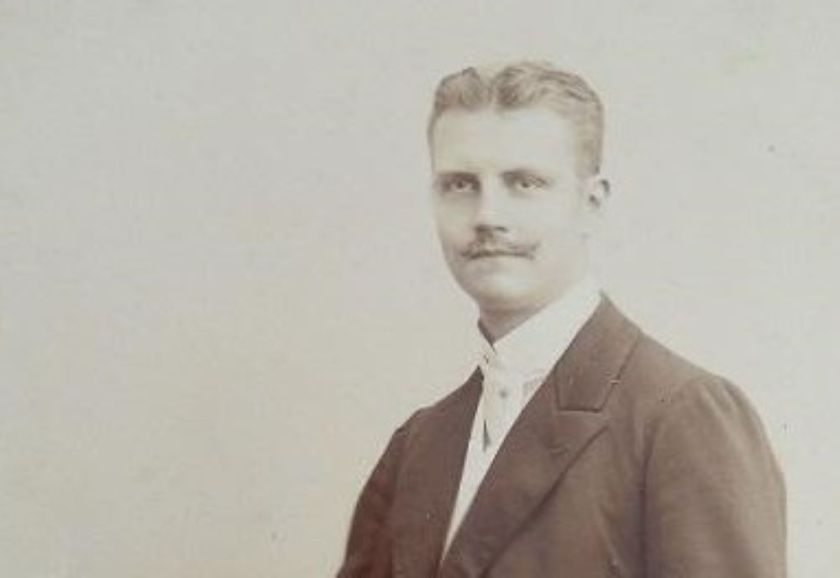
Primary diagnosis: Oligarchy (a form of government in which all power is vested in a few persons or in a dominant class or clique; government by the few.). Robert Michel’s Iron Law of Oligarchy suggests that all complex organizations develop into oligarchies. Hence no cure for the illness itself. But symptomatic treatment is warranted.
Treatment Plan: Support of six motions at the AGM by members essential to treat the most significant symptoms of this patient.
Problem 1. Electile dysfunction. Treatment: Members elect the President and Board directly; any member may run; no committee screens the ballot.
Problem 2. Transparency deficiency disorder. Treatment: Board and committee minutes posted within 30 days.
Problem 3. Restrictive Voting Syndrome, aka Evening-meeting exclusion syndrome with proxy-dependent syndrome. Treatment: Electronic advance voting on member proposals, on the system the College already runs.
Problem 4. Seasonal access disorder (member proposals accepted only during a 60-day window, in summer) Treatment: Member proposals accepted year-round.
Problem 5. Mandate amnesia. Treatment: A formal Board response within 90 days to any proposal that passes: An implementation plan, or written reasons that members then vote on.
Problem 6. Financial reserve hypertrophy disorder. Treatment: Five figures published every year: Travel and hospitality; sponsors over $10,000, by name; spending on the College’s own CPD products; consultant fees; legal fees.
PROGNOSIS
Prognosis with treatment: Good. The patient is solvent, well resourced and, on the President’s own account, wants to reconnect. Without treatment: Highly probable progressive deterioration. Adherence to treatment suggestions have historically been poor. Two unambiguous member orders above 90% went unfilled. That is why each treatment is written as a by-law the Board cannot repeal on its own.
FOLLOW UP
October 28, 7 PM Eastern, Virtual. There will be a notice of meeting arriving by October 7 (check your email). Directions for voting on treatment protocol by proxy will be reviewed in a follow up blog shortly after notice of meeting.
CODE STATUS:
Full code. The members want this patient to live. We just want it healthier.

