
For this blog, I will be telling some patient stories. They are not all my patients, but people in my area. The stories are real – the identities have been anonymized.
Last week, I received yet another rejection letter from a specialist, in this case a neurosurgeon. He declined to see my patient because his practice was “too busy to see the patient in a timely manner”. Which of course means more admin work for me as I try to find another neurosurgeon for my patient. I do a lot of procedures as a rural family physician, probably more than the average doctor – but neurosurgery is a bit beyond my skills.
All of which got me wondering (again) how our health care system, which in Ontario was once rated the best in the world (no really) came to fall so far that a certain grumpy curmudgeon has openly said if he gets sick, he would go to Turkiye. The only answer to my mind, would be that it’s because Canadians are okay with it.
LC, early 40s, seen in emergency for sudden abdominal pain. CT scan sadly shows advanced cancer. Specialist refuses to see her until she goes to a “screening clinic”. Three weeks to get to the screening clinic, that agrees it’s cancer. Refers to specialist who orders more tests. Treatment doesn’t begin until 12 weeks after the diagnosis.
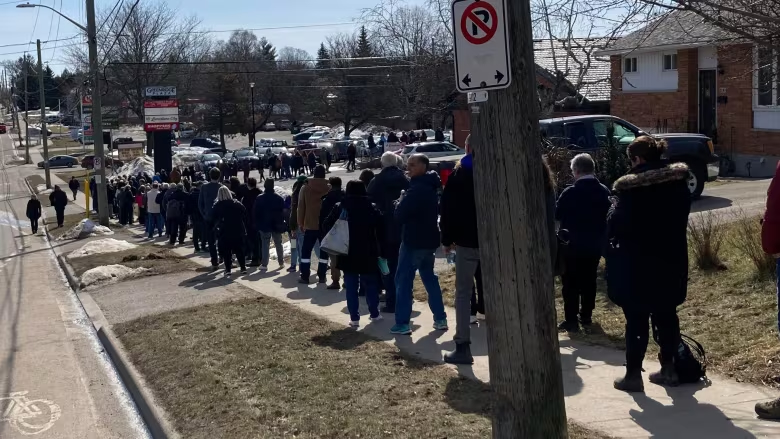
Why do I say Canadians are ok with this? Because for all of the noise on social media, and for all of the news reports highlighting ER closures, delays, and lack of health care staff, I don’t really see people organizing to demand change.
Look, if ten years ago, someone had told me, hey, in 2023 in Ontario there would be over 800 times when an Emergency Department has a partial shutdown, 2.3 million people would no have a family doctor and wait times would be forcing people to consider leaving the country to get health care, well, my first thought would have been “I need to avoid Queen’s Park, there’s gonna be a protest there every day”.
KX, 85 years old, in good health, debilitated by arthritis pain in his hip. Can’t get a fluorscopic cortisone shot to his hip for 5 months, and a specialist who does this in office under ultrasound is over 100 miles away, and has not responded to a referral request yet. Has been limping and on addictive painkillers for 3 months with no appointment in sight.
I see people protesting and demanding change for any number of issues (and I stress many of these are important causes that I support). I have yet to see the kind of sustained pressure on government needed to force drastic change in Health Care.
I’m not the only one to suggest this. Dr. Stephen Major, now the President of the Newfoundland and Labrador Medical Association (NLMA) suggested that the public has become “complacent” about health care. He correctly points out that while fish harvesters protested and shut down Confederation Building in May, he has yet to see a protest about the fact Newfoundland has over 100,000 people without a family doctor.
ET, severe sciatic style back pain. First sees the family doctor who correctly diagnosed this clinically. MRI ordered – which took 5 months to get, confirms sciatica. Referral made to back surgeon. 6 months later – still no word from back surgeon. Currently 11 months of waiting in daily pain to be assessed by surgery – still no operative time booked.
Canadians have a well deserved reputation for being “nice.” The BBC implies we can teach the rest of the world to be nice. We are polite to each other, polite to tourists and we have a habit of saying “sorry” to just about everybody – regardless of whether it’s our fault or not.
Perhaps it’s this inherent niceness that keeps us from protesting daily at each and every one of our Provincial Parliament buildings. Perhaps it’s because of an attitude that “at least our health care is free” (even though it is definitely not – your taxes pay for it). I don’t know. But I do know that for those of us in health care it really seems like the general public is content about the state of the health care system.
DD, 4 years old. Significant behavioural issues compatible with Autism Spectrum Disorder. Referral to paediatric team for assessment. Message returned informing there is a two year wait to see the paediatrician.
But wait, aren’t doctors and nurses organizations advocating for better health care? Of course they are. But the blunt reality is that there are about 43,000 members of the Ontario Medical Association, and 190,000 or so nurses in Ontario. To truly enact change – millions of people need to demand it because millions of votes will matter to politicians.
I’m not seeing that happening.
BC, 40 years old. Complex psychiatric situation. Referred by family doctor to psychiatry. Two months later a message back that this is not suitable and should be referred to Ontario Structured Psychotherapy. Six months after that an intake assessment is finally done, and was told will be entered into the program, but wait time to start the program is twelve additional months.
Our health care system continues to collapse all around us. Governments across the country appear to be making mild to moderate changes to the health care system. But the kind of bold, truly transformative change to health care (like has been done in other countries) will require Canadians to stop being so complacent about health care and protest regularly, repeatedly and with perhaps a little less niceness.
Will they?

 justanoldcountrydoctor
For the healthcare system (and the providers within it), “assessment” (triage) is taking the place of “action” (treatment).
You go to emerg, you get triaged, then you wait. Sometimes you even wait to be triaged. If you wait long enough after being triaged, you get re-triaged. In many cases, the time and effort spent on triage (and the information gathered) could actually be better utilized in starting the process of diagnosis and treatment. In a lot of cases, much of the info gathered at triage is irrelevant, but it’s on the form, and the form must be filled out! My friend, Chris Milburn, wrote about this recently on his Substack, Managed to Death – Pairodocs’ Collection of Heresy (substack.com).
Your example of the patient with abdominal cancer is similar. The diagnosis was largely made in emerg. The specialist could have seen the patient and built on that foundation. However, the patient was sent back through the oncology triage process, and more tests were ordered, without actually seeing the patient. There’s the potential that the tests were redundant, irrelevant, wasteful, or simply not what the patient would want. They might have been useful, or even necessary, but a conversation with the patient would be helpful (and reassuring).
Ditto for the patient with psychiatric issues and for the pediatric patient.
Too many healthcare systems have set up their own processes of triage and pre-treatment assessment, ostensibly to prioritize and streamline further diagnosis and treatment, but all of which serve simply to create the impression of action while adding work, delaying actual care, and wasting time and resources.
No wonder the system is a mess.
LikeLike