
FHO+: The Good, The Bad, and the Reality on the Ground

My thanks to Dr. Wael Guirguis, (pictured inset) who had a superb post on LinkedIN that he’s kindly allowed me to reproduce as a guest blog. Dr. Guirguis got his MD in Egypt in 2003 and has been practicing in Canada since 2011. He’s the lead physician for the Fairway FHO and provides comprehensive care for patients at the Danton Medical Centres. A thought provoking read which I hope you’ll enjoy.

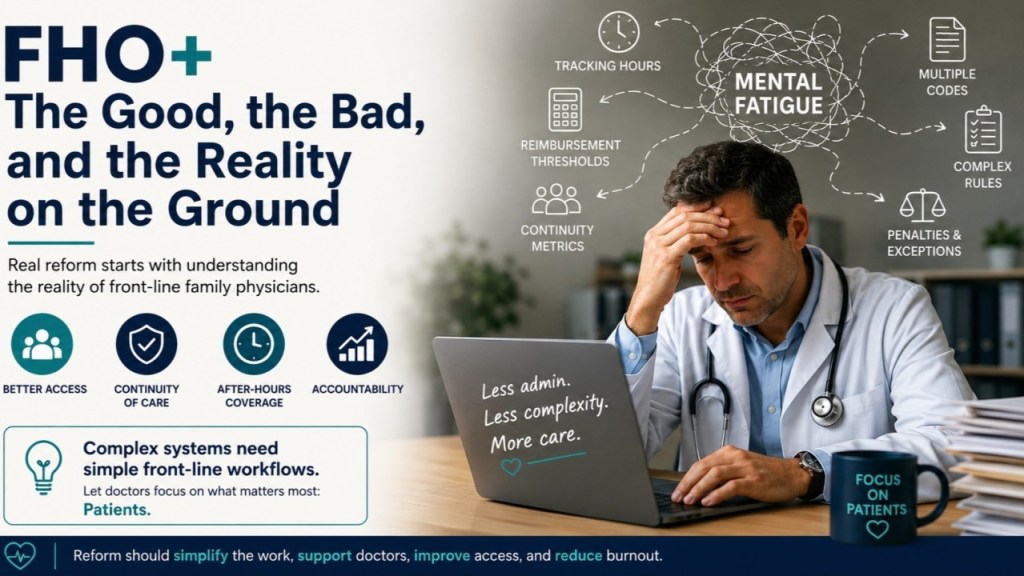
Over the past couple of months, Family physicians across Ontario have started experiencing the reality of the new FHO+ model in day-to-day practice.The goals behind the reform are understandable.

Improve access. Support continuity of care. Encourage after-hours coverage. Create more accountability in primary care.

These are important goals, and family physicians should absolutely be part of improving the system. Some aspects of FHO+ deserve recognition. Organized after-hours coverage matters. Continuity of care matters. Accountability matters. But as implementation unfolds, many front-line physicians are beginning to identify operational consequences that may not have been fully appreciated during policy design.

The Efficiency Problem

One of the biggest concerns is the relationship between productivity and compensation efficiency. Under FHO+, physicians are now heavily constrained by hourly and monthly thresholds tied to direct patient care time. In practical terms, physicians can work harder, see more patients, and still experience a significant reduction in compensation efficiency. The unintended consequence is that the model may discourage efficiency during regular clinic hours.

A physician who develops efficient workflows, uses technology effectively, and safely improves patient throughput may actually feel penalized for doing so. That creates a concerning signal within primary care. Healthcare systems should reward:

  • safe patient access
  • continuity
  • quality
  • responsible innovation
  • sustainability
  • burnout prevention

Not unintentionally encourage physicians to slow down to remain within operational thresholds.

The Hidden Mental Burden

One of the least discussed consequences of FHO+ is the cognitive burden it creates for physicians throughout the day. Doctors are now not only thinking about patient care, they are also continuously tracking:

  • direct care hours
  • monthly hour accumulation
  • reimbursement thresholds
  • after-hours eligibility
  • continuity metrics
  • outside-use implications
  • whether additional work will still be compensated fairly

That constant background calculation creates mental fatigue. Family physicians already operate in an environment of nonstop decision-making: clinical care, inbox management, staffing issues, documentation, urgent requests, abnormal results, hospital follow-ups, and administrative work. Adding another layer of continuous operational tracking changes the psychology of practice itself. Instead of focusing entirely on patient care and clinic efficiency, physicians may begin constantly asking themselves:

“Am I crossing another threshold?” That is not a healthy foundation for sustainable primary care.

The Bigger Problem: Complexity Itself

This discussion is larger than FHO+ alone, It reflects a broader pattern in healthcare reform. With each reform cycle, the Schedule of Benefits seems to become increasingly complex rather than simpler.

New rules. New modifiers. New exceptions. New thresholds. New formulas. New tracking requirements. Yet very rarely do reforms focus on reducing front-line operational complexity for physicians. And complexity itself has consequences, It increases cognitive load, administrative dependency, billing anxiety, operational inefficiency, and eventually burnout. Complex healthcare systems may be unavoidable. But complex systems still require simple front-line workflows. That principle is often overlooked.

Continuity of Care Should Be Managed by the System, Not Punitive Billing Rules

Continuity of care matters. Family physicians understand that better continuity leads to better long-term outcomes, fewer fragmented records, reduced duplication, and safer patient care. But enforcing continuity through increasingly complicated physician payment penalties is not the right approach. A simpler and more effective solution already exists. If the Ministry of Health wants to strengthen continuity of care within capitation models, the responsibility should sit primarily with the system itself, not through constant billing complexity imposed on physicians.

For example: If a rostered patient repeatedly seeks care outside their enrolled medical home beyond a defined threshold, the Ministry could automatically review or remove the patient from the roster. The patient would be notified directly by the Ministry of Health not by the physician. This creates clear accountability while avoiding unnecessary tension between doctors and patients. Most importantly, it removes one of the major hidden burdens currently placed on family physicians: constantly monitoring continuity metrics, outside use calculations, and roster penalties while simultaneously trying to run busy clinics.

Continuity of care should be encouraged through smart system design and patient accountability  not by forcing physicians to navigate increasingly complicated billing formulas and penalties. Doctors should focus on delivering care. The healthcare system should focus on managing the system.

The Human Side Nobody Talks About

Most family physicians are not trying to maximize billing. They are trying to:

  • keep clinics financially sustainable
  • reduce patient wait times
  • manage inbox overload
  • supervise staff
  • complete documentation
  • respond to urgent patient needs
  • avoid burnout

When systems unintentionally penalize high-functioning clinics for being efficient, morale suffers quickly. And eventually, patients feel the impact.

A Better Path Forward

Primary care reform is necessary. But reforms work best when governments collaborate closely with front-line physicians who actually operate clinics every day. The goal should not simply be measuring physician hours. The goal should be:

  • maximizing safe patient access
  • improving continuity
  • reducing unnecessary administrative burden
  • supporting sustainable family medicine
  • encouraging innovation and operational efficiency
  • protecting physicians from burnout

Ontario has extraordinary family physicians who want the system to succeed. The question is whether the system is being designed in a way that allows them to succeed too.

Why You Should Attend the OMA’s (Continued) Annual General Meeting

Last week, the Ontario Medical Association announced that the continuation of the 2026 Annual General Meeting (AGM) will occur on Tuesday, June 23rd, at 6:30 PM. This meeting will be virtual only. Once again, proxies will not be allowed. I would suggest that it is essential for every member to make an effort to attend.

My three loyal readers will remember that there were six member proposals (4 by Dr. Conte seconded by myself). Only one got voted on at the May 7 meeting, and the remainder will be voted on, on June 23. Regardless of what you may think of the individual motions, I would suggest the fact that members take the time to make proposals, and attend to vote is a good thing. It is important, as I’ve learned over the years, to pay attention to what’s going on at the OMA because so much of our livelihood depends on them.

This year’s AGM is proof of what can happen when members show up and make their voices heard. Now, I was criticized for my blog on the last AGM for calling out the shenanigans that occurred at the meeting. This all surrounded what were in my opinion, the two most important motions.

Both motions pertained to removing non-physicians from having voting authority over physicians at the Board of the OMA. To be abundantly clear, neither of these motions would have prevented the organization from seeking external expert advice on an ongoing basis. Organizations, particularly advocacy organizations like the OMA, do that all the time, as they absolutely should. Physicians are not experts in everything, and seeking out the best possible advice in different areas from experts in their fields is always a good thing to do.

No. These motions would simply have said that after getting the advice, and carefully reviewing it, the voting authority for who makes decisions at the organization should fall only on physicians. Only physicians have innate knowledge and lived in experience of how the healthcare system affects them. Only physicians will inherently know when such advice, well intentioned though it may be, will actually help, or those times when it is unhelpful.

At the last meeting, for reasons that are unclear to me, as I’m not a lawyer, the first motion, which would have removed non-physicians from the Board immediately, required two thirds of a vote. This motion, after much debate, got fifty-three percent. Now, I fully expected some of our colleagues to throw up roadblocks to the first motion. That happened. I won’t do a line by line analysis of that as I don’t think it’s relevant, but if it had just stopped there, I probably wouldn’t have made any comments about “shenanigans” or “the usual suspects.”

What happened was that once it became apparent that the majority of physicians at the meeting did want not want non-physicians voting at the Board level, it became crystal clear that the second motion, which only required fifty percent plus one, would likely pass. A friend of mine, who also attended virtually, commented to me, “I wasn’t in the room, but I swear I could hear the jaws drop and the shock from many of the people in the room.”

Rather than accept that the debate had already been had, that all of the points had already been made, and accept the will of the membership, some of our colleagues continued to try and delay the process and play games. Eventually they succeeded. The meeting was paused and now we have to do it all again. And those are the shenanigans that had me, quite frankly, extremely annoyed.

At any rate, the membership has another chance. If we all show up, we can vote on the second motion and determine if we do, in fact, want a large part of our futures decided by non-physicians. (Non-physicians have just over twenty-five percent of the vote at the board currently).

Other motions that are important for us to decide upon include the director election ballots process. This year marked, as far as I’m concerned, a new low in how the board director elections were run. The OMA screened candidates for board director and limited who could run based on their own criteria, that was fed to a third party firm to try to avoid blame. In essence, the OMA chose who we physicians could vote for. Furthermore, they impugned the reputation of one of the president elect candidates by printing subjective opinions about his social media posts.

The second motion would stop the OMA screening candidates and allow the members to pick who they want leading them.

Other motions include eligibility for board if you had previously held the role of president in the association. Once again, it is really the decision of the members, not the OMA, to rule out who can and can’t run (and yes, there’s a conflict of interest in there for me). There’s also a motion recommending the OMA not access personal tax information. The OMA has never actually accessed personal tax information despite significant misinformation about this. However, I personally see no harm in restating that again. And finally, there’s actually a really good idea asking the OMA to support their districts by sharing email lists in compliance with privacy legislation. Our districts do need strengthening, and this would help with that.

None of these changes, however, can occur without physicians showing up. It will take time. It will take effort. It is a couple of hours out our very busy days. I feel bad asking for members to sacrifice this amount of time, but at the end of the day, if we don’t pay attention to what’s going at the OMA, we will not get the results we deserve.

I encourage all Ontario physicians to register early for the AGM by clicking the link below:

Register for June 23, AGM

The Shrinkflation of Family Medicine

Dr. Julie Wilson (pictured inset) had a superb post on LinkedIN that she has kindly allowed me to reproduce here as a guest blog. A much smarter person than I, she is a family doctor,has been named one of Canada’s 100 Most Powerful Women, Top 40 under 40, 3 x Business award winner and much much more. I encourage you to follow her for more of her excellent insights.

There is a word for when the packaging stays the same but there is less inside. In groceries, we call it shrinkflation. In family medicine, the same process has been underway for years and we still do not have a proper name for it. The phenomenon is real, the consequences are significant, and the cause is structural rather than professional.

It deserves to be examined plainly.

What Family Medicine Was Designed to Do

When I completed my family medicine residency, the expectations were unambiguous. A graduating family physician needed to be able to deliver their own patients’ babies, follow them in hospital, suture lacerations in the office, perform biopsies and joint injections, insert IUDs, provide prenatal care, administer pediatric vaccines, conduct children’s wellness visits, and manage mental health from assessment through to ongoing treatment. You were trained to treat and manage every condition as though there were no specialists present, because in Canada, there often are not.

This was not an aspirational standard. It was the functional design of the role. Family medicine in Canada was conceived as the foundation of a system in which primary care would carry the load that specialist infrastructure could not be expected to cover across a country of this geographic scale and population distribution. Broad scope was not a luxury. It was a requirement.

What Has Changed Since the Pandemic

The erosion of that scope has been incremental and largely unremarked upon in public discourse. Since the pandemic, a substantial number of family physicians, including those whose practice is confined entirely to clinic-based work, have stopped performing procedures and providing services that were previously considered core to the role. Biopsies, suturing, contraceptive management, prenatal care, pediatric immunisation, children’s wellness visits, mental health assessments, and ongoing counselling have migrated out of the family practice setting into referral queues, specialist offices, and in many cases, emergency departments.

It would be tempting to attribute this to shifting training norms or changing physician preferences, and those factors are not entirely irrelevant. But they are not the primary explanation. Family physicians did not collectively decide to de-skill because they lost interest in comprehensive practice. The more accurate explanation is that the financial and structural conditions required to sustain comprehensive practice have deteriorated to the point where, for many clinics, broad scope is no longer economically viable.

The Economics of Comprehensive Care

Comprehensive care costs more to deliver than narrow care. It requires longer appointment slots, better equipment, more qualified support staff, more expansive insurance coverage, and considerably more time spent on coordination and documentation that does not generate a separate billing code. These are real costs that the clinic model must absorb, and for a significant proportion of BC primary care clinics, the current overhead structure cannot absorb them.

The 2025 Financial Review of Primary Care Clinics in Vancouver, produced by the Vancouver Division of Family Practice, provides useful context. Average operating expenses per physician run approximately $110,000 per year. A clinic operating at 25% overhead on a physician billing $450,000 generates $112,500 in revenue, leaving almost nothing above the average expense threshold and no margin whatsoever for the additional infrastructure that comprehensive practice requires. At overhead rates of 20% or below, which are increasingly common in recruitment conversations driven by alternative-revenue clinic models, the arithmetic becomes impossible well before extended scope enters the picture.

The result is a rational economic response to an irrational structural situation. Clinics on constrained margins contract their service offering to the minimum sustainable model. Services that require additional time, equipment, or staff are referred out. The physician’s role narrows not because of a change in values or training, but because the financial model of the clinic cannot support anything broader.

The Systemic Consequences

The consequences of this contraction do not remain contained within the family practice setting. They redistribute across the health system in ways that are cumulative, expensive, and in many cases preventable.

Canada operates on the stated premise of a primary care-based health system. The logic of that model is that a robust and comprehensive primary care foundation reduces the demand on specialist services, emergency departments, and acute care capacity. When the foundation contracts, the load it was carrying does not disappear. It transfers.

Every laceration that is no longer sutured in a family physician’s office becomes an emergency department visit. Every mental health presentation that no longer has a landing place in primary care adds to the demand on crisis services and inpatient psychiatric capacity that is already stretched beyond its design parameters. Every biopsy that moves from a family physician’s office into a specialist referral queue adds weeks or months to the interval between a patient’s first concern and a clinical diagnosis. Every prenatal patient who cannot access continuity of care through their family physician adds complexity to obstetric and hospital-based maternity services.

Specialty wait times lengthen not only because of specialist supply constraints but because specialists are now managing presentations that a well-resourced primary care system would have handled earlier and closer to home. Emergency departments are not simply overwhelmed by volume. They are absorbing a category of care that primary care has progressively stopped providing, without any corresponding expansion of emergency capacity to meet that transferred demand.

The diagnostic lag that results from this redistribution carries its own clinical cost. The interval between a patient identifying a concern and receiving a diagnosis has extended from days to months for an increasing range of conditions. In oncology, in cardiology, in neurology, earlier diagnosis consistently correlates with better outcomes. The compression of primary care scope is not a neutral administrative adjustment. It has clinical consequences that are difficult to measure at the individual encounter level but become visible at the population level in outcomes data.

Patients who have only ever experienced the contracted version of family medicine do not recognise what is absent, because they have no baseline for comparison. They do not know that the referral they received could have been managed in the same appointment by a physician who is fully trained and willing to do the work. The shrinkflation is invisible to those who have never seen the full product.

The Path Back

Restoring comprehensive family medicine will not happen through exhortation. Physicians who have adapted their practice to the structural constraints of their clinic model will not re-expand their scope because the profession asks them to. The conditions that made contraction rational need to change before expansion becomes possible.

Several directions are worth pursuing seriously. Funding models need to reflect the genuine cost of delivering comprehensive primary care, including the additional infrastructure, time, and staff that broad scope requires. The LFP billing model in BC represents progress in recognising longitudinal value, but it does not yet fully account for the procedural and extended scope work that a comprehensive practice involves.

Training culture matters as well. If residents observe that the physicians they are learning from no longer perform the procedures they are being taught, the implicit message is that those skills are aspirational rather than practical. Preserving broad scope in residency training requires that the training environment model it, which requires that the clinics where training occurs are financially equipped to sustain it.

Record transfer and cross-clinic infrastructure also warrant attention. A physician who might otherwise take on complex procedural or prenatal care is significantly less likely to do so if the clinical history required to do it safely is inaccessible because of the fragmented and non-interoperable state of EMR systems across BC. The administrative friction of comprehensive practice needs to be reduced, not compounded.

Finally, the conversation about what is being lost needs to happen at a scale and with a directness that it has not yet achieved. Policymakers, health system planners, and the public are not well positioned to advocate for the restoration of something whose disappearance they have not been clearly shown. Making the shrinkflation visible, naming it, costing it, and tracing its consequences through the system is a necessary precondition for addressing it.

The physicians are still trained. The capability is present. What is required now is a serious, sustained effort to rebuild the structural conditions that make comprehensive family medicine not only possible, but financially sustainable for the clinics and physicians who want to practice it properly.

Dr. Julie Wilson, MD, CCFP, FCFP

Use AI NOW to Reduce Bureaucratic Bloat in Health Care

On the heels of my last blog on the Auditor General’s report on AI systems in Ontario, I was asked “how then can AI help in health care?” Certainly policy makers often talk a LOT about how AI can help. Better diagnoses! Faster assessments! Better prediction of which patient is more likely to “crash”! Reduced admin time with the use of AI Scribes! Etc.

These are all valid uses for AI technology. I use an AI scribe myself (following the principle of “trust but verify”in signing off on the notes). I access some evidence based AI software to help me with challenging cases. I always have the final word on what to do next of course, but I would be lying if I said that the tools didn’t help me look after my patients.

However, in a health care system as byzantine as the one in Ontario, there is one area where AI can help almost immediately that is not talked about nearly enough. Given the topic, I get why the many government health care planners/bureaucrats/managers don’t mention this. I’m talking of course, about reducing the number of bureaucrats in health care in Ontario.

I’ve talked about Ontario’s health care system being over bureaucratized many times in the past. But there’s never been a better opportunity to meaningfully cut the bloat. It would be impossible for me to search the entire Ontario government data base to find out how many bureaucrats we have. So………I used an AI search on ChatGPT and Claude AI to review how many managers/bureaucrats we have across all government funded health care agencies in Ontario. (I will put the prompt at the end of the blog for those interested).

Both searches suggested the total size of the health care workforce in Ontario was about 500,000 people. Of that, astounding 90,000-130,000 were non-clinical employees (mostly administrative/support staff). The actual management/bureaucratic layer varied between 25,000-45,000. A precise number was difficult to define, because, in the words of ChatGPT:

“……Ontario’s healthcare system is fragmented across hundreds of entities with inconsistent titles and reporting structures.”

However, given all of that, I think Claude’s estimate of having 85,000 admin/management personnel across all Ontario Health care agencies is defensible. Heck, it’s lower than ChatGPTs 90,000 – 130,000. Claude AI further broke this down and suggested 52,000 of these were in Ontario’s 154 hospitals.

Can AI replace some of these jobs? Replace is probably not the right phrase. There can certainly be a consolidation of the actual tasks required from different jobs, and AI can do those tasks much more efficiently and accurately.

For example, AI can, as of today, help with information movement, repetitive analysis, scheduling, policy retrieval, document generation, compliance monitoring, coordination, coding, and referrals to name but a few examples. All of these tasks are currently being performed by bureaucrats, and it’s virtually certain that there is tremendous duplication in the work being done. There is plenty of software than can do these tasks right now (LeanTaas, Qventus, Nuance DAX to name a few). Yes they are mostly American, but surely can be modified to meet Canadian needs.

The cost savings from reducing the number of bureaucrats can be significant immediately, and frankly enormous as AI continues to evolve over the next five years.

For a case study, let’s look at the University Health Network (I’m not picking on them for any other reason then they are huge!). They have approximately 24,500 employees of which an estimated 4,200 are Admin/management of some sort. Many of these positions are people on Ontario’s Sunshine List (i.e. they make over $100,000 a year). Reducing the number of these positions by 10% should be easily do-able if you have the right AI software.

Then the hospital would save the money right? Especially since Ontario’s hospitals are facing massive deficits? I would say no to that. I would instead say if UHN could cut their admin staff by 420 (which should easily be done), then maybe they could hire 210 clinical staff in return (nurses, physio, rehab, RT, Xray techs etc). Instead they just fired nurses. They would still have 210 fewer positions (so some money saved) but they would have 210 more people who would actually, you know – look at a patient. People who could provide compassionate, front line care and assessments to patients and be an invaluable part of the health care team.

Looking forward five years as AI software continues to evolve, I genuinely believe UHN should set its goal for reducing Admin/Management staff by half (at a minimum). This would allow them hire over a thousand (if not more) nurses to provide that front line care that is so essential to patients well being.

From a system wide perspective, the numbers would be even more dramatic. Currently, Ontario has 38% less inpatient staffing than the Canadian average. In order to just meet the average, about 34,000 more nurses need to be hired. The money for that has to come from somewhere, and I can think of no better place than reducing the admin staffing to find those funds.

I get why the bureaucrats have not talked about these uses for AI. Bureaucracy by its very nature is self perpetuating. But we are facing a serious fiscal calamity in health care with our aging population. While it’s nice to have tools that can help physicians like myself make better diagnoses and provide safer care, the blunt reality is we desperately need more front line staff. No matter how good the tool, it will never be a substitute for the compassion or a real human being providing care. The emotional wellness we experience from having real people look after us at the bedside cannot be understated. We need to adopt bureaucracy replacing AI tools now, and put the money saved in front of patients.

For those interested, this is the AI Prompt I used to get this data: “Review the number of bureaucrats/managers in the health care system in Ontario, Canada. Include ALL health care agencies that are government funded like hospitals, Ontario Health at Home, hospitals, community health centres and more – all government funded health care agencies. Get an approximate number of bureaucrats. Then show where AI can result in cuts to management/bureaucrat jobs right now, and in five years. Use the University Health Network in Toronto Canada as an example to show how many bureaucrat/management jobs could be trimmed, allowing them to funnel resources to hiring front line clinical personnel like nurses.”

Auditor General’s Report on AI Highlights Failure of Ontario’s Health IT Bureaucrats

There’s currently a lot of talk about the recent report from Ontario’s Auditor General on AI Scribes. The headlines seem mostly to be dealing with the fact that she found numerous AI Scribe generated reports had errors. The errors happened for various reasons, including AI hallucinations, transcription errors, incorrect entry of medications and so on.

Ontario’s current Auditor General, Shelley Spence

However, to my mind, that’s not the real story.

I feel somewhat conflicted in saying this next part, mostly because I think I generally have a reputation for being an advocate for physicians, their views and their well being. However, the blunt reality is that we are all required to check any report that’s generated by an AI scribe before we sign off on them. Physicians, being human, will make mistakes. For example, this past weekend, I got a message from a colleague of mine, pointing out an error that had been made in an AI-generated note on a patient I saw. That was my fault for not double checking. I think to try and blame some software for those kind of mistakes would be inappropriate.

No, the real story is the continued ineptitude of the healthcare bureaucrats at the Ministry of Health who are in charge of health care IT systems today. If one does a deep dive into the Auditor General’s report, there are many, many legitimate question she has, all of which the hard-working taxpayers of this province deserve an answer to.

In particular she found gaps in how these AI systems were evaluated by Supply Ontario, Ontario Health, and to a certain extent OntarioMD. Yes there were three agencies all involved, triplicating the amount of work necessary and adding to the confusion.

Heck the issues began right from the initial procurement stage. The weighting given to different criteria revealed a fundamental misalignment of priorities. The accuracy of medical notes generated by AI scribes accounted for only four per cent of points awarded to potential vendors, while domestic presence in Ontario was weighted the highest at 30 per cent. Data privacy/legal controls were weighted at 23 per cent and system security controls at 11 per cent. 

Think about that for a minute. You could have software from a poorly run company, that was completely inaccurate in its transcription and system security, yet still have it approved if it happened to be Ontario based. Yet a company with the best transcription and system security would lose, if it was from out of province. Even Spence was shocked by this, stating, “In my mind, that doesn’t make sense….when we’re dealing with personal information and we’re dealing with artificial intelligence, I think security is of the utmost importance.”

Additionally, the evaluations didn’t actually watch vendors operate the software in real time! There were no live test. Vendors were apparently given recordings and ran the system offline learning. Spence said, “this allowed vendors to potentially overstate their compliance with security and privacy requirements.”

Well, duh!

Worse, 11 of the approved vendors for AI software didn’t actually meet the mandatory submission requirements. They got approved anyway. Five didn’t even submit risk assessments and privacy impact assessments as part of their bid process. They got approved anyway.

This kind of amateurish, ineffectual assessment is supposed to help increase confidence in healthcare IT?

Most damningly, it appears from the auditor general’s report that there is a broad absence of strategic governance. The auditor general benchmarked the AI strategy against Canadian and international public sector organizations and found that there were no specific actionable items, no clear plan to prioritize AI use across ministry areas, and did not identify any prohibited AI practices or areas where technology posed an unacceptable risk.

Essentially, this report paints a picture of Ontario Health/Supply Ontario/Ontario MD approving AI systems through a process that underweighted accuracy, did not require live demonstrations, accepted incomplete documentation and failed to assess bias risk. All while having no clear plan to rectify these gaps going forward.

The thing is, this kind of insanity has been permeating the politics of IT health systems for decades. I’ve written about the bloated and inefficient bureaucracy for years now. The lack of ability to get a truly integrated health care system speaks to a lack of vision and focus in the bureaucracy. It’s incredibly discouraging that it continues unabated after all these years. It seems that no one has the knowledge, wisdom, ability to fire the incompetent bureaucrats, streamline the process by getting rid of multiple agencies, and apply an overarching vision for health care IT.

And yet, instead of fixing the bureaucratic mess first, streamlining health IT infrastructure, and developing on overarching health IT vision, Ontario is instead now going ahead and launching a Provincial initiative to create a province wide primary care medical record system. The people in charge of choosing the software for this? The same bunch who botched the AI scribe issue.

I can’t wait to read the Auditor General’s report on that one in, say 2029.

Local Medical Schools Will Help Address Doctor Shortages

Old Country Doctors Note: I was a teacher with the Rural Ontario Medical Program for three decades. It was founded by Dr. Peter Wells, and based on the principle that putting trainee doctors in smaller communities will enhance the chance of them working there. It’s been wildly successful. On that same note, Dr. Butt feels that putting a Medical School in Barrie will help increase recruitment to smaller centres, and I think he’s right. His Letter to the Editor appeared in the local press, and he’s given me permission to reproduce as a guest blog here.

Dr. Atif Butt (pictured inset) guest blogs for me today. He’s one of these ultra smart characters who not only has and MBA (McMaster 2003) but also and MD (McMaster, 2011) and a CCFP (EM). He’s retired from the Military (Major) and works in ER in Alliston, and Urgent Care in Barrie and does sedations in an endoscopy clinic in Innisfil. Apparently he’s quite the dancer too.

Barrie has been home to my family and I since the fall of 2013. It is a wonderful area to raise a family and offers everything that a mid-size community requires but also the peace and quiet lacking in larger urban areas. It is also the gateway to cottage country.

I am surprised at how fast the city is expanding as demonstrated by the numerous condo buildings and townhouses being erected, especially on the Barrie/Innisfil border. A growing city will result in many consequences, some positive (e.g., more cultural diversity, more revenues for local businesses, etc.) but also some negatives (e.g., traffic headaches). It will also mean a growing population that will place greater demand on local health-care resources.

I have been practising medicine in several health-care organizations in the Barrie/Innisifil/Alliston area since 2013. I am impressed by how much demand is placed on local health-care organizations, yet they continue to persevere through. The success is fundamentally thanks to the heroic work of the health-care workers including physicians, nurses, and other allied health-care workers who band together to serve patients, often sacrificing their own nights and weekends. But we all have our limits and simply cannot do more.

Currently, almost six million Canadians (out of which over two million are in Ontario) do not have a family doctor. More specifically, it is estimated that over 55,000 people in the Simcoe County area do not have a family doctor. Almost every day, there are news reports of lengthy wait times in the ERs, which are frankly longer than plane flights from Canada to Pakistan. Attempts have been made to address such shortfalls by the use of nurse practitioners, physician assistants, and pharmacists and I am grateful for the work they provide. Nonetheless, physicians cannot simply be replaced by non-physicians and more are needed. That is why I am proposing that either a new medical school be created in the Barrie/Innisfil area or, preferably and more cost-effectively, seats from an existing Ontario medical school be expanded to our area.

I am encouraged to see that some efforts have already been made to expand medical school seats in Ontario. Examples include the 2025 opening of the Toronto Metropolitan University medical school and the upcoming opening of the York University medical school in 2028. I appreciate that such endeavours can be costly. For example, the federal government just announced almost $2 million to expand medical seats and services for the Northern Ontario School of Medicine. While this will greatly support the north, sadly, Barrie and the surrounding area seemed to be left out.

Despite investments in new medical schools, the demand far exceeds supply. For example, the newest medical school at TMU had 6,416 applications in 2025 but total projected class size in 2026 is 94. That means 1.5 per cent of applicants got accepted. Most medical schools in Ontario roughly seem to have on average about a three- to five-per-cent acceptance rate. While adding medical seats in Barrie/Innisfil maybe a drop in the bucket, it will hopefully lead to an ongoing pool of locally trained physicians that will want to practice in our area. Return of service contracts, where physicians have to practice locally for four to five years after training, can be a condition for acceptance into a medical school here.

Canada in general and Ontario in particular have a lot of talent, yet we are losing out. On a regular basis, I come across undergraduate students who have high GPAs/marks, extraordinary extra-curriculars and experiences, scored high on their MCATs, have applied multiple times to Canadian medical schools, yet are unable to even get an interview (let alone acceptance) into a Canadian medical school. Their families are often spending hundreds of thousands of dollars per year (in U.S. dollars) to send them abroad to the U.S./Caribbean/Europe so that they can pursue their dreams of becoming a physician. Even after they graduate from an international medical school, there is no guarantee that they will obtain a residency spot in Canada since preference is given to Canadian-trained grads. Hence, they may be forced to practise elsewhere like the U.S. Would it not be better if we could retain and train such talent who invested their tuition locally and then stayed to practise?

Intuitively, when medical trainees train in a particular geographical area, many will choose to stay and practise in that area. While in Barrie we have the Family Medicine Teaching Unit for training family medicine residents and the expansion of some ER residency spots at Royal Victoria Regional Health Centre, I believe that the next logical step is to have medical school seats in the Barrie/Innisifil area. This will allow us to recruit and retain future physicians in the local area.

I find that the simplest goals are often the most achievable and realistic. A brand-new expensive medical school with new infrastructure may be a costly pill for any government to swallow. Thus, simply expanding, say, a dozen seats, from an existing Ontario medical school to our area using existing hospitals or other health-care facilities may be much more palatable. Students will be able to virtually watch online any didactic lectures that are delivered at main campuses to obtain theoretical knowledge. Any practical knowledge and skills can be completed with assigned preceptors and through core rotations (e.g., ER, family medicine, obstetrics, general surgery) and elective (e.g., plastics, radiology, etc.) at several of the amazing and existing local hospitals and health-care facilities from Orillia to Barrie and Alliston to Newmarket. After doing three to four years of medical school and assuming they do a two-year family medicine residency in the Barrie/Innisfil area, I suspect many will choose to stay and practise in our wonderful area.

I have already reached out to several governing officials including the Office of the Premier of Ontario and the provincial minister of health to share my proposal. While their offices have provided some appreciative yet general responses of their broader investments, I truly believe that it is through greater and ongoing public support and engagement that expansion of a medical school in Barrie can be achieved. In other words, while I as a physician can write a prescription and explain the risks and benefits of the medicine, it is up to the patient to actually take the prescription. In this case, my prescription is the expansion of medical school seats to the Barrie/Innisfil area and I am asking you, the patient, to engage the government in filling this prescription.

Springing Forward Into Stupidity: How British Columbia Traded Science for Convenience

There’s a particular kind of modern arrogance required to look a room full of experts squarely in the eye and say: “Yes, yes, very interesting, but have you considered that people find it inconvenient?

The Government of British Columbia has that arrogance. In a bold act of democratic self-determination, BC has moved to lock in permanent Daylight Saving Time (DST), essentially agreeing, as a society, to spend half the year pretending the sun rises an hour later than it actually does. No more fussing with clocks twice a year! No more groggy Monday mornings in November! Progress, at last!

British Columbia Premier David Eby

In fairness, that decision is partially based on some good evidence that there is no need to change clocks twice a year. It does not reduce energy consumption as previously thought. It’s overall harmful to people’s health. BUT, in a trend that has been growing ever since the Covid Pandemic, there appears to be more and more ignoring of the actual science, in the name of convenience.

The scientific consensus on this is about as settled as it gets outside of climate change and vaccine safety. Study after study links permanent DST (as opposed to permanent Standard Time) to increased rates of depression, cardiovascular events, metabolic disruption, and a general dimming of the human spirit that no amount of “extra evening light” can compensate for. The medical community has been remarkably consistent: Standard Time is the one that actually aligns with human biology.

But BC picked the wrong one because the evenings feel nicer.

The 10,000 Lux Future We’re Sleepwalking Into

Here’s a prediction: within a decade, the market for bright light therapy lamps that blast 10,000 lux of artificial sunlight directly into your face, will quietly explode across British Columbia. Families will gather around them at breakfast, bathing in simulated dawn while the actual sun crawls reluctantly above the horizon sometime around 9 AM in December. It will become as mundane as having a coffee maker on the counter. A morning ritual for a society that engineered itself into needing one.

The irony is exquisite. They rejected a scientifically sound way of avoiding clock changes in the name of convenience. Now the next generation will be purchasing expensive medical devices to compensate for what their own circadian rhythms are desperately trying to tell them. The body, it turns out, doesn’t care what the clock says. It cares about the sun. When you spend six months of the year eating breakfast in the dark because a legislature decided that post work golden hours were more politically palatable than morning light, well your body will not be happy. Fatigue, depression, and the nagging sense that something is profoundly off will follow.

Where Were the Adults in the Room?

This, of course, raises the obvious question. Why didn’t anyone listen to the science? The honest answer is that our political culture has largely burned through its reserves of thoughtful, deliberate governance. This was exemplified by the Covid pandemic, when large swaths of people decided to reject the consensus that Covid was airborne , because they just didn’t like wearing masks. Political prices for following evidence that the general public didn’t like were paid. Politicians noticed.

Governments now seemingly use a cocktail of impulsiveness and ideology to make decisions. The boring, unglamorous work of actually reading the evidence, consulting experts, and acting accordingly is rejected. Into this vacuum has rushed something far less useful, the politics of framing. Instead of a straightforward public health question, “which system produces better health outcomes?”, we now have debate on what sells well with the general public. “But I like to golf at night!” “I want to sit on my patio till late!”

In that environment, experts might as well be speaking ancient Incan.

Governance today often seems to attract people operating at an almost feverish pitch. Rather than slow deliberate study of an issue, we have reactive, ideologically committed decisions allergic to nuance. Political culture now treats careful consideration as weakness and impulsiveness as authenticity. In that environment, it’s not surprising that a decision with clear scientific guidance instead got made on the basis of “vibes.”

How Did We Get Here?

That’s perhaps the most unsettling question of all. This is happening in all fields, not just public health. Urban planning, the aforementioned climate change, immigration policy, you name it. Experiences and facts say one thing. Politics, convenience, or ideology says another. Convenience wins. Our society absorbs the consequences.

This has been particularly fuelled by the rise of social media. At its worst, social media is well known to promote a culture of instant gratification. Which has profoundly impacted decision making. “Oh, I may get Covid tomorrow, but I don’t feel like wearing a mask today”. “Maybe I’ll be depressed in six months, but I want to golf tonight.” Etc.

The sad thing is that I think that deep down, most of us know this. We know that good governance requires scientific literacy, patience, and a willingness to accept inconvenient truths. We know that political culture has drifted away from those qualities. We know that we are, collectively, making ourselves worse off.

But we allow governments to do it again anyway.

The Clocks Are Wrong, and So Are We

There’s something almost poetic about using time itself as the canvas for this particular failure. Time is the one thing nobody can argue doesn’t affect them. Every person in British Columbia will experience the consequences of this decision in their own health, every dark winter morning, without exception. The evidence on that is pretty clear.

So go ahead and enjoy your long summer evenings. The light really is lovely. In November, when the alarm goes off and the sky outside is pitch black and your body is quietly staging a protest you can’t quite articulate, you might find yourself idly browsing light therapy lamps from online stores.

They work pretty well, actually. The science on that is solid.

Not that it’ll stop us from ignoring the experts next time.

Which Pharmacy Should You Use?

My patients are increasingly expressing unhappiness with their pharmacy. I’m not surprised. A recent study by JD Power  showed a 10-point drop in customer satisfaction with brick and mortar pharmacies in 2024 alone. This is attributed to problems with systemic pressures, health human resources challenges, burnout amongst pharmacists, increasing drug shortages, and competition from online pharmacies. (N.B. I know this was a US survey but I believe the results would be similar in Canada as many of the pressures are the same).

In the past, I would tell patients to choose whichever pharmacy they want. The College of Physicians and Surgeons (CPSO) has some pretty strict rules around who/what I can recommend to patients. They are particularly stringent if there is even a perception of a conflict of interest. This would be why I never insist patients use the pharmacy in the medical centre I work at. Most doctors are very reluctant to run afoul of their licensing body (and I’m no exception).

However, the actual CPSO rules around prescribing drugs states:

Respecting Patient Choice When Choosing a Pharmacy

13) Physicians must respect the patient’s choice of pharmacy.

14) Physicians must not attempt to influence the patient’s choice of pharmacy unless doing so is in the patient’s best interest and does not create a conflict of interest for the physician

It seems like I can give some advice to patients. The short version: Stay away from “Big Box” pharmacies.

To understand why I give this advice, it’s important to know what I think of the role of pharmacists. This will surprise those who have been critical of my position on expansion of pharmacists scope of practice, but I actually truly believe that pharmacists are an essential part of a patients health care team. In my area, the smaller, independent pharmacists and their staff all know the patients well. They feel very comfortable messaging me with issues. I often get updates from them about changes to medications a specialist has made (often before I hear from the specialist!). And I’ve always gotten great advice on what alternatives are out there for medications that aren’t unavailable (an increasing problem these days).

The smaller pharmacies always flag drug interactions well (for me and the patient), know which patients react to which medications (even the over the counter ones), have provided great individualized advice on how to take medications. If for some reason, I’m doing something “off label” – they have been very supportive of that.

I (and more importantly, my patients) get that level of support, because the small pharmacies have consistent staff, who have, over time, built up great professional relationships with our mutual patients.

In contrast, dealing with some of the big box pharmacies is getting worse all the time. Some issues are just plain annoying. For example, I generally give a one year supply of medications for patients of mine who have stable medical conditions (three months for diabetic patients). I cannot tell you how many times I’ll get a message from one of the big box pharmacies (the red ones in our area are particularly bad) asking for a renewal three months later, even though we clearly have an electronic record that shows those pharmacies got, and downloaded, a one year prescription. Essentially, the pharmacy refuses to give needed medications to my patients, because of their error inputting my prescription.

It’s gotten so bad that my replies to the pharmacies have, over the past couple of years, gone from informing them of their error, to asking them to fix their internal process, to being rude. I haven’t quite hit unprofessional yet – though the pharmacists may beg to differ.

The big problem with big box pharmacies is that their staff are under pressure to first and foremost, generate profits for their chain. Patient care is actually secondary.

Shot of a mature pharmacist expressing stress while working in a pharmacy

It’s been reported (by pharmacists and staff) that corporate pressure from Shoppers Drug Mart (SDM) head offices led to their pharmacists doing unnecessary MedCheck reviews (and billing the taxpayer $75 per review). Shoppers head office of course denied the accusation and stated all MedChecks were necessary. Yet just one month later the CBC wrote “Shoppers Drug Mart says it doesn’t have medication review targets, but records show it does.

The Toronto Star had an excellent report in November 2024 outlining just how much pressure corporate pharmacy staff were under. The report showed that:

  • pharmacists were asked to rush through minor assessments for their new expanded scope of practice in under 5 minutes (Kathleen Leach, a Hamilton pharmacist recognized that this would degrade care)
  • 85% of pharmacists felt compelled to meet service quotas
  • there was strong concern about how the big chains had stripped back support staff from pharmacists, affecting care
  • It also outlined how patients were encouraged to have health assessments, even when not necessary, to try and increase revenue

This appears to be a Canada wide problem. The Ontario College of Pharmacists is exploring legal options to address allegations of corporate pressure. The BC College of Pharmacist 2024 report on Workplace Practice clearly showed that pharmacists in corporate and franchise settings experience more time pressure than independent pharmacists. The Toronto Start article above also indicated the Saskatchewan Pharmacy College recognized that focusing on business targets leads to errors and increased patient risks. In New Brunswick a pilot program for expanding pharmacy care fell apart, in large part because a virtual care company that SDM had heavily invested in (Maple), overwhelmed pharmacies with referrals.

Kristen Watt, who’s the current Vice-Chair of the Ontario Association of Pharmacists, wrote a blog in the Medical Post strongly supporting expanded scope of practice for pharmacists. While I have, and will continue to, fundamentally disagree on that, I was struck by her comment in that blog:

“Granted, the government roll-out video, shot in a noticeable big box pharmacy, didn’t help us. There are lots of cries of foul about billings going to shareholders of large corporations.”

It’s the kind of statement that clearly suggests some awareness of issues, without getting oneself into hot water. And certainly left me wanting to know more.

As I mentioned previously, a good pharmacist, and their staff, are integral parts of your health care team. They need to know you as a patient. They need to know some of your medical history. Over time they need to develop a professional relationship with you to provide you with the best advice. At the Big Box pharmacies, you are often getting different pharmacists and different staff every time you visit. Due to some of the corporate pressures above, there is a lot of turnover in those pharmacies.

At a small local pharmacy, you’ll get someone who knows you and says “Dr. Gandhi always gives a one year supply of medications, so I’m sure you’ve got refills.” Whereas at a big box, you’ll get some new staff who mindlessly will tell you “Ok, I’ll message him, you’ll have to come back in 48 hours” because the previous person didn’t enter data properly. Or you’ll get advice from different people at different times, which is NOT the same as having a consistent relationship with one pharmacist.

So my advice, to you dear reader. Find yourself a nice small pharmacy. Make sure they are independently owned. Ensure they have a consistent staff. Build a professional relationship with them. Your overall health deserves it.

Bonus: Red Flags When Searching for a Pharmacy:

  1. Pharmacies that sell groceries.
  2. Pharmacies in department stores or grocery stores.
  3. Don’t fall for “points” schemes – not worth sacrificing good health advice for
  4. They have different pharmacy staff every time you go

Artificial Intelligence is Naturally Stupid

Over the past two years, there has been an explosion in the amount of artificial intelligence (AI) software available, not just to healthcare professionals like myself, but to the general public. In many ways, AI has been quite helpful. I myself have been using AI scribe software in my office for close to a year now. The software listens to the conversation I have with my patient, and automatically generates a clinical note.

The AI scribe has been an enormous benefit to me. My medical notes are much better (also somewhat more detailed). I also save one hour of admin time a day (!) As an aside, this is actually a reason why the government should fund AI scribes for physicians. Under the new FHO+ model, we are paid an hourly rate for administrative work. Surely, saving five hours of physicians time a week is worth the government purchasing a scribe for physicians.

There are also some significant benefits for patient care. Another piece of AI software I use (that’s restricted to health care professionals) helps me with challenging cases. I am able to put the symptoms and test results into the software and it generates a list of potential diagnoses, and suggestions for next steps. It can also recommend treatments for rare conditions.

The general public can also benefit from AI. I recently had a little bit of trouble with my trusty 13-year-old SUV. I put the make and model of the SUV into a commercially available AI, put the symptoms in, and it generated a list of potential causes based on known issues about my SUV.

To be abundantly clear, I would never attempt to fix a car myself. Just as, with all due respect, patients should never, ever attempt to implement a treatment plan for themselves. What AI did do is give me the ability to have an intelligent conversation with the auto mechanic about the situation. And, dare I say it, allowed me to ensure that the mechanic was not trying to pull the wool over my eyes. (My vehicle is now fixed and running very smoothly.)


But along with the many benefits of AI software, there is, of course, potential for harm. This can range from ludicrous to dangerous.

The phenomenon of AI scribe hallucination is well known to physicians like myself. I have seen it in my own software, and it is the reason why I always read the note before I paste it into the patient’s chart. Admittedly, some of that is laughable :

Hopefully this is an AI hallucination of my skills, as opposed to the software’s judgement!

Additionally, the reality is that AI scribes can’t often put a patient’s lived experience (which is so important to building a relationship with a patient) into a note. My colleague Keith Thompson had a superb post on LinkedIn talking about how the AI scribe failed to recognize his personal interactions with an Indigenous patient, particularly with respect to understanding generational trauma.

Sadly, there have been cases where actual harm has been caused by AI. Grok is currently being investigated for generating sexualized images without consent, including those of minors. This causes severe emotional distress and real harm to the victims. There have also been concerns that AI chatbots are helping or suggesting people harm themselves. No one wants any of this stuff to happen, including the people who write AI software. But it has happened.

All of which reminds me of something that my computer science teacher in high school was fond of saying. (Note to my younger readers, and particularly my sons if they ever read my blog: Yes, there actually were computers when I was a teenager. I am not that prehistoric!)

How I’m viewed by my younger colleagues and my children!

The redoubtable Mr. Williams always implored:

“Do not forget, computers and software are actually very very stupid. They can do some things very fast, but they can only do what they are told.”

It’s a piece of wisdom that still holds true today.

With processing speeds almost infinitely faster than when I took computer science, computers can do multiple calculations very very fast. My desktop computer, which is a few generations old, can run 11 trillion operations a second. Heck my phone, which itself is 4 years old, could probably run a fleet of 1980s Space Shuttles. Speed is not the problem now.

The fleet of US Space Shuttles

The problem is that these computers and software still don’t actually have the ability to “think” outside of their parameters. They only do what they are programmed to do. If for example, they are programmed to answer questions asked by a user, but they are not given specific rules to avoid illegal answers, well, they will answer the questions directly. If the programming contains an inadvertent error (someone entered a “0” in the code, instead of a “1”), well, then the software will NOT be able to realize that was a mistake, and will carry out calculations based on the wrong code.

It is true that software is increasingly being taught to “look” for errors. But again, the software can only see the errors it is programmed to look for. It can’t find inadvertent errors and it can’t “think outside of the box.” They are, for lack of better wording, too stupid to do so.

All of which is my fancy and longish way of saying that while these new tools are great, at the end of the day they simply cannot replace the human experience. Just as the software couldn’t recognize the generational trauma of an Indigenous patient, there is a lack of “gut instinct” present. That feeling you have when you are missing something, and you know a patient is sicker than they may seem. It’s a trait that seen in our best clinicians, and one that no programming can replace.

Using an AI tool is just fine. But for my part, I’m going to agree with Mr. Spock:

What’s Behind OHIPs Persecution of Dr. Elaine Ma?

In over 3 decades of medical practice, I’ve seen so much stupidity from government bureaucrats that I really shouldn’t be surprised by the dumb things they do anymore. And yet, every once in a while, they do something so colossally, mind numbingly and egregiously idiotic, that I’m still left stunned. Such is the situation with the ongoing persecution of Dr. Elaine Ma. Last week, the general manager of OHIP recommended, and the Minister of Health agreed, to appeal the decision of the Divisional Court that gave Dr. Ma a partial victory in her seemingly endless dispute with OHIP.

Picture of Dr. Elaine Ma, family physician from Kingston, Ontario
Dr. Elaine Ma

I’ve written about this before, but a brief summary follows. Links are provided for people who want more detail. My three loyal readers can just skip the next paragraph.

Dr. Ma organized, set up and paid for dozens of Covid Vaccination clinics in 2021. She billed the codes for organizing the clinics to OHIP (since she paid for all the overhead). A couple of years later OHIP told her that she should have billed an hourly rate and demanded over $600,000 in fees back. Their reasons for saying she inappropriately billed varied seemingly from week to week. The clinic was outside, not inside! She used Medical Students! Different people injected! etc.

The case eventually made its way to Divisional Court. I never thought I’d see a more laughably ludicrous comment from bureaucrats than when the Ministry of Health’s negotiations team announced there was no concern about a lack of comprehensive care family doctors. But, as Einstein once said, stupidity is infinite and these OHIP bureaucrats outdid the MoH crew by suggesting that there were “no extenuating circumstances” warranting the setting up of these Covid Vaccinations clinics. The whole country was in the midst of a pandemic, there was the largest public health crisis in my lifetime, the country was locked down, travel had ceased and so on. But these were not extenuating circumstances in these eyes of these rigid, automaton bureaucrats.

However, it was also at the Divisional Court hearings that I personally feel that we may finally have seen why OHIP is so intent on tormenting Dr. Ma. The court did scold the bureaucrats for the absurd suggestion that extenuating circumstances didn’t exist. But, as I mentioned in my last blog, the court also found:

…that the wording of section 17.5 does not limit relief to unpaid claims; it only requires the presence of extenuating circumstances. Since OHIP typically pays claims first and reviews them later, a restriction on unpaid claims would effectively nullify the provision. The court called this interpretation unreasonable.”

Section 17.5 of the legislation that governs OHIP (which in it’s current form is found buried in Bill 138) states:

The General Manager shall refuse to pay for an insured service if the claim for payment for the service is not prepared in the required form, does not meet the prescribed requirements or is not submitted to the General Manager within the prescribed time. However, the General Manager may pay for the service if, in the General Manager’s opinion, there are extenuating circumstances.

I mentioned last time that OMA lawyers really need to take a deep look at this ruling as it likely had implications for other billing disputes. And, indeed, the court’s interpretation of Section 17.5 appears to be main basis for OHIPs appeal.

According to a report by Michelle Dorey Forestell (who has done an excellent job reporting on this issue over the years), the General Manager of OHIP is appealing because:

“section 17.5 contemplates discretionary payment decisions only before funds are issued, noting that other provisions of the act expressly address recovery and reimbursement of payments already made……the court’s broader reading will make physician payment disputes more complex and uncertain.”

AND

“the case raises issues of public importance, given the potential impact on how physician billing disputes are assessed and adjudicated and on the administration of OHIP.”

This, in my personal opinion, is the real reason that OHIP is fighting Dr. Ma tooth and nail now, despite having (deservedly) lost at Divisional Court. It may have started out as bureaucratic ineptitude. But it’s no longer about recouping the money. Heck bureaucrats have wasted far more on various schemes.

No, the clear sense I’m getting is that OHIP bureaucrats, having botched their attempt to bully and harass Dr. Ma, they now find themselves in a position where they may be forced to make changes to their review process. If the Divisional Court ruling holds, it means that OHIP would have to modernize how they review payments (gasp!). Who knows, they might even need to buy some new billing computers that can more efficiently review physicians claims (double gasp!). But worst of all, it means OHIP bureaucrats will actually have to do real work (triple gasp!) to develop new processes.

Dr. Ma deserves better. By acting so quickly during the pandemic she ensured Kingston was one of the most highly vaccinated areas in Ontario. She not only saved lives, she prevented many hospitalizations. She undoubtedly saved the health care system far more than $600,000 by her actions.

Unfortunately for her, rigid thinking bureaucrats were unable to use some basic common sense and recognize how urgent things were in 2021. She has been egregiously wronged as a result.

But the sliver of hope is that she may actually have the last laugh. If the appeal is denied, or she wins at a higher court again, the bureaucrats will be forced to confront their own incompetence. They will need to develop a fair, modern and rational review process. If they don’t many other physicians will use her case as precedent by saying OHIPs review of their billing comes from an unreasonable process.

By not yielding to common sense, the OHIP bureaucrats may have wound up giving themselves much more headaches. And as far as I’m concerned, it’s entirely well deserved.