

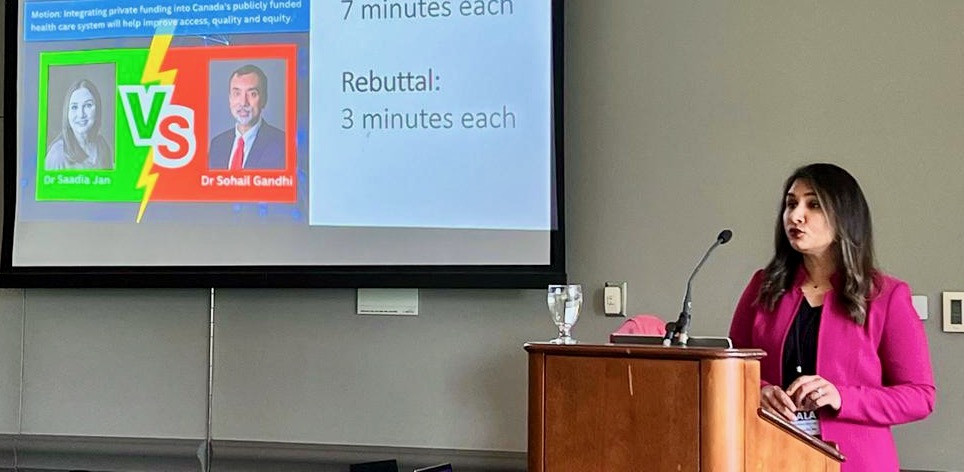
Recently, I was honoured to have been invited to participate in a debate hosted by the London and Area Muslim Healthcare Professionals group. The topic was a current hot button issue in health care:
“ Integrating private funding into Canada’s publicly funded health care system will help improve access, quality and equity“
I wound up having to speak against the motion, even though I actually do support the concept of increasing private sector involvement in health care with strong oversight. (I can already hear the usual suspects alleging I believe in “Two Tier American Style Health Care!”)
It’s a challenge to come up with ways to advocate for a position you don’t truly believe in, particularly when your opponent is the incomparable Dr. Saadia Hameed Jan. This woman is brilliant. Became a physician in an extremely patriarchal country (Pakistan), was an anchor on their national television service, then wound up doing more training in Canada and rose to the ranks of associate Professor at Western all the while maintaining a family practice. I had to be on my toes for this one.

In the process of trying to figure out what to say, one fact continued to stand out in my mind. While one can argue about the merits of private funding, no reasonable person with any familiarity with our health care system could argue that it’s efficient.
During the debate I brought up the story of a patient of mine with cancer. She needed to see a surgeon, a medical oncologist and a radiation oncologist. When she got to the surgeon, the surgeon couldn’t access the actual imaging I had done (did have the written report, but any surgeon will tell you they want to see the pictures). The medical oncologist didn’t get the pathology report (fax machine blurred) and radiation oncology didn’t get a couple of things either.
All of which meant my patient had completely unnecessary delays in treatment. We all know that delays in treatment lead to worsened health care outcomes.

Did the situation eventually resolve and my patient start treatment? Yes of course, after some running around and re-faxing of information and so on, but the point is that there was rather a lot of wasted time.
And that really was the genesis of my position in the debate. We have so many inefficiencies in our health care system right compared to other countries and all of that leads to waste.
Let’s look at a comparable patient in Turkiye. (Full disclosure – I do consulting work for Medicte, a medical tourism firm that provides cost effective health care services for Canadians in Turkiye). In Turkiye, my patient would have her entire health history accessible to her via eNabiz, an app on her phone that’s free to all citizens of Turkiye and allows them access to their health records. On going to see the surgeon, she would have been asked to consent to the surgeon looking at her health files, which would have allowed him, through his own software, to look at the images directly. The two oncologists could have gotten everything they needed right away as well.
Now take this patient, and multiple by 40 million Canadians, and just think of how much better everything in health care would work if we had such a system. No more specialists not getting full information. No more pharmacies losing prescriptions. No more need to repeat tests because you can’t access the tests that were done a short time ago.
The really frustrating thing is that our politicians have known all along just how inefficient our health system is. Heck, Matthew Lister, a top health systems executive and now consultant wrote back in 2011 (!) that our health system had far too many bureaucrats. Back then we had 10 times as many health care bureaucrats per capita as Germany (!). Having watched health care devolve over the past decade, I dare say that ratio is worse now.
Just one example (albeit an important one) is the mess that is the digital health system in Ontario. The Ministry of Health has a digital health branch. Then you have a separate government funded arms length agency eHealth. But wait, there’s yet ANOTHER government funded agency, OntarioMD. This is complete nonsense. You don’t need three agencies to run digital health. Get rid of two of them already and have one unified vision for digital health.
I met with all three agencies during my term on the Ontario Medical Association Board and while it’s true that they are all staffed by nice people (except for one bureaucrat who’s a grade A prick), the reality is they often had competing visions for health IT and frankly, weren’t able to articulate a clear reason for their existence, or a vision for the province.
Now multiply this by all the other areas in health care and you get my drift. As Lister wrote:
“Our current health-care processes are lethargic, inefficient and unproductive. Excessive approvals (“courage in numbers,” in the words of one health-care administrator) hinder decision-making. Overproduction of documentation was cited as a necessary waste to accommodate the whims of bureaucrats.“

This is why we have ridiculous situations in Canada like that of Christine Kaschuba, who’s had to wait years for badly needed scoliosis surgery, and now finds that she may not get it at all because the bureaucrats can’t decide whether or not to pay for the procedure.
Look, I realize that Canadians value our health care system and as such are always going to have strong opinions about the role of private companies in health care. But if we value health care so much, we should also hold our politicians to account, and ask them why we waste so much money on needless bureaucrats in the first place. Who would object to a more efficient health care system, where money is spent on doctors and nurses, as opposed to the loathsome bureaucrats who contribute to Ms. Kaschuba’s suffering.
Dr. Katherine Smart, past president of the Canadian Medical Association, said last year that the health care system is “collapsing all around us“. Surely if that’s the case, there has never been a better time for our politicians to show the courage, leadership and chutzpah needed to re-organize and reduce the health care bureaucracy and transform our health care system. Is that really too much to ask?


One thought on “Never Been a Better Time to Slash Bureaucracy, Inefficiency in Health Care”