

Wasaga Beach’s Much Needed Nursing Home Reveals Haphazard Government Bureaucracy

Recently, the Ontario government announced a hundred million dollars of new funding towards a new, 288 bed nursing home in Wasaga Beach. What’s really impressive is that the project is already ready to put shovels in the ground. Construction is expected to begin in late 2026, and it’s anticipated that the first residents will be welcomed in 2029. This will become the largest nursing home in the South Georgian Bay region.


To be abundantly clear, Ontario does need more nursing home beds. In 2017, I wrote about the then desperate need to build 35,000 nursing home beds. For reasons that I can’t fathom, the previous Liberal governments never really did anything to build up healthcare infrastructure, despite the fact that we had a growing and aging population. That particular government seemed to think that the healthcare needs of the population would simply fix themselves.

I’ve been critical of some of the things that the current Conservative government has done in health care, but they do deserve credit for significantly ramping up healthcare infrastructure builds. Whether it’s new hospitals being built, new equipment like MRIs being purchased, and yes, finally building new nursing homes, this particular government has recognized that you simply can’t provide healthcare to an aging and growing population without increasing the capacity of the infrastructure.

However, I continue to be frustrated by the fact that a government whose leader is famous for having made extremely critical comments of overlapping and haphazard bureaucracy, hasn’t done more to get the various facets of the healthcare system to be streamlined and work together.
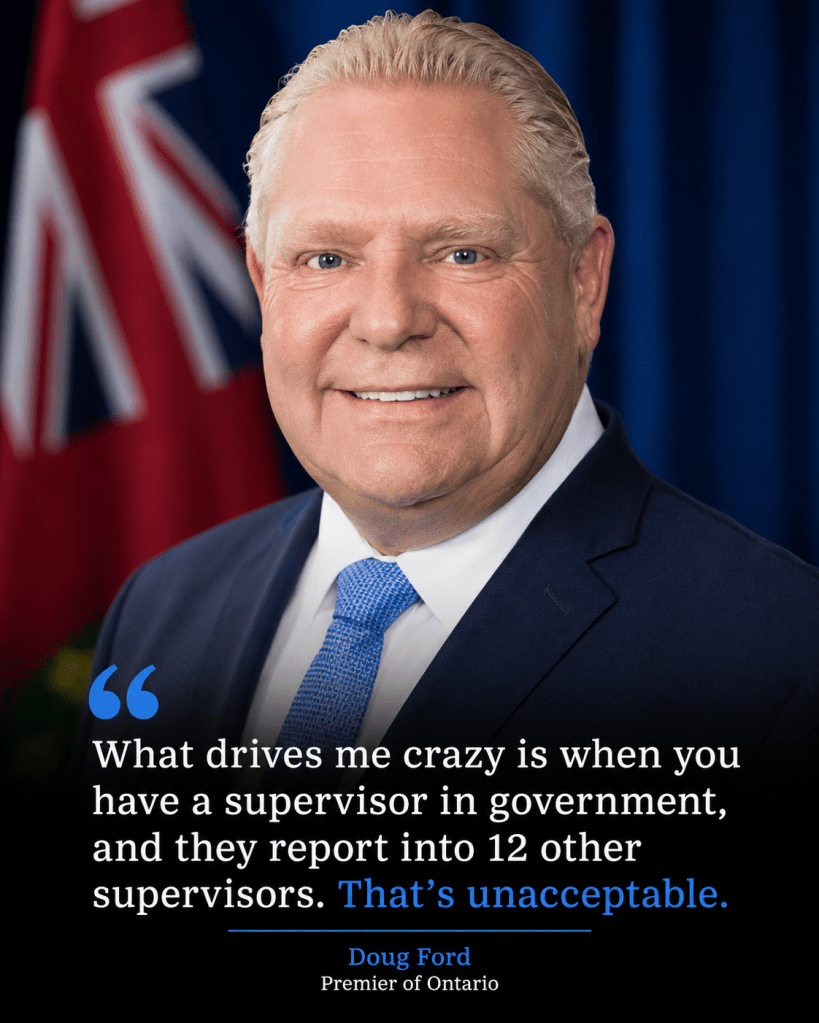
The Wasaga Beach Nursing Home (as much as it’s needed and should be built) is a perfect example of this.

Nursing homes, by definition, have complex patients with significant health care needs. Some of them, will get sick and will need to be transferred to the nearest hospital Emergency for assessment. For Wasaga Beach, this means the Collingwood General and Marine Hospital (CGMH). Being complex patients with multiple health needs, some will be admitted to hospital.

However, as of 2024/25, the CGMH already showed over 39,000 ER visits (up 8% from the year before!) Their inpatient status showed overcapacity for the entire fiscal year. All hospitals have fluctuations and times where they are more full than others, but to be overfull for an entire fiscal year is extra ordinarily busy.

How much more stress will be added to the CGMH by the new nursing home?

Trying to find reasonable data is painfully difficult. I searched a number of sites, but the best that I could come up with was a 2018 analysis. Yes, there was fluctuation during Covid, but we are back to pre-Covid numbers. Crunching a lot of numbers (so that you, dear reader, don’t have to) gives the following, what I consider to be reasonable, projections:

  • The CGMH can expect about 160 ER visits per year from the new nursing home. These patients are very complex so their ER visits will take much longer. (By comparison, 288 seniors who live independently in the community would only result in 58 ER visits per year).
  • Given that just under half of all nursing home patients who go to the ER wind up getting admitted to hospital, we are looking at about 75 more admissions to hospital per yer.
  • It was even tougher trying to find out how long patients who are admitted to hospital from a nursing home will stay in hospital. That link above had some information, but hardly enough to be accurate. The best guess I could come up with was between 5-7 days per admission, so if we go with 6 days in hospital on average, we’re looking at about 450 days in hospital per year.

Now let’s keep in mind that the CGMH is already full. We no longer have hallway health care. We have chair health care (the hallways are full). So where are these patients going to go? (N.B. I do appreciate that there might be some relief as some of our hospitals Alternate Level of Care patients will now have a nursing home to go to – but I’m going to make an educated guess that the stress on the hospital will outweigh the benefit).

My three loyal readers might be aware of the fact that Collingwood is getting a new hospital. Once again, kudos to the current government for approving a badly needed new facility. However, there are still a bunch of bureaucratic approvals needed, and shovels won’t go into the ground until at least the fall of 2028. Hopefully, the project will be complete in 2033 (because government run projects always come in on time).

And this is the part that really drives physicians and healthcare workers crazy. Could there not be some common sense in the eyes of the bureaucrats at the ministry of health who approve these projects? If you are able to approve shovels in the ground by this fall for the nursing home, why can’t you do it for the hospital? You know that patients from the nursing home are going to wind up in hospital and stress an already overburdened place. You know that the new hospital’s been approved. Why doesn’t the Ministry of Health co-ordinate the builds? Do these bureaucrats from each department (hospital and nursing home) not talk to each other? (Having been involved in many meetings with many bureaucrats at different branches of the ministry when I was president of the Ontario Medical Association, I can tell you the answer to that is no.)

Overbureaucratization of our health care system has been a problem for decades now. It’s been unrelenting and farcical at times. The Wasaga Beach nursing home, as needed as it is, is just one more example of this. It’s where the real silos exist in health care and our system will not improve until we get a government that is willing to tackle the bureaucracy.


Bureaucratic Vertigo in Ontario’s Home Care System

Bureaucratic vertigo in Ontario’s home care system, exacerbated by ineffective reforms and rebranding, has led to chaos and service stagnation, necessitating genuine engagement with frontline providers for meaningful transformation.

Dr. Merritt Cade (not their real name) is a concerned and experienced Ontario physician familiar with the current crisis in home care. Dr. Cade is worried about potential blowback from this blog that will affect their patients and so this blog is posted under a pseudonym.

Vertigo is a sensation where one perceives movement that isn’t happening. In the realm of healthcare administration, a similar phenomenon occurs—bureaucratic vertigo—an organizational dizziness that mimics change but leaves structures and systems untouched. Nowhere is this more glaring than in Ontario’s home care sector, a pivotal yet neglected component of our healthcare system.

In 2023, amid promises of reform, the Ontario government introduced Bill 135, the “Convenient Care at Home Act,” envisioning a streamlined home care service managed by Ontario Health atHome (OHAH). OHAH itself was to now be brought under the umbrella of Ontario Health, the implementation arm of the Ministry of Health. Hopes were pinned on this transformation bringing ease and efficiency. However, the reality has been a déjà vu of previous cycles of centralization and decentralization of health care structures, with patients and families shouldering the consequences.

Nowhere is the bureaucratic vertigo more evident than in the successive re-branding of home care over the last 8 years from “Community Care Access Centres (CCAC)” to “Local Health Integration Networks (LHINs)” in 2017 to “Home and Community Care Support Services (HCCSS)” in 2021, to the latest iteration, “Ontario Health atHome (OHAH)” in 2024. Meanwhile, regardless of the name used, the services provided by the home care system remained untouched.

Ontario Health and OHAH’s first substantive move—renegotiating contracts for medical supplies—illustrates how bureaucratic vertigo can lead to harmful consequences. Instead of solving issues, the new contract process disconnected decision-makers from frontline realities. The result? A severe shortage of medical supplies, medication delays, and a burden placed on already overwhelmed caregivers and families. Despite clear warnings from supply companies, these decisions disregarded frontline input, leaving healthcare providers to navigate chaos without support.

OHAH’s own front-line staff, the beleaguered Care Coordinators, were also caught completely off guard as rules regarding medications and catalogues of supplies changed overnight. Care Coordinators are the quarterbacks of the home care system, matching services to patients’ needs. What OHAH and Ontario Health did was akin to completely changing the playbook on their quarterbacks and teams, with sadly predictable results.

Despite all this, however, home care holds immense potential to address systemic challenges, from reducing ER congestion and the alternate level of care logjam to facilitating dignified end-of-life care at home instead of in hospitals. What is required is not another bureaucratic shuffle, but genuine engagement with those who understand home care’s nuances best: frontline providers. It is they who hold the practical knowledge necessary for meaningful reform.

The path forward demands that decision-making authority be shared with these healthcare professionals. Their experiences can inform policies that work in reality, not just on paper. This means abandoning the “bureaucrat knows best” mentality and embracing trust and collaboration. It means abandoning committees struck merely to check a box that says that frontline professionals were consulted when, in fact, their concerns do not meaningfully contribute to decisions made.

Furthermore, the status quo must not define future transformations. Further substantial changes to home care delivery, this time relating to the supply of equipment such as hospital beds, wheelchairs, walkers and other essential aids, was planned for rollout in October but has been delayed until January. Without a change in approach, we should expect similar upheaval when this takes place. Past failures demonstrate that superficial organizational changes do not equate to operational improvements. Genuine progress relies on a foundational renewal of leadership and strategy, prioritizing empathy, accountability, and proactive stakeholder engagement.

If we are to lift Ontario’s home care from its current crisis, change must be substantive, rooted in the insights of those who deliver care day-in, day-out. We must move beyond the spectre of bureaucratic vertigo and commit to sensible, informed solutions that truly benefit patients and families across the province. By trusting, listening to and involving the frontline, we can stop the spin and start the real work of reform.

Sunday Snippets – October 6, 2024

Another in a weekly series of brief snippets of health care stories that bemused, intrigued and otherwise beguiled me over the past week along with my random thoughts on the matter.

Item: Ontario nurses are leaving the profession in droves. This article from the Seeker states: “Ontario ranked third, with 35.1 young nurses leaving for every 100 entering in 2022. This is 83 per cent higher than in 2013.” The overall numbers for Canada aren’t pretty either, with an expected shortage of over 115,000 nurses by 2030.

My thoughts: Who can blame them? Most of the nurses that I work with are really excellent at their jobs and try their best. But, much like with family physicians, they are now relegated to data entry clerks for EMRs that require a PhD in software programming to understand, bear the brunt of patients frustrations and suffer high rates of workplace violence. Yet more reason to implement drastic health care reform now.

Item: The Ontario Federation of Labour met in Sudbury, and have come out with some pretty strong statements about the state of health care in the north. The article is damning with condemnations just how broken our health care system is in Ontario.

My thoughts: I get that Sudbury is a union town and not really a Conservative stronghold, so there is bound to be criticism of the Conservative government there. I also get all the talk about potential early elections and strong results in by-elections pointing to another victory for Ford. But if meaningful steps to fix health care aren’t taken now, this issue is going to haunt the Conservatives in the next election (whenever that is).

Item: The National Post ran a harrowing account about Christine Tizzard and how she paid almost $100,000 US for out of country care when our health system failed her. CBC reported on a woman who likely will have to wait three years to have her surgery.

My thoughts: When I wrote that if I were to get a serious illness, I would go to Turkiye for my health care needs, I was met with blowback. Some of that was because I consult for a medical tourism firm (I did disclose that in the blog and am quite open about it). Some of that was because I seemed to be taking a somewhat “un-Canadian” stance on health care. But the more of these stories that come out, the more I’m convinced I’ve made the right decision.

Item: Dr. Michelle Cohen writes about the letters that the Ontario Ministry of Health sent to (by my rough count) several hundred family physicians last week. They were in 75 group practices called Family Health Organizations (FHOs). While it’s true I wrote about this last week as well, she did a much better job and I encourage you to read her blog.

My thoughts: She’s a great writer.

Item: The Annals of Internal Medicine published an article showing significant benefits to intermittent fasting (or time restricted eating) for health.

My thoughts: I’m a big fan of intermittent fasting. I think it’s the simplest and most straightforward lifestyle change to make and has huge benefits.

Item: A new Angus Reid poll suggests the current Conservative government increased its potential votes share despite it getting terrible ratings on government performance. In particular, 80% of those polled thought they were doing a terrible job on health care. The numbers on housing and affordable living were even worse.

My thoughts: As mentioned above, just because it looks like another Conservative win, doesn’t mean it will be. There is an awful lot of dissatisfaction out there. Several months or a year are an eternity in politics. I wouldn’t be so sure of the results of the next election without meaningful improvement in those numbers.

Item: New Covid-19 vaccines are available at pharmacies. But there is rather a lot of concern about “vaccine fatigue” and also around the fact that messaging around these vaccines has been poor.

My thoughts: Get vaccinated. Get your flu shot as well. And if you are in a high risk group – get your RSV vaccine as well. The fact the messaging around vaccines has been poor will be little solace to you if you wind up with a bad preventable infection that hospitalizes you and leaves you with long term complications.

Item: The Toronto Star reports yet another nursing home decided to close, rather than go through the upgrade process to meet 2024 standards. North Park has 75 residents, all of whom will need a new place to stay. Additionally this comes while it is well known that the demand for nursing home beds will only increase (44,000 people on the wait list right now according to the article). The article pointed out that 25 Toronto area nursing homes have their licences set to expire in July 2025 and there is no guarantee these will be renewed.

My thoughts: The current government has pledge to build 30,000 new nursing home beds by 2028. Good for them. But I worry that with so many others closing this will not be enough. We need to start looking at alternatives for our seniors, such as various living at home programs so that they can be cared for with dignity and compassion. I also hope the new nursing homes will follow the “Butterfly Model” of care for the aged.

That’s it for this week. More snippets hopefully next Sunday.