OMA Manipulates Board Elections and Weakens Members Voices

On November 20, Ontario Medical Association (OMA) Past President Dr. Dominik Nowak sent all members an email encouraging them to run for positions in the upcoming OMA Elections cycle. As Past President, his role is to oversee the elections for over 100 positions. He needs to ensure they are fairly run so the voice of all Ontario physicians can be heard.
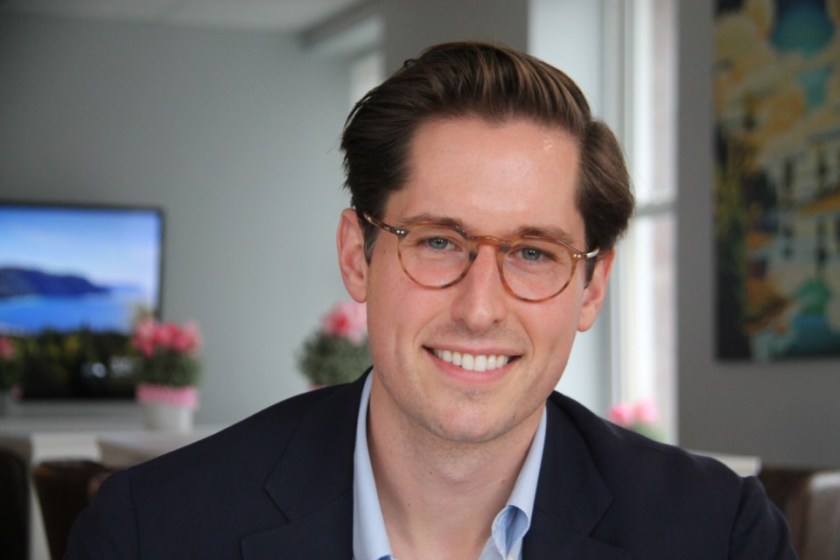
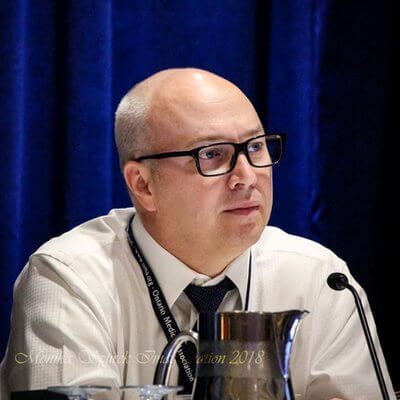
Current Past President of the OMA, Dr. Dominik Nowak

Unfortunately, the current Board has sabotaged this process and rather than listen to the members, will only present pre-approved candidates for Board Director, the most important role. They have the responsibility of ensuring the OMA speaks for, you know, the members. Buried in his email were the following statements:

  • A streamlined shortlisting process for board candidates, with two to four candidates, whose skills and experience align with the board’s needs, being presented on the ballot for each open position 
  • Stronger screening and evaluation for consistency and fairness of candidates 
  • More transparency about how the board performs and what gaps are in the skills-based matrix

There is no explanation of what exactly this “streamlined” process is. But it’s clear that there will be now be increased vetting of candidates and some candidates will be found wanting and not allowed to run. Now, there always was some vetting of Board Candidates. Candidates had to be in good standing with College of Physicians and Surgeons, the OMA, pass background police checks etc. Some basic stuff.

But now, undoubtedly based on the fact that something like 38 people ran for Board last year, the OMA Board has determined to vet candidates even more and reject qualified people if they don’t meet these nebulous criteria. Importantly, the criteria will be to pick candidates who align with the BOARD‘s needs, not the MEMBERS. This is of course, all in the name of “fairness” and “transparency” and to make decisions “easier” for physicians.

But here’s the thing, the Board will NOT do the vetting. Board’s don’t actually do any operational work. Their job is to set policy, and then let the staff of the OMA implement it. So it will be up to the staff of the OMA to vet the Board candidates, and then approve whoever is acceptable……..to the staff.

Colleagues, we have a big problem.

The OMA staff are generally good people who work quite hard on behalf of physicians. They get a lot of unwarranted criticism for decisions that are actually made by physician leaders. Our elected leaders that should bare the blame.

But, at the end of the day, the OMA staff are only human, and prone to human tendencies and failures. My friend Dr. Greg Dubord, who I was honoured to pen a blog with, introduced me to Robert Michel‘s “Iron Law of Oligarchy“. It would seem to apply just not to the CFPC, but to what is going on at the OMA. From Wikipedia:

… all organizations eventually come to be run by a leadership class who often function as paid administratorsexecutivesspokespersons, or political strategists for the organization. Far from being servants of the masses…. this leadership class, rather than the organization’s membership, will inevitably grow to dominate the organization’s power structures.[3]

And that is exactly what is going to happen with these new changes. The OMA staff (not physician leaders, but employees of the OMA) will review the candidates for Board. THEY will decide who meets certain criteria. THEY will determine how many candidates run for each Board position, hiding behind a policy the Board has set.

Will they do their best to pick some good people? Sure. But their definition of “good” may not be what the members want. For example, someone like Shawn Whatley was openly critical of the OMA prior to being elected as President. Would he have passed these criteria? How about Nadia Alam? Prior to getting involved in medical political activism she was a relative unknown with little leadership experience (even though she is arguably the most well respected President of the past 25 years).

Nope. My guess is they would have been found wanting. A total guess on my part would have been Dr. Whatley would be deemed “too disruptive” (he famously resigned from the OMA Board prior to being elected President). Dr. Alam would like be viewed as “too inexperienced.”

Worse, the blunt reality is that the staff will likely decide who is “best qualified” based on how well they can work with them (that’s just human nature). Not necessarily those who can, you know, push them and challenge them to do better.

The staff, generally being very nice people, always had a tendency to try to work co-operatively with the various government bureaucrats on bilateral committees. This is despite the over 30 years of evidence that always trying to be nice and reasonable just isn’t working. Cynics have suggested that its in part because they realize if they want to advance their careers – one of the places they can go after working in the OMA is the government, and it doesn’t help to burn bridges there. So why would they approve a candidate who had a reputation for being less than reasonable?

Want proof? Just look at how badly the OMA as an organization handled last year’s elections. I asked potential Board Directors to commit to filing a Freedom of Information Act request, to determine just how many patients Nurse Practitioners saw in a day and how much they cost the health care system per patient (easy to do with billing numbers). The goal was to get proof that they were more expensive overall (by a lot) than family physicians and slow down scope creep.

Not only did the OMA put a stop to that, they threatened the careers of people who signed that with a Code of Conduct violation. Can’t have people on the OMA Board who will be too aggressive can we? (Psst – hey Kim Moran, CEO of the OMA – how is sending strongly worded letters to the government asking them to stop scope expansion working out? Oh, right.)

Do you really think with that history, the current staff will allow someone even remotely controversial to run?

The OMA Board has shamefully allowed this to happen. As a result there will not be a diverse Board with many viewpoints that focus on members. Rather a bland, non-controversial Board that will be limiting to speaking in political jargon speaking points in response to all issues.

Physicians will truly be hurt by this short sighted decision.
Re-Post: It’s Time To End The War On Drugs In Canada

NB: This blog originally appeared in Huffington Post Canada on Nov 3, 2015. With the demise of HuffPo it’s being reposted here for future reference.

As someone who had his formative years in the 1980s I can still vividly recall former First Lady Nancy Regan launching the ambitious “Just Say No” campaign. She championed this slogan as part of the “war on drugs.” This “war” was started by Richard Nixon in 1971. He declared that drug abuse was “public enemy number one” and that “the only way to fight this menace was on many fronts.” I can personally attest to having been a true believer in that policy myself, after having done some volunteer work in an emergency department as a teenager.

In recent years Canada of course, for the most part followed this policy. In our country, the main technique to fight this war appears to be conviction and incarceration of those caught with illicit drugs. For example, possession (not sale, but possession) is punishable by up to five years in prison. However, what’s clear is that this has failed to help the problem. Data from Statistics Canada (the most recent I could find) shows that while marijuana use in Canada has been relatively constant, the rate of cocaine and other drug use has gradually been increasing since 1977.

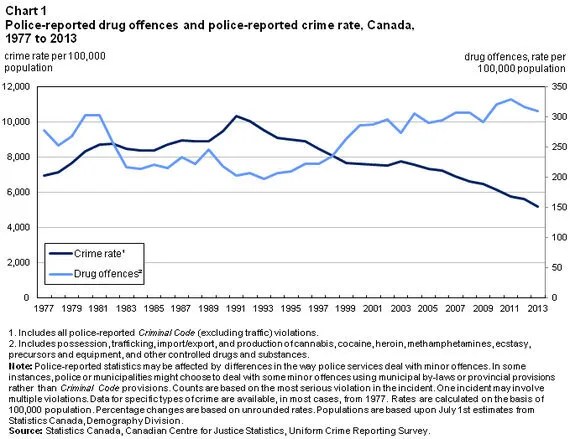
The drug trade itself has seemed to grow and is now considered to have a global value of over $300 billion (U.S.) per year. In Canada, as you can see below on this chart from Statistics Canada, drug offences continue to rise, while the total crime rate decreases. So certainly based on this data, it would be difficult to suggest that the “war” has been successful.

From an economic point of view, the costs of this war are even more staggering. It currently costs $117,000 a year to house a prisoner. Additionally, while the total overall rate of crime has decreased in the past twenty years, the incarceration rate is up, and 80 per cent of offenders have substance abuse problems. It’s clearly not hard to postulate that the main reason for the increased rate of incarceration is drug offences. 

As a family physician, I have seen first hand the effects of untreated drug addiction. Far beyond the relatively easy to measure economic numbers, lives have been ruined, families torn apart, some young women forced into the sex trade to pay for their habit and more, are all part and parcel of this terrible disease. Clearly, the goal of any national policy should be to take proven effective steps to reduce the rate of addiction.

The newly elected Liberal government of Justin Trudeau plans to legalize marijuana. To that end, my hope is that Canada can go one step further and focus on what works to reduce addiction rates. While it is clearly counter intuitive to suggest this, it turns out that the best way to do this, is to decriminalize the possession of small amounts of drugs.

While about 25 countries have decriminalized drugs, the best example of how this policy works is seen in Portugal. They decriminalized the possession (not sale, possession) of drugs for personal use in 2001. The offence was re-classified to an administrative offence as opposed to a criminal one, punishable at most by a fine. At the time, may people, myself included I might add, predicted that this would lead to an explosion of drug use, and that children would be targeted, and the nation would decay. As an aside, this rhetoric is similar to what Stephen Harper alleged would happen if we were to legalize marijuana in the last election. However, a review of the results 14 years later suggest that quite the opposite has happened.

Among other benefits, Portugal has seen a reduction in “past year” and “past month” drug use; a reduction in a dramatic decline in HIV and AIDS in drug users, a reduction in crime; a reduction in addicts in prison and a reduction in drug deaths. This has clearly been an extremely successful policy.

So what happens in Portugal when you are caught with 10 or less days supply of an illicit drug? Your case is referred from the Ministry of Justice to the Ministry of Health (a huge shift in and of itself) and you appear before a drug dissuasion committee. You may be fined, but more often are not and you are offered treatment for your addiction, part of which included social re-integration. Their rate of drug addiction has fallen in half since the implementation of the policy.

Ah, but these programs are expensive aren’t they? Surely it would cost a lot to provide this service for addicts. You mean more than the $117,000 a year we currently pay to incarcerate them? Which, as is proven, doesn’t work.

As mentioned, I was a true believer in the war on drugs, but at the end of the day, as a physician, I have believe in an evidenced-based approach. The evidence shows that incarceration doesn’t work, and decriminalization with offers of treatment do. It’s time to ignore dogma and act in the best interests of Canadians. It’s time to end this war.

Supporting Education the Key to Helping Developing Countries

I recently had the honour of being a guest speaker (along with the amazing Dr. Nadia Alam) at a fund raising dinner for Friends of Namal, an organization that provides university scholarships for students in Pakistan. The following is an abridged version of my speech.

I want to tell the story of a man who was born in Surat, in the State of Gujarat in India in 1933. He moved to Karachi in 1947 during the Partition, and as a teenager witnessed many of the horrors that occurred during that time. He was academically bright, but his family was poor and there was no way that he could afford a University education. However, in 1951 he became aware of a foreign students scholarship from McGill University, applied, and was successful. Four years later he became the first student in the history of McGill to complete his Chartered Accountant and Registered Industrial Accountant degrees simultaneously.

Mohamed Qasim Gandhi, who simultaneously completed the Chartered Accountant and Registered Industrial Accountant Degrees.

After that, he went back to Pakistan and worked for a number of years to support his extended family (his parents had died when he was young so he took care of his sisters who had raised him). In 1966, he and his young wife had a baby boy at the Holy Family Hospital in Karachi. Two years later, he went to Africa with his family as there was a better opportunity there. In 1972, when things got bad in Africa, he decided to move to Canada with his wife and son.

The rest of his family thought he was crazy. ”Where is this Canada place?” ”How far away is it anyway?” “Are there even any muslims there?”

And indeed, there was not much of a Muslim community in Toronto at the time. There was the Jami Mosque, one Halal meat shop on Gerrard street, and, well, that was about it. Not like today when, by the blessing of Allah there are mosques and halal restaurants seemingly every few blocks.

As you may have guessed by now, that man was my father. Because he brought me here at a young age, I didn’t really appreciate the significance of such a move. Truth be told, I really didn’t have great study habits. But one day, when I was visiting my Nana Abba (maternal grandfather), he recited a Hadith (a saying of the Prophet Muhammad, PBUH):

“The ink of the scholar is worth more than the blood of a martyr.”

I am aware that some scholars feel the Hadith is weak, but the sentiment is a good one and fits with Islamic principles. I took that message to heart, began studying harder, and was fortunate to have graduated from the University of Toronto Medical School in 1990. My Nana Abba came to my graduation ceremony. After that, he told me clearly that I was blessed to be an educated man, but now I had a responsibility to help others who wanted an education. I had to pay back my blessings by helping other people, no matter from what walk of life they came from.

So, after I finished my residency, I took over a family practice in a small town called Stayner……and my parents thought I was crazy. ”Where is this Stayner place?” “How far away is it anyway?” “Are there even any muslims there?” Funny how that works.

But I have now been there for 31 years, taught many medical students through the excellent Rural Ontario Medical Program, and seen the community grow significantly. Where once the muslim population of the area doubled just by me getting married, there are now 50 or 60 families, three halal restaurants and a Musallah (prayer site – not quite a mosque). 

Along the way, I managed to run into Dr. Nadia Alam through some medical politics. She convinced me that I should run for OMA Leadership (I still haven’t forgiven her for that by the way). Eventually this lead to me being the President of the Ontario Medical Association (I was the second Pakistani born president in its history, Dr. Alam was the first). This gave me the opportunity to meet many health care leaders, and politicians, and achieve things I never thought possible.

Dr. Nadia Alam, the first Pakistani born President of the Ontario Medical Association, as she gives a speech at the Friends of Namal Fundraising Dinner.

When I look back on this, I ask myself “How did this happen?” To my mind, there are two reasons. First and foremost it is because it is a blessing from Allah. Nothing happens without His will and whatever I have achieved is a result of His kindness.

The second reason of course, is because somebody gave a deserving young Pakistani student a scholarship in 1951, to let him get an education that he otherwise could not have afforded. This then, is the power of education and this then is why it is incumbent upon every muslim to get an education. Another Hadith:

Seeking knowledge is an obligation upon every Muslim.” 

Note the wording. It’s not a request. It’s not a suggestion. It’s an obligation, a command if you will, that every Muslim MUST seek an education. Every Muslim. The Prophet PBUH did not believe there were “types of muslims” and did not distinguish between gender for eductation. Therefore, it’s also an obligation for those of us who can, to HELP other muslims get an education. 

We’ve seen what can happen when just one deserving student gets an education he could not otherwise have afforded. Imagine what can happen if five students do. Or ten. One hundred. More. Education is the key to making a better society and a better future for any country. I encourage those of you who are able to visit the Friends of Namal website, and contribute generously. 

Will the OMA Continue to Restrict Their Elections Process?

Ontario Medical Association (OMA) Election season is upon us again. The nomination period for people interested in running for leadership positions ended recently. This included a video promo in which a certain cantankerous old geezer contributed his two cents. But, will the OMA allow a proper elections process this time round, or will the OMA continue to impose stringent controls on the election process, thus ensuring banality, dullness, and an advantage for mediocre candidates (no really).

In the past, while campaigns for positions at the OMA have hardly been edge of the seat exciting (with many positions either acclaimed or unfilled), there at least was a spectre of campaigning that created some interest in the OMA and the elections process. However, that all started to change a few years ago, due to what I call the Nadia Alam rules. Unlike the real Nadia Alam, those rules desperately need to go the way of the Dodo bird.

Former OMA President Dr. Nadia Alam, the most widely beloved OMA leader in recent memory.

I actually remember when the controversy started. There was to be an election for President Elect. As part of that there was going to be a virtual Town Hall with the candidates. At the town hall, each candidate was asked some pre-selected questions. But then, some random questions were tossed in. And……the complaining began almost instantly after the fact.

“It wasn’t fair to toss random questions in.” “We weren’t prepared to be asked surprise questions” “It was designed to make us look bad.” Etc. The fact that answering unexpected questions might be a skill worth evaluating for a position that entailed a lot of media work, didn’t matter to the complainers. (I mean surely the media would never ever toss unexpected questions your way).

Immediately after my own induction as President, there was a minor controversy that popped up that I had to deal with, completely unprepared. Even the usually benign Medical Post tossed tough questions my way. This happens when you are the spokesperson for the profession (i.e. the actual job of President). Newsflash for those who complained – you didn’t look bad because the “process was unfair” – you looked bad because, well, you sucked at handling the unexpected.

But that wasn’t enough. The next rule that got put in place was to prevent former OMA Presidents from running for the Board, even if they have less than the six year maximum term limit. The reason was ostensibly that “we put our Presidents up on a pedestal and publicize them so much that they have so much name recognition”. Therefore it gives them an “unfair advantage” against others who would run.

To which I say, quoting former Toronto Mayor Mel Lastman – EL TORO POO POO!

There’s a whole bunch of ex-Presidents who, if they ran for something at the OMA, would get completely trounced because of their name recognition. This works both ways people. Do excellent people get positive name recognition? Of course they do. But it’s positive because they are excellent. They are exactly the type of people we need in leadership positions. The…..suboptimal people will get name recognition, just not the kind they want.

It gets worse. In recent years the Board election process has become so restrictive that candidates for Board are basically banned from campaigning. All they can do is have a statement and video message and, well, that’s about it. Heck they are all given a tool kit with “approved” messages to distribute on social media. Once again, this is to ensure “transparent, open and fair election” or some such thing.

Forgetting about the hackneyed nature of the “approved” messages, is it really to much to expect that people running for leadership might actually, you know, have the ability to communicate on their own? And would not the members be better able to judge candidates if they come up with their own messages, rather than some bland, inefficacious template from the OMA?

The problem with this of course is that the only candidates that benefit are the ones who haven’t, through their own hard work, built up their reputation amongst their peers or have the ability to effectively communicate with their colleagues. The mediocre candidates, who don’t have these skills are actually given a leg UP over better candidates because this process brings excellent people down to a mediocre level.

The result is an insomnia curing election process that resulted in barely 10 per cent of all members voting last year.

Why put all these rules in effect?. I’ll be blunt. In my opinion it’s because many OMA physician leaders (including Board Directors) were running scared of Nadia (in medical politics, she’s basically a one name rockstar like Beyonce ). They all knew that if she ran for anything, she would beat whoever she ran against. This is why I call these the Nadia Alam rules. They are designed to minimize the opportunity for someone who through perseverance and inherent excellence has become a great candidate. These rules were put in place to make it easier for the mediocre candidates (like themselves) to win.

I notice with interest that a few candidates for Board (whom I happen to think are excellent) have already announced on some well read physician social media pages that they are running for Board positions. I wonder if some of the usual complainers will be calling the OMA to say that this was “unfair”. This “gives them an unjust head start!”

Look, the reality is that life isn’t fair. Some people are better at being leaders than others. They should be allowed to promote their excellence as it is these excellent people that we need in leadership positions.

As for those candidates who seem to think they “deserve” to be put on an equal footing with those who are clearly better suited for leadership positions? I leave you with some thoughts from one of my favourite, satirists, George Carlin:

RePost: Inside Ontario’s Bloated Health Care Bureaucracy

NB: This is a copy of a column I originally wrote for Postmedia in October of 2015. It’s copied here so that I can access it easily in the future. And a sad reminder that as of 2023, things haven’t changed for the better. If anything, they are worse.

Ontario’s health-care bureaucracy has exploded over the past 12 years, mostly because the government has set up a series of arm’s-length agencies it can scapegoat.

I’ve experienced this bureaucratic mess first-hand.

From 2013 to early 2015, I was the lead physician for the South Georgian Bay Health Links. I took the position because I was told the goal was to co-ordinate care between various health-care agencies to better help patients with the most complex illnesses.

Then-health minister Deb Matthews said there were too many “silos” in the health-care system and anointed her then-associate deputy minister the “silo-buster.” The ADM told us to develop a local solution — because each area is different — and focus on our strengths to help these patients.

Our area is very fortunate to have an advanced IT infrastructure. Virtually all 60,000 residents have an electronic medical record (EMR) in a joint database. We are also one of only two regions in Ontario with electronic prescriptions. This process requires the pharmacy to have a portal that allows it to communicate securely, in real time, with the physician to discuss issues of clinical importance.

My patients have benefitted significantly from this technology, so our thought was to set it up with other allied health-care providers (home-care nurses, retirement and nursing homes, community support workers, etc).

The Ministry of Health funded Health Links through the Local Health Integration Network (LHIN). So we put a proposal together and took it to the LHIN. The LHIN’s IT department liked the idea, but wanted to get input from the ministry. The ministry liked the idea, but wanted us to get the input of eHealth Ontario, the independent agency trying to create electronic health records. eHealth told us to come to a “regional network meeting.”

At the meeting, they thought the idea was good, but asked for the ministry’s eHealth liaison to comment. The liaison referred it to the ministry’s IT group (yes, the ministry has both an eHealth liaison group and an IT group) who wanted to ensure compatibility with a “provincial solution” — even though we were told to develop a local one — and suggested we review with the LHIN IT department.

After a year of “circling back” (a phrase I learned from these guys that I came to detest) we finally gave up, funded the project ourselves for $70,000 — less than a salary on the province’s Sunshine List — and my complex patients are now starting to see the benefits.

As I have come to appreciate, the government set up these various arm’s-length agencies, such as the LHINs, eHealth, Health Quality Ontario, Community Care Access Centres and so on, rather than simply have the ministry accept responsibility for these tasks. From a politician’s point of view, this gives them the ability to deflect criticism by saying such and such agency is “independent.” For the most part, this has worked for the Liberals. They’ve won four elections in a row. But it certainly hasn’t helped the patients any.

My colleague, Dr. Shawn Whatley, posted a superb blog piece that looks at how many bureaucrats work in Canada’s health-care system. It shows Canada has three times as many bureaucrats as other countries with advanced universal-care systems. Even worse, Ontario has only 1.7 acute-care hospital beds per 1,000 people, which is about HALF the average for other OECD countries. Ontario got to this number by closing 17,000 acute-care beds — and laying off the nurses needed to staff them — between 1990 and 2013.

But at least the bureaucrats are producing meaningful reports and are happy to be helping with moving health system transformation forward, right? Not so, according to a recent survey of health leaders conducted by Quantum Transformation Technologies. Most respondents said they aren’t happy with Hoskins or the LHINs.

It’s dramatic just how badly health leaders feel the system is working. The comments at the bottom of the survey are equally telling. There are repeated calls to cut the number of LHINs and reduce the size of the bureaucracy.

So in summary, Ontario is burdened with a bloated, ineffective, and demoralized health-care bureaucracy.

Wynne and Hoskins’ solution to this? Lay off nurses and start a fight with doctors over their fees.

Franz Kafka couldn’t have come up with something this convoluted.

— Mohammad Gandhi, MD, CCFP, FCFP, is an assistant clinical professor at McMaster and Queens universities. 

* More than 1,000 doctors recently joined a Facebook group to complain about how the Ontario Medical Association, which represents them, isn’t sticking up for them in their fee fight with the province.

Earlier this month, the province cut funding for doctor services by $235 million, chopping doctor fees by 1.3%.

******************************

GROWING HEALTH-CARE BUREAUCRACY

* There are 0.9 health-care bureaucrats per 1,000 people in Canada, compared to 0.4 per 1,000 in Sweden; 0.255 in Australia and 0.23 in Japan. Germany has 0.06 bureaucrats per 1,000 people.

* Ontario has only 1.7 acute-care hospital beds per 1,000 people, which is about half the average for other OECD countries. 

*****************************

A recent Canadian Institute for Health Information (CIHI) report — the one Premier Kathleen Wynne and Health Minister Eric Hoskins say shows “Ontario has the best paid doctors in the country” — also says 12,000 Ontario nurses left the profession this past year.

* It also shows Ontario has only 176 physicians per 100,000 people (ranking 7th in Canada).

* Ontario has the fewest family doctors per 100,000 people out of all the provinces. Only 10% of family doctors in the province are accepting new patients.

* A recent Quantum Transformation Technologies survey of Ontario health leaders found 55% think Hoskins is doing a poor to fair job, 62% think the LHINs are doing a poor to fair job, and 50% feel the government has a poor track record of helping those with mental health issues.

Dear Premier Ford, You Know You’re a Conservative, Right?

Dear Premier Ford,

I’m not exactly your harshest critic. I actually support some (not all) of what what you’ve done in health care. Moving procedures from hospitals to outpatient clinics, building new hospitals, enhanced funding for paediatric mental health, are good steps. I hope there will be more commendable steps in the future.

Ontario Premier Doug Ford makes a health care spending announcement

However, I would be remiss if I didn’t point out that the health care system is going to be under a lot of fiscal pressure in the next couple of years. The remuneration that taxpayers pay for front line health care workers is about to increase drastically.

You will note, I hope, that I said “taxpayers” pay. I, like you in the past, try to avoid saying “government money”. The money to pay for health care and other services comes from the pockets of the little guy as a certain politician once put it. Calling it “government money” is just a way to deflect the public from the truth.

At any rate, you are no doubt aware that the nurses in Ontario got a well deserved 11 % arbitration award. You are probably aware that negotiations for a Physicians Services Agreement in Ontario are about to begin. Given that Manitoba just negotiated a record overall funding agreement with their doctors, and Nova Scotia doctors got a significant increase, you will not be able to hold the line against physicians getting an increase in Ontario.

Which of course means that many more health care workers will want an increase too. In short, there is going to be a lot of fiscal pressure on the taxpayer in the near future.

With that in mind, I will confess that my biggest disappointment in your management of health care is that I can’t honestly see that your government has reigned in the bureaucratic bloat that has so hampered the ability of front line physicians (and other health care workers) to look after patients properly.

Bureaucratic bloat is common in all government agencies. I greatly admire politicians who’ve made comments about needing to “end the gravy train” that provides jobs for bureaucrats and a myriad of consultants at the Provincial Government. Perhaps it’s because I live it daily, but no where does this gravy train seem to be so prevalent as health care.

Let’s look at digital health in Ontario for example. You have Ontario MD, which is an arms length agency that claims to be “the only truly provincial digital health network in Canada”, whatever that means. When I was on the OMA Board, OntarioMD was funded by taxpayers around $18 million a year.

But wait, you also have eHealth Ontario, that claims to be “creating a secure electronic health record information system so that all your medical information can be safely shared and accessed by your health care providers“. If I can decipher their audit statements correctly, they get a further $234 million dollars in revenue.

But that’s not all. The Ministry of Health has not one but TWO separate departments that appear to deal with health IT issues. Their organizational chart clearly shows a bureaucrat in charge of Health Services for an Information and IT cluster. She has her own team of well paid bureaucrats. Yet there is another bureaucrat in charge of Digital and Analytics strategy all with his own team of well paid bureaucrats. The Digital Health Branch of the Ministry of Health had a budget of almost $324 million in 2021/22.

And this is where the waste comes in. You have three agencies (one with two departments) to deal with one field, all reporting separately, none of whom necessarily agree with the other on what to do next. I saw this a lot at government when I was with the OMA. So progress was significantly impaired in digital health because not only was there not one vision amongst the agencies, but because every single issue went back and forth between the three agencies to try to get alignment (to cover the asses of the Sunshine List bureaucrats in case something went wrong). As a result, we are far behind every developed country (except the United States) when it comes to digital health.

I remember a politician who said:

What drives me crazy is when you have a supervisor in government, and they report into 12 other supervisors. That’s unacceptable.

That’s exactly what happens with the digital health care strategy in Ontario.

But moreover, the same thing happens in every single branch of the health care system. I mean seriously, if you already have a Clinical Care and Delivery Branch of the Ministry (see organizational chart) why do you need a separate arms length agency like Cancer Care Ontario? Or Ontario Drug Benefit? Or a myriad of others? They should be rolled up into the Ministry. There are many more examples but you get the point I hope.

If you were to simply stop funding OntarioMD (which in my opinion is no longer useful) and the scandal plagued, eHealth Ontario (which completely failed in its mission anyway), that would represent a savings of $250 million. At $100,000 each, that could pay for 2,500 front line nurses. Clearly nurses who provide front line care are more needed than bureaucrats who go around in circles.

The bureaucrats will no doubt fight you if you tried to do this. They will produce reams of power points and glossy manuals (all on the taxpayers dime of course) saying their work is important. But seriously, what would you expect from those who are accustomed to the gravy train?

Conservatives are supposed to be about reducing government waste, decreasing bureaucracy and efficient delivery of services. These are age old principles that, to be honest, I have yet to see from you as Premier.

If you don’t want to heed my advice, might I suggest that you instead take to heart the advice of the politician I mentioned above who wanted to end the gravy train and reduce the reporting to 12 other supervisors nonsense. That politician? A guy by the name of Doug Ford.

Respectfully submitted,

An Old Country Doctor.

RePost: Ontario’s Heading For Another Family Doctor Shortage

This is the follow up blog to my last one, originally published in the Huffington Post on June 13, 2017. Reprinted here so that I can keep track of my old blogs, and also to once again point out how warnings of a crisis in Family Medicine were ignored for years.

The Barer-Stoddart report. Ask any physician of a certain age and the immediate reaction is likely to be disparaging. Written in 1991, it purported to help chart the course of the physician workforce into the 21st century. 

While it’s true that much of the report was ignored by the Ontario government of Bob “Super Elite” Rae, it’s still widely remembered for suggesting that the number of physicians in Ontario needed to be cut by 10 per cent. To accomplish this, medical school enrollment was slashed in the early 1990s.

Given that the population of Ontario continued to grow and age, the result was completely predictable. A massive doctor shortage (particularly in family medicine) hit the province at the end of the decade. It has taken the last 15 years to come close to correcting that. We’re not there yet (we still have fewer doctors per capita than Mongolia), but we were improving.

Alas, Ontario Health Minister “Unilateral Eric” Hoskins and Deputy Health Minister Bob Bellwere unable to remember the old saying, “Those who cannot remember the past are condemned to repeat it.”

Former Health Minister Dr. Eric Hoskins

Last week I blogged about how Hoskins and Bell need to support family medicine. Because they are not doing so, many physicians who graduate from family medicine residencies are not starting comprehensive family practices. Instead, they are doing things like hospitalist work, sports medicine and even medical marijuana clinics.

However, the situation is even worse than I thought. It was pointed out to me after my blog was published that the number of medical students applying to family medicine programs has dropped considerably this year. In Canada, to become a practicing physician, you first have to graduate from medical school, then do a residency (essentially a training program) in the specialty of your choice. To choose a residency, you apply to CARMs — which is a Canada-wide program that matches medical school graduates to the residency of their choice.

This year’s CARMs match shows some alarming results for family medicine in Ontario. Ideally, we should have 45 to 50 per cent of all graduates from medical school apply to family medicine for a sustainable workforce. However, only the Northern Ontario School of Medicine achieved that goal. While it’s a great school, it’s still the smallest of Ontario’s six medical schools.

By comparison, only 24 per cent of graduates of University of Toronto applied to family medicine, 27 per cent of Queen’s graduates, 32 per cent of Ottawa’s graduates, etc. Multiple studies show that comprehensive family medicine is responsible for decreased health-care costs, more efficient utilization of the health system, better patient outcomesand decreased hospitalizations. It is essential for a sustainable health-care system to have a strong family medicine component. The fact that so few medical school graduates chose family medicine, on top of the fact that recent graduates are not opening practices, should be setting off alarm bells.

So, why is this happening? First and foremost, it’s because Hoskins and Bell have refused to support family medicine. They have talked loudly about how they want to cut payments to higher paying specialties so that they could fund family medicine. Hoskins even went to the trouble of doctoring (pun intended) a chart to accuse specialists of overbilling. 

(Seriously, see the picture in this article. Notice how he made the pie chart on the right larger — the whole circle, not just the wedge showing percentage of billings. Makes the red area look LARGER than it really is, and makes the specialists look they are billing disproportionately more than they are.)

Unfortunately, while Hoskins and Bell were saying this in public, what they were actually doing is cutting family physicians. They unilaterally cut the number of physicians who could apply to the capitation (salary plus performance bonus) models of funding that I mentioned last week. This is the preferred method for paying physicians for newer graduates, and also for health care bureaucrats who like a predictable budget. Additionally, they cut a number of the performance bonuses family physicians got for looking after complex patients.

Medical students are not dumb. They saw all of this going on, and realized that family practice was no longer preferred by Hoskins and Bell. So they made career choices accordingly.

Currently, the Hoskins/Bell legacy is not a pretty one. It’s one of internecine disputes with doctors, laid-off nurses, hospital deficits, patients in stretchers for days and egregious wait times. At least with family medicine, they have an opportunity to begin to correct this mess by once again allowing new physicians to enter the capitation model, and restoring the various performance bonuses.

Failure to do so will mean that many years from now, as patients struggle to find a family physician, Hoskins and Bell will be remembered with the same disparaging legacy as Barer-Stoddart.

RePost – Hoskins and Bell Need to Support Family Medicine

The following is a reprint of an article that I wrote for the Huffington Post on June 5, 2017. Re-posting here so that we can see how the seeds of declining family physicians was planted by Drs. Eric Hoskins and Bob Bell, and also so that I can refer to it in the future if needed.

For the past 23 years, it’s been my pleasure to be a preceptor with the Rural Ontario Medical Program based out of Collingwood. As a preceptor, I have had the honour of supervising a wide variety of Medical Trainees, from first year Medical Students, all the way up to those in their last year of Residency. 

I often find I learn as much from them as they learn from me (it’s good to be questioned by students about why you do things the way you do). I clearly have some experience on my side, and they have more recent book knowledge. It’s a great combination for patient care.

Unfortunately, I can see that we are once again heading for the same situation as the late 1990s/early 2000s, when many medical trainees stopped going into comprehensive family medicine. The reasons then were due to increased workload, better opportunities in other specialties and an extremely poor relationship with the government of the day. 

At one point, only about 25% of graduates from medical school applied to Family Medicine Residencies. To suggest that there was a crisis in family medicine would be dramatically understating the issue.

However, the Conservative government of Mike Harris finally realized you need to co-operate with doctors if you want to improve patient care. In 2000, Health Minister Elizabeth Witmer rolled out something called Primary Care Reform (PCR) in co-operation with the Ontario Medical Association (OMA). This, over the next few years, led to a revitalization of Family Medicine, and now, close to 40% of medical school graduates are once again choosing Family Medicine as their specialty. 

While not the sole part of the PCR, a major component was a new model of paying physicians known as capitation. Capitation is essentially salary plus performance bonuses. Family Physicians would be paid a certain monthly rate to look after their patients, regardless of how often they saw them. They get bonuses based on how many complex (eg. Diabetic) medical cases they take on. This was in stark contrast to the old system known as Fee For Service (FFS) where physicians were essentially paid piecemeal (only got paid when they saw a patient).

The capitation based models were extremely popular with both Family Physicians and government. For Family Physicians, it allowed them to spend the time needed with patients during just one visit, instead of requiring multiple visits. For the government, it provided a predictable funding envelope. I appreciate this will come as a surprise to a couple of the frequent critics of my articles (in the comments), who have long implied that I was critical of Health Minister “Unilateral Eric” Hoskins because I was allegedly supporting the FFS model, but I actually have been in a capitated model since 2004.

Drs. Bob Bell (left) and Eric Hoskins

Did PCR work? In 2001, the population of Ontario was 11.4 million, and almost 3 million people didn’t have a family doctor. In 2016, the population of Ontario was 13.9 million, and only 800,000 did not have a family doctor. So over 4.5 MILLION people got a family doctor.

Then along came the hapless “Unilateral Eric”, and his widely disliked sidekick, Deputy Minister Bob Bell. “Unilateral Eric” likes to claim that he himself is family doctor. The reality is that he has NEVER provided the cradle to grave care that comprehensive family doctors in Ontario do on an ongoing basis. He does work a day a month at a walk in clinic, and I understand he donates that income to charity – which is good of him, but it’s hardly the same as what comprehensive family doctors do. 

Bob Bell for his part, likes to boast about how he used to be a family doctor back in the 1970s, but he seems to be unable to grasp that family medicine might have evolved since then.

Acting with the same level of competence as Tweedle Dee and Tweedle Dum, the infelicitous duo of Hoskins and Bell unilaterally cut the number of family physicians who could apply to capitated funding models. Again, this is likely a surprise to a couple of the critics of my columns, who have long been demanding that physicians go on salary. Surprise, it was Hoskins and Bell who unilaterally stopped the salary style models, not the OMA. They also unilaterally cut some of the performance bonuses (for things like diabetic care, medical education and so on).

The result was clearly predictable to anyone who understands Family Medicine in the 2010s. Over the past three years newer graduates from Family Medicine programs are avoiding comprehensive care. Many of my trainees are choosing to work solely in areas like emergency, anaesthesia, sports medicine or others. And while there is a need for doctors in all fields, the reality is that it’s comprehensive Family Medicine that leads to health system stability

It’s comprehensive Family Medicine that reduces hospitalizations. It’s comprehensive Family Medicine that when supported properly, reduces costs of health care.

In response to this, the dolorous duo of Hoskins and Bell unleashed something called the New Graduate Entry Program (NGEP) to provide new family medicine graduates with what they claimed was a capitated funding model. Alas they attached so many conditions including a morass of bureaucratic oversight that I understand only two new graduates have taken them up on this offer.

Hoskins and Bell have left a legacy of a crumbling health care system with their arroganceand unilateral cuts

However, they still have the ability, and opportunity to begin to correct one of their most egregious mistakes. A new crop of Family Medicine Residents will graduate on July 1. Hoskins and Bell can unilaterally reverse the cuts to the capitated models and performance bonuses. No one from the OMA will complain.

It’s time for them to recognize the important role of comprehensive Family Physicians, and support that with actions, not just words.