NB: The following is a guest blog, written by the (anonymous) author of the survey I referenced in, “Will the OMA Learn Lessons from OHIPs Latest Attack on Doctors?“. While it’s true these surveys tend to attract negative responses by their nature, the rather large number of respondents (especially compared to some of the OMAs own Thought Lounge surveys), suggests the OMA really needs to pay attention to the extreme dissatisfaction this issue has caused. My thoughts follow at the end.
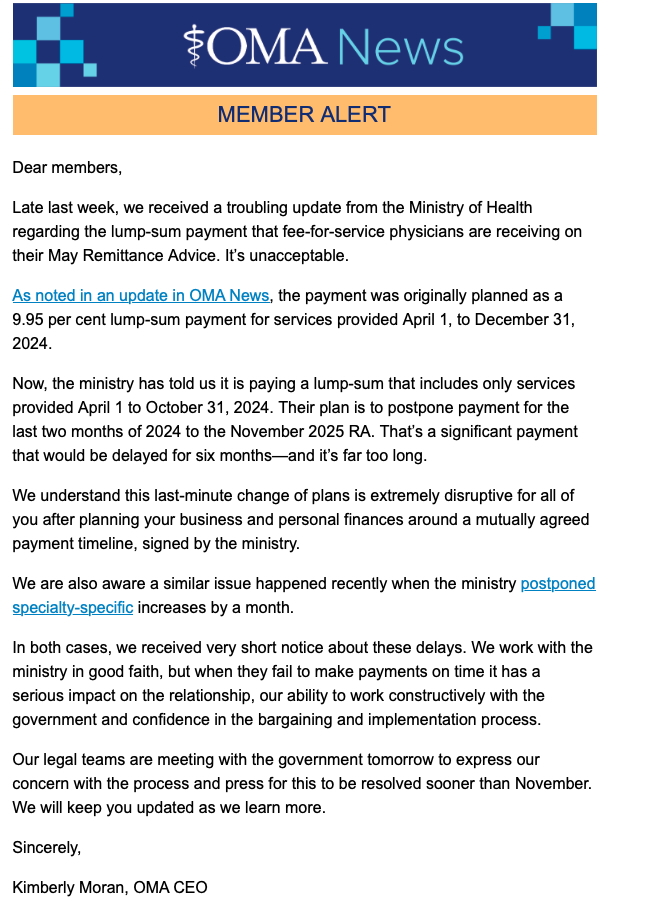
The purpose of this survey was to highlight to the OMA the need to take this issue more seriously and to outline the impact the delayed payments had on members. The OMA’s response to this has been tepid. At the time the survey responses were collected, the payment timeline for November and December, 2024 retroactive pay was set as November, 2025. This was changed to August, but this does not alter the fact that the MOH has repeatedly delayed payments for physicians over the years.
Even with a signed, public agreement, the MOH has not managed to uphold its obligations, yet the OMA seems resigned, on behalf of its members, to accept whatever delays happen, based on whatever excuse the MOH provides. The members are not the cause of the MOH’s problems, yet they pay, over and over, for these deficiencies.
The survey results are summarized below. As a practicing physician, my time is at a premium, so I utilized AI to summarize the main findings of the survey.
Technology willing, the full survey results are here. Survey Monkey dashboard is here.
AI-Generated Summary of the Full Survey Document:
The survey responses reveal widespread dissatisfaction among Ontario physicians regarding delayed payments, systemic issues in healthcare administration, and inadequate advocacy by the Ontario Medical Association (OMA). Key themes include the impact of late payments, financial hardship and impact to personal finances.
Many respondents reported being unable to meet financial obligations, pay taxes, or fund discretionary purchases due to delayed payments. Some had to take on debt or cancel planned expenses like maternity leave benefits, vacations, or home down payments.
Clinic Operations:
Clinic owners faced cash flow disruptions, inability to pay staff, and delayed renovations. Others mentioned the administrative burden of tracking payments and rejected claims.
Mental and Emotional Toll:
Physicians expressed feelings of moral injury, frustration, and discouragement, with some considering early retirement or leaving the province entirely. The delay has eroded trust in the Ministry of Health and the OMA.
Lack of Accountability:
Respondents described the Ministry as untrustworthy, disrespectful, and adversarial, with unilateral decisions that breach agreements. Many called for interest payments on delayed funds and legal action to hold the Ministry accountable.
Systemic Issues:
Complaints included outdated payment systems, rejected claims, and lack of transparency in billing processes.
Weak Advocacy:
Many respondents felt the OMA failed to advocate strongly for physicians, with delayed and insufficient responses to the payment issue. Some called for legal action, media campaigns, and stronger negotiation tactics.
Loss of Trust:
Physicians expressed frustration with the OMA’s perceived lack of power and transparency, with some questioning the value of membership dues.
Declining Appeal to Practicing in Ontario:
Many respondents are considering leaving Ontario or medicine altogether due to poor compensation, lack of respect, and systemic challenges. Some noted that other provinces offer better pay structures and support.
Family Medicine Crisis:
Respondents highlighted the lack of investment in family medicine and primary care, with concerns about burnout, scope creep, and inadequate funding.
Rejected Claims:
Physicians reported valid claims being rejected by OHIP , causing financial losses and administrative burdens.
Delayed Payments:
Delays in flow-through funding, parental leave benefits, and relativity-based fee adjustments were frequently mentioned.
Outside Use Penalties:
Respondents criticized penalties for outside use, especially when patients sought care elsewhere due to hospitalizations or urgent needs.
Recommendations for Advocacy:
Demand Accountability:
Push the Ministry to honour agreements, pay interest on delayed funds, and improve payment systems.
Increase Transparency:
Advocate for clearer communication about payment timelines, rejected claims, and billing processes.
Strengthen Negotiation:
Take a more aggressive stance in negotiations, including legal action and public campaigns to highlight the Ministry’s failures.
Support Physicians:
Address broader issues like rejected claims, outside use penalties, and inadequate funding for family medicine and specialists.
Conclusion:
There have been severe financial, emotional, and operational impacts of the delayed OHIP payment. There is an urgent need for the OMA to advocate more forcefully with the Ministry of Health to address late payments and systemic issues affecting Ontario physicians. Physicians are calling for immediate action, including interest payments, stronger advocacy, and accountability from the Ministry of Health and the OMA. The dissatisfaction expressed by respondents highlights the risk of losing physicians to other provinces or professions if these issues are not resolved.
An Old Country Doctors Thoughts:
While the above was written by my colleague, my personal thoughts on the survey is that I’m not really surprised by the results. I try to “keep my ear to the ground” so to speak, and there is a broad level of dissatisfaction with how the MOH repeatedly gets away with violating its own signed contracts, and the frankly abject level of incompetence at the MOH. The incompetence is unfortunately, not limited to just their payment systems/processes, but also how they run health care in general.
I’m also not surprised by the negative comments towards the OMA. Admittedly (as mentioned before) these surveys tend to cater to negative responses. However, there is a real sense of defeat on the ground about how physicians are being treated by the current government (protracted arbitration, stupid statements about the family physician shortage, and more). My sense is most physicians are resigned to defeat and are disengaging from health care – which is bad for the whole health system.
It does not help frankly, that a few short days after being told physicians would not get paid on time, OMA CEO Kim Moran was quoted in an Ontario Government News release on Primary Care saying:
“Ontario’s doctors are encouraged by this announcement and look forward to working with government to ensure that every Ontarian has access to a family doctor. We will do everything we can to accelerate this goal by collaborating with Deputy Premier and Minister of Health Sylvia Jones, and the lead of the Primary Care Action Team, Dr. Jane Philpott. It’s a long road ahead but this is a positive step forward to protecting Ontario’s valued health care system.”
Kimberly Moran
CEO, Ontario Medical Association (OMA)”
A very well respected physician from another province told me after seeing this: “It’s a bit pathetic. Screw us over and we’ll still be nice to you”. Personally I think Ms. Moran should look up “Stockholm Syndrome“.
I’ve repeatedly said you cannot have a high functioning health care system without happy, healthy and engaged physicians. These survey results suggest that that isn’t the case in Ontario.