
Auditor General’s Report on AI Highlights Failure of Ontario’s Health IT Bureaucrats

There’s currently a lot of talk about the recent report from Ontario’s Auditor General on AI Scribes. The headlines seem mostly to be dealing with the fact that she found numerous AI Scribe generated reports had errors. The errors happened for various reasons, including AI hallucinations, transcription errors, incorrect entry of medications and so on.

Ontario’s current Auditor General, Shelley Spence

However, to my mind, that’s not the real story.

I feel somewhat conflicted in saying this next part, mostly because I think I generally have a reputation for being an advocate for physicians, their views and their well being. However, the blunt reality is that we are all required to check any report that’s generated by an AI scribe before we sign off on them. Physicians, being human, will make mistakes. For example, this past weekend, I got a message from a colleague of mine, pointing out an error that had been made in an AI-generated note on a patient I saw. That was my fault for not double checking. I think to try and blame some software for those kind of mistakes would be inappropriate.

No, the real story is the continued ineptitude of the healthcare bureaucrats at the Ministry of Health who are in charge of health care IT systems today. If one does a deep dive into the Auditor General’s report, there are many, many legitimate question she has, all of which the hard-working taxpayers of this province deserve an answer to.

In particular she found gaps in how these AI systems were evaluated by Supply Ontario, Ontario Health, and to a certain extent OntarioMD. Yes there were three agencies all involved, triplicating the amount of work necessary and adding to the confusion.

Heck the issues began right from the initial procurement stage. The weighting given to different criteria revealed a fundamental misalignment of priorities. The accuracy of medical notes generated by AI scribes accounted for only four per cent of points awarded to potential vendors, while domestic presence in Ontario was weighted the highest at 30 per cent. Data privacy/legal controls were weighted at 23 per cent and system security controls at 11 per cent. 

Think about that for a minute. You could have software from a poorly run company, that was completely inaccurate in its transcription and system security, yet still have it approved if it happened to be Ontario based. Yet a company with the best transcription and system security would lose, if it was from out of province. Even Spence was shocked by this, stating, “In my mind, that doesn’t make sense….when we’re dealing with personal information and we’re dealing with artificial intelligence, I think security is of the utmost importance.”

Additionally, the evaluations didn’t actually watch vendors operate the software in real time! There were no live test. Vendors were apparently given recordings and ran the system offline learning. Spence said, “this allowed vendors to potentially overstate their compliance with security and privacy requirements.”

Well, duh!

Worse, 11 of the approved vendors for AI software didn’t actually meet the mandatory submission requirements. They got approved anyway. Five didn’t even submit risk assessments and privacy impact assessments as part of their bid process. They got approved anyway.

This kind of amateurish, ineffectual assessment is supposed to help increase confidence in healthcare IT?

Most damningly, it appears from the auditor general’s report that there is a broad absence of strategic governance. The auditor general benchmarked the AI strategy against Canadian and international public sector organizations and found that there were no specific actionable items, no clear plan to prioritize AI use across ministry areas, and did not identify any prohibited AI practices or areas where technology posed an unacceptable risk.

Essentially, this report paints a picture of Ontario Health/Supply Ontario/Ontario MD approving AI systems through a process that underweighted accuracy, did not require live demonstrations, accepted incomplete documentation and failed to assess bias risk. All while having no clear plan to rectify these gaps going forward.

The thing is, this kind of insanity has been permeating the politics of IT health systems for decades. I’ve written about the bloated and inefficient bureaucracy for years now. The lack of ability to get a truly integrated health care system speaks to a lack of vision and focus in the bureaucracy. It’s incredibly discouraging that it continues unabated after all these years. It seems that no one has the knowledge, wisdom, ability to fire the incompetent bureaucrats, streamline the process by getting rid of multiple agencies, and apply an overarching vision for health care IT.

And yet, instead of fixing the bureaucratic mess first, streamlining health IT infrastructure, and developing on overarching health IT vision, Ontario is instead now going ahead and launching a Provincial initiative to create a province wide primary care medical record system. The people in charge of choosing the software for this? The same bunch who botched the AI scribe issue.

I can’t wait to read the Auditor General’s report on that one in, say 2029.
Artificial Intelligence is Naturally Stupid

Over the past two years, there has been an explosion in the amount of artificial intelligence (AI) software available, not just to healthcare professionals like myself, but to the general public. In many ways, AI has been quite helpful. I myself have been using AI scribe software in my office for close to a year now. The software listens to the conversation I have with my patient, and automatically generates a clinical note.

The AI scribe has been an enormous benefit to me. My medical notes are much better (also somewhat more detailed). I also save one hour of admin time a day (!) As an aside, this is actually a reason why the government should fund AI scribes for physicians. Under the new FHO+ model, we are paid an hourly rate for administrative work. Surely, saving five hours of physicians time a week is worth the government purchasing a scribe for physicians.

There are also some significant benefits for patient care. Another piece of AI software I use (that’s restricted to health care professionals) helps me with challenging cases. I am able to put the symptoms and test results into the software and it generates a list of potential diagnoses, and suggestions for next steps. It can also recommend treatments for rare conditions.

The general public can also benefit from AI. I recently had a little bit of trouble with my trusty 13-year-old SUV. I put the make and model of the SUV into a commercially available AI, put the symptoms in, and it generated a list of potential causes based on known issues about my SUV.

To be abundantly clear, I would never attempt to fix a car myself. Just as, with all due respect, patients should never, ever attempt to implement a treatment plan for themselves. What AI did do is give me the ability to have an intelligent conversation with the auto mechanic about the situation. And, dare I say it, allowed me to ensure that the mechanic was not trying to pull the wool over my eyes. (My vehicle is now fixed and running very smoothly.)


But along with the many benefits of AI software, there is, of course, potential for harm. This can range from ludicrous to dangerous.

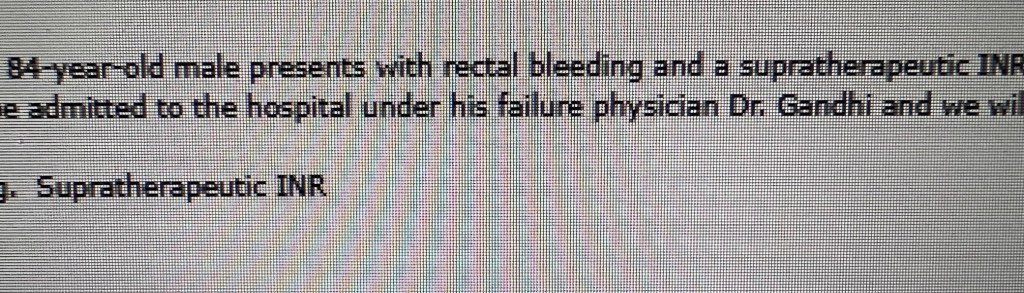
The phenomenon of AI scribe hallucination is well known to physicians like myself. I have seen it in my own software, and it is the reason why I always read the note before I paste it into the patient’s chart. Admittedly, some of that is laughable :

Hopefully this is an AI hallucination of my skills, as opposed to the software’s judgement!

Additionally, the reality is that AI scribes can’t often put a patient’s lived experience (which is so important to building a relationship with a patient) into a note. My colleague Keith Thompson had a superb post on LinkedIn talking about how the AI scribe failed to recognize his personal interactions with an Indigenous patient, particularly with respect to understanding generational trauma.

Sadly, there have been cases where actual harm has been caused by AI. Grok is currently being investigated for generating sexualized images without consent, including those of minors. This causes severe emotional distress and real harm to the victims. There have also been concerns that AI chatbots are helping or suggesting people harm themselves. No one wants any of this stuff to happen, including the people who write AI software. But it has happened.

All of which reminds me of something that my computer science teacher in high school was fond of saying. (Note to my younger readers, and particularly my sons if they ever read my blog: Yes, there actually were computers when I was a teenager. I am not that prehistoric!)

How I’m viewed by my younger colleagues and my children!

The redoubtable Mr. Williams always implored:

“Do not forget, computers and software are actually very very stupid. They can do some things very fast, but they can only do what they are told.”

It’s a piece of wisdom that still holds true today.

With processing speeds almost infinitely faster than when I took computer science, computers can do multiple calculations very very fast. My desktop computer, which is a few generations old, can run 11 trillion operations a second. Heck my phone, which itself is 4 years old, could probably run a fleet of 1980s Space Shuttles. Speed is not the problem now.

The fleet of US Space Shuttles

The problem is that these computers and software still don’t actually have the ability to “think” outside of their parameters. They only do what they are programmed to do. If for example, they are programmed to answer questions asked by a user, but they are not given specific rules to avoid illegal answers, well, they will answer the questions directly. If the programming contains an inadvertent error (someone entered a “0” in the code, instead of a “1”), well, then the software will NOT be able to realize that was a mistake, and will carry out calculations based on the wrong code.

It is true that software is increasingly being taught to “look” for errors. But again, the software can only see the errors it is programmed to look for. It can’t find inadvertent errors and it can’t “think outside of the box.” They are, for lack of better wording, too stupid to do so.

All of which is my fancy and longish way of saying that while these new tools are great, at the end of the day they simply cannot replace the human experience. Just as the software couldn’t recognize the generational trauma of an Indigenous patient, there is a lack of “gut instinct” present. That feeling you have when you are missing something, and you know a patient is sicker than they may seem. It’s a trait that seen in our best clinicians, and one that no programming can replace.

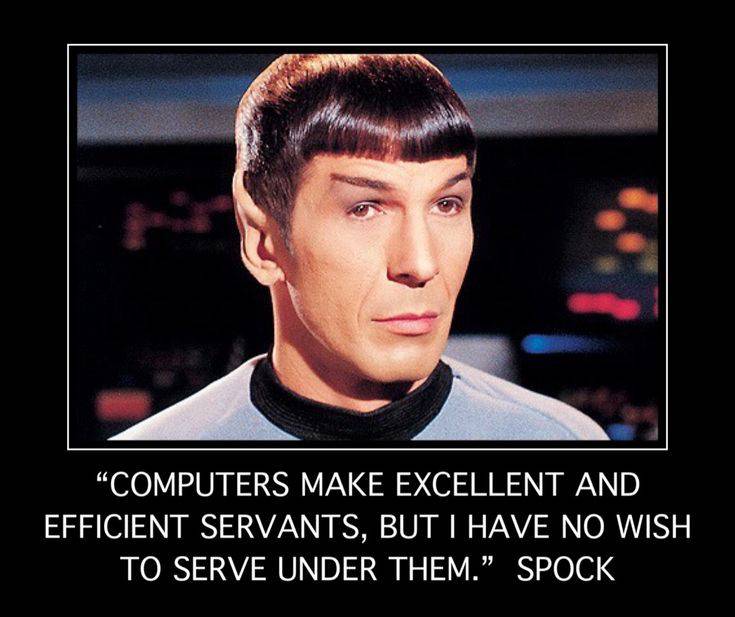
Using an AI tool is just fine. But for my part, I’m going to agree with Mr. Spock: