
FHO+: The Good, The Bad, and the Reality on the Ground

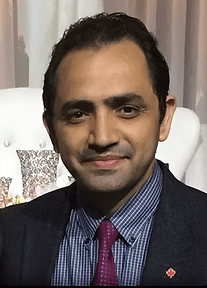
My thanks to Dr. Wael Guirguis, (pictured inset) who had a superb post on LinkedIN that he’s kindly allowed me to reproduce as a guest blog. Dr. Guirguis got his MD in Egypt in 2003 and has been practicing in Canada since 2011. He’s the lead physician for the Fairway FHO and provides comprehensive care for patients at the Danton Medical Centres. A thought provoking read which I hope you’ll enjoy.

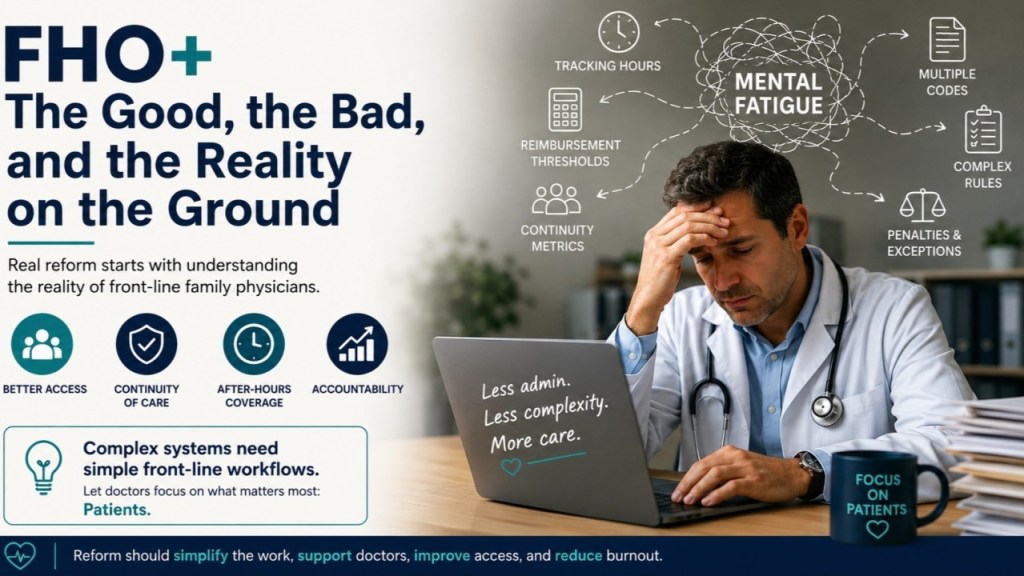
Over the past couple of months, Family physicians across Ontario have started experiencing the reality of the new FHO+ model in day-to-day practice.The goals behind the reform are understandable.

Improve access. Support continuity of care. Encourage after-hours coverage. Create more accountability in primary care.

These are important goals, and family physicians should absolutely be part of improving the system. Some aspects of FHO+ deserve recognition. Organized after-hours coverage matters. Continuity of care matters. Accountability matters. But as implementation unfolds, many front-line physicians are beginning to identify operational consequences that may not have been fully appreciated during policy design.

The Efficiency Problem

One of the biggest concerns is the relationship between productivity and compensation efficiency. Under FHO+, physicians are now heavily constrained by hourly and monthly thresholds tied to direct patient care time. In practical terms, physicians can work harder, see more patients, and still experience a significant reduction in compensation efficiency. The unintended consequence is that the model may discourage efficiency during regular clinic hours.

A physician who develops efficient workflows, uses technology effectively, and safely improves patient throughput may actually feel penalized for doing so. That creates a concerning signal within primary care. Healthcare systems should reward:

  • safe patient access
  • continuity
  • quality
  • responsible innovation
  • sustainability
  • burnout prevention

Not unintentionally encourage physicians to slow down to remain within operational thresholds.

The Hidden Mental Burden

One of the least discussed consequences of FHO+ is the cognitive burden it creates for physicians throughout the day. Doctors are now not only thinking about patient care, they are also continuously tracking:

  • direct care hours
  • monthly hour accumulation
  • reimbursement thresholds
  • after-hours eligibility
  • continuity metrics
  • outside-use implications
  • whether additional work will still be compensated fairly

That constant background calculation creates mental fatigue. Family physicians already operate in an environment of nonstop decision-making: clinical care, inbox management, staffing issues, documentation, urgent requests, abnormal results, hospital follow-ups, and administrative work. Adding another layer of continuous operational tracking changes the psychology of practice itself. Instead of focusing entirely on patient care and clinic efficiency, physicians may begin constantly asking themselves:

“Am I crossing another threshold?” That is not a healthy foundation for sustainable primary care.

The Bigger Problem: Complexity Itself

This discussion is larger than FHO+ alone, It reflects a broader pattern in healthcare reform. With each reform cycle, the Schedule of Benefits seems to become increasingly complex rather than simpler.

New rules. New modifiers. New exceptions. New thresholds. New formulas. New tracking requirements. Yet very rarely do reforms focus on reducing front-line operational complexity for physicians. And complexity itself has consequences, It increases cognitive load, administrative dependency, billing anxiety, operational inefficiency, and eventually burnout. Complex healthcare systems may be unavoidable. But complex systems still require simple front-line workflows. That principle is often overlooked.

Continuity of Care Should Be Managed by the System, Not Punitive Billing Rules

Continuity of care matters. Family physicians understand that better continuity leads to better long-term outcomes, fewer fragmented records, reduced duplication, and safer patient care. But enforcing continuity through increasingly complicated physician payment penalties is not the right approach. A simpler and more effective solution already exists. If the Ministry of Health wants to strengthen continuity of care within capitation models, the responsibility should sit primarily with the system itself, not through constant billing complexity imposed on physicians.

For example: If a rostered patient repeatedly seeks care outside their enrolled medical home beyond a defined threshold, the Ministry could automatically review or remove the patient from the roster. The patient would be notified directly by the Ministry of Health not by the physician. This creates clear accountability while avoiding unnecessary tension between doctors and patients. Most importantly, it removes one of the major hidden burdens currently placed on family physicians: constantly monitoring continuity metrics, outside use calculations, and roster penalties while simultaneously trying to run busy clinics.

Continuity of care should be encouraged through smart system design and patient accountability  not by forcing physicians to navigate increasingly complicated billing formulas and penalties. Doctors should focus on delivering care. The healthcare system should focus on managing the system.

The Human Side Nobody Talks About

Most family physicians are not trying to maximize billing. They are trying to:

  • keep clinics financially sustainable
  • reduce patient wait times
  • manage inbox overload
  • supervise staff
  • complete documentation
  • respond to urgent patient needs
  • avoid burnout

When systems unintentionally penalize high-functioning clinics for being efficient, morale suffers quickly. And eventually, patients feel the impact.

A Better Path Forward

Primary care reform is necessary. But reforms work best when governments collaborate closely with front-line physicians who actually operate clinics every day. The goal should not simply be measuring physician hours. The goal should be:

  • maximizing safe patient access
  • improving continuity
  • reducing unnecessary administrative burden
  • supporting sustainable family medicine
  • encouraging innovation and operational efficiency
  • protecting physicians from burnout

Ontario has extraordinary family physicians who want the system to succeed. The question is whether the system is being designed in a way that allows them to succeed too.

Use AI NOW to Reduce Bureaucratic Bloat in Health Care

On the heels of my last blog on the Auditor General’s report on AI systems in Ontario, I was asked “how then can AI help in health care?” Certainly policy makers often talk a LOT about how AI can help. Better diagnoses! Faster assessments! Better prediction of which patient is more likely to “crash”! Reduced admin time with the use of AI Scribes! Etc.

These are all valid uses for AI technology. I use an AI scribe myself (following the principle of “trust but verify”in signing off on the notes). I access some evidence based AI software to help me with challenging cases. I always have the final word on what to do next of course, but I would be lying if I said that the tools didn’t help me look after my patients.

However, in a health care system as byzantine as the one in Ontario, there is one area where AI can help almost immediately that is not talked about nearly enough. Given the topic, I get why the many government health care planners/bureaucrats/managers don’t mention this. I’m talking of course, about reducing the number of bureaucrats in health care in Ontario.

I’ve talked about Ontario’s health care system being over bureaucratized many times in the past. But there’s never been a better opportunity to meaningfully cut the bloat. It would be impossible for me to search the entire Ontario government data base to find out how many bureaucrats we have. So………I used an AI search on ChatGPT and Claude AI to review how many managers/bureaucrats we have across all government funded health care agencies in Ontario. (I will put the prompt at the end of the blog for those interested).

Both searches suggested the total size of the health care workforce in Ontario was about 500,000 people. Of that, astounding 90,000-130,000 were non-clinical employees (mostly administrative/support staff). The actual management/bureaucratic layer varied between 25,000-45,000. A precise number was difficult to define, because, in the words of ChatGPT:

“……Ontario’s healthcare system is fragmented across hundreds of entities with inconsistent titles and reporting structures.”

However, given all of that, I think Claude’s estimate of having 85,000 admin/management personnel across all Ontario Health care agencies is defensible. Heck, it’s lower than ChatGPTs 90,000 – 130,000. Claude AI further broke this down and suggested 52,000 of these were in Ontario’s 154 hospitals.

Can AI replace some of these jobs? Replace is probably not the right phrase. There can certainly be a consolidation of the actual tasks required from different jobs, and AI can do those tasks much more efficiently and accurately.

For example, AI can, as of today, help with information movement, repetitive analysis, scheduling, policy retrieval, document generation, compliance monitoring, coordination, coding, and referrals to name but a few examples. All of these tasks are currently being performed by bureaucrats, and it’s virtually certain that there is tremendous duplication in the work being done. There is plenty of software than can do these tasks right now (LeanTaas, Qventus, Nuance DAX to name a few). Yes they are mostly American, but surely can be modified to meet Canadian needs.

The cost savings from reducing the number of bureaucrats can be significant immediately, and frankly enormous as AI continues to evolve over the next five years.

For a case study, let’s look at the University Health Network (I’m not picking on them for any other reason then they are huge!). They have approximately 24,500 employees of which an estimated 4,200 are Admin/management of some sort. Many of these positions are people on Ontario’s Sunshine List (i.e. they make over $100,000 a year). Reducing the number of these positions by 10% should be easily do-able if you have the right AI software.

Then the hospital would save the money right? Especially since Ontario’s hospitals are facing massive deficits? I would say no to that. I would instead say if UHN could cut their admin staff by 420 (which should easily be done), then maybe they could hire 210 clinical staff in return (nurses, physio, rehab, RT, Xray techs etc). Instead they just fired nurses. They would still have 210 fewer positions (so some money saved) but they would have 210 more people who would actually, you know – look at a patient. People who could provide compassionate, front line care and assessments to patients and be an invaluable part of the health care team.

Looking forward five years as AI software continues to evolve, I genuinely believe UHN should set its goal for reducing Admin/Management staff by half (at a minimum). This would allow them hire over a thousand (if not more) nurses to provide that front line care that is so essential to patients well being.

From a system wide perspective, the numbers would be even more dramatic. Currently, Ontario has 38% less inpatient staffing than the Canadian average. In order to just meet the average, about 34,000 more nurses need to be hired. The money for that has to come from somewhere, and I can think of no better place than reducing the admin staffing to find those funds.

I get why the bureaucrats have not talked about these uses for AI. Bureaucracy by its very nature is self perpetuating. But we are facing a serious fiscal calamity in health care with our aging population. While it’s nice to have tools that can help physicians like myself make better diagnoses and provide safer care, the blunt reality is we desperately need more front line staff. No matter how good the tool, it will never be a substitute for the compassion or a real human being providing care. The emotional wellness we experience from having real people look after us at the bedside cannot be understated. We need to adopt bureaucracy replacing AI tools now, and put the money saved in front of patients.

For those interested, this is the AI Prompt I used to get this data: “Review the number of bureaucrats/managers in the health care system in Ontario, Canada. Include ALL health care agencies that are government funded like hospitals, Ontario Health at Home, hospitals, community health centres and more – all government funded health care agencies. Get an approximate number of bureaucrats. Then show where AI can result in cuts to management/bureaucrat jobs right now, and in five years. Use the University Health Network in Toronto Canada as an example to show how many bureaucrat/management jobs could be trimmed, allowing them to funnel resources to hiring front line clinical personnel like nurses.”

Auditor General’s Report on AI Highlights Failure of Ontario’s Health IT Bureaucrats

There’s currently a lot of talk about the recent report from Ontario’s Auditor General on AI Scribes. The headlines seem mostly to be dealing with the fact that she found numerous AI Scribe generated reports had errors. The errors happened for various reasons, including AI hallucinations, transcription errors, incorrect entry of medications and so on.

Ontario’s current Auditor General, Shelley Spence

However, to my mind, that’s not the real story.

I feel somewhat conflicted in saying this next part, mostly because I think I generally have a reputation for being an advocate for physicians, their views and their well being. However, the blunt reality is that we are all required to check any report that’s generated by an AI scribe before we sign off on them. Physicians, being human, will make mistakes. For example, this past weekend, I got a message from a colleague of mine, pointing out an error that had been made in an AI-generated note on a patient I saw. That was my fault for not double checking. I think to try and blame some software for those kind of mistakes would be inappropriate.

No, the real story is the continued ineptitude of the healthcare bureaucrats at the Ministry of Health who are in charge of health care IT systems today. If one does a deep dive into the Auditor General’s report, there are many, many legitimate question she has, all of which the hard-working taxpayers of this province deserve an answer to.

In particular she found gaps in how these AI systems were evaluated by Supply Ontario, Ontario Health, and to a certain extent OntarioMD. Yes there were three agencies all involved, triplicating the amount of work necessary and adding to the confusion.

Heck the issues began right from the initial procurement stage. The weighting given to different criteria revealed a fundamental misalignment of priorities. The accuracy of medical notes generated by AI scribes accounted for only four per cent of points awarded to potential vendors, while domestic presence in Ontario was weighted the highest at 30 per cent. Data privacy/legal controls were weighted at 23 per cent and system security controls at 11 per cent. 

Think about that for a minute. You could have software from a poorly run company, that was completely inaccurate in its transcription and system security, yet still have it approved if it happened to be Ontario based. Yet a company with the best transcription and system security would lose, if it was from out of province. Even Spence was shocked by this, stating, “In my mind, that doesn’t make sense….when we’re dealing with personal information and we’re dealing with artificial intelligence, I think security is of the utmost importance.”

Additionally, the evaluations didn’t actually watch vendors operate the software in real time! There were no live test. Vendors were apparently given recordings and ran the system offline learning. Spence said, “this allowed vendors to potentially overstate their compliance with security and privacy requirements.”

Well, duh!

Worse, 11 of the approved vendors for AI software didn’t actually meet the mandatory submission requirements. They got approved anyway. Five didn’t even submit risk assessments and privacy impact assessments as part of their bid process. They got approved anyway.

This kind of amateurish, ineffectual assessment is supposed to help increase confidence in healthcare IT?

Most damningly, it appears from the auditor general’s report that there is a broad absence of strategic governance. The auditor general benchmarked the AI strategy against Canadian and international public sector organizations and found that there were no specific actionable items, no clear plan to prioritize AI use across ministry areas, and did not identify any prohibited AI practices or areas where technology posed an unacceptable risk.

Essentially, this report paints a picture of Ontario Health/Supply Ontario/Ontario MD approving AI systems through a process that underweighted accuracy, did not require live demonstrations, accepted incomplete documentation and failed to assess bias risk. All while having no clear plan to rectify these gaps going forward.

The thing is, this kind of insanity has been permeating the politics of IT health systems for decades. I’ve written about the bloated and inefficient bureaucracy for years now. The lack of ability to get a truly integrated health care system speaks to a lack of vision and focus in the bureaucracy. It’s incredibly discouraging that it continues unabated after all these years. It seems that no one has the knowledge, wisdom, ability to fire the incompetent bureaucrats, streamline the process by getting rid of multiple agencies, and apply an overarching vision for health care IT.

And yet, instead of fixing the bureaucratic mess first, streamlining health IT infrastructure, and developing on overarching health IT vision, Ontario is instead now going ahead and launching a Provincial initiative to create a province wide primary care medical record system. The people in charge of choosing the software for this? The same bunch who botched the AI scribe issue.

I can’t wait to read the Auditor General’s report on that one in, say 2029.

Artificial Intelligence is Naturally Stupid

Over the past two years, there has been an explosion in the amount of artificial intelligence (AI) software available, not just to healthcare professionals like myself, but to the general public. In many ways, AI has been quite helpful. I myself have been using AI scribe software in my office for close to a year now. The software listens to the conversation I have with my patient, and automatically generates a clinical note.

The AI scribe has been an enormous benefit to me. My medical notes are much better (also somewhat more detailed). I also save one hour of admin time a day (!) As an aside, this is actually a reason why the government should fund AI scribes for physicians. Under the new FHO+ model, we are paid an hourly rate for administrative work. Surely, saving five hours of physicians time a week is worth the government purchasing a scribe for physicians.

There are also some significant benefits for patient care. Another piece of AI software I use (that’s restricted to health care professionals) helps me with challenging cases. I am able to put the symptoms and test results into the software and it generates a list of potential diagnoses, and suggestions for next steps. It can also recommend treatments for rare conditions.

The general public can also benefit from AI. I recently had a little bit of trouble with my trusty 13-year-old SUV. I put the make and model of the SUV into a commercially available AI, put the symptoms in, and it generated a list of potential causes based on known issues about my SUV.

To be abundantly clear, I would never attempt to fix a car myself. Just as, with all due respect, patients should never, ever attempt to implement a treatment plan for themselves. What AI did do is give me the ability to have an intelligent conversation with the auto mechanic about the situation. And, dare I say it, allowed me to ensure that the mechanic was not trying to pull the wool over my eyes. (My vehicle is now fixed and running very smoothly.)


But along with the many benefits of AI software, there is, of course, potential for harm. This can range from ludicrous to dangerous.

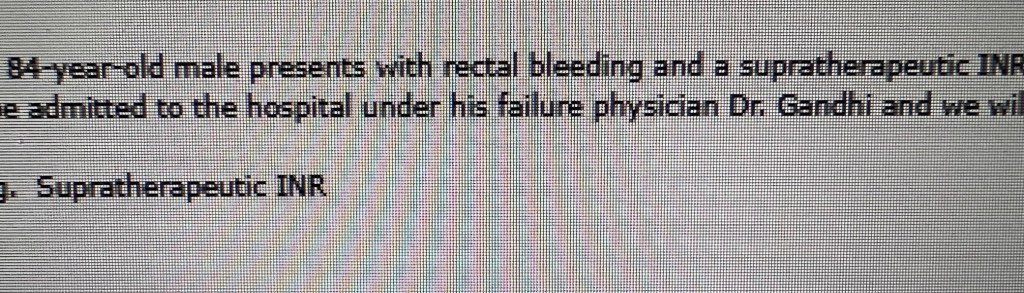
The phenomenon of AI scribe hallucination is well known to physicians like myself. I have seen it in my own software, and it is the reason why I always read the note before I paste it into the patient’s chart. Admittedly, some of that is laughable :

Hopefully this is an AI hallucination of my skills, as opposed to the software’s judgement!

Additionally, the reality is that AI scribes can’t often put a patient’s lived experience (which is so important to building a relationship with a patient) into a note. My colleague Keith Thompson had a superb post on LinkedIn talking about how the AI scribe failed to recognize his personal interactions with an Indigenous patient, particularly with respect to understanding generational trauma.

Sadly, there have been cases where actual harm has been caused by AI. Grok is currently being investigated for generating sexualized images without consent, including those of minors. This causes severe emotional distress and real harm to the victims. There have also been concerns that AI chatbots are helping or suggesting people harm themselves. No one wants any of this stuff to happen, including the people who write AI software. But it has happened.

All of which reminds me of something that my computer science teacher in high school was fond of saying. (Note to my younger readers, and particularly my sons if they ever read my blog: Yes, there actually were computers when I was a teenager. I am not that prehistoric!)

How I’m viewed by my younger colleagues and my children!

The redoubtable Mr. Williams always implored:

“Do not forget, computers and software are actually very very stupid. They can do some things very fast, but they can only do what they are told.”

It’s a piece of wisdom that still holds true today.

With processing speeds almost infinitely faster than when I took computer science, computers can do multiple calculations very very fast. My desktop computer, which is a few generations old, can run 11 trillion operations a second. Heck my phone, which itself is 4 years old, could probably run a fleet of 1980s Space Shuttles. Speed is not the problem now.

The fleet of US Space Shuttles

The problem is that these computers and software still don’t actually have the ability to “think” outside of their parameters. They only do what they are programmed to do. If for example, they are programmed to answer questions asked by a user, but they are not given specific rules to avoid illegal answers, well, they will answer the questions directly. If the programming contains an inadvertent error (someone entered a “0” in the code, instead of a “1”), well, then the software will NOT be able to realize that was a mistake, and will carry out calculations based on the wrong code.

It is true that software is increasingly being taught to “look” for errors. But again, the software can only see the errors it is programmed to look for. It can’t find inadvertent errors and it can’t “think outside of the box.” They are, for lack of better wording, too stupid to do so.

All of which is my fancy and longish way of saying that while these new tools are great, at the end of the day they simply cannot replace the human experience. Just as the software couldn’t recognize the generational trauma of an Indigenous patient, there is a lack of “gut instinct” present. That feeling you have when you are missing something, and you know a patient is sicker than they may seem. It’s a trait that seen in our best clinicians, and one that no programming can replace.

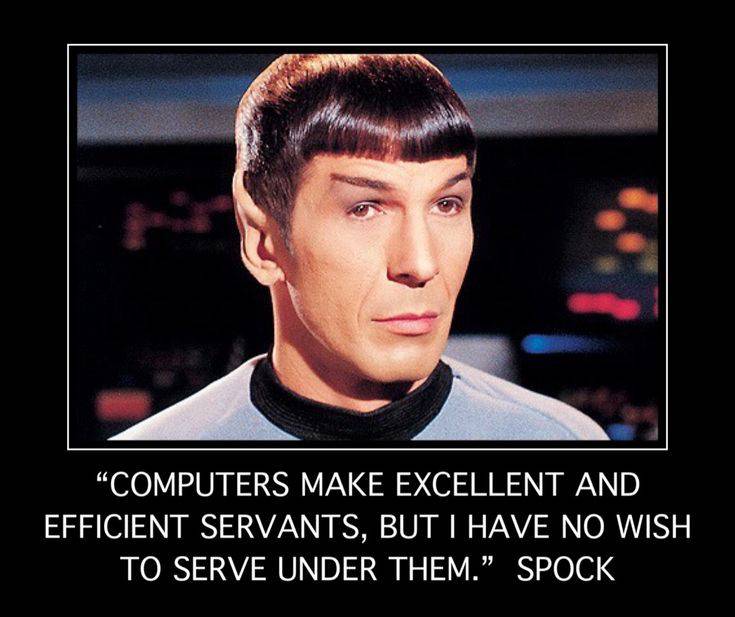
Using an AI tool is just fine. But for my part, I’m going to agree with Mr. Spock: