
RePost: Inside Ontario’s Bloated Health Care Bureaucracy

NB: This is a copy of a column I originally wrote for Postmedia in October of 2015. It’s copied here so that I can access it easily in the future. And a sad reminder that as of 2023, things haven’t changed for the better. If anything, they are worse.

Ontario’s health-care bureaucracy has exploded over the past 12 years, mostly because the government has set up a series of arm’s-length agencies it can scapegoat.

I’ve experienced this bureaucratic mess first-hand.

From 2013 to early 2015, I was the lead physician for the South Georgian Bay Health Links. I took the position because I was told the goal was to co-ordinate care between various health-care agencies to better help patients with the most complex illnesses.

Then-health minister Deb Matthews said there were too many “silos” in the health-care system and anointed her then-associate deputy minister the “silo-buster.” The ADM told us to develop a local solution — because each area is different — and focus on our strengths to help these patients.

Our area is very fortunate to have an advanced IT infrastructure. Virtually all 60,000 residents have an electronic medical record (EMR) in a joint database. We are also one of only two regions in Ontario with electronic prescriptions. This process requires the pharmacy to have a portal that allows it to communicate securely, in real time, with the physician to discuss issues of clinical importance.

My patients have benefitted significantly from this technology, so our thought was to set it up with other allied health-care providers (home-care nurses, retirement and nursing homes, community support workers, etc).

The Ministry of Health funded Health Links through the Local Health Integration Network (LHIN). So we put a proposal together and took it to the LHIN. The LHIN’s IT department liked the idea, but wanted to get input from the ministry. The ministry liked the idea, but wanted us to get the input of eHealth Ontario, the independent agency trying to create electronic health records. eHealth told us to come to a “regional network meeting.”

At the meeting, they thought the idea was good, but asked for the ministry’s eHealth liaison to comment. The liaison referred it to the ministry’s IT group (yes, the ministry has both an eHealth liaison group and an IT group) who wanted to ensure compatibility with a “provincial solution” — even though we were told to develop a local one — and suggested we review with the LHIN IT department.

After a year of “circling back” (a phrase I learned from these guys that I came to detest) we finally gave up, funded the project ourselves for $70,000 — less than a salary on the province’s Sunshine List — and my complex patients are now starting to see the benefits.

As I have come to appreciate, the government set up these various arm’s-length agencies, such as the LHINs, eHealth, Health Quality Ontario, Community Care Access Centres and so on, rather than simply have the ministry accept responsibility for these tasks. From a politician’s point of view, this gives them the ability to deflect criticism by saying such and such agency is “independent.” For the most part, this has worked for the Liberals. They’ve won four elections in a row. But it certainly hasn’t helped the patients any.

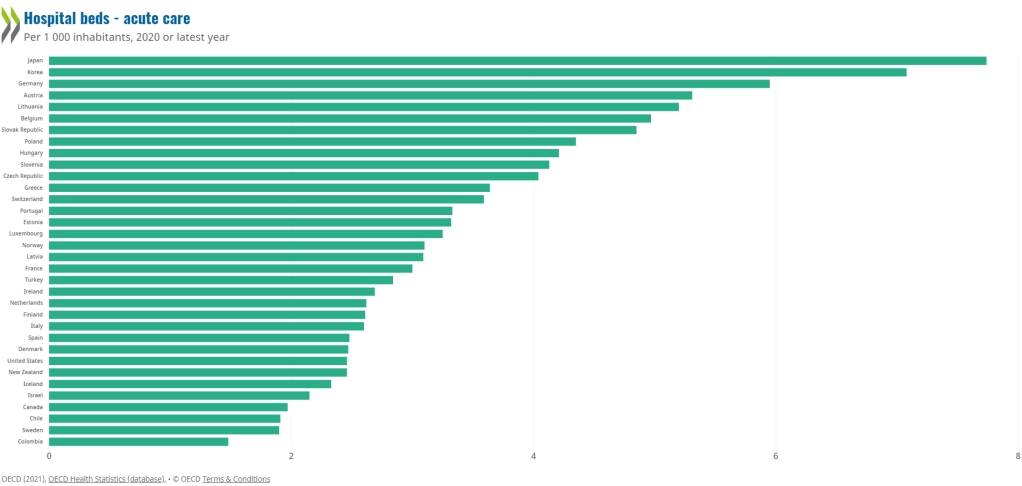
My colleague, Dr. Shawn Whatley, posted a superb blog piece that looks at how many bureaucrats work in Canada’s health-care system. It shows Canada has three times as many bureaucrats as other countries with advanced universal-care systems. Even worse, Ontario has only 1.7 acute-care hospital beds per 1,000 people, which is about HALF the average for other OECD countries. Ontario got to this number by closing 17,000 acute-care beds — and laying off the nurses needed to staff them — between 1990 and 2013.

But at least the bureaucrats are producing meaningful reports and are happy to be helping with moving health system transformation forward, right? Not so, according to a recent survey of health leaders conducted by Quantum Transformation Technologies. Most respondents said they aren’t happy with Hoskins or the LHINs.

It’s dramatic just how badly health leaders feel the system is working. The comments at the bottom of the survey are equally telling. There are repeated calls to cut the number of LHINs and reduce the size of the bureaucracy.

So in summary, Ontario is burdened with a bloated, ineffective, and demoralized health-care bureaucracy.

Wynne and Hoskins’ solution to this? Lay off nurses and start a fight with doctors over their fees.

Franz Kafka couldn’t have come up with something this convoluted.

— Mohammad Gandhi, MD, CCFP, FCFP, is an assistant clinical professor at McMaster and Queens universities. 

* More than 1,000 doctors recently joined a Facebook group to complain about how the Ontario Medical Association, which represents them, isn’t sticking up for them in their fee fight with the province.

Earlier this month, the province cut funding for doctor services by $235 million, chopping doctor fees by 1.3%.

******************************

GROWING HEALTH-CARE BUREAUCRACY

* There are 0.9 health-care bureaucrats per 1,000 people in Canada, compared to 0.4 per 1,000 in Sweden; 0.255 in Australia and 0.23 in Japan. Germany has 0.06 bureaucrats per 1,000 people.

* Ontario has only 1.7 acute-care hospital beds per 1,000 people, which is about half the average for other OECD countries. 

*****************************

A recent Canadian Institute for Health Information (CIHI) report — the one Premier Kathleen Wynne and Health Minister Eric Hoskins say shows “Ontario has the best paid doctors in the country” — also says 12,000 Ontario nurses left the profession this past year.

* It also shows Ontario has only 176 physicians per 100,000 people (ranking 7th in Canada).

* Ontario has the fewest family doctors per 100,000 people out of all the provinces. Only 10% of family doctors in the province are accepting new patients.

* A recent Quantum Transformation Technologies survey of Ontario health leaders found 55% think Hoskins is doing a poor to fair job, 62% think the LHINs are doing a poor to fair job, and 50% feel the government has a poor track record of helping those with mental health issues.

Dear Premier Ford, You Know You’re a Conservative, Right?

Dear Premier Ford,

I’m not exactly your harshest critic. I actually support some (not all) of what what you’ve done in health care. Moving procedures from hospitals to outpatient clinics, building new hospitals, enhanced funding for paediatric mental health, are good steps. I hope there will be more commendable steps in the future.

Ontario Premier Doug Ford makes a health care spending announcement

However, I would be remiss if I didn’t point out that the health care system is going to be under a lot of fiscal pressure in the next couple of years. The remuneration that taxpayers pay for front line health care workers is about to increase drastically.

You will note, I hope, that I said “taxpayers” pay. I, like you in the past, try to avoid saying “government money”. The money to pay for health care and other services comes from the pockets of the little guy as a certain politician once put it. Calling it “government money” is just a way to deflect the public from the truth.

At any rate, you are no doubt aware that the nurses in Ontario got a well deserved 11 % arbitration award. You are probably aware that negotiations for a Physicians Services Agreement in Ontario are about to begin. Given that Manitoba just negotiated a record overall funding agreement with their doctors, and Nova Scotia doctors got a significant increase, you will not be able to hold the line against physicians getting an increase in Ontario.

Which of course means that many more health care workers will want an increase too. In short, there is going to be a lot of fiscal pressure on the taxpayer in the near future.

With that in mind, I will confess that my biggest disappointment in your management of health care is that I can’t honestly see that your government has reigned in the bureaucratic bloat that has so hampered the ability of front line physicians (and other health care workers) to look after patients properly.

Bureaucratic bloat is common in all government agencies. I greatly admire politicians who’ve made comments about needing to “end the gravy train” that provides jobs for bureaucrats and a myriad of consultants at the Provincial Government. Perhaps it’s because I live it daily, but no where does this gravy train seem to be so prevalent as health care.

Let’s look at digital health in Ontario for example. You have Ontario MD, which is an arms length agency that claims to be “the only truly provincial digital health network in Canada”, whatever that means. When I was on the OMA Board, OntarioMD was funded by taxpayers around $18 million a year.

But wait, you also have eHealth Ontario, that claims to be “creating a secure electronic health record information system so that all your medical information can be safely shared and accessed by your health care providers“. If I can decipher their audit statements correctly, they get a further $234 million dollars in revenue.

But that’s not all. The Ministry of Health has not one but TWO separate departments that appear to deal with health IT issues. Their organizational chart clearly shows a bureaucrat in charge of Health Services for an Information and IT cluster. She has her own team of well paid bureaucrats. Yet there is another bureaucrat in charge of Digital and Analytics strategy all with his own team of well paid bureaucrats. The Digital Health Branch of the Ministry of Health had a budget of almost $324 million in 2021/22.

And this is where the waste comes in. You have three agencies (one with two departments) to deal with one field, all reporting separately, none of whom necessarily agree with the other on what to do next. I saw this a lot at government when I was with the OMA. So progress was significantly impaired in digital health because not only was there not one vision amongst the agencies, but because every single issue went back and forth between the three agencies to try to get alignment (to cover the asses of the Sunshine List bureaucrats in case something went wrong). As a result, we are far behind every developed country (except the United States) when it comes to digital health.

I remember a politician who said:

What drives me crazy is when you have a supervisor in government, and they report into 12 other supervisors. That’s unacceptable.

That’s exactly what happens with the digital health care strategy in Ontario.

But moreover, the same thing happens in every single branch of the health care system. I mean seriously, if you already have a Clinical Care and Delivery Branch of the Ministry (see organizational chart) why do you need a separate arms length agency like Cancer Care Ontario? Or Ontario Drug Benefit? Or a myriad of others? They should be rolled up into the Ministry. There are many more examples but you get the point I hope.

If you were to simply stop funding OntarioMD (which in my opinion is no longer useful) and the scandal plagued, eHealth Ontario (which completely failed in its mission anyway), that would represent a savings of $250 million. At $100,000 each, that could pay for 2,500 front line nurses. Clearly nurses who provide front line care are more needed than bureaucrats who go around in circles.

The bureaucrats will no doubt fight you if you tried to do this. They will produce reams of power points and glossy manuals (all on the taxpayers dime of course) saying their work is important. But seriously, what would you expect from those who are accustomed to the gravy train?

Conservatives are supposed to be about reducing government waste, decreasing bureaucracy and efficient delivery of services. These are age old principles that, to be honest, I have yet to see from you as Premier.

If you don’t want to heed my advice, might I suggest that you instead take to heart the advice of the politician I mentioned above who wanted to end the gravy train and reduce the reporting to 12 other supervisors nonsense. That politician? A guy by the name of Doug Ford.

Respectfully submitted,

An Old Country Doctor.

#Docxit on the Rise, Means More Trouble for Our Health System

Acknowledgement: I want to thank my friend Dr. Graham Slaughter for coming up with the term “Docxit”. Graham is not only a brilliant internist, but is incredibly talented at wordplay and music. Plus, he has really thick, lustrous wavy hair!

A bunch of stuff has come to my attention recently in my social life and on my social media feeds. I’m saddened by all of these and even more saddened by what this means for the residents of Canada.

Item 1: a friend of mine in her early 40s confided she is going to give up her family practice. She loves her patients, but the admin burden and the poor remuneration make it no longer feasible to do this work.

Item 2: two more friends of mine, also in their 40s, are actively making plans to leave medicine altogether. One of them told me she knew four family physicians (all in their 40s) who left this year alone, and two others in their 30s who have moved out of country.

Item 3: I came across a social media post from a friend of mine from my days in OMA leadership announcing he was now a real estate agent. Amongst the people congratulating him on passing his real estate exams were other physicians also saying they were look at ways of getting out of medicine.

Item 4: The family health organization I’m part of in the Collingwood area has gone from 52 family physicians to 47 as some have retired without finding a replacement, despite trying.

Provincially of course, there are many more such stories. Three family doctors in the Ottawa area left their practices earlier this year. Twenty per cent of family doctors in Toronto are planning on closing their practices in the next five years. The list goes on.

It’s not just Ontario. British Columbia is facing a “dire picture” when it comes to family physicians. Doctors Manitoba, through their excellent (now past) president Dr. Candace Bradshaw, pointed out the need for more doctors on more than one occasion. I could probably find articles from every province highlighting issues with recruiting and retaining physicians, but you get the point.

Doctors, it seems, are looking at leaving the profession (for either retirement or other jobs) in alarmingly high numbers. This phenomenon, dubbed Docxit by Dr. Slaughter, is happening at a time when our health system can arguably least afford it (if it ever really could).

This is particularly a concern as our younger physicians seem to be more likely to quit. A report by Statistics Canada suggested that up to 47% of physicians with less that 5 years experience are intending to leave or change jobs in the next three years. To be clear, they are not intending to retire, just do something other than what they’ve trained for.

From Statistics Canada

This phenomenon is not just present in Canada. The American Medical Association is concerned about “Medicine’s great resignation” as 1 in 5 physicians in the U.S. are also planning an exit in the next two years.

The situation in Europe would appear to be even more dire. The Politico article I linked to states that seven million people in France do not have a family doctor, with more family doctors retiring than setting up a practice. There is a shortage of two million health care workers in Europe. Brexit has badly worsened the shortage of doctors in the United Kingdom. Spain is running out of doctors. And so on.

Once again, those leaving appear to be over represented by younger physicians. It’s so bad that European Junior Doctors (an association of younger doctors in continental Europe) issued a press release warning the health care system there was going to collapse.

What’s going on then? Why are so many doctors leaving? I mean, despite the few (but loud) vociferous miscreants on social media, being a physician is still the most respected profession in the world (at 83% we’re tied with farmers and scientists). Studies show that Canadians trust their doctors to make the right choice for them and are afforded a measure of leeway that politicians and bureaucrats must surely be envious of. And you know that stereotype about first generation South Asian immigrants always wanting their kids to grow up to be doctors because of their status in society – it’s true (trust me, I and many of my friends lived it).

But the reality is that over the past ten years, practicing medicine has devolved to where it is no longer about caring for patients (which is what all good doctors want to do). In Canada, it’s been about fighting bureaucracy. With doctors now spending up to 19 hours a week doing paperwork (that’s a half a work week for most people) or fighting nameless, pointy headed, basement cellar cubicle dwelling bureaucrats to get them to actually pay for surgery that a patient needs, medicine is now more about who can do paperwork better than who can promote health care better.

In the United States, the rise of corporate entities eating up private medical practices has fuelled an explosion of a different kind of paper work, all with its own stresses. One study suggested that each physician spends almost $83,000 U.S. a year interacting with insurance companies.

Add to that the ludicrous number of options and waivers and liabilities and I sometimes think it’s easier to understand Einstein’s Theory of Relativity than it would be to understand U. S. Health Care. Dr. Glaucomflecken does an excellent job of explaining the frustration here:

I don’t know what the reasons for #Docxit are in Europe, but I imagine they are similar. The over bureaucratization of medicine is taking its toll everywhere. As was stated in the Politico article:

“At its core, it’s really that there is the perception that potentially medicine is no longer an attractive career choice, a choice for people to stay in for a whole career. And this will really endanger the sustainability of health care systems in future,” – Sarada Das, secretary-general for the Standing Committee of European Doctors (CPME)

There are so many crises in our health care system right now, it’s honestly hard to keep track. But two things are for certain. First, we won’t be able to fix health care without retaining doctors. Second, as more doctors opt for Docxit, we would appear to be doing a lousy job at retention.

Dear CFPC Board, Provide Business Training to Family Physician Residents

Dear Board of the College of Family Physicians of Canada (CFPC),

There’s a whole lot of talk about the crisis in family medicine. Even the College of Physicians and Surgeons of Ontario felt compelled to do a cover story on this issue. I’m just a (not very) humble ordinary member of the CFPC, so I don’t need point out the ramifications to the health system to such learned members as yourselves.

I fully respect that it will take a multi-lateral approach to fix this. However, the impression one gets is that the CFPC is focusing on extending the family medicine residency to three years, from the current two.  This expansion has even been presented as a possible solution to recruitment woes.

Nancy Fowler, executive director of the CFPC, states that the current program is “way too compressed” to deal with increasing complexity of health needs in Canada, changing technologies, and greater awareness of the health impacts of racism. In the same article, she also notes that residents have told her they would like more opportunities in different kinds of practices and settings (basically that they want the extra year).

I think these arguments are weak. The most learning I ever got was in my first year of practice. There is simply no substitute for being out on your own.  Join a supportive group like I did, and you will be fine.

I do respect that the current training program may not be adequate. I’ve taught many residents myself over the past 25+ years. The amount of useless “clinic day backs” and forums, research days and “behavioural science modules” that the residents are asked to do has increased to the point where I wonder when the residents actually, you know, see a patient in real life. No wonder they may feel unprepared for having their own practice. 

University of Toronto and McMaster – I’m looking at you.

But the solution to that is, you know, fix the residency program. Not extend it with a year of the doing exactly the same nonsense that made residents feel inadequate to practice comprehensive family medicine to begin with. All that would mean is that after three years the residents will still feel unprepared.

Also, have you considered that if you do increase the residency by a year, you will have one year where NO family medicine residents graduate into practice? Would you care to explain to everyone how that will help the current shortage of family docs?

Anyway, if you do increase the CFPC residency to three years, would you at least add some practical training for our younger colleagues to the residency? I believe they would benefit from two months of their third year being dedicated to learning about the business of running a practice. How to hire people. Employment standards. Performance appraisals for staff. Negotiating leases. Finding the best prices for supplies. And yes, how to maximize your billings.

All of those above tasks (and more) are absolutely essential to running a comprehensive family practice. Yet NONE of those are taught in medical school or residency. In fact, in many universities, the feeling one gets when one brings up the idea that we should teach something as simple as billing is that you have spoken of that which shall not be spoken of, lest the appearance be created that your desire to practice medicine might even in the smallest part be less than altruistic and rather more about a hedonistic desire to generate a fair income.

The horror, the horror!

And yes, McMaster and U of T, I’m looking at you (again).

These are practical business skills all of us absolutely need to run a practice and isn’t the point of residency to, you know, make the residents comfortable running an actual practice in real life? Additionally, the reality is that we now face the existential threat of corporatization in family medicine.

This is how it works.  A corporate clinic, let’s call them  The Haleness Infirmary goes to a young family doc.  They whisper siren like inducements like “Let us do the business of medicine for you”.  “We do all the admin work so you can practice the medicine.” “We believe in high quality patient centred health care you can trust” and other alluring catch phrases.  These clinics are almost always owned by some large corporation. Let’s say in this case, a pharmaceutical chain called Buyers Pharmaceutical Bazaar. All to entice the young, business naive family doctor so sign up with their chain.

The Haleness Infirmary could care less about the doctor they hire, or the patients they serve.  What they want is the gold mine of patient data.  It allows them to create a digital profile of the patient to target you with ads to sell products, because, the patient is nothing more than a commodity to them to be exploited. 

It’s absolutely true that there are privacy laws that prevent individuals from collecting your personal information. Funnily enough, those laws don’t apply to software or AI.  Software can figure out a lot about you based on your spending habits (it’s why if you look up say mattresses on a website once, you get ads for mattress stores on your social media feeds for a week).

If you go to Haleness Infirmary, the software would identify you as someone who needs cholesterol pills, and therefore you would see targeted ads for cholesterol lowering products (all sold at a special discount at Buyers Pharmaceutical Bazaar) so you can buy more products (and get extra points if you enrol in their Choicest points program which collects even more of your personal data).  Nice ecosystem.

Don’t believe this is their goal? When I was OMA President, one of the pressing issues for OMA Legal was the fact that doctors who left (or were asked to leave) these fancy corporate owned clinics– suddenly found they no longer had any access to their notes or patients’ charts (“owned by us and only for use by our employees – and you are no longer one”).

The holier than thou types that haughtily profess that they are better than us for not teaching basic business skills of course would be the first to be horrified that patient data was being used for marketing (gasp!) and making money (double gasp!).  The irony that their own belligerent refusal to teach basic business skills drives physicians to these corporate clinics is, of course completely lost on them.  It’s hard to see irony why your head is constantly tilted upwards befitting your lofty altruistic ideals.

Extend the CFPC residency to three years if you must. But for the love of Allah/God/Yahweh/insert deity of your choice, at least give our future colleagues an appropriate education that teaches all aspects of running a comprehensive family practice.  You will be doing them, and patients, a huge service, whether you realize it or not.

The Admin Burden That’s Really Killing Family Practice

Recently, there’s been a lot of talk about the “administration burden” faced by family physicians. The Ontario College of Family Physicians estimates family doctors spend up to 19 hours a week on “paper work”. Given there are only so many hours in a week, the more hours spent doing paperwork, the less hours seeing patients.

It also contributes to situations where people just get too frustrated with family medicine, and quit. Twenty percent of Toronto family doctors are planning on leaving within five years. This bad karma is not lost on medical students, who, as I mentioned in a previous blog – are avoiding family practice like the plague, worsening a crisis that has been years in the making.

But what exactly is this “administration burden”? What’s the “paper work” that is driving us all to frustration? I would argue it’s not paper per se, it’s digital.

That’s not to say there isn’t paper. I frequently get asked for completely pointless sick notes from employers, impractical forms to return to work and seemingly useless – “we agreed your patient was permanently disabled, but we want a one year update to make sure your patient is still permanently disabled” forms from the pointy headed bureaucrats at insurance companies. But I’ve taken a somewhat mercenary approach to those forms in order to keep myself sane.

A sick note costs $20 and takes about a minute to write. A form the insurance company asks for usually takes a few minutes to fill out and I charge $40-$175 depending on the form. I reconcile the fact that these forms are a burden, with the fact that at least I make money out of them. While somewhat unscrupulous on my part, it keeps me from totally blowing my lid whenever I see one of these.

No the real admin burden comes from the completely absurd and unrelenting avalanche of reports/lab work/follow up notes – all of which present to me in a haphazard way, seemingly designed to drive me to psychiatric medications.

I took the Friday of Eid ul Fitr off to celebrate with my family. On Saturday, I logged into my Electronic Medical Record (EMR), correctly realizing that if I waited until Monday, the EMR inbox would crush my sorry soul.

Unsurprisingly, I had a total of 75 labs/reports/messages about patients to review. It wasn’t so much the number of items to take care of, (truly if they were straight forward it wouldn’t have been too bad). It was rather how badly and inefficiently the information came to me that sucked all of the happiness I had enjoyed on Eid from my spirit.

One method of getting information to me is via a system called Hospital Report Manager (HRM). I look at HRM in my EMR and see a report on a renal transplant patient from Sick Kids. But the note was “uncategorized” which meant that I had to go into the HRM software and enter the category “nephrologist” in the report. The VERY NEXT report in my HRM in box was……the exact same report on the exact same patient, but this time HRM had categorized the report as being from a cardiologist – so I had to go in, change the report once again to “nephrologist” and I now have two copies of the same report.

By the way – Sick Kid’s hospital provides exceptional medical and nursing care to my patients, but ever since they switched their hospital IT systems to a company called EPIC there has been no end of issues like this. The only thing that software is epic at is causing physician distress.

That’s not all. HRM has more goodies awaiting for me. There’s a report from my colleague Dr. Collings on his expert management of a wrist fracture on one of my patients. Thorough, comprehensive, and well done. Except HRM has auto-categorized him to be a gynaecologist So yes, I either have inaccurate information in my patients chart, or I go back and re-categorize the report to reflect that Dr. Collings is an orthopaedic surgeon.

Next up, HRM has a report from an Emergency Room physician about a patient who was seen and apparently had some abnormal bloodwork. Not life threatening, so asked to follow up with me. Only problem is the blood work from the hospital doesn’t come to me via HRM. Now I have to go to that patients chart, and access yet another system called OLIS, log into that and download the lab work from the hospital. But wait the note from the ER was unfortunately late getting to me (about 10 days out). OLIS is set up to auto download for the past seven days, unless I click more buttons, and back date – which I have to do.

Next up, a report from HRM that a patient of mine had a Covid swab done. But HRM won’t tell me if the swab was positive or negative. Just that it was done. Now I go back to that patient chart and access OLIS where the result is, adding yet more steps to my day.

Next come messages (yes, that’s on top of HRM and OLIS). I note a message from the local Shoppers Drug Mart asking for a renewal of blood pressure medications for a patient of mine. Only problem is that a brief look at the chart shows I sent a one year supply of that same medicine to the Shoppers three months ago, and they accepted this and downloaded it. I tell the pharmacy staff who tell me they “can’t find it” which leads to……well, let’s just say a deterioration in the conversation.

As an aside, while I’m not allowed to endorse any specific pharmacy, I will say I’ve generally found care to be much better when provided by smaller, independent pharmacists who build relationships with their patients, rather than big chains that just seem to fly in itinerant staff.

Anyway, you get the point. In total it took about 3 hours on Saturday to sort through this mess and it just doesn’t have to be this way. The reason I wrote a blog about Health IT in Turkiye was to show that other countries do a much better job of managing this burden. I’m sure there are other examples and we need to learn from them.

The vast majority of my family practice colleagues practice family medicine because they genuinely like their patients, like providing comprehensive care, value the relationships built over time and feel like they make a difference in peoples lives. But unless we do something about this administration burden, I fear more and more will leave the profession, because at some point, being human, they just won’t be able to take it any more.

What if We Didn’t Lose the Doctors We Trained?

Canada is in the midst of doctor shortage. In particular there are at least 6 million Canadians with out family doctor. The situation is worsening. The most recent Canadian Residency Match for medical students applying to specialties, showed that there were 268 empty spots for family medicine after the first round. This is the highest number of unmatched family medicine positions ever. Medical Students, being really smart people, are viewing family medicine as a dead end specialty and avoiding it like the plague.

If only the boorish loudmouth who predicted we were heading in this direction six years ago and been listened to…..

Governments at both federal and provincial levels are taking steps to try to address this. In British Columbia, they have introduced a capitation based payment model for family physicians (think of it as salary + performance bonuses). Ontario has a model like this that had great success in the early 2000’s. The federal government pledged more spending on health care in the future. Ontario plans the “largest expansion of medical school education in ten years.” And so on.

But what would have things been like if successive governments didn’t drive doctors away from Canada in the first place?

Going back as far as the 1990s, inept governments have, over the years, done their best to make physicians feel unwelcome. The Bob (“I am super elite“) Rae NDP government of 1990-1995 in Ontario implemented the Barer-Stoddart report. This report decided “there were too many doctors” (I kid you not) and cut medical school enrolment by 10%. Three decades later we are still feeling the adverse ramifications created by that move.

Similarly, the disreputable Kathleen Wynne Ontario Liberal government went to war with physicians in the mid 2010s, led by her woefully incompetent Health Minister Eric Hoskins, and his inept sidekick, Deputy Minister Bob Bell. Those geniuses thought it was a good idea to CUT 50 residency positions (training for doctors) and only saw the light during a deathbed confession just in time for the 2018 election. In particular, Hoskins and Bell’s blatant disregard and borderline contempt for family physicians resulted in, as OMA Vice-Chair Audrey Karlinsky put it, 6 years of family medicine graduates not choosing comprehensive family medicine.

Do you think supporting hundreds of those young potential family docs then would have made a difference now when 2.2 Million Ontario residents are without a family doctor?

To prove that idiocy in health care management can occur with parties of all political stripes, the former Alberta Conservative Health Minister, the combustible Tyler Shandro, actually verbally attacked a physician at his home in Alberta, along with, you guessed it, going to war with physicians in his own province. Really helps to retain physicians, no?

In my first ever blog for the Huffington Post (seven years ago!), I pointed out to then Health Minister Eric Hoskins that 30% of my graduating class no longer worked in Ontario due to Bob Rae’s intransigence. I urged Hoskins to change his behaviour or that by the time of the next election, health care would be in a worse crisis and hinted his government would pay the price in the 2018 election. (I wonder if Kathleen Wynne regrets sticking with him as health minister for so long, despite the fact he was obviously not up to the task).

Admittedly, that’s one person’s recollection. Are there any statistics out there that show just how many Canadian trained doctors have left Canada? There are, although they are really hard to come by, and not as up to date as I’d like. Huge shout out to Dr. Mary Fernando for digging these up for me.

In 2000, the OECD published a report on the mobility of health care professionals. On page 50, it indicated that 19% of doctors born in Canada were working in other countries. Given the crisis we see in health care around us right now, do you think it would help if we could have retained those doctors in Canada?

But wait, aren’t we trying get international medical graduates (IMGs) to come to Canada? Ontario health minister Sylvia Jones did direct colleges to come up with a way to speed up the ability to get foreign doctors licensed. But it turns out we have trouble keeping them as well. A study on retention patterns of IMGs in Canada showed that 12% of IMGs were approved to practice in Canada between 2005 and 2011 LEFT Canada by 2015. While IMGs apply, we have trouble retaining them too.

Clearly, governments need to focus on retention of physicians just as much (if not more so) than recruiting new physicians. What can they do?

The federal government can do a couple of things to help. First it can heed the results of a poll taken by the Medical Post magazine (I voted just before closing and these were the results):

Doctors don’t have pensions and benefits mostly due to some weird federal tax laws. Changing these should be easy and offering pensions and benefits would be a strong way to retain physicians. Similarly, reversing the 2017 tax changes that completely threw retirement planning out the window for doctors would be a big help.

Provincial governments should of course, take note of the fact that going to war with doctors always leads to a deterioration in health care for the residents of their province. But since most politicians are incapable of thinking about anything but their own self interest, let me point out three facts.

In 1995, after going to war with doctors, the Bob Rae NDP government was turfed from power in Ontario and the NDP has yet to form a provincial government since. In 2018, after going to war with doctors, the Kathleen Wynne Liberal government was decimated in the Ontario election, even losing official party status, which they have yet to regain. In 2022 after going to war with doctors, Alberta Premier Jason Kenny had to resign as premier because his own party saw the writing on the wall.

The message is clear. Going to war with doctors is bad for health care and bad for political careers. It’s time politicians realized that, and came up with meaningful solutions like pensions to retain the ones we train.

Canada’s Health Care Landscape has Changed Since the Canada Health Act

I’m honoured to have Dr. Silvy Mathew guest blog for me today. She’s a former member of the OMA Board, former member of the Physicians Services Committee, has a Master’s in Health Policy and Economics, a Certificate in Global Health and is hands down one of the smartest people I know.

Health care in Canada is governed by the Canada Health Act, a federal act that essentially states that medically necessary care provided by physicians and hospitals, will be covered by public insurance and administered by each province. 

The Act was passed in 1984, and is reflective of the type of acute medical care practiced at the time. However, in 2023 (and for at least a decade prior), medical care, through technology, medical advancements and aging, has changed drastically. Publicly covered care now, however well intentioned, is sorely lacking. Ironically, because of that, it is also very expensive.

For exampe, we lack public pharmacare  for adults despite being promised this by 2006 by then Prime Minister Paul Martin. (There is some pharmacare for seniors and children).

We lack dental care. We lack appropriate home care in an aging population that is getting weaker and frailer. We lack coverage on physiotherapy. In an era of increasing mental health burdens we lack psychotherapy.

The list goes on and on, notwithstanding the severe social issues that contribute to many of these issues (healthy food, exercise, housing and all the other social determinants of health).

Because we have not invested upfront, we pay significant costs in expensive procedures, prolonged hospital stays, and medications much of which could be minimized or avoided.

Why does it matter?

McKinsey Global Institute published a prospective analysis of 200 countries, looking forward on the impact of 52 diseases over the next two decades to quantify the social and economic gains if health is made a priority by government and private sector.  They quantified the value of health to the economy and showed that if using the existing interventions we have today, we can reduce disease burden by 40% in the next 20 years and extend “active middle age by 10 years”. This translates to an economic return of $2-$4 for each $1 invested. That’s remarkable. 

What’s the hold up? The lack of foresight, upfront cost and political inertia is costing us.

We have a shortage of healthcare professionals, and we use the ones we have, in extremely inefficient ways. For example, the lack of a proper digital health infrastructure in Ontario (like they have in Turkiye!) results in duplication of services, poor coordination, and inconsistent delivery of health care. Even the electronic services we DO have don’t capitalize on Artificial Intelligence (AI).

Technology advancement is a double edged sword. There are benefits to patients in terms of ongoing updated guidelines for care. But health care workers are having to do more, monitor more and change practice styles more, all leading to more individual HCW time.

Each test, often results in further testing or reassessment down the line, which compounds the problem. It’s rare that physicians just close the door on one issue a day.

Again, at the time of the Canada Health Act, we were practicing acute, limited health care. Today’s world is focused on prevention and chronic illness with monitoring. That shift has placed a huge burden on physicians time to review, inform/educate, coordinate new referrals and remind individuals to do monitoring.  Much of the time, it seems like we still don’t know how much benefit we will get from this. Hopefully the data will show we were correct to do this.

To collect and review the data though, we would need better digital systems to capture the information, which we don’t have.

Some people imply this will be managed with more “healthcare team members”. I think a huge solution for this particular issue is investing in technology and AI solutions.

Right now, we are trying and failing at holding back an avalanche.  We have technological advancements, but limited access to those. We have lack of integration of our digital infrastructure. An ageing population is leading to increased needs. But an aging health care work force is seeing retirements and illness leading to less access. New providers are available but their impact is less clear due to lesser training and duplication of services leading to increased costs. Delayed diagnoses are leading to worsened health outcomes and more expensive care. There is less preventative care due to a shortage of family physicians which leads to delayed diagnoses, worsened health outcomes and more expensive care. Lack of care giver support and home care support means that people are leaving the workforce to care for ill relatives which leads to hospital dumping. Burnout is endemic in health care, due to a feeling of disrespect and an inability to practice best patient care.

And so, physicians are in all areas of the country are giving up and closing their practices.

In the meantime, while we wait for our wishes to come true, there is opportunity to push the envelope and to drive change. People are desperate and they want options.

When access to health care is inadequate, people will choose out of jurisdiction options for delayed procedures and even screening tests. There is a moral hazard involved. People are taking risks by going elsewhere under the assumption that they will be taken care of properly.

However, with any challenges, there are opportunities. Some “non-medically necessary” medical tests (eg. screening for vitamin D) are not covered by medicare. However, it’s increasingly viewed as an early intervention. We will only see technology increase these options as better screening methods become available, and governments delay paying for them. Perhaps instead of waiting for open heart surgery or stenting, there may come a day where preventative procedures can be used to dissolve plaque in the heart arteries.

Health care faces inescapable and exponential change. However, it is unlikely, at least in the near future, that Canada (or any country’s) public health system will be able to keep up with technology and demand.

Oh for some strong, principled leadership that can see these challenges and address them head on, without resorting to political sound bites.

Canada Should Look to Turkiye for Health Information/Data Systems

Disclosure: I have a business relationship with Medicte, a firm that provides high quality medical tourism services for Canadians. They provided me with some information for this blog. If you are on a prohibitively long waiting list for medical or surgical services, and are willing to consider travelling out of country to have treatment, contact Dr. Abdullah Erdogan at: medical.developer@mestassistance.com

I’ve written previously about Health Data Systems and what a poor job Ontario (and indeed all of Canada) does at using information technology (IT) to help with health care. Let’s look at country that does things the right way, Turkiye (formerly Turkey). I appreciate this choice may come as a surprise to many, but Turkiye has a very modern, highly efficient health care system, and had to go through their own period of transformation from a fragmented system to a more integrated one.

The long version of how Turkiye evolved their health systems can be found here. The short version is that in 2003, the Turkish government came up with the political will to introduce the Health Transformation Program. Over the next ten years this act, and unyielding political will, transformed the Turkish health care into a fully integrated system. In many ways, it’s a model for what Canada needs to do.

I had the honour of being invited to do a talk for the Canadian Turkish Business Council on the Canadian health system (along with my smarter and more esteemed colleagues Drs. Nadia Alam and Silvy Mathew). In preparation, I studied up on how Turkiye handles health data (with the help of Medicte). I cannot tell you how impressed I was with their system.

In Turkiye, the federal government has mandated that all hospitals in Turkiye use the Hospital Information Management System (HIMS). Now to be clear, different hospitals in Turkiye still use some different modules of software, but they are all compatible with HIMS. The data for all citizens of Turkiye is then backed up securely.

Then, every citizen of Turkiye is offered a patient portal called e-Nabiz.

Official logo of Turkiye’s patient portal.

What does this portal allow patients in Turkiye to do? According to Medicte:

“When people enter their E-Nabız profile, they can make appointments at all public hospitals and access the records of these appointments. They can review all of their examination, diagnosis and treatment data in the health facilities they visit and access the details of all the tests performed during this process. This includes all data related to the process, such as all laboratory tests and radiology images with their reports, prescriptions, diagnoses and drug usage details.” 

Further more, the app can be used to allow other health care providers access to patients health information (with consent). Let’s say a resident of Istanbul happens to travel to Antalya (a truly lovely tourist destination about an 8 hour drive away). If that person gets ill, they can use the E-Nabiz portal to allow doctors in Antalya to see their previous health information to help guide their care. Not only that, information about their visit in Antalya will automatically be available to their family doctor in Istanbul, including lab work, diagnosis, and prescriptions. I can’t even get health information on patients of mine that go to a walk in clinic in Barrie, and that’s only 30 minutes away from my office.

Not only does this system allow for much better communication between health care professionals of all kinds (physicians, nurses, pharmacists, home care and so on), but having knowledge of a patient’s previous health history significantly reduces duplication of tests. And leads to more optimal outcomes.

For people who are not citizens of Turkiye, but go there for medical tourism (Turkiye is one of the top medical tourist destinations in the world), their travel companies can offer them similar access to their health care records. For example, Medicte will soon offer the MestCard app via its parent company MestGroup.

Screenshots of the MestCard Apps

Essentially, a patient of mine, who choses not to wait the 13 months that they currently have to wait for a hip replacement in my area, could go to Turkiye next month, get their hip replaced AND have much better access to all their health records than a patient of mine who got that done in Canada. (And yes, all of these apps/software/portals are compliant with recent security standards).

But that’s not all, this tight integration of IT allows for other benefits. For example, Health Systems Consultant Matthew Lister, who spoke at the same event, informed how this allowed hospitals across Turkiye to manage their supply issues. If one hospital was short on something (tubing, a drug, IV fluid or so on), it can immediately check the inventory of nearby hospitals and request a transfer. No phone calls, no double checking. It’s all online, backed up, and available for hospital management to see. He also emphasized that this has been the case in Turkiye since at least 2011!

Matthew Lister speaking at the Canadian Turkish Business Council event.

In Canada, given the disastrous current state of our health care system, there have been calls for system transformation from multiple sources. Whether from what are viewed as conservative organizations like the Fraser Institute and Postmedia News, or progressive organizations like Canadian Doctors for Medicare and the Torstar Media group, everyone from all sides of the political spectrum agrees that health care is need of a fix.

Here’s thought. Rather than start from scratch, let’s look at countries like Turkiye, that have taken their own fragmented health care systems, unified them and leapfrogged Canada to develop a much more efficient health system. Then just do what they did.

The benefits to the citizens of Canada would be enormous.

Post Script: While it’s true that Turkiye has a modern, high functioning health system, even such a system can be overwhelmed by a disaster like the recent Earthquake that has claimed at least 50,000 lives. To help the victims of the earthquake in both Turkiye and Syria, I encourage you to donate to the IDRF Earthquake Relief Fund.

It’s Time to Make Health Care a Federal Responsibility

Health care is consistently viewed by Canadians as their number one priority in any federal or provincial election.  It is the largest portfolio of provincial government budgets and is responsible for a substantial proportion of the federal budget.  Yet despite all this expenditure, it continues to fail the citizens of Canada.

As I’ve repeatedly said in the past, our health system needs a bold and innovate transformation if it’s to provide care to Canadians in the 21st century.  In a previous blog, I had promised to come with some ideas on how to do that.  I submit the first step should be to make health care a federal responsibility, and not a provincial one.

Parliament of Canada, the seat of the Federal Government

I know, I know, this will require an amendment to the Canadian Constitution, a dizzyingly complex process.  But I have an idea for that as well, that I will get into later in the blog.

For now, let’s look at just some of the reasons why we should have a National Health Care system.

Canadians Already believe we have a National Health Care system

Regardless of how the division of authority is laid out, the reality is that Canadians feel that no matter where they go in this country, they will get health care paid for by their taxes.  “You shouldn’t need a credit card to pay for your health care” is a mantra that is oft repeated by politicians.  It’s part of the Canadian identity say other pundits.  Logistics aside, politically speaking, this simply is in keeping with what Canadians already think.

The Canada Health Act puts provinces in a no-win situation. 

Somewhat unbelievably, I find myself defending some politicians here (I’m just as shocked as both of my loyal readers are).  The argument presented to me by political leaders with whom I have spoken in the past was that premier’s don’t want Ottawa telling them what to do, or how to spend dollars. Certainly, we saw some of that in the wrangling over the most recent health care accord where premiers pushed back on simple things like data collection.

But I feel that it’s the premiers who are in a bind here.  The feds can go around saying, “hey, we are going to support the five principles of the Canada Health Act” and then……well do very little about ensuring that.  The premiers are stuck because they can’t violate the act. However, they have to figure out how to manage the system with declining revenues. And of course, take the flack when the system is failing.  

It’s time to make the level of government that boldly proclaims that Canadians don’t have “pay out of pocket” for health care responsible for implementing it.

The efficiency of the system will increase

I’m serious (honest).  Once again, let’s look at the most recent health accord.  The federal government agreed to increase spending on health but in return requested health data management.  In order to do so the feds propose to have “tailored bilateral agreements” with the provinces and territories.

That’s right, instead of having one team come up with a national data standard, there now have to be 13 committees to hash out how to do it.  Which means, you guessed it, 13 times the number of bureaucrats.  In 13 times the number of meetings.  If the feds ran health care, they could just have one committee to oversee the changes for the whole country.  

The same would apply to just about every other aspect of health care.  Whether determining what services are covered (there is intra provincial variation), to determining things like public health policies and so on, a unified Canada wide health system would be far more efficient.

Who knows, they might even be able to take the money saved from having 1/13th the number of bureaucrats and invest that into hiring more health care workers………nah, they’ll probably put it into more $6000 a night hotel rooms for our effete Prime Minister.

Unified Rules/Licensure requirements across the Country

The Canadian Medical Association (CMA) is strongly advocating for pan-Canadian licensure to deal with the physician shortage (so much so they almost make it sound like a panacea).  I support national licensure of course. Although I wish the CMA would focus on getting us pensions and getting the government to reverse the tax changes that so harmed physicians in 2017.  That would really help their members (the ones they are supposed to be serving).

But let’s be real, national licensure ain’t gonna happen with 13 separate provincial regulatory bodies all trying to generate income to run their organizations with licensing dues. 

BUT, make Health Care federal, and you only need one regulatory college that can set Canada wide standards (for all professions, not just physicians).  

Similarly, programs like national pharmacare (the one then Prime Minister Paul Martin promised us by 2006) and other programs can all be implemented more easily.  

So what are the next steps to take?

There are undoubtedly many other examples of what could run better with a single, Canada wide health system.  The big question of course, is how do we change the constitution to allow this?

Canada is due for an election by 2025.  It might happen sooner if NDP leader Jagmeet Singh tires of the foppish behaviour of our current Prime Minister and pulls his support for the “confidence and supply agreement”.  I propose that whenever that election is, there be a referendum on altering the Constitution.  (It would be better than having two separate votes).  

Canadians would go to the polls, vote for the candidate of their choice, and then have a question to answer as to whether they support amending the constitution.  Make it binding on the provincial governments.  If there is Canada wide support for this, then the provinces would have no choice but to agree to the amendment (and as pointed out earlier, it would be better for them politically anyway).

Canadians have long viewed their ability to access health care without paying out of pocket as a quintessential Canadian quality.  Having the provinces run health care may have made sense in the days of paper and telegraphs, when integration was nigh on impossible anyway. But in the 21st century, when integration is paramount to running a health care system, it makes no sense.

It’s time for the federal government to take over health care, so that the system can be run in the best interests of all Canadians.

Federal-Provincial Health Care Deal Fails Canadians

This blog has been updated to reflect that the fact that the offer from the federal government has been accepted by the provinces.

Lots of chatter about what is an agreed upon funding formula for Health Care between the provinces and the federal government. Some astronomical dollars are being thrown around and called investments in health care. But at the end of the day, will this deal mean better health care for Canadians? The sad answer, is likely no.

One of the advantages(?) of being old is that you’ve lived through lots of things, and can see the past repeating itself. Case in point, in 2004 then Prime Minister Paul Martin introduced a health care “accord” that was designed to “fix health care for a generation“. Essentially the federal government ponied up an eye watering amount of money then, and the provinces were to implement targeted programs that would:

  • Reduce wait times
  • reform Primary Care
  • Develop a National Home Care program
  • Provide a National Prescription Drug Program (by 2006!)

Now Primary Care reform did happen in Ontario, with the development of capitation based payments to family physicians. Think of it as a salary with performance bonuses and you get the gist. There was also the implementation of some Family Health Teams. I’m unaware if any of these were implemented in other Provinces. I do note with interest that British Columbia is only now getting around to reforming primary care with their own new payment model for family physicians.

But both of these programs in Ontario were summarily slashed by then Health Minister Eric Hoskins and his servile deputy Health Minister Dr. Bob Bell in 2015. Indeed their unilateral freezing of the capitation model significantly damaged primary care in Ontario, and the effects of their folly are still being badly felt today by the 2 million residents of Ontario without a family doctor.

OMA Board Vice Chair Audrey Karlinsky put it best on Twitter.

Wait times for surgical procedures however, continued to rise, and I have no idea whatever happened to the National Home Care program.

For those of you paying close attention, the same Eric Hoskins who stopped Primary Care reform in Ontario, went on chair a federal advisory council with the goal of creating a National Prescription Drug Program……….in 2018. Which hasn’t been implemented yet. I suppose being 17 years overdue is not bad by government standards.

By the way, this whole process is basically recycling a failed politician to recycle a failed government promise. And politicians seriously wonder why average Canadians like me are so cynical??

So now, 19 years later, Canadians are being told that the provinces have accepted a federal government proposal to put an eye watering $196 billion into health care, according to Prime Minister Trudeau. But wait they were committed to $150 billion anyway so it’s really only $46 billion more, but wait, when you take out the planned budgeted increases it’s only $21 billion more. Whatever.

In return, for however much money it really is, Trudeau promises there will be “tailored bilateral agreements to address“:

  • Family Health Services
  • Health workers and the backlog of health care
  • Mental health and substance abuse
  • Modernized health care system

Our politicians need to study Albert Einstein a bit more.

Here’s the sad truth about our health care system that no politician, of any political stripe seems to be willing to admit. The system is dying and in need of radical surgery. It needs a bold, transformative vision that will completely change the way we deliver health care and will leverage technology appropriately. Anything less is simply more of the same, and will not stave off the inevitable collapse of the system.

How then do we achieve this transformation that is essential to the well being of Canadians? I will go into some further thoughts about this in future blogs, but first I would implore our political leaders to stop listening to old voices who have been advising for decades (if their advice had been good we wouldn’t be in this mess). It’s time to seek out some newer voices who have bright ideas on how to restructure health care delivery in Canada.

It’s also time to wrest control of health care data management from the current group of bureaucrats in charge of it. We can’t transform health care in Canada without a robust health care IT infrastructure and the current group simply is not getting it done.

As mentioned, I will put some more though into how, in my opinion, health care can be transformed in the future. But for now, just know that whatever the numbers or promises being tossed around, the blunt reality is that it all amounts to trying to spend you way out of trouble.

When has that ever worked out well?