
We Should Return to the Health Care Model Tommy Douglas Envisoned

In 2004, the CBC surveyed Canadians to see who would take the title of “The Greatest Canadian.” The winner was former Saskatchewan Premier Tommy Douglas. Douglas is widely, and correctly viewed as the founder of socialized health care in Canada.

His selection speaks not only to the dramatic impact he has had on this country, but just how much Canadians value health care. I will dispense with calling it “free health care” because that just isn’t true. Our tax dollars pay for it. But those dollars are supposed to provide care for all those who need it.
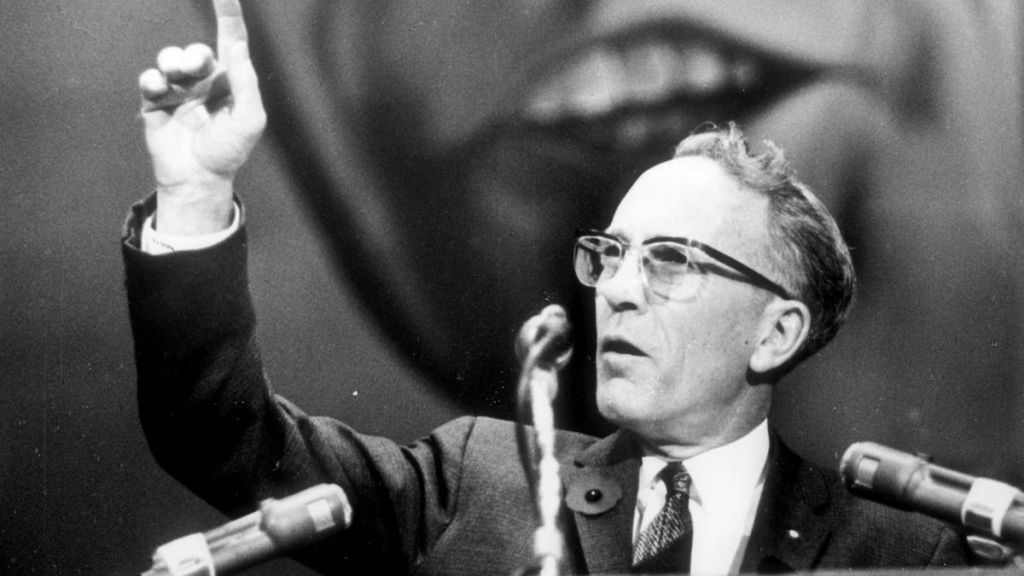
Tommy Douglas, the Greatest Canadian, and the founder Medicare.

As our health care system continues to collapse all around us, it’s worthwhile, I think, to look back at the type of health care that Douglas envisioned. The truth of the matter is, that it is quite a bit different than what we have today. And I think, is not at all what Douglas would want.

According to “The Canadian Encyclopedia“, Douglas’ views on health care were shaped by a number of events in his early life.

As a six year old, Douglas fell and cut his knee. Unfortunately, he developed osteomyelitis ( a bone infection) and the consequences hampered him for his entire life. He had numerous operations and at one point doctors in Winnipeg considered amputating his leg. Fortunately, a well know orthopaedic surgeon (Dr. R. J. Smith) offered to operate for free, so long as Douglas allowed medical students to watch. This saved Douglas’ leg, and helped convince him that health care should be readily accessible to everyone.

Later, as a young man, he moved to Weyburn Saskatchewan, and was dismayed by the complete lack of medical care. He buried a 14 year old girl who died of a ruptured appendix because she couldn’t get medical care. He also vividly told of burying two young family men in their 30s, who simply couldn’t afford to get medical care.

These experiences helped to shape his belief that we could do better as a country. I would suggest that all Canadian should share the belief that one should not have to choose between going bankrupt (or dying) and getting basic medical care.

As premier of Saskatchewan, he implemented the Saskatchewan Hospital Services Plan covering the needs of patients admitted to hospital. In 1961, he implemented the Saskatchewan Medical Care Insurance Act, that provided medical insurance for all residents of Saskatchewan. This of course eventually led to other provinces and the Federal Government adopting similar programs.

The wording is important, and I think speaks to what Douglas was trying to achieve, and frankly, where I believe we need to go back to. The plan was “Insurance”. With all the benefits, AND RESPONSIBILITIES that go along with insurance.

Here’s the thing. In Canada, ever since the Canada Health Act, we have really deviated far from what Douglas really envisioned. He never ever wanted a system where you could go to any health care provider and get assessed without any responsibility on your part. Indeed, he spoke to that quite eloquently in the Saskatchewan Legislature on October 13, 1961:

“I want to say that I think there is a value in having every family and every individual make some individual contribution. I think it has psychological value. I think it keeps the public aware of the cost and gives the people a sense of personal responsibility. I would say to the members of this House that even if we could finance the plan without a per capita tax, I personally would strongly advise against it. I would like to see the per capita tax so low that it is merely a nominal tax, but I think there is a psychological value in people paying something for their cards. It is something which they have bought; it entitles them to certain services. We should have the constant realization that if those services are abused and costs get out of hand, then of course the cost of the medical care is bound to go up.”

Douglas intuitively grasped that if people perceive something as “free” they will start to lose their sense of using it responsibly. That’s why the initial Medical Insurance Act was just that. A form of insurance funded by the taxpayer, and like all forms of insurance, there was a deductible and reasonable limitations.

People were able to now access health care, for a small fee that allowed them to recognize that they too had to take some responsibility for how they used the system. They also had to realize that not everything was covered. Basic health care yes. Options like wanting, say, a private room instead of a ward bed in hospital – well that would be an extra.

There are many problems with the Canada Health Act. But the most fundamental is that it is based on the premise that you can endlessly get something (in this case health care) for nothing. Gutless politicians (from all parties) continue to promote this mantra in never ending attempts to woo votes as opposed to, you know, actually telling the people the truth. Namely, that people should take some responsibility for how they use the health care system.

By continuing to perpetuate the the lack of accountability, our cowardly politicians have created a culture of entitlement instead of a culture of empowerment. Many (not all) people believe that they should be able to get all manner of testing because it’s “free”. I’ve been blessed to have a very pragmatic practice in general, but even I have had to tell people that I will not be ordering the serum rhubarb levels their naturopath wanted because it would be “free” if I ordered it instead of them, or the full body MRI that some “wellness consultant” asked for.

It’s time to bring some patient accountability back to health care. And the first step in that would be to go back to the model that Tommy Douglas had proposed all along.

Dear OMA Board Member, About That Mandate for Negotiations

Dear OMA Board Member,

I read, with interest Ontario Medical Association (OMA) Board Chair Dr. Cathy Faulds update last Friday. There’s the usual information in there about the goings on at the OMA (which sadly not enough members pay attention to, though they should). Critically for most members however, was this comment by Dr. Faulds:

“The board will hold a special meeting at the end of September to finalize the negotiations mandate for use by the Negotiations Task Force (NTF)..”

This is a big step in the negotiations process and to truly understand that, members need to understand what a “mandate” is. Allow me to briefly expand on what Dr. Faulds wrote. The short version is that a mandate is the minimum offer the NTF can accept from the government. If the government offers an increase that is equal to or exceeds the mandate, then the NTF will automatically accept that offer on behalf of the Board.

The corollary to that, which some Board members did not understand when I was on the Board, is that if the mandate is met, and the NTF accepts – then it will automatically mean that you as a Board have to accept the offer as well. As per Board rules, you will then have to endorse the government offer to the membership. You can’t very well tell the NTF “you must achieve XYZ”, and if they do achieve XYZ, turn around and say it’s not enough.

Therefore, it is incumbent on you as a Board, to make sure the mandate is sufficient for the membership as a whole, given the times we live in, and the environment around us.

To that end, without spilling specific secrets, I will state that there was quite a lot of discussion about what an acceptable mandate was during my time on the Board. There were some Board Members who wanted to be “reasonable” and some who wanted to take a hard line and keep the mandate high.

I would, respectfully, point out that for the most part, mandates are never met. Usually the NTF comes back to the Board with “we tried – but this is the best we could get” and presents that to the Board. To be clear, I’m referring to all labour negotiations in general, not just physician ones. Negotiations Legal Counsel told us this last time, just ask them. Whatever you (or any Board) sets as the initial mandate, there is a strong chance the NTF will come back to you later and ask you to lower that mandate.

You will need to keep that in mind when setting your mandate.

To that end, I would encourage you to recognize that the time really has never been better to set the bar extremely high for the NTF mandate. It’s not just that physicians are considering leaving the profession. It’s not just that health care is collapsing all around us. It’s not just the ongoing problems with not just recruiting, but retaining physicians. You already know about all of those issues in excruciating detail.

No, the reality is that we now also have some significant competition for physicians within Canada from other provinces. And I mean strongly significant.

Not sure how many of you have seen this summary form the recently approved Physicians Services Agreement (PSA) in Nova Scotia. On the surface there would appear to be a fairly minimal 10% raise over four years. A deep dive however shows significant add ons like improved parental benefits, funding for overhead, funding to hire allied health care professionals, funding for admin work, enhanced FTE and income stabilization for specialists and so on. That plus a retirement fund!

Similarly, in Manitoba, their recent agreement was widely hailed as a landmark and a game changer. I spoke to a friend of mine from Manitoba who confirmed that it too contains things like a retention bonus ($21,000 and higher for those in rural communities), funding for admin time, funding for new models of care, additional funding for those patients who are older and an equity lens applied to fees. In short, the increase is widely viewed to be in the double digits percentage wise per year.

Look, I know the NTF knows all the stuff I’m pointing out (but others who read my open letter may not). I also would acknowledge that Dr. Mizdrak is a fine chair for the NTF and is (in a very good way and said with total admiration on my part) a real pitbull on behalf of the profession. I also have full confidence that the NTF did it’s due diligence in reviewing the many asks by the leaders of all the specialties.

But at the end of the day, it is up to you, dear Board Member to set the minimum acceptable deal (mandate) and it is up to you dear Board Member to ensure that Ontario remains a competitive place to attract physicians.

To that end, you must ensure that if there is a negotiated agreement, it must at least equal the increase in Manitoba or Nova Scotia (whichever is higher). Anything less would, quite frankly, be rightly viewed as the Board selling the profession out. (If we wind up going to arbitration, that’s a different story – but at least we will have gone there because the Board refused to take a sub optimal deal).

All of which is a long way of saying that since it is quite likely that an initial mandate may not be met, it is incumbent on the Board to set a mandate for the NTF that is HIGHER than what was achieved in Manitoba/Nova Scotia. This will allow for the usual process of the NTF having to come back and say what parts can be achieved and what can’t, and allow some wiggle room.

If you set the bar lower, well, frankly, I have to wonder how you can justify saying that you are advocating for the Doctors of Ontario.

Yours truly,

An Old Country Doctor.

Dear Premier Ford, You Know You’re a Conservative, Right?

Dear Premier Ford,

I’m not exactly your harshest critic. I actually support some (not all) of what what you’ve done in health care. Moving procedures from hospitals to outpatient clinics, building new hospitals, enhanced funding for paediatric mental health, are good steps. I hope there will be more commendable steps in the future.

Ontario Premier Doug Ford makes a health care spending announcement

However, I would be remiss if I didn’t point out that the health care system is going to be under a lot of fiscal pressure in the next couple of years. The remuneration that taxpayers pay for front line health care workers is about to increase drastically.

You will note, I hope, that I said “taxpayers” pay. I, like you in the past, try to avoid saying “government money”. The money to pay for health care and other services comes from the pockets of the little guy as a certain politician once put it. Calling it “government money” is just a way to deflect the public from the truth.

At any rate, you are no doubt aware that the nurses in Ontario got a well deserved 11 % arbitration award. You are probably aware that negotiations for a Physicians Services Agreement in Ontario are about to begin. Given that Manitoba just negotiated a record overall funding agreement with their doctors, and Nova Scotia doctors got a significant increase, you will not be able to hold the line against physicians getting an increase in Ontario.

Which of course means that many more health care workers will want an increase too. In short, there is going to be a lot of fiscal pressure on the taxpayer in the near future.

With that in mind, I will confess that my biggest disappointment in your management of health care is that I can’t honestly see that your government has reigned in the bureaucratic bloat that has so hampered the ability of front line physicians (and other health care workers) to look after patients properly.

Bureaucratic bloat is common in all government agencies. I greatly admire politicians who’ve made comments about needing to “end the gravy train” that provides jobs for bureaucrats and a myriad of consultants at the Provincial Government. Perhaps it’s because I live it daily, but no where does this gravy train seem to be so prevalent as health care.

Let’s look at digital health in Ontario for example. You have Ontario MD, which is an arms length agency that claims to be “the only truly provincial digital health network in Canada”, whatever that means. When I was on the OMA Board, OntarioMD was funded by taxpayers around $18 million a year.

But wait, you also have eHealth Ontario, that claims to be “creating a secure electronic health record information system so that all your medical information can be safely shared and accessed by your health care providers“. If I can decipher their audit statements correctly, they get a further $234 million dollars in revenue.

But that’s not all. The Ministry of Health has not one but TWO separate departments that appear to deal with health IT issues. Their organizational chart clearly shows a bureaucrat in charge of Health Services for an Information and IT cluster. She has her own team of well paid bureaucrats. Yet there is another bureaucrat in charge of Digital and Analytics strategy all with his own team of well paid bureaucrats. The Digital Health Branch of the Ministry of Health had a budget of almost $324 million in 2021/22.

And this is where the waste comes in. You have three agencies (one with two departments) to deal with one field, all reporting separately, none of whom necessarily agree with the other on what to do next. I saw this a lot at government when I was with the OMA. So progress was significantly impaired in digital health because not only was there not one vision amongst the agencies, but because every single issue went back and forth between the three agencies to try to get alignment (to cover the asses of the Sunshine List bureaucrats in case something went wrong). As a result, we are far behind every developed country (except the United States) when it comes to digital health.

I remember a politician who said:

What drives me crazy is when you have a supervisor in government, and they report into 12 other supervisors. That’s unacceptable.

That’s exactly what happens with the digital health care strategy in Ontario.

But moreover, the same thing happens in every single branch of the health care system. I mean seriously, if you already have a Clinical Care and Delivery Branch of the Ministry (see organizational chart) why do you need a separate arms length agency like Cancer Care Ontario? Or Ontario Drug Benefit? Or a myriad of others? They should be rolled up into the Ministry. There are many more examples but you get the point I hope.

If you were to simply stop funding OntarioMD (which in my opinion is no longer useful) and the scandal plagued, eHealth Ontario (which completely failed in its mission anyway), that would represent a savings of $250 million. At $100,000 each, that could pay for 2,500 front line nurses. Clearly nurses who provide front line care are more needed than bureaucrats who go around in circles.

The bureaucrats will no doubt fight you if you tried to do this. They will produce reams of power points and glossy manuals (all on the taxpayers dime of course) saying their work is important. But seriously, what would you expect from those who are accustomed to the gravy train?

Conservatives are supposed to be about reducing government waste, decreasing bureaucracy and efficient delivery of services. These are age old principles that, to be honest, I have yet to see from you as Premier.

If you don’t want to heed my advice, might I suggest that you instead take to heart the advice of the politician I mentioned above who wanted to end the gravy train and reduce the reporting to 12 other supervisors nonsense. That politician? A guy by the name of Doug Ford.

Respectfully submitted,

An Old Country Doctor.

#Docxit on the Rise, Means More Trouble for Our Health System

Acknowledgement: I want to thank my friend Dr. Graham Slaughter for coming up with the term “Docxit”. Graham is not only a brilliant internist, but is incredibly talented at wordplay and music. Plus, he has really thick, lustrous wavy hair!

A bunch of stuff has come to my attention recently in my social life and on my social media feeds. I’m saddened by all of these and even more saddened by what this means for the residents of Canada.

Item 1: a friend of mine in her early 40s confided she is going to give up her family practice. She loves her patients, but the admin burden and the poor remuneration make it no longer feasible to do this work.

Item 2: two more friends of mine, also in their 40s, are actively making plans to leave medicine altogether. One of them told me she knew four family physicians (all in their 40s) who left this year alone, and two others in their 30s who have moved out of country.

Item 3: I came across a social media post from a friend of mine from my days in OMA leadership announcing he was now a real estate agent. Amongst the people congratulating him on passing his real estate exams were other physicians also saying they were look at ways of getting out of medicine.

Item 4: The family health organization I’m part of in the Collingwood area has gone from 52 family physicians to 47 as some have retired without finding a replacement, despite trying.

Provincially of course, there are many more such stories. Three family doctors in the Ottawa area left their practices earlier this year. Twenty per cent of family doctors in Toronto are planning on closing their practices in the next five years. The list goes on.

It’s not just Ontario. British Columbia is facing a “dire picture” when it comes to family physicians. Doctors Manitoba, through their excellent (now past) president Dr. Candace Bradshaw, pointed out the need for more doctors on more than one occasion. I could probably find articles from every province highlighting issues with recruiting and retaining physicians, but you get the point.

Doctors, it seems, are looking at leaving the profession (for either retirement or other jobs) in alarmingly high numbers. This phenomenon, dubbed Docxit by Dr. Slaughter, is happening at a time when our health system can arguably least afford it (if it ever really could).

This is particularly a concern as our younger physicians seem to be more likely to quit. A report by Statistics Canada suggested that up to 47% of physicians with less that 5 years experience are intending to leave or change jobs in the next three years. To be clear, they are not intending to retire, just do something other than what they’ve trained for.

From Statistics Canada

This phenomenon is not just present in Canada. The American Medical Association is concerned about “Medicine’s great resignation” as 1 in 5 physicians in the U.S. are also planning an exit in the next two years.

The situation in Europe would appear to be even more dire. The Politico article I linked to states that seven million people in France do not have a family doctor, with more family doctors retiring than setting up a practice. There is a shortage of two million health care workers in Europe. Brexit has badly worsened the shortage of doctors in the United Kingdom. Spain is running out of doctors. And so on.

Once again, those leaving appear to be over represented by younger physicians. It’s so bad that European Junior Doctors (an association of younger doctors in continental Europe) issued a press release warning the health care system there was going to collapse.

What’s going on then? Why are so many doctors leaving? I mean, despite the few (but loud) vociferous miscreants on social media, being a physician is still the most respected profession in the world (at 83% we’re tied with farmers and scientists). Studies show that Canadians trust their doctors to make the right choice for them and are afforded a measure of leeway that politicians and bureaucrats must surely be envious of. And you know that stereotype about first generation South Asian immigrants always wanting their kids to grow up to be doctors because of their status in society – it’s true (trust me, I and many of my friends lived it).

But the reality is that over the past ten years, practicing medicine has devolved to where it is no longer about caring for patients (which is what all good doctors want to do). In Canada, it’s been about fighting bureaucracy. With doctors now spending up to 19 hours a week doing paperwork (that’s a half a work week for most people) or fighting nameless, pointy headed, basement cellar cubicle dwelling bureaucrats to get them to actually pay for surgery that a patient needs, medicine is now more about who can do paperwork better than who can promote health care better.

In the United States, the rise of corporate entities eating up private medical practices has fuelled an explosion of a different kind of paper work, all with its own stresses. One study suggested that each physician spends almost $83,000 U.S. a year interacting with insurance companies.

Add to that the ludicrous number of options and waivers and liabilities and I sometimes think it’s easier to understand Einstein’s Theory of Relativity than it would be to understand U. S. Health Care. Dr. Glaucomflecken does an excellent job of explaining the frustration here:

I don’t know what the reasons for #Docxit are in Europe, but I imagine they are similar. The over bureaucratization of medicine is taking its toll everywhere. As was stated in the Politico article:

“At its core, it’s really that there is the perception that potentially medicine is no longer an attractive career choice, a choice for people to stay in for a whole career. And this will really endanger the sustainability of health care systems in future,” – Sarada Das, secretary-general for the Standing Committee of European Doctors (CPME)

There are so many crises in our health care system right now, it’s honestly hard to keep track. But two things are for certain. First, we won’t be able to fix health care without retaining doctors. Second, as more doctors opt for Docxit, we would appear to be doing a lousy job at retention.

Dear CFPC Board, Provide Business Training to Family Physician Residents

Dear Board of the College of Family Physicians of Canada (CFPC),

There’s a whole lot of talk about the crisis in family medicine. Even the College of Physicians and Surgeons of Ontario felt compelled to do a cover story on this issue. I’m just a (not very) humble ordinary member of the CFPC, so I don’t need point out the ramifications to the health system to such learned members as yourselves.

I fully respect that it will take a multi-lateral approach to fix this. However, the impression one gets is that the CFPC is focusing on extending the family medicine residency to three years, from the current two.  This expansion has even been presented as a possible solution to recruitment woes.

Nancy Fowler, executive director of the CFPC, states that the current program is “way too compressed” to deal with increasing complexity of health needs in Canada, changing technologies, and greater awareness of the health impacts of racism. In the same article, she also notes that residents have told her they would like more opportunities in different kinds of practices and settings (basically that they want the extra year).

I think these arguments are weak. The most learning I ever got was in my first year of practice. There is simply no substitute for being out on your own.  Join a supportive group like I did, and you will be fine.

I do respect that the current training program may not be adequate. I’ve taught many residents myself over the past 25+ years. The amount of useless “clinic day backs” and forums, research days and “behavioural science modules” that the residents are asked to do has increased to the point where I wonder when the residents actually, you know, see a patient in real life. No wonder they may feel unprepared for having their own practice. 

University of Toronto and McMaster – I’m looking at you.

But the solution to that is, you know, fix the residency program. Not extend it with a year of the doing exactly the same nonsense that made residents feel inadequate to practice comprehensive family medicine to begin with. All that would mean is that after three years the residents will still feel unprepared.

Also, have you considered that if you do increase the residency by a year, you will have one year where NO family medicine residents graduate into practice? Would you care to explain to everyone how that will help the current shortage of family docs?

Anyway, if you do increase the CFPC residency to three years, would you at least add some practical training for our younger colleagues to the residency? I believe they would benefit from two months of their third year being dedicated to learning about the business of running a practice. How to hire people. Employment standards. Performance appraisals for staff. Negotiating leases. Finding the best prices for supplies. And yes, how to maximize your billings.

All of those above tasks (and more) are absolutely essential to running a comprehensive family practice. Yet NONE of those are taught in medical school or residency. In fact, in many universities, the feeling one gets when one brings up the idea that we should teach something as simple as billing is that you have spoken of that which shall not be spoken of, lest the appearance be created that your desire to practice medicine might even in the smallest part be less than altruistic and rather more about a hedonistic desire to generate a fair income.

The horror, the horror!

And yes, McMaster and U of T, I’m looking at you (again).

These are practical business skills all of us absolutely need to run a practice and isn’t the point of residency to, you know, make the residents comfortable running an actual practice in real life? Additionally, the reality is that we now face the existential threat of corporatization in family medicine.

This is how it works.  A corporate clinic, let’s call them  The Haleness Infirmary goes to a young family doc.  They whisper siren like inducements like “Let us do the business of medicine for you”.  “We do all the admin work so you can practice the medicine.” “We believe in high quality patient centred health care you can trust” and other alluring catch phrases.  These clinics are almost always owned by some large corporation. Let’s say in this case, a pharmaceutical chain called Buyers Pharmaceutical Bazaar. All to entice the young, business naive family doctor so sign up with their chain.

The Haleness Infirmary could care less about the doctor they hire, or the patients they serve.  What they want is the gold mine of patient data.  It allows them to create a digital profile of the patient to target you with ads to sell products, because, the patient is nothing more than a commodity to them to be exploited. 

It’s absolutely true that there are privacy laws that prevent individuals from collecting your personal information. Funnily enough, those laws don’t apply to software or AI.  Software can figure out a lot about you based on your spending habits (it’s why if you look up say mattresses on a website once, you get ads for mattress stores on your social media feeds for a week).

If you go to Haleness Infirmary, the software would identify you as someone who needs cholesterol pills, and therefore you would see targeted ads for cholesterol lowering products (all sold at a special discount at Buyers Pharmaceutical Bazaar) so you can buy more products (and get extra points if you enrol in their Choicest points program which collects even more of your personal data).  Nice ecosystem.

Don’t believe this is their goal? When I was OMA President, one of the pressing issues for OMA Legal was the fact that doctors who left (or were asked to leave) these fancy corporate owned clinics– suddenly found they no longer had any access to their notes or patients’ charts (“owned by us and only for use by our employees – and you are no longer one”).

The holier than thou types that haughtily profess that they are better than us for not teaching basic business skills of course would be the first to be horrified that patient data was being used for marketing (gasp!) and making money (double gasp!).  The irony that their own belligerent refusal to teach basic business skills drives physicians to these corporate clinics is, of course completely lost on them.  It’s hard to see irony why your head is constantly tilted upwards befitting your lofty altruistic ideals.

Extend the CFPC residency to three years if you must. But for the love of Allah/God/Yahweh/insert deity of your choice, at least give our future colleagues an appropriate education that teaches all aspects of running a comprehensive family practice.  You will be doing them, and patients, a huge service, whether you realize it or not.

What if We Didn’t Lose the Doctors We Trained?

Canada is in the midst of doctor shortage. In particular there are at least 6 million Canadians with out family doctor. The situation is worsening. The most recent Canadian Residency Match for medical students applying to specialties, showed that there were 268 empty spots for family medicine after the first round. This is the highest number of unmatched family medicine positions ever. Medical Students, being really smart people, are viewing family medicine as a dead end specialty and avoiding it like the plague.

If only the boorish loudmouth who predicted we were heading in this direction six years ago and been listened to…..

Governments at both federal and provincial levels are taking steps to try to address this. In British Columbia, they have introduced a capitation based payment model for family physicians (think of it as salary + performance bonuses). Ontario has a model like this that had great success in the early 2000’s. The federal government pledged more spending on health care in the future. Ontario plans the “largest expansion of medical school education in ten years.” And so on.

But what would have things been like if successive governments didn’t drive doctors away from Canada in the first place?

Going back as far as the 1990s, inept governments have, over the years, done their best to make physicians feel unwelcome. The Bob (“I am super elite“) Rae NDP government of 1990-1995 in Ontario implemented the Barer-Stoddart report. This report decided “there were too many doctors” (I kid you not) and cut medical school enrolment by 10%. Three decades later we are still feeling the adverse ramifications created by that move.

Similarly, the disreputable Kathleen Wynne Ontario Liberal government went to war with physicians in the mid 2010s, led by her woefully incompetent Health Minister Eric Hoskins, and his inept sidekick, Deputy Minister Bob Bell. Those geniuses thought it was a good idea to CUT 50 residency positions (training for doctors) and only saw the light during a deathbed confession just in time for the 2018 election. In particular, Hoskins and Bell’s blatant disregard and borderline contempt for family physicians resulted in, as OMA Vice-Chair Audrey Karlinsky put it, 6 years of family medicine graduates not choosing comprehensive family medicine.

Do you think supporting hundreds of those young potential family docs then would have made a difference now when 2.2 Million Ontario residents are without a family doctor?

To prove that idiocy in health care management can occur with parties of all political stripes, the former Alberta Conservative Health Minister, the combustible Tyler Shandro, actually verbally attacked a physician at his home in Alberta, along with, you guessed it, going to war with physicians in his own province. Really helps to retain physicians, no?

In my first ever blog for the Huffington Post (seven years ago!), I pointed out to then Health Minister Eric Hoskins that 30% of my graduating class no longer worked in Ontario due to Bob Rae’s intransigence. I urged Hoskins to change his behaviour or that by the time of the next election, health care would be in a worse crisis and hinted his government would pay the price in the 2018 election. (I wonder if Kathleen Wynne regrets sticking with him as health minister for so long, despite the fact he was obviously not up to the task).

Admittedly, that’s one person’s recollection. Are there any statistics out there that show just how many Canadian trained doctors have left Canada? There are, although they are really hard to come by, and not as up to date as I’d like. Huge shout out to Dr. Mary Fernando for digging these up for me.

In 2000, the OECD published a report on the mobility of health care professionals. On page 50, it indicated that 19% of doctors born in Canada were working in other countries. Given the crisis we see in health care around us right now, do you think it would help if we could have retained those doctors in Canada?

But wait, aren’t we trying get international medical graduates (IMGs) to come to Canada? Ontario health minister Sylvia Jones did direct colleges to come up with a way to speed up the ability to get foreign doctors licensed. But it turns out we have trouble keeping them as well. A study on retention patterns of IMGs in Canada showed that 12% of IMGs were approved to practice in Canada between 2005 and 2011 LEFT Canada by 2015. While IMGs apply, we have trouble retaining them too.

Clearly, governments need to focus on retention of physicians just as much (if not more so) than recruiting new physicians. What can they do?

The federal government can do a couple of things to help. First it can heed the results of a poll taken by the Medical Post magazine (I voted just before closing and these were the results):

Doctors don’t have pensions and benefits mostly due to some weird federal tax laws. Changing these should be easy and offering pensions and benefits would be a strong way to retain physicians. Similarly, reversing the 2017 tax changes that completely threw retirement planning out the window for doctors would be a big help.

Provincial governments should of course, take note of the fact that going to war with doctors always leads to a deterioration in health care for the residents of their province. But since most politicians are incapable of thinking about anything but their own self interest, let me point out three facts.

In 1995, after going to war with doctors, the Bob Rae NDP government was turfed from power in Ontario and the NDP has yet to form a provincial government since. In 2018, after going to war with doctors, the Kathleen Wynne Liberal government was decimated in the Ontario election, even losing official party status, which they have yet to regain. In 2022 after going to war with doctors, Alberta Premier Jason Kenny had to resign as premier because his own party saw the writing on the wall.

The message is clear. Going to war with doctors is bad for health care and bad for political careers. It’s time politicians realized that, and came up with meaningful solutions like pensions to retain the ones we train.

Canada Should Look to Turkiye for Health Information/Data Systems

Disclosure: I have a business relationship with Medicte, a firm that provides high quality medical tourism services for Canadians. They provided me with some information for this blog. If you are on a prohibitively long waiting list for medical or surgical services, and are willing to consider travelling out of country to have treatment, contact Dr. Abdullah Erdogan at: medical.developer@mestassistance.com

I’ve written previously about Health Data Systems and what a poor job Ontario (and indeed all of Canada) does at using information technology (IT) to help with health care. Let’s look at country that does things the right way, Turkiye (formerly Turkey). I appreciate this choice may come as a surprise to many, but Turkiye has a very modern, highly efficient health care system, and had to go through their own period of transformation from a fragmented system to a more integrated one.

The long version of how Turkiye evolved their health systems can be found here. The short version is that in 2003, the Turkish government came up with the political will to introduce the Health Transformation Program. Over the next ten years this act, and unyielding political will, transformed the Turkish health care into a fully integrated system. In many ways, it’s a model for what Canada needs to do.

I had the honour of being invited to do a talk for the Canadian Turkish Business Council on the Canadian health system (along with my smarter and more esteemed colleagues Drs. Nadia Alam and Silvy Mathew). In preparation, I studied up on how Turkiye handles health data (with the help of Medicte). I cannot tell you how impressed I was with their system.

In Turkiye, the federal government has mandated that all hospitals in Turkiye use the Hospital Information Management System (HIMS). Now to be clear, different hospitals in Turkiye still use some different modules of software, but they are all compatible with HIMS. The data for all citizens of Turkiye is then backed up securely.

Then, every citizen of Turkiye is offered a patient portal called e-Nabiz.

Official logo of Turkiye’s patient portal.

What does this portal allow patients in Turkiye to do? According to Medicte:

“When people enter their E-Nabız profile, they can make appointments at all public hospitals and access the records of these appointments. They can review all of their examination, diagnosis and treatment data in the health facilities they visit and access the details of all the tests performed during this process. This includes all data related to the process, such as all laboratory tests and radiology images with their reports, prescriptions, diagnoses and drug usage details.” 

Further more, the app can be used to allow other health care providers access to patients health information (with consent). Let’s say a resident of Istanbul happens to travel to Antalya (a truly lovely tourist destination about an 8 hour drive away). If that person gets ill, they can use the E-Nabiz portal to allow doctors in Antalya to see their previous health information to help guide their care. Not only that, information about their visit in Antalya will automatically be available to their family doctor in Istanbul, including lab work, diagnosis, and prescriptions. I can’t even get health information on patients of mine that go to a walk in clinic in Barrie, and that’s only 30 minutes away from my office.

Not only does this system allow for much better communication between health care professionals of all kinds (physicians, nurses, pharmacists, home care and so on), but having knowledge of a patient’s previous health history significantly reduces duplication of tests. And leads to more optimal outcomes.

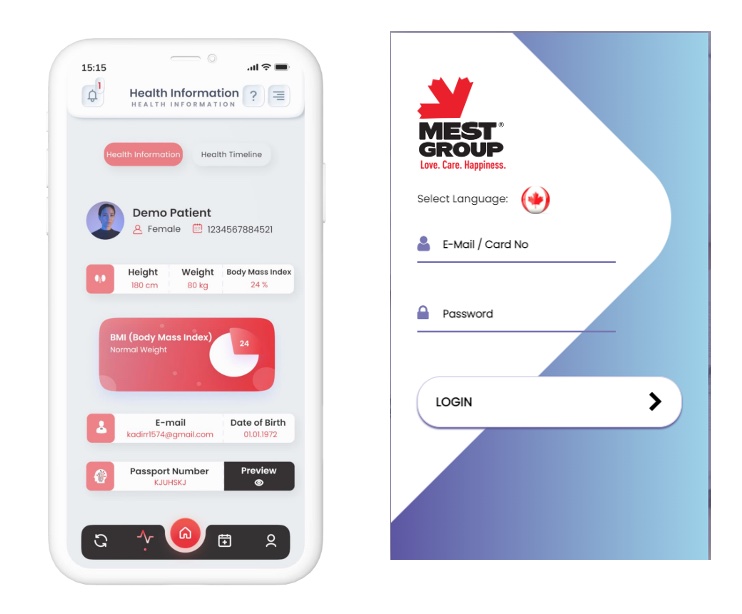
For people who are not citizens of Turkiye, but go there for medical tourism (Turkiye is one of the top medical tourist destinations in the world), their travel companies can offer them similar access to their health care records. For example, Medicte will soon offer the MestCard app via its parent company MestGroup.

Screenshots of the MestCard Apps

Essentially, a patient of mine, who choses not to wait the 13 months that they currently have to wait for a hip replacement in my area, could go to Turkiye next month, get their hip replaced AND have much better access to all their health records than a patient of mine who got that done in Canada. (And yes, all of these apps/software/portals are compliant with recent security standards).

But that’s not all, this tight integration of IT allows for other benefits. For example, Health Systems Consultant Matthew Lister, who spoke at the same event, informed how this allowed hospitals across Turkiye to manage their supply issues. If one hospital was short on something (tubing, a drug, IV fluid or so on), it can immediately check the inventory of nearby hospitals and request a transfer. No phone calls, no double checking. It’s all online, backed up, and available for hospital management to see. He also emphasized that this has been the case in Turkiye since at least 2011!

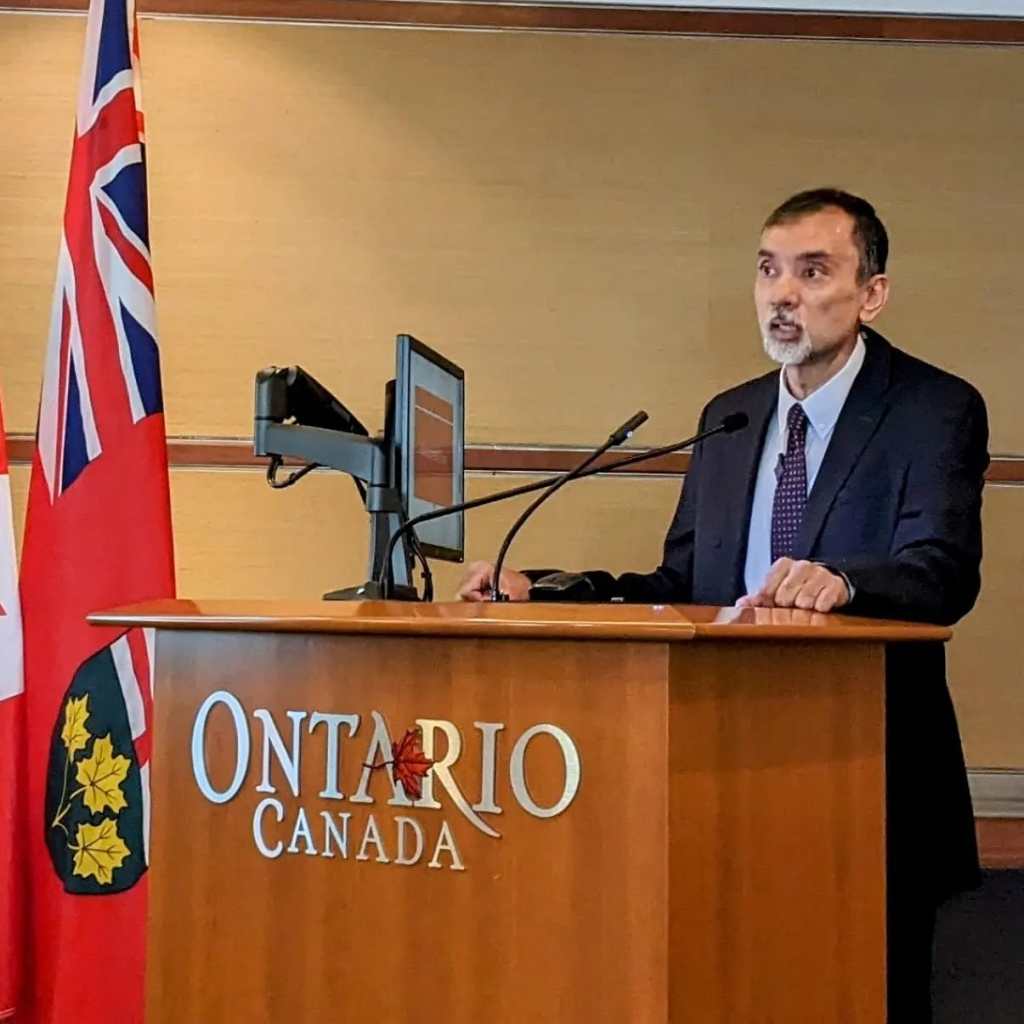
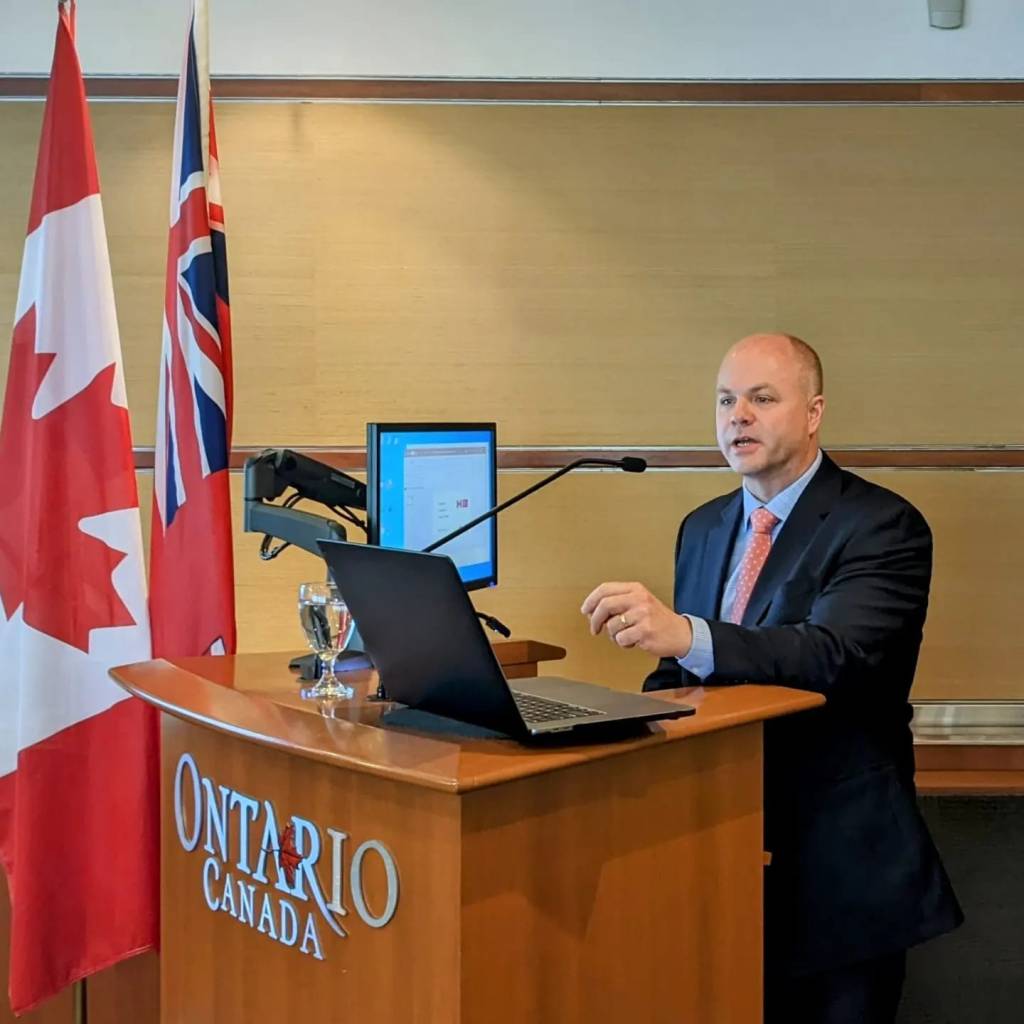
Matthew Lister speaking at the Canadian Turkish Business Council event.

In Canada, given the disastrous current state of our health care system, there have been calls for system transformation from multiple sources. Whether from what are viewed as conservative organizations like the Fraser Institute and Postmedia News, or progressive organizations like Canadian Doctors for Medicare and the Torstar Media group, everyone from all sides of the political spectrum agrees that health care is need of a fix.

Here’s thought. Rather than start from scratch, let’s look at countries like Turkiye, that have taken their own fragmented health care systems, unified them and leapfrogged Canada to develop a much more efficient health system. Then just do what they did.

The benefits to the citizens of Canada would be enormous.

Post Script: While it’s true that Turkiye has a modern, high functioning health system, even such a system can be overwhelmed by a disaster like the recent Earthquake that has claimed at least 50,000 lives. To help the victims of the earthquake in both Turkiye and Syria, I encourage you to donate to the IDRF Earthquake Relief Fund.

Federal-Provincial Health Care Deal Fails Canadians

This blog has been updated to reflect that the fact that the offer from the federal government has been accepted by the provinces.

Lots of chatter about what is an agreed upon funding formula for Health Care between the provinces and the federal government. Some astronomical dollars are being thrown around and called investments in health care. But at the end of the day, will this deal mean better health care for Canadians? The sad answer, is likely no.

One of the advantages(?) of being old is that you’ve lived through lots of things, and can see the past repeating itself. Case in point, in 2004 then Prime Minister Paul Martin introduced a health care “accord” that was designed to “fix health care for a generation“. Essentially the federal government ponied up an eye watering amount of money then, and the provinces were to implement targeted programs that would:

  • Reduce wait times
  • reform Primary Care
  • Develop a National Home Care program
  • Provide a National Prescription Drug Program (by 2006!)

Now Primary Care reform did happen in Ontario, with the development of capitation based payments to family physicians. Think of it as a salary with performance bonuses and you get the gist. There was also the implementation of some Family Health Teams. I’m unaware if any of these were implemented in other Provinces. I do note with interest that British Columbia is only now getting around to reforming primary care with their own new payment model for family physicians.

But both of these programs in Ontario were summarily slashed by then Health Minister Eric Hoskins and his servile deputy Health Minister Dr. Bob Bell in 2015. Indeed their unilateral freezing of the capitation model significantly damaged primary care in Ontario, and the effects of their folly are still being badly felt today by the 2 million residents of Ontario without a family doctor.

OMA Board Vice Chair Audrey Karlinsky put it best on Twitter.

Wait times for surgical procedures however, continued to rise, and I have no idea whatever happened to the National Home Care program.

For those of you paying close attention, the same Eric Hoskins who stopped Primary Care reform in Ontario, went on chair a federal advisory council with the goal of creating a National Prescription Drug Program……….in 2018. Which hasn’t been implemented yet. I suppose being 17 years overdue is not bad by government standards.

By the way, this whole process is basically recycling a failed politician to recycle a failed government promise. And politicians seriously wonder why average Canadians like me are so cynical??

So now, 19 years later, Canadians are being told that the provinces have accepted a federal government proposal to put an eye watering $196 billion into health care, according to Prime Minister Trudeau. But wait they were committed to $150 billion anyway so it’s really only $46 billion more, but wait, when you take out the planned budgeted increases it’s only $21 billion more. Whatever.

In return, for however much money it really is, Trudeau promises there will be “tailored bilateral agreements to address“:

  • Family Health Services
  • Health workers and the backlog of health care
  • Mental health and substance abuse
  • Modernized health care system

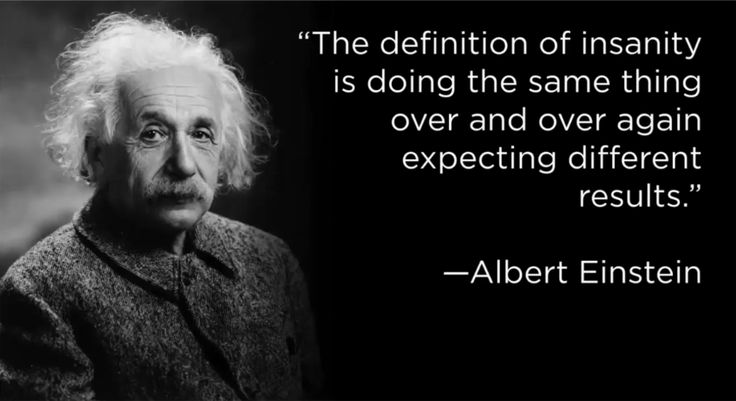
Our politicians need to study Albert Einstein a bit more.

Here’s the sad truth about our health care system that no politician, of any political stripe seems to be willing to admit. The system is dying and in need of radical surgery. It needs a bold, transformative vision that will completely change the way we deliver health care and will leverage technology appropriately. Anything less is simply more of the same, and will not stave off the inevitable collapse of the system.

How then do we achieve this transformation that is essential to the well being of Canadians? I will go into some further thoughts about this in future blogs, but first I would implore our political leaders to stop listening to old voices who have been advising for decades (if their advice had been good we wouldn’t be in this mess). It’s time to seek out some newer voices who have bright ideas on how to restructure health care delivery in Canada.

It’s also time to wrest control of health care data management from the current group of bureaucrats in charge of it. We can’t transform health care in Canada without a robust health care IT infrastructure and the current group simply is not getting it done.

As mentioned, I will put some more though into how, in my opinion, health care can be transformed in the future. But for now, just know that whatever the numbers or promises being tossed around, the blunt reality is that it all amounts to trying to spend you way out of trouble.

When has that ever worked out well?

RePost – Hoskins and Bell Need to Support Family Medicine

The following is a reprint of an article that I wrote for the Huffington Post on June 5, 2017. Re-posting here so that we can see how the seeds of declining family physicians was planted by Drs. Eric Hoskins and Bob Bell, and also so that I can refer to it in the future if needed.

For the past 23 years, it’s been my pleasure to be a preceptor with the Rural Ontario Medical Program based out of Collingwood. As a preceptor, I have had the honour of supervising a wide variety of Medical Trainees, from first year Medical Students, all the way up to those in their last year of Residency. 

I often find I learn as much from them as they learn from me (it’s good to be questioned by students about why you do things the way you do). I clearly have some experience on my side, and they have more recent book knowledge. It’s a great combination for patient care.

Unfortunately, I can see that we are once again heading for the same situation as the late 1990s/early 2000s, when many medical trainees stopped going into comprehensive family medicine. The reasons then were due to increased workload, better opportunities in other specialties and an extremely poor relationship with the government of the day. 

At one point, only about 25% of graduates from medical school applied to Family Medicine Residencies. To suggest that there was a crisis in family medicine would be dramatically understating the issue.

However, the Conservative government of Mike Harris finally realized you need to co-operate with doctors if you want to improve patient care. In 2000, Health Minister Elizabeth Witmer rolled out something called Primary Care Reform (PCR) in co-operation with the Ontario Medical Association (OMA). This, over the next few years, led to a revitalization of Family Medicine, and now, close to 40% of medical school graduates are once again choosing Family Medicine as their specialty. 

While not the sole part of the PCR, a major component was a new model of paying physicians known as capitation. Capitation is essentially salary plus performance bonuses. Family Physicians would be paid a certain monthly rate to look after their patients, regardless of how often they saw them. They get bonuses based on how many complex (eg. Diabetic) medical cases they take on. This was in stark contrast to the old system known as Fee For Service (FFS) where physicians were essentially paid piecemeal (only got paid when they saw a patient).

The capitation based models were extremely popular with both Family Physicians and government. For Family Physicians, it allowed them to spend the time needed with patients during just one visit, instead of requiring multiple visits. For the government, it provided a predictable funding envelope. I appreciate this will come as a surprise to a couple of the frequent critics of my articles (in the comments), who have long implied that I was critical of Health Minister “Unilateral Eric” Hoskins because I was allegedly supporting the FFS model, but I actually have been in a capitated model since 2004.

Drs. Bob Bell (left) and Eric Hoskins

Did PCR work? In 2001, the population of Ontario was 11.4 million, and almost 3 million people didn’t have a family doctor. In 2016, the population of Ontario was 13.9 million, and only 800,000 did not have a family doctor. So over 4.5 MILLION people got a family doctor.

Then along came the hapless “Unilateral Eric”, and his widely disliked sidekick, Deputy Minister Bob Bell. “Unilateral Eric” likes to claim that he himself is family doctor. The reality is that he has NEVER provided the cradle to grave care that comprehensive family doctors in Ontario do on an ongoing basis. He does work a day a month at a walk in clinic, and I understand he donates that income to charity – which is good of him, but it’s hardly the same as what comprehensive family doctors do. 

Bob Bell for his part, likes to boast about how he used to be a family doctor back in the 1970s, but he seems to be unable to grasp that family medicine might have evolved since then.

Acting with the same level of competence as Tweedle Dee and Tweedle Dum, the infelicitous duo of Hoskins and Bell unilaterally cut the number of family physicians who could apply to capitated funding models. Again, this is likely a surprise to a couple of the critics of my columns, who have long been demanding that physicians go on salary. Surprise, it was Hoskins and Bell who unilaterally stopped the salary style models, not the OMA. They also unilaterally cut some of the performance bonuses (for things like diabetic care, medical education and so on).

The result was clearly predictable to anyone who understands Family Medicine in the 2010s. Over the past three years newer graduates from Family Medicine programs are avoiding comprehensive care. Many of my trainees are choosing to work solely in areas like emergency, anaesthesia, sports medicine or others. And while there is a need for doctors in all fields, the reality is that it’s comprehensive Family Medicine that leads to health system stability

It’s comprehensive Family Medicine that reduces hospitalizations. It’s comprehensive Family Medicine that when supported properly, reduces costs of health care.

In response to this, the dolorous duo of Hoskins and Bell unleashed something called the New Graduate Entry Program (NGEP) to provide new family medicine graduates with what they claimed was a capitated funding model. Alas they attached so many conditions including a morass of bureaucratic oversight that I understand only two new graduates have taken them up on this offer.

Hoskins and Bell have left a legacy of a crumbling health care system with their arroganceand unilateral cuts

However, they still have the ability, and opportunity to begin to correct one of their most egregious mistakes. A new crop of Family Medicine Residents will graduate on July 1. Hoskins and Bell can unilaterally reverse the cuts to the capitated models and performance bonuses. No one from the OMA will complain.

It’s time for them to recognize the important role of comprehensive Family Physicians, and support that with actions, not just words.

What Backlogged Health Care Looks Like and How to Fix It.

Dr. Silvy Mathew guest blogs for me today. She is hands down one of the smartest people I know. She writes about her experience in visiting the ER to help a family member. Dr. Mathew has been a strong advocate for health system reform and it is a loss for all Ontario residents that her warnings about the impending crisis in health care were not heeded by Health Ministers dating back to Eric Hoskins.

A few days ago I was in the Emergency Room (ER) with a family member. The ER was slammed. The paramedics were lovely and about four teams that I could see were stuck in waiting room, waiting for their patients to be triaged. We were on a stretcher by the front sliding doors. Almost outside.

We were there for urgent imaging, and possibly consultation. We tried to do this in the outpatient setting, but lack of access to both urgent images and consults for urgent care makes that impossible. So we go off to ER by EMS (needed for transport).

I’m fortunate. I am able to fill in gaps. I can advise triage what issue is, as they can’t do physical exam in the waiting room in front of what seems like hundreds of people. I can provide medical information on relevant questions. I can monitor the patient status for changes.

I did remind staff after several hours to check blood sugar as my relative is an insulin dependent diabetic, now off food/fluids. I did remind about necessary medications to be given. Of course, if I wasn’t there, they may have reviewed the chart closer but they were clearly slammed and trying to manage.

And we weren’t in distress. My family member was unable to advocate for themselves. We got imaging about six hours in, and I watched the imaging staff, working with 50% less nursing staff, literally just running in and out moving people. Doing their best.

We had excellent care from people busting their butts. But so many potential falls through the cracks and errors. Twelve hours later, we got home, luckily without any new issues from ER. And we had a plan. And we had a specialist who called first thing in the a.m. to ensure we have close follow-up.

The system in Ontario has relied for decades on individuals and work-arounds making things work (like above) when the system design is archaic. Successive Ontario governments have refused to participate in strategic multi-pronged co-design, instead of piecemeal band-aids.

I have worked for 15 yrs in Ontario health care. I’ve witnessed how far things have fallen and how none of our work arounds previously used are available now after the Covid 19 pandemic, for multiple reasons. I’ve participated with the Ontario Medical Association and sat on bilateral committees with the government to try to advocate for system change.

I’ve witnessed how siloed and unaware most people outside of primary care are. Family Medicine is the canary NOT the Emergency Department. The issues that have caused this system collapse have been occurring since 2012. Many of us, especially Dr. Nadia Alam, tried to be loud and warn.

Last year, in 2021, we gave up. It was obvious to us it was too late. We heard for years from our mid-career colleagues about how they couldn’t do this anymore. How they wouldn’t work in a system that didn’t allow them ANY joy or success while taking more and more from them personally.

Covid-19 just pushed the dial a bit faster. The family doctors who were hanging on from retiring have chosen to live now (not leave, but LIVE). The mid-career family docs are struggling as mentioned above and also choosing to leave family medicine if possible, because nothing is working in it. Obviously, new graduates are terrified.

And so here we are, and the CCFP answer to this is to ADD a third year to residency. Because somehow they think adding more school, asking people to take on more debt, delay starting their lives longer, while having less non-academic preceptor support will somehow help?

What it will do is: add even more fuel to the family medicine crisis and shortage. It’s not gonna teach you how to run a business (last I checked real life experience mattered more). It’s not going to teach how to manage complexity in real life. It WILL drive more people out of family medicine residency.

What we REALLY need is a re design of the health system. You want people to do this job? LET them. You want family doctors to work at the top of their scope? ENABLE them. Support access to resources OUTSIDE of hospital and provide help to coordinate.

Stop advocating for more debt and school CCFP, and advocate for real life mentorship, group practices and shared care. You want Emergency Rooms to not house people? Fund home care and long term care. Fund resource teams to support those in seniors neighborhoods already. Use a community approach.

While we are at it, stop spending all the money on pharmacology. Fund allied health, encourage exercise programs and healthy meals because that’s WAY more useful than the hundreds of thousands of dollars of Botox we spend on contractures AFTER they occur. Keeping people mobile keeps them out of hospital and long term care.

The Canadian media can stop asking if health care has collapsed, anyone working in it knows it has. It will show in a year or two, when the numbers of late-diagnosed cancers, life expectancy and other markers of care get affected. But in real-time we are seeing it now.

If we don’t have some real leadership here and some true innovation, we are in for some truly sad times in the next decade. End.