Dr. Alex Duong: The Challenges Facing an Early-Mid Career Family Physician

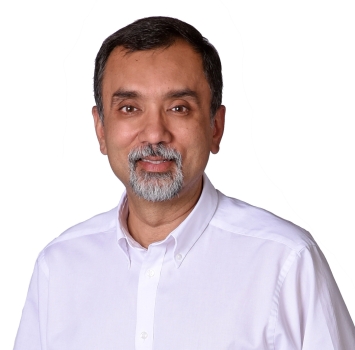
Dr. Alex Duong, a family physician from the Vanier district of Ottawa (which amazingly enough is one of the more underserviced areas of Ontario).

Recently, Maria DiDanieli, the clinical lead for system navigation at the Burlington Family Health Team, published an opinion piece in Healthy Debate that was critical of the decision of Drs. Alam/Mathew and yours truly to recommend that family practice residents bide their time instead of starting up a comprehensive care practice in Ontario. Dr. Duong replies and has kindly allowed me to reproduce his reply here.

I am a full-time community family physician, and I read this article with great disappointment.


I am at the face of our health care system. When patients cannot get a timely breast biopsy or a knee replacement, they come to ask me. I address their frustrations, alleviate their pain, and manage expectations.


I am the backstop when issues are missed during transitions in care and issues that require follow up.


I am the navigator that helps patients, and their families orient themselves to housing resources, mental health and financial resources.


I am the advocate for my patient’s health when they deal with their employer or insurance companies.


I do all these things and more, alongside everything from newborn care to palliative medicine.


I, like the great majority of family physicians, take pride in our work, and in what we contribute to our patients and the community at large. But Banks do not grant loans for a new clinic based on my contributions to Ontario’s healthcare system. My rent payments do not decrease because of the positive impact I make on my patients’ lives. The salaries of our exceptional staff are not funded by the sound of clanging pots and pans.


Today, to outfit a new clinic with the minimum number of physicians for a FHO requires high 6 figures to 1 million dollars, loaned at 6.95% interest. We guarantee our own lease – we are on the hook for ensuring it gets paid for the entire term. We are responsible for hiring and ensuring our staff are paid a living wage. We invest our own time in making sure the clinic runs. For many community family physicians like me, there is no assistance for any of this from any level of government. No money for staff, no incentives for starting up, no support for logistics. We are in a precarious, failing business model with ever growing administrative burdens patching the system equal to a part-time job. We have been trying to expound on this, and frankly have been completely unsuccessful in this.


You realize that “… there does not seem to be much political will to improve this situation at this time.” Yet, you ask family physicians to work harder expecting a different result from the government.


You state that “With these current barriers and shifts, any new practice can feel fragile or vulnerable to imminent obsolescence.” Yet, you expect new graduates to take on a massive financial risk: long term lease, EMR contracts, and double their already tremendous debt in start-up costs.


You lament that “Instead of acting as beacons of wisdom, encouragement and level-headed advice, we see a growing shift toward inciting everyone to walk out!”. Do you apply this standard to the teachers in Quebec who recently concluded a strike? Are they less dedicated to their students? Do you apply this standard to all groups who organize to make their voices heard?


The authors, Drs. Alam, Gandhi and Mathew made it clear that there are many options available to new family doctors. They warn of the current state of specifically locking into comprehensive family medicine, to ensure that new grads do not put themselves in a position where they will be burnt out early in their career. To me, leadership requires honest conversations, not empty promises, or exploiting the ideals of new family doctors. I find it unethical to sell a romantic vision of what it is like to start and maintain a Family Medicine practice in the current environment. It is a recipe for moral injury when those ideals run flat into the economic realities, as I have experienced.

And frankly, to say to those of us, like myself, still practicing longitudinal family medicine we should be working harder, or we are just doing family practice wrong is demoralizing. It is grossly offensive to my early-mid career family medicine colleagues who have burnt out through great moral struggle and guilt. Disillusioned family physicians who leave longitudinal family practice will not return. The greater harm to the public and to patients is not the Star article that speaks truth to the issue, but the issue itself: that family physicians, whose concerns are being gaslit, continue to leave longitudinal practices.

Open Letter to All Family Practice Residents

The following letter was jointly written by the three of us and published in the Toronto Star on February 20, 2024. It is being reproduced below so that we can share the letter on Facebook as we believe it will be of interest to physicians across Canada.

To All Family Medicine Residents, 

We are writing to say congratulations! You are nearly at the end of a decade of hard work, perseverance and sacrifice; ready to start your career and “real life”. You have joined a beautiful and unique specialty. You will be the key to the healthcare system. You will find answers when patients arrive with ambiguous symptoms. Others will tag in and out of a patient’s health journey. You will stay and be an essential part of the beginning, middle and end of every patient’s story. You will save lives. 

Your skill and knowledge are unparalleled, and there is no substitute for your expertise. 

Which is why with heavy hearts, we, the undersigned, recommend that you do not start your own family medicine practice in Ontario. Not right now.  

Family medicine is in crisis. Family doctors in Ontario are unable to provide the care they could and should. We face unprecedented levels of administrative burden, unsustainable business expenses, lack of healthcare resources, lack of social and cultural support for our patients and ourselves and finally, a lack of respect. This has led to widespread burnout and exhaustion.

In short, it is becoming frankly unsafe to run a family practice in Ontario, especially for those just starting.

We are family doctors with decades of experience. We are also physician leaders, past-presidents and board directors of the Ontario Medical Association (OMA), academic faculty, and health policy experts. We understand the situation well. 

Do not sign that contract. Do not sign a lease, hire staff, buy equipment, contract with an EMR or any of the million things that must be done so that you can start a comprehensive care family practice. 

Starting a practice at this time will require you to continue to sacrifice everything else in your life. If you have debt, you may not be able to pay it down, let alone start living the life you and many others have postponed for so long. You will struggle to spend time with your family, buy a home, care for vulnerable loved ones and more. You will continue to work at a non-stop pace, this time with no end in sight.

You will burn out and like many others, leave family medicine for good. This is why millions of Ontarians no longer have a family doctor.

The Ontario Ministry of Health can solve this crisis. 

Governments in Manitoba, Saskatchewan and British Columbia have done so. This past year, they made family medicine a priority – and backed their words with targeted funding toward key programs to support both new and established doctors. It comes as no surprise that they have welcomed hundreds of new family doctors into their communities.

If they can do it, so can Ontario.

What can you do in the meantime? Work in hospitals, hospices, operating rooms and long-term care. Work in obstetrics, anesthesia, as a hospitalist, in emergency or palliative care, oncology, sports medicine etc. Be a locum. Bide your time. 

You are skilled, smart, and adaptable. Your knowledge is extensive, demonstrating an unmatched depth and breadth of training. Use it.

When people leave comprehensive care family medicine, they almost never come back. 

We don’t want that to happen to you. When the government of Ontario recognizes family doctors as the foundation of medical care, negotiates a fair contract and improves health policies to reflect patient needs in 2024… well, when that happens, we will write a different letter and welcome you to the world you were meant to be in.

 We hope by then it is not too late.

Sincerely,

Dr. Nadia Alam, comprehensive care family physician and anesthetist, past-president of the OMA 

Dr. Sohail Gandhi, comprehensive care family physician and hospitalist, past-president of the OMA

Dr. Silvy Mathew, comprehensive care family physician and long-term care, past-board director of the OMA

Actually, Ontario Does NOT Have a Shortage of Family Physicians….

You’re probably wondering if I’ve lost my mind. The media is currently littered with stories about how 2.3 million people in Ontario don’t have a family doctor and how that number is expected to double in two years. Family practices are closing down. In Sault Ste Marie – over 10,000 people are about to be orphaned (left without a family doctor). The Ontario Union of Family Physicians just held an event geared towards helping family doctors leave the profession.

How out of touch must I be to make the assertion, as I did on CTV news recently, that we don’t have a shortage of family doctors?

Yours truly on CTV News

Truth be told, there is an important distinction that has to made, which is key to solving the orphaned patient crisis. There are family doctors, and there are family doctors who are willing to work in a comprehensive care family practice like I do. 

According to the Ontario Medical Association (OMA) website, there are over 15,000 members of the Section of General and Family Practice. These doctors have got their medical licence, are qualified to practice in Ontario, and are able to practice family medicine without any further regulatory hurdles (like getting foreign doctors licensed would entail). There are likely many more as some doctors with a family practice billing licence don’t choose a section – but let’s go with 15,000.

What’s really telling is that only about 9,300 are in what’s called a PEM (Practice Enrolment Model – where a formal agreement exists to run a family practice). The number that are in Fee For Service alone (without an agreement) but still run a practice, is likely only a couple of hundred. So at most we have 9,500 comprehensive care family doctors. The other 5,500+ do something else (hospital only work, clinical associate work, walk in, etc).

From the OMA website. PEM + APP is about 9,300. This would be the number of docs with a formal agreement to run a family practice. 

There’s a myriad of reasons why comprehensive family practice is so unappealing, but let’s look at the two main ones.

1)Decreasing net incomes over the years. It is of course, unpopular to talk about the money doctors make. The OMA has historically felt that the general public views doctors as “fat cats” and “part of the rich elite.” So they’ve shied away from talking about physicians incomes or trying to positively frame that discussion – with predictable results.

As Boris Kralj (PhD in Economics, Adjunct Asst. Prof at McMaster and former Staff at the OMA) points out, net income for family physicians has fallen drastically over the past 20 years.

My thanks to Dr. Kralj for allowing me to share his graph.

2) Increasing Admin Burden. I think everybody has heard how family doctors now spend up to 19 hours a week doing administrative work, ON TOP of the time they spend seeing patients. This work is unpaid of course (there is no fee code for admin work). On a personal note, in about 2004, my office, which was already electronic, got a vpn (virtual private network). This allowed me to connect to he office from anywhere in the world. Initially, I thought it was great. I would go on vacation, spend 20 minutes a day taking care of messages and when I got back from vacation – I would not have the backlog of messages to deal with. 

This past summer, I went on a hiking trip with one of my sons. He pointed out that I was now spending over two hours a day going through labs and messages. Essentially, family doctors don’t have any vacation now. I don’t care what your job is or who you are, a life without any breaks is unsustainable.

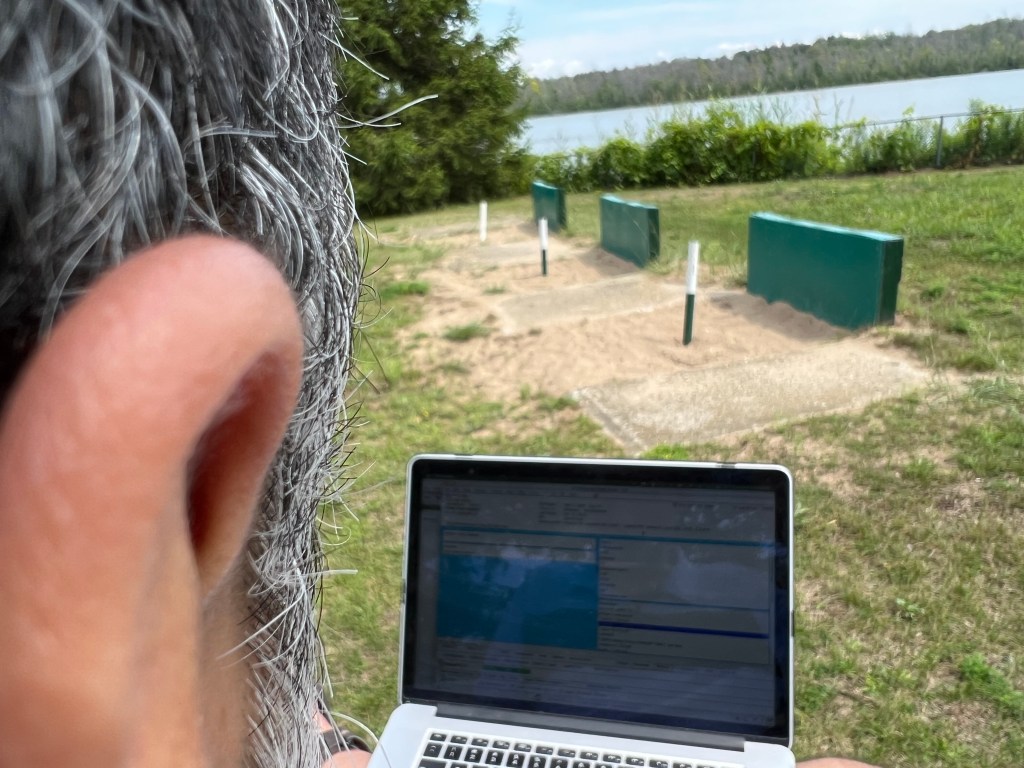
Me last summer, by a lake, on vacation, checking my office messages and lab work (dummy chart)

What can be done about this? How does one make family medicine more appealing? This may rub some people the wrong way but the first step is simple. Pay family physicians more. In Ontario, the most common fee billed by a family physician is about $37. (The last time I got a haircut, I paid $40). Out of that $37 the family doctor has to pay their nurse, receptionist, rent, cleaning, supplies and so on. Gets used up pretty quickly. 

Additionally, you need to pay physicians for admin work. If there is 19 hours of admin work that needs to be done – it’s only fair that work is paid for. There are people who are skeptical this will work. To them I would point out that British Columbia has gotten 700 more family doctors since increasing the pay to family physicians. 

You mean if you increase the income for a job, more people will apply for it? Who knew?

B.C. isn’t even the province that pays physicians the most. That’s arguably, as I have written before, Manitoba. Saskatchewans new deal is also much better than what Ontario offers.

The second aspect is to reduce the admin burden for all physicians. Many experts suggest this is a process that will take time. They are the same experts that oversaw the increase in Admin work for physicians with “oh it’s just one extra click or it’s just a simple form”. 

To reduce the Admin burden significantly, one needs to drastically revamp digital health care. Get rid of eHealth Ontario and OntarioMD, and run all decisions through the Digital Health Branch of the Ministry of Health. It’s too late to unify all of our electronic medical records, but you can approve one (and only one) patient app that will allow patients to access and transfer their records to the physician of their choice to reduce duplication and waste. That’s the kind of bold steps that we need to take, not just crowing about the fact that doctors don’t have to sign hearing aid forms any more.

Look we already have 5,500 licensed family physicians in Ontario able to open up a practice. If 40 per cent did so, it would end this crisis immediately without having to resort to years long plans of modifying licensing and training requirements for foreign graduates (who in fairness are generally very good).

Do our leaders have the boldness and vision to do the right thing?

Dr. Soni Reflects on the Delays in Emergency Rooms

Dr. Deepa Soni, and Emergency Room physician for over twenty years, reflects on the case of a young woman with appendicitis, and the delays in getting her care.

NB: Recently, Julia Malott spoke out on X (formerly known as Twitter) about how terrified she was about Canada’s health care crisis. She wrote how her daughter had not eaten in 18 hours as she continued to wait for surgery for appendicitis. She expressed concern about the lack of the beds and wondered if her daughter would get surgery before the appendix ruptured.

My friend Dr. Soni, who has worked in an Emergency Department for over 20 years, had, as usual, a very thoughtful and well spoken X thread of her own. (Dr. Soni was NOT involved in the care of this young woman). I thank her for allowing me to reproduce her thoughts here.

The only way these stories (about long delays in Emergency rooms) will stop being the norm, is when patients start sharing their experience like this mother did. Only voters can make federal and provincial governments change because votes are the only currency that matter. Doctors and nurses have been raising alarm bells for years without success.

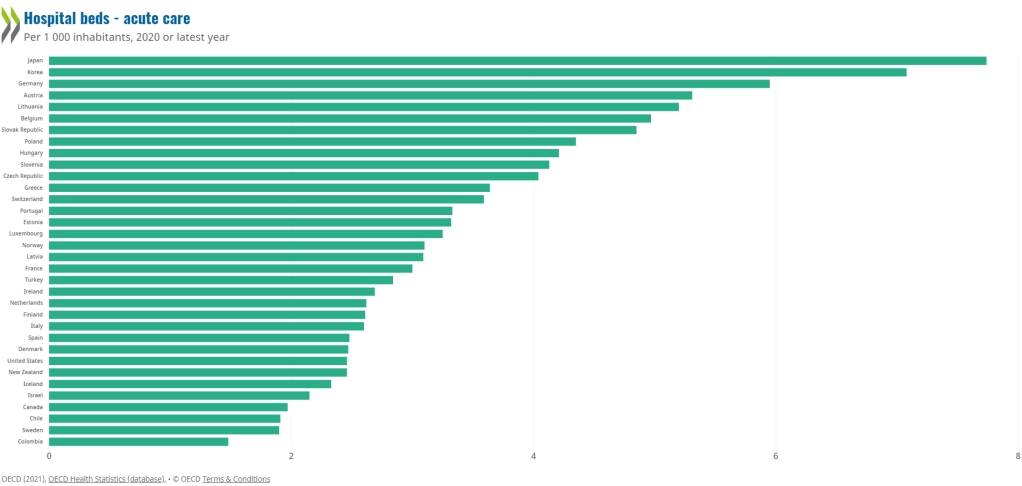
Canada has one of the lowest number of hospital beds of all the OECD countries, around 2.3/1000 people. In comparison countries like Japan, Korea and Germany are around 13/1000.

Graph showing how Canada fourth from the bottom (!) in hospital beds per capita.

Why does this matter? Having low hospital bed numbers means that words like “flu surge“, and “winter surge” — which have been used for decades to explain away long wait times and hallway medicine, are actually not “surges.” Rather, they are the expected backlog in a system that lacks adequate beds and resources.

The population of Canada is increasing and aging. We are about to enter a silver tsunami where a large cohort of our population will be over the age of 65 and many over the age of 85. This will place unprecedented pressures on our health care system.

What happens when the hospital bed capacity is outstripped by the numbers of patients needing care? It means that the elderly patient who needs admission to a hospital bed to recover from a heart attack has no bed to go to and spends days “admitted” in the emergency department. Bureaucrats call these “unconventional spaces.” What they really are, are stretchers.

When the vast majority of the emergency department beds are being used to take care of hospital patients, that means that patients that are waiting in the emergency department waiting room, will wait for hours for care, much like this story is describing.

Media needs to scratch beyond the surface and hold government to account. Real solutions are going to require thinking beyond the four-year election cycle. What will our system look like in 20 years? How do you plan for that?

It’s going to require recognizing the backbone of our healthcare system is primary care. Family doctors are overwhelmed by administrative burden, trying to run their offices and taking care of large practises in the community without adequate resources.


Build community infrastructure with resources like palliative care so that people can remain in their homes comfortably in their last days; and sufficient homecare services so that patients can receive antibiotics and other intravenous treatments at home to ease the pressure on hospitals. These services are vastly underfunded and do not have enough staff to properly provide care for everyone that needs it in the community.

It’s going to require building more nursing homes, retirement homes, seniors services and dementia care programs, as our elderly population will be the largest it’s ever been in this country.


Incentivize and properly pay hospital nurses so that we can recruit and retain them to be able to run departments and programs properly. Currently, agency nurses make at least two times as much as a hospital nurse, and this has created instability in the workforce. Governments need to show that they value nurses and the important work that they do.

Creative solutions like interprovincial licensing of doctors and nurses and a National Pharmacare program will help. While the idea of recruiting from other countries sounds like an easy quick fix, it will not solve anything if those newly obtained doctors and nurses find themselves overworked and burning out soon after arriving to Canada. The system problems are going to impact them just as they have impacted those who are already working in the system. This type of strain is what contributes to moral distress and burn out.

The backlog in the emergency department is a reflection of multiple failing areas that create an overall system that is strained beyond capacity. With each passing year, Canada’s healthcare system has become more and more stretched, trying to provide more care to more people, with fewer resources. Throwing Band-Aids at it is like trying to mop up the floor under an overflowing sink instead of trying to figure out how to turn off the tap.

Stories like this one are happening every day in Ontario and all of Canada. Most patients and families are too busy dealing with the acute health problem to take the time to write to their MP/MPP or to go to the media. But when people take the time to bring these stories to light, a critical tipping point will eventually occur where they can no longer be ignored by government. Because votes matter.

No one who went into healthcare wants to work in a system that makes patients feel like this story illuminated. But we need more voices bringing their stories out in the open. It will improve the system for the people working in it, and for the people receiving care within it. And that is better for everyone.

DFCM at Temerty Faculty of Medicine’s Stunt is DANGEROUS for Physicians AND Patients

I’ve been involved in medical politics for some time and in health care for much longer. I’ve seen a lot of foolish things. And yet, I confess, I’m still dumbfounded when some really smart people come up with a really stupid ideas. I guess I’m just a slow learner.

The most recent of these ideas comes from the Department of Family and Community Medicine (DFCM) at Temerty Faculty of Medicine. (Temerty is the name for the University of Toronto Medical School – and no, I have no idea when or why they changed their name to Temerty). In an attempt to address the crisis in Family Medicine, Drs. Pinto/Kiran and Martin would like the governments to declare a state of emergency in access to primary care.

Do I understand wanting to draw more attention to the crisis in Family Medicine? Of course I do. Family Doctors are planning to leave the field in droves. Compensation for family medicine has failed to keep up with inflation much less given them a raise. The admin burden makes one feel like Sisyphus (In Greek mythology Sisyphus was dammed by the gods to roll a boulder to the top of a hill only to have it roll suddenly back down to the bottom when it got close to the top and thus be forced to roll it up again. A more apt description of the family medicine paperwork burden I have never seen).

Heck across the country our whole health care system is in crisis, not just family medicine. Patients are not getting timely specialist care (some even choosing euthanasia as a result) as well as family practice care, resulting in worsening health care outcomes for all Canadians. We should be screaming about this.

But I honestly don’t think Drs. Pinto/Kiran/Martin (who combined have more letters after their name than the entire alphabet) could possibly have thought this recommendation through. Frankly, I’m genuinely left wondering if they even know what the government declaring “a state of emergency” means. The only way to enact this, is to invoke the Canada Emergency Act.

This Act clearly lays out what governments can do to solve a crisis in any particular area. And it’s not pretty. It includes:

  • giving the government the “ability to make orders or regulations that are believed, on reasonable grounds, to be necessary…”
  • Directing specified persons to render essential services…
  • Regulating the use of specified property, including goods…
  • The imposition of fines or imprisonment for contravening on any of the measures declared..

In short, having the government declare a state of emergency gives them a whole lotta power to do a whole lotta things. I guarantee you not all of those things will be smart.

No one in their right minds is going to argue with the issues identified in the letter three doctors wrote about:

The crisis in family medicine is real. There has been a lack of investment in primary care. This will get worse. This will cost the health system more money in the future if we fail to fix the problem. And yes, thank goodness somebody other than a cranky cynical old country doctor wants a significant overhaul and feels that “modest changes are not enough”.

But – to tell the government to enact a state of emergency, giving the same bureaucrats who have completely screwed up the health care system for the past thirty years almost unfettered power is not the solution. Let’s look at some of the goals of these three doctors:

If there is a state of emergency – do you know how these pointed headed bureaucrats will take “decisive action” to “ensure every person in their jurisdiction has equitable access”? You think they will licence more physicians? You think they will allow Ontario Health Teams (OHTs) to have strong physician leadership (which is the ONLY thing that has been proven to work in accountable care type organizations like these OHTs)?

I got news for you. The pointy headed bureaucrats will simply mandate zones, unilaterally determine how many patients a doctor must roster, and will make decisions in the interests of “urgency” given the new powers they just got from a state of emergency to show they are doing something.

Say for example the recent situation when Royal Victoria Hospital had to close down their obstetrics service. Hell that Gandhi fellow delivered babies 20 years ago, he probably hasn’t forgotten what to do – send him there to cover so it doesn’t close, he’s only 45 minutes away. Or a hospital about close their ER again – force a local doc who hasn’t worked in ER for 15 years to do so. 7,000 patients without a doctor in a certain town? Have each family doctor take a couple hundred more – even though those docs are already working night and day. (Trust me – these ideas will not sound outlandish to bureaucrats.)

Drs. Pinto/Kiran/Martin know that to make inroads into solving the primary care crisis you need to do three things:

  • increase the payment to family physicians to reflect the work they do. Decades of sub inflationary wage increases (cuts by another name) have made it untenable to run a family physicians office. Pay family docs more and don’t be afraid to say so.
  • The OHTs actually have potential for improving health care, but they need strong family physician leadership – not any other health care professional (and certainly not bureaucrats) – family physicians need to lead this. (The OMA has plenty of evidence on this and has shared with the government and will share with you).
    • Interchangeable IT technology that allows easy access to patient data and thus minimizes the admin burden.

The only reason I can think of for doing this is some sort of political stunt to embarrass the politicians. Heck I agree politicians should be embarrassed for how badly they’ve messed things up. But to do it in a way that gives them more power (not less) instead of demanding a true collaboration with family physicians doesn’t strike me as a very smart move at all.

Meditech Expanse – How Do I Hate Thee?

Authour’s Note: After another frustrating time of dealing with our hospital’s health information (?) system, Meditech, I felt compelled to re-publish my altogether horrid attempt at poetry.

Meditech Expanse – How Do I Hate Thee?

How do I hate thee?  Let me count the ways.
I hate thee to the depth and breadth and height
My soul does retch when my eyes see your sight
Beginning to end, Expanse does torment
I will despise thee all my living days
Most un-needed code, for us a true blight
I hate thee truly, you dim all good light
Hate thy order entry, makes my mind craze
I hate thee with passion I will not excuse
In my Nuance, errors show up like wraiths
I hate thy med rec so I turn to booze
With my lost joy, I hate thee with the death
and anguish of soul, wrought by those who choose
This Expanse that shall surely take my last breath

– with profuse apologies to Elizabeth Barrett Browning, authour of the original “How Do I Love Thee?”

Screenshot of the highly cluttered and remarkably UN-intuitive Meditech Expanse Home Screen found on the web, presumably from one of their training modules. Patients listed are fake.

#Docxit on the Rise, Means More Trouble for Our Health System

Acknowledgement: I want to thank my friend Dr. Graham Slaughter for coming up with the term “Docxit”. Graham is not only a brilliant internist, but is incredibly talented at wordplay and music. Plus, he has really thick, lustrous wavy hair!

A bunch of stuff has come to my attention recently in my social life and on my social media feeds. I’m saddened by all of these and even more saddened by what this means for the residents of Canada.

Item 1: a friend of mine in her early 40s confided she is going to give up her family practice. She loves her patients, but the admin burden and the poor remuneration make it no longer feasible to do this work.

Item 2: two more friends of mine, also in their 40s, are actively making plans to leave medicine altogether. One of them told me she knew four family physicians (all in their 40s) who left this year alone, and two others in their 30s who have moved out of country.

Item 3: I came across a social media post from a friend of mine from my days in OMA leadership announcing he was now a real estate agent. Amongst the people congratulating him on passing his real estate exams were other physicians also saying they were look at ways of getting out of medicine.

Item 4: The family health organization I’m part of in the Collingwood area has gone from 52 family physicians to 47 as some have retired without finding a replacement, despite trying.

Provincially of course, there are many more such stories. Three family doctors in the Ottawa area left their practices earlier this year. Twenty per cent of family doctors in Toronto are planning on closing their practices in the next five years. The list goes on.

It’s not just Ontario. British Columbia is facing a “dire picture” when it comes to family physicians. Doctors Manitoba, through their excellent (now past) president Dr. Candace Bradshaw, pointed out the need for more doctors on more than one occasion. I could probably find articles from every province highlighting issues with recruiting and retaining physicians, but you get the point.

Doctors, it seems, are looking at leaving the profession (for either retirement or other jobs) in alarmingly high numbers. This phenomenon, dubbed Docxit by Dr. Slaughter, is happening at a time when our health system can arguably least afford it (if it ever really could).

This is particularly a concern as our younger physicians seem to be more likely to quit. A report by Statistics Canada suggested that up to 47% of physicians with less that 5 years experience are intending to leave or change jobs in the next three years. To be clear, they are not intending to retire, just do something other than what they’ve trained for.

From Statistics Canada

This phenomenon is not just present in Canada. The American Medical Association is concerned about “Medicine’s great resignation” as 1 in 5 physicians in the U.S. are also planning an exit in the next two years.

The situation in Europe would appear to be even more dire. The Politico article I linked to states that seven million people in France do not have a family doctor, with more family doctors retiring than setting up a practice. There is a shortage of two million health care workers in Europe. Brexit has badly worsened the shortage of doctors in the United Kingdom. Spain is running out of doctors. And so on.

Once again, those leaving appear to be over represented by younger physicians. It’s so bad that European Junior Doctors (an association of younger doctors in continental Europe) issued a press release warning the health care system there was going to collapse.

What’s going on then? Why are so many doctors leaving? I mean, despite the few (but loud) vociferous miscreants on social media, being a physician is still the most respected profession in the world (at 83% we’re tied with farmers and scientists). Studies show that Canadians trust their doctors to make the right choice for them and are afforded a measure of leeway that politicians and bureaucrats must surely be envious of. And you know that stereotype about first generation South Asian immigrants always wanting their kids to grow up to be doctors because of their status in society – it’s true (trust me, I and many of my friends lived it).

But the reality is that over the past ten years, practicing medicine has devolved to where it is no longer about caring for patients (which is what all good doctors want to do). In Canada, it’s been about fighting bureaucracy. With doctors now spending up to 19 hours a week doing paperwork (that’s a half a work week for most people) or fighting nameless, pointy headed, basement cellar cubicle dwelling bureaucrats to get them to actually pay for surgery that a patient needs, medicine is now more about who can do paperwork better than who can promote health care better.

In the United States, the rise of corporate entities eating up private medical practices has fuelled an explosion of a different kind of paper work, all with its own stresses. One study suggested that each physician spends almost $83,000 U.S. a year interacting with insurance companies.

Add to that the ludicrous number of options and waivers and liabilities and I sometimes think it’s easier to understand Einstein’s Theory of Relativity than it would be to understand U. S. Health Care. Dr. Glaucomflecken does an excellent job of explaining the frustration here:

I don’t know what the reasons for #Docxit are in Europe, but I imagine they are similar. The over bureaucratization of medicine is taking its toll everywhere. As was stated in the Politico article:

“At its core, it’s really that there is the perception that potentially medicine is no longer an attractive career choice, a choice for people to stay in for a whole career. And this will really endanger the sustainability of health care systems in future,” – Sarada Das, secretary-general for the Standing Committee of European Doctors (CPME)

There are so many crises in our health care system right now, it’s honestly hard to keep track. But two things are for certain. First, we won’t be able to fix health care without retaining doctors. Second, as more doctors opt for Docxit, we would appear to be doing a lousy job at retention.

RePost: Marcus Welby Couldn’t Handle Today’s Medicine

This blog originally appeared in the Huffington Post on May 2, 2016. Reprinted here so that I can keep track of my old blogs, and also to once again point out how warnings of a crisis in Family Medicine were ignored for years.

Recently, Globe and Mail columnist Gary Mason lost his family physician to retirement. In an eloquent post, he reflected on how much he was going to miss his physician of 22 years, and how difficult it was to find himself in the position of not having the family physician. Unfortunately, as he pointed out, a growing number of Canadians are finding themselves in the same position.

Understandably concerned about his predicament, and wanting to know what’s going on, he did what most reporters and politicians do to find out about health care. He asked a health-care policy consultant, in this case Steven Lewis.

As an aside, it never ceases to amaze me how when people want advice with what’s wrong with health care, they always turn to health care consultants. Why not just ask a physician instead? If I have a leaky faucet, I don’t ask a Water Flow Policy Analyst from the Ministry of Environment what’s wrong. I call a plumber.

At any rate, I happen to think that Mr. Lewis gave Mr. Mason some pretty bad advice. Mr. Lewis suggested that newer Family Docs were incentivized to “do less.” This led Mr. Mason to opine that “in other words, Marcus Welby is dead.”

While I agree the situation is complex, the main reason that younger family physicians are taking fewer patients has nothing to do with either a lack of dedication or desire to help their patients, but rather that medicine has become far more complex in the past 30 years.

The past 30 years have seen an exponential increase in the number of screening and preventive care tests, all of which the family physician is expected to order.

For example, when I took over my current practice 24 years ago, I recall looking at one patient’s chart, and seeing the notation: “April 26, 1990. Strep throat. Penicillin.” This was clearly all the family physician at the time, really needed to know. However, there is no way on God’s green earth that you could get away with such a note in this day and age.

Since the 1990s there been a number of regulations on documenting patient visits set by Provincial Colleges and physician funding agencies (eg. OHIP in Ontario). In principle, the rules are put in place under the very reasonable rationale that there needs to be some accounting for spending public funds, and that documentation will prove those funds were spent wisely. In practice, that means that even a notation for such a simple problem, requires a minimum of four to five sentences in the chart. All of which means that there is less time in the day to see patients.

Additionally, contrary to what Mr. Lewis has told Mr. Mason, the responsibilities of the average family physician has actually increased since 1990. The past 30 years have seen an exponential increase in the number of screening and preventive care tests, all of which the family physician is expected to order.

For example, we never used to do bone density test on men. These were exclusively a test done on women, as they were thought to be at higher risk for osteoporosis. The guidelines have changed and now men over 50 are also being tested based on certain criteria.

In the past week, I have had six bone density results, four of which came back with a diagnosis of “low bone mass,” which require the patient to be called back, and counselled on the importance of the intake of dietary calcium, and vitamin D, weight bearing exercise etc, to preserve bone health and reduce the risk of fractures as patients get older.

I happen to be one of the relatively few physicians in Ontario lucky enough to have a superb Nurse Practitioner working with me, and she is really enthusiastic about counselling patients about these type of lifestyle changes. As a result, I am able to get patients to see her to learn about these lifestyle issues while I deal with some more complex cases. I appreciate that this may seem to be a “clinic” to Mr. Mason, but it certainly does maximize the value of both my time and hers.

Similarly, we now screen (in appropriate patients) for aortic aneurysms, colon cancer, breast cancer, diabetes and several other diseases. All of which require more time per patient, and result in abnormalities found, which result in time required to address those abnormalities.

One of the benefits of having an electronic medical record system, is the you can program them to have the system remind your patients when they are due for appropriate screening test. This could never be done on the old patient’s chart. 

Recently, a patient came in to see me with a sore foot. Marcus Welby would undoubtedly have looked at the foot, and wrote in the chart: “Gout. Indomethacin.”

In contrast, my note documents when the pain started, that there was no history of trauma, a review of previous blood work to check his uric acid level (a contributing factor to gout), whether the neuro-vascular status was affected, how far up the foot the redness goes, and his vital signs. To which I add, “Assessment: Gout, Treatment: Indomethacin.”

At his visit, I also looked at the reminder screen of his electronic chart. I’ve included a snapshot (with personal information removed) of what I saw.

So now, not only did I treat his gout, but I ordered all of the investigations this fellow was due for (he tends to avoid coming to see doctors). If you do this on enough patients, you will find abnormalities, which will then require follow up.

Lest you think I’m complaining, let me categorically state, all of this is a good thing. Reports have shown that investing in primary preventative care, is good not only for the patient, but also for the population as a whole. These are wise investments to make, as they prevent far more expensive complications from occurring in the future. It’s like that old commercial about getting your oil changed on time in your car. You can either pay a little now, or pay a lot later. 

However what it also does a significantly increase the workload per patient per family physicians. Which means it is no longer possible for a family physician to look after the same number of patients as Marcus Welby did. It is not as Mr. Lewis was quoted as saying “A desire to do less”, rather the work per patient has increased.

I’ve generally enjoyed Mr. Mason’s columns in the Globe and Mail. I wish him well in his quest to find a family physician. If he moves to my neck of the woods, I would probably consider taking him on, if only because I rather enjoy funny stories and debating politics with people. As a bonus, I don’t drink, so Mr. Mason would not even have to give me the expensive bottle of scotch he promised. (I would however, demand some inside dirt on his fellow columnist and health care reporter Andre Picard!)

The Admin Burden That’s Really Killing Family Practice

Recently, there’s been a lot of talk about the “administration burden” faced by family physicians. The Ontario College of Family Physicians estimates family doctors spend up to 19 hours a week on “paper work”. Given there are only so many hours in a week, the more hours spent doing paperwork, the less hours seeing patients.

It also contributes to situations where people just get too frustrated with family medicine, and quit. Twenty percent of Toronto family doctors are planning on leaving within five years. This bad karma is not lost on medical students, who, as I mentioned in a previous blog – are avoiding family practice like the plague, worsening a crisis that has been years in the making.

But what exactly is this “administration burden”? What’s the “paper work” that is driving us all to frustration? I would argue it’s not paper per se, it’s digital.

That’s not to say there isn’t paper. I frequently get asked for completely pointless sick notes from employers, impractical forms to return to work and seemingly useless – “we agreed your patient was permanently disabled, but we want a one year update to make sure your patient is still permanently disabled” forms from the pointy headed bureaucrats at insurance companies. But I’ve taken a somewhat mercenary approach to those forms in order to keep myself sane.

A sick note costs $20 and takes about a minute to write. A form the insurance company asks for usually takes a few minutes to fill out and I charge $40-$175 depending on the form. I reconcile the fact that these forms are a burden, with the fact that at least I make money out of them. While somewhat unscrupulous on my part, it keeps me from totally blowing my lid whenever I see one of these.

No the real admin burden comes from the completely absurd and unrelenting avalanche of reports/lab work/follow up notes – all of which present to me in a haphazard way, seemingly designed to drive me to psychiatric medications.

I took the Friday of Eid ul Fitr off to celebrate with my family. On Saturday, I logged into my Electronic Medical Record (EMR), correctly realizing that if I waited until Monday, the EMR inbox would crush my sorry soul.

Unsurprisingly, I had a total of 75 labs/reports/messages about patients to review. It wasn’t so much the number of items to take care of, (truly if they were straight forward it wouldn’t have been too bad). It was rather how badly and inefficiently the information came to me that sucked all of the happiness I had enjoyed on Eid from my spirit.

One method of getting information to me is via a system called Hospital Report Manager (HRM). I look at HRM in my EMR and see a report on a renal transplant patient from Sick Kids. But the note was “uncategorized” which meant that I had to go into the HRM software and enter the category “nephrologist” in the report. The VERY NEXT report in my HRM in box was……the exact same report on the exact same patient, but this time HRM had categorized the report as being from a cardiologist – so I had to go in, change the report once again to “nephrologist” and I now have two copies of the same report.

By the way – Sick Kid’s hospital provides exceptional medical and nursing care to my patients, but ever since they switched their hospital IT systems to a company called EPIC there has been no end of issues like this. The only thing that software is epic at is causing physician distress.

That’s not all. HRM has more goodies awaiting for me. There’s a report from my colleague Dr. Collings on his expert management of a wrist fracture on one of my patients. Thorough, comprehensive, and well done. Except HRM has auto-categorized him to be a gynaecologist So yes, I either have inaccurate information in my patients chart, or I go back and re-categorize the report to reflect that Dr. Collings is an orthopaedic surgeon.

Next up, HRM has a report from an Emergency Room physician about a patient who was seen and apparently had some abnormal bloodwork. Not life threatening, so asked to follow up with me. Only problem is the blood work from the hospital doesn’t come to me via HRM. Now I have to go to that patients chart, and access yet another system called OLIS, log into that and download the lab work from the hospital. But wait the note from the ER was unfortunately late getting to me (about 10 days out). OLIS is set up to auto download for the past seven days, unless I click more buttons, and back date – which I have to do.

Next up, a report from HRM that a patient of mine had a Covid swab done. But HRM won’t tell me if the swab was positive or negative. Just that it was done. Now I go back to that patient chart and access OLIS where the result is, adding yet more steps to my day.

Next come messages (yes, that’s on top of HRM and OLIS). I note a message from the local Shoppers Drug Mart asking for a renewal of blood pressure medications for a patient of mine. Only problem is that a brief look at the chart shows I sent a one year supply of that same medicine to the Shoppers three months ago, and they accepted this and downloaded it. I tell the pharmacy staff who tell me they “can’t find it” which leads to……well, let’s just say a deterioration in the conversation.

As an aside, while I’m not allowed to endorse any specific pharmacy, I will say I’ve generally found care to be much better when provided by smaller, independent pharmacists who build relationships with their patients, rather than big chains that just seem to fly in itinerant staff.

Anyway, you get the point. In total it took about 3 hours on Saturday to sort through this mess and it just doesn’t have to be this way. The reason I wrote a blog about Health IT in Turkiye was to show that other countries do a much better job of managing this burden. I’m sure there are other examples and we need to learn from them.

The vast majority of my family practice colleagues practice family medicine because they genuinely like their patients, like providing comprehensive care, value the relationships built over time and feel like they make a difference in peoples lives. But unless we do something about this administration burden, I fear more and more will leave the profession, because at some point, being human, they just won’t be able to take it any more.

What if We Didn’t Lose the Doctors We Trained?

Canada is in the midst of doctor shortage. In particular there are at least 6 million Canadians with out family doctor. The situation is worsening. The most recent Canadian Residency Match for medical students applying to specialties, showed that there were 268 empty spots for family medicine after the first round. This is the highest number of unmatched family medicine positions ever. Medical Students, being really smart people, are viewing family medicine as a dead end specialty and avoiding it like the plague.

If only the boorish loudmouth who predicted we were heading in this direction six years ago and been listened to…..

Governments at both federal and provincial levels are taking steps to try to address this. In British Columbia, they have introduced a capitation based payment model for family physicians (think of it as salary + performance bonuses). Ontario has a model like this that had great success in the early 2000’s. The federal government pledged more spending on health care in the future. Ontario plans the “largest expansion of medical school education in ten years.” And so on.

But what would have things been like if successive governments didn’t drive doctors away from Canada in the first place?

Going back as far as the 1990s, inept governments have, over the years, done their best to make physicians feel unwelcome. The Bob (“I am super elite“) Rae NDP government of 1990-1995 in Ontario implemented the Barer-Stoddart report. This report decided “there were too many doctors” (I kid you not) and cut medical school enrolment by 10%. Three decades later we are still feeling the adverse ramifications created by that move.

Similarly, the disreputable Kathleen Wynne Ontario Liberal government went to war with physicians in the mid 2010s, led by her woefully incompetent Health Minister Eric Hoskins, and his inept sidekick, Deputy Minister Bob Bell. Those geniuses thought it was a good idea to CUT 50 residency positions (training for doctors) and only saw the light during a deathbed confession just in time for the 2018 election. In particular, Hoskins and Bell’s blatant disregard and borderline contempt for family physicians resulted in, as OMA Vice-Chair Audrey Karlinsky put it, 6 years of family medicine graduates not choosing comprehensive family medicine.

Do you think supporting hundreds of those young potential family docs then would have made a difference now when 2.2 Million Ontario residents are without a family doctor?

To prove that idiocy in health care management can occur with parties of all political stripes, the former Alberta Conservative Health Minister, the combustible Tyler Shandro, actually verbally attacked a physician at his home in Alberta, along with, you guessed it, going to war with physicians in his own province. Really helps to retain physicians, no?

In my first ever blog for the Huffington Post (seven years ago!), I pointed out to then Health Minister Eric Hoskins that 30% of my graduating class no longer worked in Ontario due to Bob Rae’s intransigence. I urged Hoskins to change his behaviour or that by the time of the next election, health care would be in a worse crisis and hinted his government would pay the price in the 2018 election. (I wonder if Kathleen Wynne regrets sticking with him as health minister for so long, despite the fact he was obviously not up to the task).

Admittedly, that’s one person’s recollection. Are there any statistics out there that show just how many Canadian trained doctors have left Canada? There are, although they are really hard to come by, and not as up to date as I’d like. Huge shout out to Dr. Mary Fernando for digging these up for me.

In 2000, the OECD published a report on the mobility of health care professionals. On page 50, it indicated that 19% of doctors born in Canada were working in other countries. Given the crisis we see in health care around us right now, do you think it would help if we could have retained those doctors in Canada?

But wait, aren’t we trying get international medical graduates (IMGs) to come to Canada? Ontario health minister Sylvia Jones did direct colleges to come up with a way to speed up the ability to get foreign doctors licensed. But it turns out we have trouble keeping them as well. A study on retention patterns of IMGs in Canada showed that 12% of IMGs were approved to practice in Canada between 2005 and 2011 LEFT Canada by 2015. While IMGs apply, we have trouble retaining them too.

Clearly, governments need to focus on retention of physicians just as much (if not more so) than recruiting new physicians. What can they do?

The federal government can do a couple of things to help. First it can heed the results of a poll taken by the Medical Post magazine (I voted just before closing and these were the results):

Doctors don’t have pensions and benefits mostly due to some weird federal tax laws. Changing these should be easy and offering pensions and benefits would be a strong way to retain physicians. Similarly, reversing the 2017 tax changes that completely threw retirement planning out the window for doctors would be a big help.

Provincial governments should of course, take note of the fact that going to war with doctors always leads to a deterioration in health care for the residents of their province. But since most politicians are incapable of thinking about anything but their own self interest, let me point out three facts.

In 1995, after going to war with doctors, the Bob Rae NDP government was turfed from power in Ontario and the NDP has yet to form a provincial government since. In 2018, after going to war with doctors, the Kathleen Wynne Liberal government was decimated in the Ontario election, even losing official party status, which they have yet to regain. In 2022 after going to war with doctors, Alberta Premier Jason Kenny had to resign as premier because his own party saw the writing on the wall.

The message is clear. Going to war with doctors is bad for health care and bad for political careers. It’s time politicians realized that, and came up with meaningful solutions like pensions to retain the ones we train.