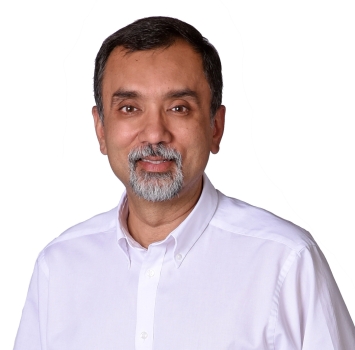
Dr. Madura Sundareswaran guest blogs for me today. She’s a community family physician who’s resume is too long to print here. She helped found the Peterborough Newcomer Health Clinic and is a recipient of the CPSO Board Award which recognizes outstanding Ontario Physicians. This article originally appeared on her LinkedIn page.
The day people stop asking this question is the day we have fixed the primary care crisis.
I’m a family physician doing community-based comprehensive family practice in Peterborough, Ontario. I currently work in three different primary care models in our community – fee-for-service, a team-based family health organization, and nurse-practitioner led clinics. All of my colleagues work very hard providing excellent care to their patients.
Despite this, the latest figures suggest that 32,000 people living in the Peterborough region do not have a family doctor.
What does that look like?
A woman in Peterborough notices a breast lump today and is very worried about it. She frantically searches google and reddit to learn that there are no walk-in clinics here. She calls a number late in the afternoon for a local clinic for unattached patients, but all the spots are full for the day. Her options are a virtual doctor who will never conduct a physical exam – but she thinks an exam is important – how will they ever know what this lump feels like virtually? She wants someone’s expertise, she wants reassurance. She decides to go to the emergency department for this problem…but leaves after waiting for 9 hours. She is guilt-ridden as she waits there – she is not as sick as the others in the waiting room. No physician or nurse practitioner will have enough of a relationship with this woman to know that she recently lost her best friend to breast cancer and the impact this has on her illness experience. She is freaking out about this lump…alone.
Or…
A 68 year old male has seen a few pharmacists and virtual family doctor for his hemorrhoids over the last year. He decides that he just has to live with hemorrhoids. A google search says his symptoms are classic for the problem; he’s reassured. As a doctor, I know that this gentleman needs a physical exam but this man cannot find someone to do it. After a few months he winds up in the emergency department with terrible pain – a physical exam very obviously demonstrates rectal cancer. It’s had a year to grow.
Or…
George is a 58 year old man who has never had a family doctor. He has been on Health Care Connect for four years but no one has ever called him to say they have found him a family doctor or nurse practitioner. He is in “perfect health” so he does not need a doctor. He has never had his blood pressure checked, never been counselled on smoking cessation, and has never had bloodwork done. What he doesn’t know is that his Hemoglobin A1c is 7.4 (he has Type II diabetes but too early for symptoms), he has hypertension (high blood pressure – which in its most common form has no symptoms or signs), and his cholesterol is really high. George will probably have a heart attack in the next 10 years. The potential consequences of a heart attack are death. This was entirely preventable.
What we know: attachment to a regular primary care provider (family physician or nurse practitioner) leads to more preventative care, better chronic disease management, and lower rates of hospital admission (ref)
We need a solution ASAP
I eagerly watched as Ontario announced $110 million that will “connect up to 328,000 people across Ontario to primary care teams.” For my community this also translated to a promise for a community health centre (CHC) to connect 11,375 people to primary care. This is much needed but not enough.
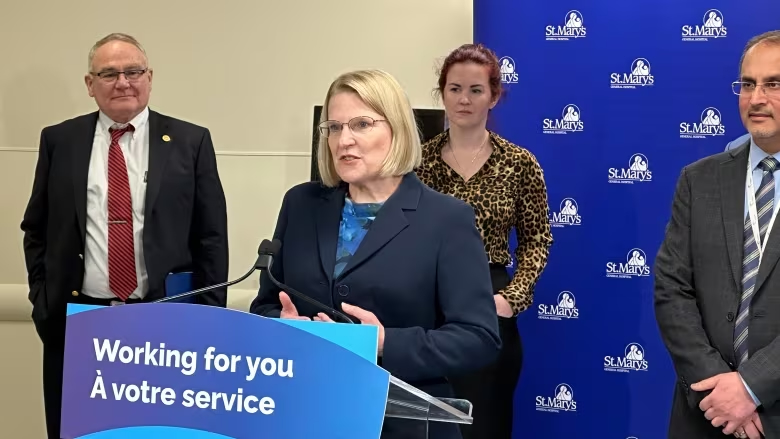
Ontario Health Minister Sylvia Jones announcing expansion of primary health care teams
In order to develop a community health centre – a building must be built or set up, policies will need to be implemented, and several primary care providers including physicians, nurse practitioners, social workers, pharmacists, dieticians, etc. will need to be hired. Even if this could be set up within 12 months, where does that leave the other 20,625 in the region without a family doctor? I’ll tell you – scrambling door to door and still knocking asking if anyone is accepting new patients.
But wait! There are other options. A single full-time family physician working in one of Peterborough’s existing family health organizations can roster approximately 1300 patients and join an existing team-based model. We currently have job openings in every one of our five existing multi-disciplinary teams for family physicians. A clinic could be up and running in a matter of weeks. There are family doctors in this community who are very eligible to take on this job – and would likely consider it if they were fairly and adequately compensated.
Learning from British Columbia
I am a firm believer in learning what works and never reinventing the wheel.
In 2023, British Columbia completely revamped its pay structure for family doctors. They paid their doctors better and restructured compensation models – and apparently within a year they got 700 more doing comprehensive, community-based family medicine.
Dr. Ramneek Dosanjh, Past President of Doctors of BC, who called the new funding formula for family physicians in BC a “seismic shift”
I am going to make a few assumptions but I want to illustrate and oversimplify something here.
In the new BC payment model, the pay per full time doctor increased by $135,000/year (assume per full time equivalent). It wasn’t just a pay raise – it involved a few critical changes regarding what doctors could bill for and some restructuring. But the end result was a pay raise.
This resulted in an increase of 700 family physicians (assume full time equivalent) practicing comprehensive family medicine over one year.
Let’s say 1 full time doctor rosters 1300 patients.
If Ontario could get 700 new full-time family doctors to provide comprehensive, community-based family medicine, 910,000 people could now have a family doctor.
The entire rollout for the BC program is budgeted at $708 million over three years but this would include complete restructuring from fee for service care. Ontario already invests over $1 billion annually in interdisciplinary primary care teams and we have a significant head start compared to BC a year ago.
In contrast, Ontario plans to spend an additional $110 million to connect up to 328,000 people across Ontario to primary care teams.
Providing family doctors with the financial support and resources to set up their own practices is the best bang-for-your-buck approach if the goal is patient attachment to a primary care provider.
We need an all hands on deck approach. Support community health centres, nurse practitioner led clinics, but please also support family physician’s practicing family medicine. That is the only way you will achieve attachment for all Ontarians.
Your most obvious solution is pay family physicians better today – so they will hold off retiring for a couple more years and may actually sign on to take a practice.
British Columbia just proved that fair and competitive compensation for family physicians may result in more of them doing it.
Why do I care?
I have been in family practice for five years. I have a roster of patients who have access to a whole range of team-based primary care services – a pharmacist, a social worker, a nurse practitioner, an RPN and multiple other service through our family health team. Every day I get asked if I can take on a friend or family member as they do not have or just lost their family doctor. This simple ask creates a great deal of stress and guilt for me. I know what happens when someone does not have a family doctor or nurse practitioner. They will be sicker, they may die sooner, they will be alone trying to “doctor” themselves.
The moral distress of being made to feel like I am determining people’s fate – giving some people a high standard of care while others are left to fend for themselves will be what ultimately leads to my exit from this profession in this province.Why do I get to give a small handful of people comprehensive team-based care, while the rest (often marginalized, more vulnerable patients) get nothing? It is not fair.
What next?
We are all eagerly awaiting the next negotiation between the Ontario Medical Association and the Ministry of Health.
If we do not see a pay raise for physicians, or worse, we pay them less – everyone in Ontario can accept the reality that they may have a lovely multidisciplinary medical home with a diverse range of primary care providers – but a family doctor probably will unlikely be part of it.
The next time a leader or politician is raving about their new model for care – or pitch a strategy that does not include a family doctor I urge every tax payer and journalist to ask them:
1. Do you have a publicly funded family doctor? (Do you truly understand what it means not to have one? Have you ever had to endure the struggle?)
2. If you are so confident in your plan, would you be willing to give up your family doctor to one of the 2.3 million people in Ontario without one?
3. Why is fair and competitive financial compensation of family physicians not part of your multi-pronged approach?
We are listening to politicians and leaders sell us on an idea of a fully-funded, glorious renovation. Meanwhile the house is on fire. Your family doctors are a dwindling number of people who cannot contain the flames. What are they worth?
Full disclosure: I am a consultant for Medicte, a medical tourism firm that provides high quality, cost-effective medical treatments for ALL health conditions in Turkiye. Contact: info@medicte.ca for more information.
Recently, former Ontario Medical Association (OMA) President Dr. Shawn Whatley wrote an opinion piece in the National Post (later reproduced in the Medical Post) quite correctly rebuking Federal Health Minister Mark Holland for insulting people who consider leaving Canada for medically necessary health care. According to an Ipsos Reid poll, that’s 42 percent of all Canadians. As Dr. Whatley pointed out, this isn’t exactly a new phenomenon. In 2017, well before the Covid pandemic that people like to blame for just about everything, over 217,000 Canadians left the country for medical care. God only knows the 2023 number, but it will most certainly be higher.
Federal Health Minister Mark HollandOMA Past President Dr. Shawn Whatley
Ironically enough, the day after Dr. Whatley’s piece was reproduced in the Medical Post, the Medical Post sent me their daily email which included a link to an article that showed Canadians are waiting even longer for surgical procedures than they were in 2019, and it’s not like the 2019 numbers were any good to begin with. It’s well known that increased wait times result in worsening morbidity and mortality (i.e. the longer you wait, the sicker you become). So it’s no wonder that Canadians are exploring ways to get treatments quickly, even if they have to pay out of pocket. Heck, I’m already on record as saying that I will go to Turkiye if Allah/God/Yahweh forbid I got a serious medical illness.
If you too are exploring medical tourism, here’s a list of things to consider.
How safe is the country I’m going to?
The sad reality is that the world has turned decidedly ugly these past few years. Picking a safe country can be hard. Stories like the one about Americans who went to Mexico for medical tourism and got shot by drug cartels get widely publicized. But there are many unsafe countries in the world. If I was looking at south of the United States, I’d probably limit my choices to Costa Rica and Cayman Islands. There are simply too many economic, political and frankly criminal elements in the rest of the countries south of the U.S.
Even in different continents you have to look at safety first. About 5 years ago a patient of mine of Ukrainian descent went back to Ukraine for a procedure. Obviously would not suggest that now with the war on. So look for somewhere stable.
What is the quality of the hospital I will get treatments at?
No hospital is perfect. But you should at least ensure that the hospital you are going to get care at is accredited by the Joint Commission International (JCI). They are the leading international organization that accredits hospitals and other health care organizations in 70 countries across the world. JCI Accreditation won’t guarantee a successful treatment, but it comes with the assurance that you will be getting appropriate health care.
After ensuring JCI accreditation at the facility you are looking at, then check for references. See if you can talk to people who got care there for their first hand experience.
Get a video consult first.
It’s the 21st century people. Video calls are a thing. If the health care organization you are looking doesn’t offer you the ability to have a video consultation with their doctors, before flying out to their country, well that’s a bad sign. During the consultation, ask lots of questions. Specifically ask about their complication rates and what is covered if you are unfortunate enough to get one. Get a “feel” for the doctor. It’s a big decision, be 100 per cent comfortable that the health care organization you are considering, will be able to take care of your needs.
What’s the Cost?
Obviously, at the end of the day, you are going to have to pay for your treatment. I would, of course, not suggest getting the cheapest possible treatment – because that institution has likely cut a lot of corners to get the price down. But at the same time, I weep for the lady from British Columbia, who, frustrated with the long wait times to see an oncologist, spent over $200,000 (US) on cancer care in the United States. She could have gotten the same treatments for around $70-80K in Turkiye. That’s obviously a lot of money, but still a significant savings.
This is actually why I would recommend you NOT go to the United States for medical tourism. Firstly, they have quite a bit of variability in terms of the care they provide. Some facilities are really good and others……well, some are really good. Secondly, the cost just isn’t worth it. A joint replacement that costs $50,000 US in the United States, could likely be had for $15-$20,000 US in another country.
If you are on a budget, or if you, like many others, are going to take out a loan or dip into your retirement savings to pay for these treatments, that difference is significant.
In Conclusion
While some provinces are making necessary investments in health care, the reality is that improvement in wait times are likely years away. The Canadian public is not stupid, they know this. Only 17% of Canadians feel the health system will improve in the near term.
In the interim, I fully expect the number of Canadian citizens who opt for medical tourism to increase. This can be a safe and effective option for Canadians willing to explore this route, but it is important to do your homework first.
Just me again, your erstwhile, somewhat (but not completely) humble old country doctor. Like last time, I would point out that I am really not your harshest critic. I want to recognize that you have done much for health care infrastructure over the past few years.
For reasons that I cannot fully explain, the previous Liberal regime simply stopped building the necessary infrastructure to help Ontarians. Whether it was new (badly needed) nursing homes, new hospitals, or new teams, the Liberals basically did, well, nothing in terms of infrastructure. To your credit, you’ve reversed that trend and are building facilities we in Ontario need. (As an aside, you seem to like building things a lot!)
Ontario Premier Doug Ford
But all of that building will not mean much in two years (when the next election is – nudge, nudge, wink, wink) if, as projected, over 25% of Ontarians don’t have a family doctor. Yes, you can correctly point out that the decline in family medicine was caused by the Liberals (it truly was – Eric Hoskins was by far the worst Health Minister I personally have seen in my time in health care). You can point out that the Liberals slashed the capitation model favoured by most family docs that started the downward trend. You can also point out that their favoured Deputy Health Minister Bob Bell thought family medicine was so easy he could return to it after over thirty years away:
Screenshot
He even tried to mansplain one of the true leaders of family medicine on how the system should work.
Thx Doc Silvy. I suggest that we need fundamental re-think of highly prevalent, poorly managed conditions. Agree that GP focused practices have cropped up in many of these areas, Sports, MH, PC, Chronic Pain- real issue is lack of programmatic care across province. 1/4 https://t.co/hblPVJqDzX
It’s true Bell and Hoskins were completely wrong. That will NOT matter because by 2026, the general public will say – “well you’ve had 8 years to fix this – you haven’t done enough”. That’s just how politics is, and I think deep down you know that.
You can, truthfully, also say that you are listening to organizations like the Ontario College of Family Physicians or the Ontario Medical Association (OMA) and who continue to go on about how team based care is the future of family medicine and how it can help solve the problem. You may not know this but I was the founding Chair of the Georgian Bay Family Health Team . I happen to believe in physician led team based care.
But here’s the thing. It will take a minimum of five years (if we’re lucky) to build out all those teams. That’s assuming the bureaucrats from the Ministry GET OUT OF THE WAY and let front line family physicians be in charge of the teams. But we are losing family doctors by the week. The people of Ontario can’t wait five years.
There is one thing that can be done now however, to stem the tide, and stabilize the system. You need to give comprehensive care family physicians an immediate, and significant raise. How significant? You will need to give an immediate 35% increase to comprehensive care family docs along with annual normative increases for the next four years. If you think that’s outrageous – I invite you to look at Manitoba’s contract or Saskatchewan’s or British Columbia’s. The competition for comprehensive care family doctors has increased significantly, and Ontario is falling behind.
I can pretty well guess what your “advisors” are telling you. They will say you are in arbitration with the OMA, just promise to abide by the result. Honestly, I do believe you will abide by the result, both this year and next.
But…
Arbitration will take months this year, and months if not a year next year. Frankly, I doubt that the OMA, despite their strong words, will advocate for an increase of the amount necessary for comprehensive family medicine (hopefully I’m wrong).
I have absolutely no doubt that the Arbitrator, William Kaplan, will give a raise to family docs, especially after the recent award to nurses. But if the raise isn’t enough, you going out to the general public in two years and saying “we honoured the arbitrators rulings” – will make zero difference to the close to five million people who won’t have a family doctor. They will still blame you for not having been pro active.
William Kaplan, Chair of the Arbitration Board
Listen, I’m on the conservative side of the political spectrum. I’ve always voted for the Conservatives in every provincial election since I was eligible to vote. I live in Simcoe – Grey which is one of, if not the most strongly conservative ridings in Ontario. Heck, in the early 1990s we were the ONLY riding east of Manitoba to vote for a Reform Party MP.
I’m telling you that most of the voices on the ground are really upset about the lack of family doctors. We have about 7,000 patients without a family doctor in our area last I heard. It’s true that when asked who they will vote for in polls, they, like most recent polls, say they’ll vote conservative. However, they always add “I guess, there’s nobody else out there”. That softness in your vote is a problem, and that softness doesn’t show up in the poll numbers.
Listen, I want you to win the next election. I personally think the NDP would be a complete disaster. I have no faith the Liberals, who showed just how much they hate doctors, have changed their tune. But in order to do that, you’re going to need to bite the bullet, and stem the haemorrhage of family docs.
Go to tell your negotiations team to offer up a deal that strengthens family medicine. Mask the increase with things like retention bonuses (like Manitoba) and matching RRSP payments (like BC) and other methods (paid admin time, paid supervision of team members and pensions would be nice). But get it done ASAP.
Otherwise, I genuinely think you will be in more trouble than you might be led to believe by your handlers in 2026.
Dr. Alex Duong, a family physician from the Vanier district of Ottawa (which amazingly enough is one of the more underserviced areas of Ontario).
Recently, Maria DiDanieli, the clinical lead for system navigation at the Burlington Family Health Team, published an opinion piece in Healthy Debate that was critical of the decision of Drs. Alam/Mathew and yours truly to recommend that family practice residents bide their time instead of starting up a comprehensive care practice in Ontario. Dr. Duong replies and has kindly allowed me to reproduce his reply here.
I am a full-time community family physician, and I read this article with great disappointment.
I am at the face of our health care system. When patients cannot get a timely breast biopsy or a knee replacement, they come to ask me. I address their frustrations, alleviate their pain, and manage expectations.
I am the backstop when issues are missed during transitions in care and issues that require follow up.
I am the navigator that helps patients, and their families orient themselves to housing resources, mental health and financial resources.
I am the advocate for my patient’s health when they deal with their employer or insurance companies.
I do all these things and more, alongside everything from newborn care to palliative medicine.
I, like the great majority of family physicians, take pride in our work, and in what we contribute to our patients and the community at large. But Banks do not grant loans for a new clinic based on my contributions to Ontario’s healthcare system. My rent payments do not decrease because of the positive impact I make on my patients’ lives. The salaries of our exceptional staff are not funded by the sound of clanging pots and pans.
Today, to outfit a new clinic with the minimum number of physicians for a FHO requires high 6 figures to 1 million dollars, loaned at 6.95% interest. We guarantee our own lease – we are on the hook for ensuring it gets paid for the entire term. We are responsible for hiring and ensuring our staff are paid a living wage. We invest our own time in making sure the clinic runs. For many community family physicians like me, there is no assistance for any of this from any level of government. No money for staff, no incentives for starting up, no support for logistics. We are in a precarious, failing business model with ever growing administrative burdens patching the system equal to a part-time job. We have been trying to expound on this, and frankly have been completely unsuccessful in this.
You realize that “… there does not seem to be much political will to improve this situation at this time.” Yet, you ask family physicians to work harder expecting a different result from the government.
You state that “With these current barriers and shifts, any new practice can feel fragile or vulnerable to imminent obsolescence.” Yet, you expect new graduates to take on a massive financial risk: long term lease, EMR contracts, and double their already tremendous debt in start-up costs.
You lament that “Instead of acting as beacons of wisdom, encouragement and level-headed advice, we see a growing shift toward inciting everyone to walk out!”. Do you apply this standard to the teachers in Quebec who recently concluded a strike? Are they less dedicated to their students? Do you apply this standard to all groups who organize to make their voices heard?
The authors, Drs. Alam, Gandhi and Mathew made it clear that there are many options available to new family doctors. They warn of the current state of specifically locking into comprehensive family medicine, to ensure that new grads do not put themselves in a position where they will be burnt out early in their career. To me, leadership requires honest conversations, not empty promises, or exploiting the ideals of new family doctors. I find it unethical to sell a romantic vision of what it is like to start and maintain a Family Medicine practice in the current environment. It is a recipe for moral injury when those ideals run flat into the economic realities, as I have experienced.
And frankly, to say to those of us, like myself, still practicing longitudinal family medicine we should be working harder, or we are just doing family practice wrong is demoralizing. It is grossly offensive to my early-mid career family medicine colleagues who have burnt out through great moral struggle and guilt. Disillusioned family physicians who leave longitudinal family practice will not return. The greater harm to the public and to patients is not the Star article that speaks truth to the issue, but the issue itself: that family physicians, whose concerns are being gaslit, continue to leave longitudinal practices.
Just me again. The grumpy, aged quack with a history of being a bit of a thistle in your obliques. Well intentioned I assure you (although I’m told some may not see it that way).
Negotiations with the provincial government on a Physicians Services Agreement (PSA) continue and mediation began on February 20th. That’s all great and part of the process. However, things HAVE CHANGED a lot since the last time I wrote to you and urged you to set a strong mandate.
I am asking you to revisit the negotiations mandate at this time, in light of threenew key pieces of information that are very relevant to Ontario doctors.
To recap – the negotiations mandate is the bare minimum ask that the Negotiations Task Force (NTF) can accept on behalf of the Board. If the government makes an offer that meets or exceeds that – well, then they accept it on behalf of the Board and the Board is compelled to endorse it. The mandate is, quite correctly, confidential (you can’t let the other side know your bare minimum ask any more than they would let you know their mandate). But it’s up to the Board to determine if the mandate is enough (not the NTF).
Now to be clear, I’m not saying you should revise it, just revisit it. Perhaps the mandate is already sufficiently strong. That would be great. But things are different now.
The first reason to revisit the mandate:
Other provinces have surpassed Ontario physicians in terms of income. BC and Saskatchewan have significant deals to stabilize the physician work force. Manitoba’s deal with physicians appears to be the best of the bunch. Manitoba has not only a well deserved increase for all physicians, but significant steps towards gender pay equity.
As an aside, while I applaud the fact that DoctorsManitoba made steps towards gender pay equity, I’m forced to wonder what happened to Ontario? When I was on the OMA Board we were proud of the fact that although it was too late, we were the first PTMA to report on the issues around gender pay equity. We proved that the pay gap was not because “women work less hard”. What happened ?
Also, to be clear I want to acknowledge that the negotiations counsel (Messrs Goldblatt and Barrett) are very well aware of any topic that could affect negotiations. I remember Darren Cargill, who at the time was on our NTF, told me “they read everything.”
Howard Goldblatt, Negotiations Counsel for OMASteven Barrett, Negotiations Counsel for OMA
Therefore, I know they read the Manitoba Schedule of Benefits which is available online and reported back to you. I’m sure you are fully aware of the retention bonuses in that deal. I’m sure you know about the significant changes that decrease the gender pay gap. I’m sure you know about the fact that Manitoba pays physicians for Admin time. And that their capitation model has no negation (although a lower base rate). And that they have an age premium. A pelvic exam premium (gender equity again). And that they allow extra payments for dealing with more than one problem at a visit. I have absolutely no doubt that our negotiations counsel has fully and thoroughly advised you of this, along with the benefits of the deals in BC and Saskatchewan.
The second reason to revisit the mandate:
The crisis in family medicine is spiralling out of control, faster than I thought possible. Not only is it badly affecting patient care, but the health, well being and morale of physicians is sinking like a stone. Last September, I never dreamed that I, along with Drs. Alam and Mathew, would write a letter to Family Practice residents telling them to stay away from comprehensive family medicine in Ontario. I never dreamed that there would be story after story after story of individual family physicians openly talking about how they were burning out. This situation has gone form bad to desperate frighteningly quickly.
The third reason to revisit the mandate:
Bill 124, the piece of legislation that limited increases to the public sector, was used to promote a low ball PSA to us the last time. You even, admittedly and embarrassingly, convinced a guy who should have known better. It’s ruled unconstitutional and the government will not appeal this. In fact they will repeal the Bill entirely. In light of that, many other public sector workers will be asking for catch up pay.
So it really is time for you to re-visit the negotiations mandate. Just double check to make sure it’s as strong as it should be given the above factors. Make sure it takes into account that the the BC deal has attracted over 700 physicians to comprehensive family practice. Make sure it recognizes that Manitoba will likely be showing a net growth in physicians shortly, and can reasonably attract physicians from out of their province. If you have to revise the mandate upwards after looking at it, then do so.
NB – IF the NTF were to push back if you do revise the mandate upwards, then make sure you hold your ground. Remember, YOU are the Board and YOU give direction to ALL committees and task forces, including the NTF. I’ll be careful how I say this so as not to divulge Board confidentiality, but the NTF in my day did have a proposal on one particular issue (not the whole PSA) that they told us to approve and our Board pushed back and said no. We had to listen to some (quite eloquent) speeches about how hard they worked and this undermined their work and so on and so forth – but after that they went back and kept negotiating as directed. Don’t do any less this time.
These negotiations are likely to make or break the profession for decades to come. They are that important. You owe it to your members to take another look at the mandate.
Dr. Corli Barnes , pictured here, guest blogs for me today. She is a Family Practice resident who is just completing her residency. She sent the following letter to the Sudbury media after reading reports about the crisis in family medicine. I thank her for allowing me to reproduce the letter here.
Hi Len,
I read your article about family physicians. I am a second-year family medicine resident here in Sudbury, ON, originally from Manitoba. Thank you for taking the time to help raise awareness about the crisis in Family Medicine. I wanted to write to you to offer a viewpoint not often accounted for in this conversation.
I’m about to graduate as a family physician. After ten years of climbing that Mount Everest, eight of those years without an income, paying for two full-time degrees plus inflation and living costs, I’m $350,000 in debt. That’s living on around $31,000 a year.
The government just denied me loan repayment assistance because I get paid ~$68,500 a year as a resident. The cost to write my final exam just went from around $1,500 to $4,201. When starting a practice, a monthly bill of anywhere from $7,000 to $12,000 in overhead is waiting for most grads who take up a clinic practice, plus ~$2,000 a month in interest on debt if you supported yourself through school.
When I start practice, I can expect the Ministry of Health to take it’s time (at least two months) to approve my funding model. My first paycheck will come in at fee-for-service levels that won’t cover my costs.
About a year and a half ago, after working a 60-hour week, I started to quietly panic when I did the math to project my net income as an attending physician. Clinic-based family medicine is my passion, and I realized that it wasn’t going to work out based on the way most physicians work. I wouldn’t be able to even begin to pay off my debt.
After all that work, sacrificing my twenties, my health, friendships, and enduring the stress of medical training – I wouldn’t be able to cover my living costs as an attending family physician.
Try imagining uprooting your entire life to go on a pilgrimage to a promise land and when you finally get there, it’s a shell of what it once was. A ghost town with worn out buildings and hardly anyone in sight. You’re 10,000 miles from home and way worse off than when you started.
The only promise this journey has fulfilled is providing the education necessary to safely and meaningfully help people who are sick and enable them to seek wellness.
A family doctor is the only professional that is trained adequately to be able to pick out disease from the general population. It is the only medical specialty educated in every body system, who is there to catch those who fall through the cracks, prevent disease, and deliver medicine in a way that suits an individual.
This work will always be challenging and meaningful, requiring dedication to keep up with rapidly increasing medical knowledge and motivation to continue to seek excellence. The challenge is great, and the reward for doing it well – a healthy patient – even greater. This is why I’m passionate about it, and sad to see it fall apart and go unappreciated. It’s hard to watch as its integrity is cheapened by being grouped into an emerging category of primary care providers with far less training and liability, and have its voice drown out by promises of funding that seem to keep ending up in someone else’s pocket.
Because of the way things are, I have had to pivot considerably by coming up with creative ways to practice medicine and supplement in my income in the future.
Many of my peers have elected to do emergency medicine, hospitalist, subspecialize in family medicine or locum while they contemplate their options.
With every news release, I read about funding for health teams, funding for free schooling for nurses, funding for nurse practitioners, funding for “programs to reduce administrative burden” that I have yet to see a benefit of. I open the news everyday, hoping to read something about increased pay for family physicians. Instead, I read about how negotiations are not going well with the government. I read that the planned increase of 2 or 3% has been cut down to 1% or 0%.
Sometimes, it’s hard to not regret going into any number of specialties I could have. I go to work, and I do my best to help the patient in front of me. They ask about where I’m going to practice with hope in their eyes. They leave feeling better, and I try not to think about the fact that for many family physicians, the thanks for that visit is just $12 to take home.
Eventually, fueled by the same determination that got me into medical school, I started to dig deep to find a solution that wouldn’t mean I would have to abandon my dream of opening a clinic-based practice. A solution that wouldn’t mean I have to give up freedom I’ve waited years for, work unsustainable hours or in a toxic environment bred by chronic underfunding.
I scoured Ontario looking for a place that would help fund the start of my career in a meaningful way while having a sustainable business model that supports good medicine. After around a year of this search, I am lucky to have found a place in Madoc, Ontario but I can report that it is a very hard thing to find.
I am sad to be leaving Sudbury, where I currently live and initially hoped to call home when I moved here in 2022. I hope this letter helps to raise awareness about the difficult situation many residents are in and how urgently family physicians need change.
How out of touch must I be to make the assertion, as I did on CTV news recently, that we don’t have a shortage of family doctors?
Yours truly on CTV News
Truth be told, there is an important distinction that has to made, which is key to solving the orphaned patient crisis. There are family doctors, and there are family doctors who are willing to work in a comprehensive care family practice like I do.
According to the Ontario Medical Association (OMA) website, there are over 15,000 members of the Section of General and Family Practice. These doctors have got their medical licence, are qualified to practice in Ontario, and are able to practice family medicine without any further regulatory hurdles (like getting foreign doctors licensed would entail). There are likely many more as some doctors with a family practice billing licence don’t choose a section – but let’s go with 15,000.
What’s really telling is that only about 9,300 are in what’s called a PEM (Practice Enrolment Model – where a formal agreement exists to run a family practice). The number that are in Fee For Service alone (without an agreement) but still run a practice, is likely only a couple of hundred. So at most we have 9,500 comprehensive care family doctors. The other 5,500+ do something else (hospital only work, clinical associate work, walk in, etc).
From the OMA website. PEM + APP is about 9,300. This would be the number of docs with a formal agreement to run a family practice.
There’s a myriad of reasons why comprehensive family practice is so unappealing, but let’s look at the two main ones.
1)Decreasing net incomes over the years. It is of course, unpopular to talk about the money doctors make. The OMA has historically felt that the general public views doctors as “fat cats” and “part of the rich elite.” So they’ve shied away from talking about physicians incomes or trying to positively frame that discussion – with predictable results.
As Boris Kralj (PhD in Economics, Adjunct Asst. Prof at McMaster and former Staff at the OMA) points out, net income for family physicians has fallen drastically over the past 20 years.
My thanks to Dr. Kralj for allowing me to share his graph.
2) Increasing Admin Burden. I think everybody has heard how family doctors now spend up to 19 hours a week doing administrative work, ON TOP of the time they spend seeing patients. This work is unpaid of course (there is no fee code for admin work). On a personal note, in about 2004, my office, which was already electronic, got a vpn (virtual private network). This allowed me to connect to he office from anywhere in the world. Initially, I thought it was great. I would go on vacation, spend 20 minutes a day taking care of messages and when I got back from vacation – I would not have the backlog of messages to deal with.
This past summer, I went on a hiking trip with one of my sons. He pointed out that I was now spending over two hours a day going through labs and messages. Essentially, family doctors don’t have any vacation now. I don’t care what your job is or who you are, a life without any breaks is unsustainable.
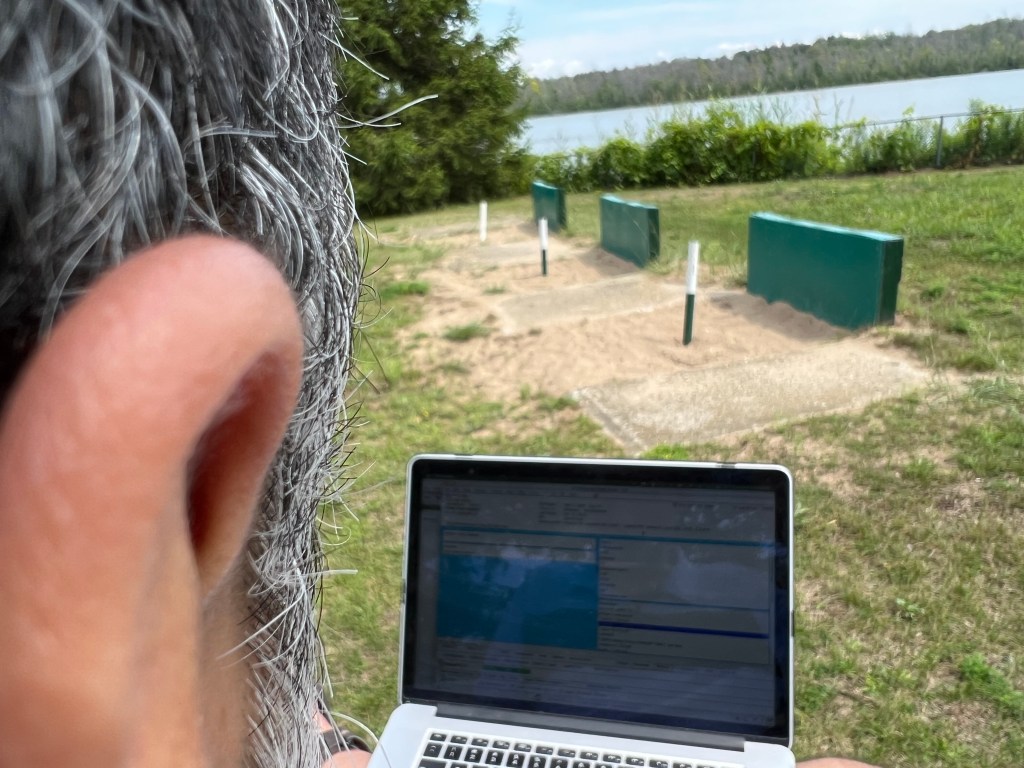
Me last summer, by a lake, on vacation, checking my office messages and lab work (dummy chart)
What can be done about this? How does one make family medicine more appealing? This may rub some people the wrong way but the first step is simple. Pay family physicians more. In Ontario, the most common fee billed by a family physician is about $37. (The last time I got a haircut, I paid $40). Out of that $37 the family doctor has to pay their nurse, receptionist, rent, cleaning, supplies and so on. Gets used up pretty quickly.
Additionally, you need to pay physicians for admin work. If there is 19 hours of admin work that needs to be done – it’s only fair that work is paid for. There are people who are skeptical this will work. To them I would point out that British Columbia has gotten 700 more family doctors since increasing the pay to family physicians.
You mean if you increase the income for a job, more people will apply for it? Who knew?
B.C. isn’t even the province that pays physicians the most. That’s arguably, as I have written before, Manitoba. Saskatchewans new deal is also much better than what Ontario offers.
The second aspect is to reduce the admin burden for all physicians. Many experts suggest this is a process that will take time. They are the same experts that oversaw the increase in Admin work for physicians with “oh it’s just one extra click or it’s just a simple form”.
To reduce the Admin burden significantly, one needs to drastically revamp digital health care. Get rid of eHealth Ontario and OntarioMD, and run all decisions through the Digital Health Branch of the Ministry of Health. It’s too late to unify all of our electronic medical records, but you can approve one (and only one) patient app that will allow patients to access and transfer their records to the physician of their choice to reduce duplication and waste. That’s the kind of bold steps that we need to take, not just crowing about the fact that doctors don’t have to sign hearing aid forms any more.
Look we already have 5,500 licensed family physicians in Ontario able to open up a practice. If 40 per cent did so, it would end this crisis immediately without having to resort to years long plans of modifying licensing and training requirements for foreign graduates (who in fairness are generally very good).
Do our leaders have the boldness and vision to do the right thing?
Dr. Deepa Soni, and Emergency Room physician for over twenty years, reflects on the case of a young woman with appendicitis, and the delays in getting her care.
NB: Recently, Julia Malott spoke out on X (formerly known as Twitter) about how terrified she was about Canada’s health care crisis. She wrote how her daughter had not eaten in 18 hours as she continued to wait for surgery for appendicitis. She expressed concern about the lack of the beds and wondered if her daughter would get surgery before the appendix ruptured.
My friend Dr. Soni, who has worked in an Emergency Department for over 20 years, had, as usual, a very thoughtful and well spoken X thread of her own. (Dr. Soni was NOT involved in the care of this young woman). I thank her for allowing me to reproduce her thoughts here.
The only way these stories (about long delays in Emergency rooms) will stop being the norm, is when patients start sharing their experience like this mother did. Only voters can make federal and provincial governments change because votes are the only currency that matter. Doctors and nurses have been raising alarm bells for years without success.
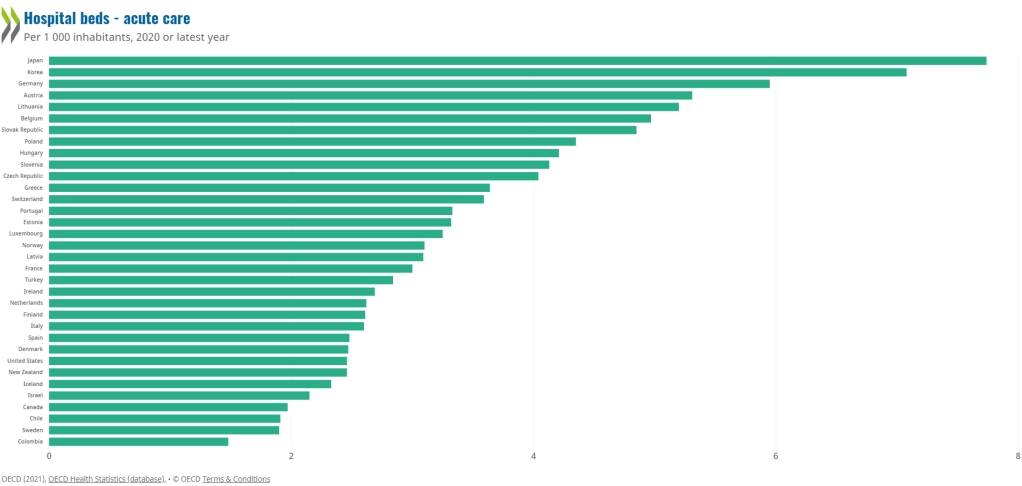
Graph showing how Canada fourth from the bottom (!) in hospital beds per capita.
Why does this matter? Having low hospital bed numbers means that words like “flu surge“, and “winter surge” — which have been used for decades to explain away long wait times and hallway medicine, are actually not “surges.” Rather, they are the expected backlog in a system that lacks adequate beds and resources.
The population of Canada is increasing and aging. We are about to enter a silver tsunami where a large cohort of our population will be over the age of 65 and many over the age of 85. This will place unprecedented pressures on our health care system.
What happens when the hospital bed capacity is outstripped by the numbers of patients needing care? It means that the elderly patient who needs admission to a hospital bed to recover from a heart attack has no bed to go to and spends days “admitted” in the emergency department. Bureaucrats call these “unconventional spaces.” What they really are, are stretchers.
Photo of admitted patients lying in stretchers in a hallway as no beds available (found on X)
When the vast majority of the emergency department beds are being used to take care of hospital patients, that means that patients that are waiting in the emergency department waiting room, will wait for hours for care, much like this story is describing.
Media needs to scratch beyond the surface and hold government to account. Real solutions are going to require thinking beyond the four-year election cycle. What will our system look like in 20 years? How do you plan for that?
It’s going to require recognizing the backbone of our healthcare system is primary care. Family doctors are overwhelmed by administrative burden, trying to run their offices and taking care of large practises in the community without adequate resources.
Build community infrastructure with resources like palliative care so that people can remain in their homes comfortably in their last days; and sufficient homecare services so that patients can receive antibiotics and other intravenous treatments at home to ease the pressure on hospitals. These services are vastly underfunded and do not have enough staff to properly provide care for everyone that needs it in the community.
It’s going to require building more nursing homes, retirement homes, seniors services and dementia care programs, as our elderly population will be the largest it’s ever been in this country.
Incentivize and properly pay hospital nurses so that we can recruit and retain them to be able to run departments and programs properly. Currently, agency nurses make at least two times as much as a hospital nurse, and this has created instability in the workforce. Governments need to show that they value nurses and the important work that they do.
Creative solutions like interprovincial licensing of doctors and nurses and a National Pharmacare program will help. While the idea of recruiting from other countries sounds like an easy quick fix, it will not solve anything if those newly obtained doctors and nurses find themselves overworked and burning out soon after arriving to Canada. The system problems are going to impact them just as they have impacted those who are already working in the system. This type of strain is what contributes to moral distress and burn out.
The backlog in the emergency department is a reflection of multiple failing areas that create an overall system that is strained beyond capacity. With each passing year, Canada’s healthcare system has become more and more stretched, trying to provide more care to more people, with fewer resources. Throwing Band-Aids at it is like trying to mop up the floor under an overflowing sink instead of trying to figure out how to turn off the tap.
Stories like this one are happening every day in Ontario and all of Canada. Most patients and families are too busy dealing with the acute health problem to take the time to write to their MP/MPP or to go to the media. But when people take the time to bring these stories to light, a critical tipping point will eventually occur where they can no longer be ignored by government. Because votes matter.
No one who went into healthcare wants to work in a system that makes patients feel like this story illuminated. But we need more voices bringing their stories out in the open. It will improve the system for the people working in it, and for the people receiving care within it. And that is better for everyone.
NB. I am a consultant for Medicte, a medical tourism firm that connects people with the Acibadem Health Group in Turkiye. I appreciate my two loyal fans may read this to be an “advertorial” – but it does represent how I feel.
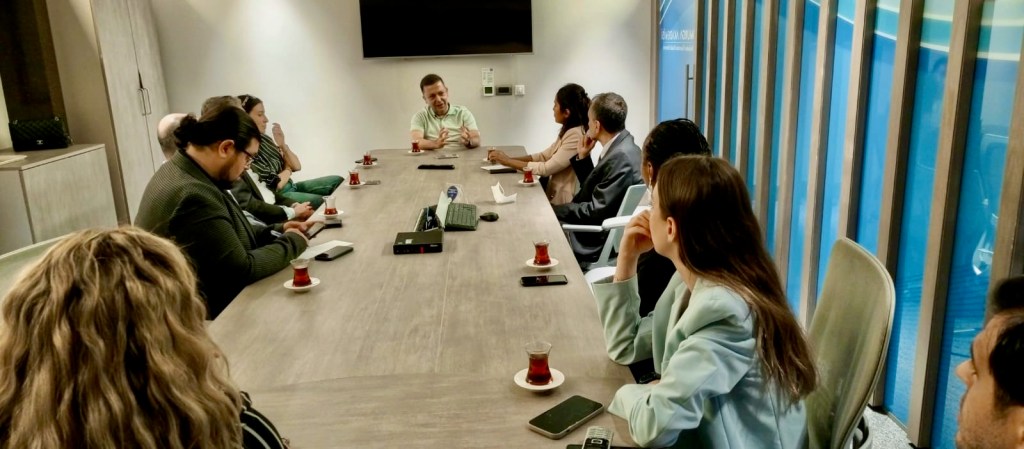
Yours truly at an Acibadem Hospital in Turkiye with their team and representatives from Medicte
Recently, Leger released the findings of a survey that polled Canadians on their thoughts about the health care system. 70% of Canadians worried about not being able to get high quality health care. Surprisingly, only 37% thought the health care system was poor – did 63% not need medical care recently? But the number that should demoralize all of us is that only 17% feel the system will improve.
Like everyone else of a certain age, I’m coming to the realization that the one fight I won’t win, is the battle against time. More of my friends and colleagues are developing health issues. While I’m blessed to be in good health, like 83% of Canadians, I realize that the current health care system (which doctors call horrific and inhumane ), will not provide the access and care we should expect as standard in this country. I can only see things getting worse in the near future.
It does not help that I live in the health system every day. I’ve watched patients I really care about suffer in ways that I would not have imagined possible. Young people with cancer not getting treatment for three months. People with joint pain waiting a year for surgery. Patients developing complication after complication while on wait lists to access necessary treatments.
Most heartbreakingly, I see the toll that the burnout of working in such a hellishly damnable health care system is taking on doctors, nurses and other allied health care professionals on a daily basis.
That’s why I recently made the decision that if I, or someone in my family needed health care, I would seek care outside of Canada. I am not alone in this. The data is hard to get at, but going back as far as 2014, between 52,000 to 217,000 Canadians were seeking health care outside of Canada annually.
There are a variety of reasons to seek care outside of Canada, and specifically Türkiye:
Getting immediate care. I could get hip surgery next week, not next year. Cancer patients get all the tests they need done within a week, not three months like I’ve seen.
Getting treatments that are not available in Canada. Canada offers a host of great medical treatments, but many are not covered by government plans. Lap Band surgery is one. New, emerging radiation therapies for pancreatic cancer is another. There are more. All of these are available in Türkiye.
Getting better allied health care support. Canada has GREAT nurses and other allied health care workers. But the system does not let them care for patients the best. Last time I was on call at my hospital, I overheard the nurses talking about how they each had 7 patients to look after for the shift. The safe number for an acute care hospital ward is 5 patients per nurse. We have excellent nurses but if you are constantly working at 40% over capacity, things are not going to go well. At the Acibadem hospitals in Türkiye, they have 4 nurses for 15 patients (3.75 patients per nurse).
More cost effective care. I’m fortunate I can afford to pay out of pocket for care if needed. Worst comes to worst I’ll put off retirement for a couple of years to pay for things if necessary. But even I would have trouble with $200,000 (U.S.!) that B. C. resident Allison Ducluzeau spent on her cancer care. Costs in Türkiye for most procedures I looked at are generally less than half of what it costs in the U.S.
First World Standards for Health Care Treatments. All of the Acibadem hospitals are JCI Accredited (the global leader in health care accreditation agencies). This puts them on par (and in some cases better) than top European hospitals.
As part of my consulting work, I went on a fact finding tour to Türkiye and visited the Acibadem hospitals. To say my jaw dropped would be an understatement.
The team and I reviewing the process for orthopaedic care with their top spine surgeon.
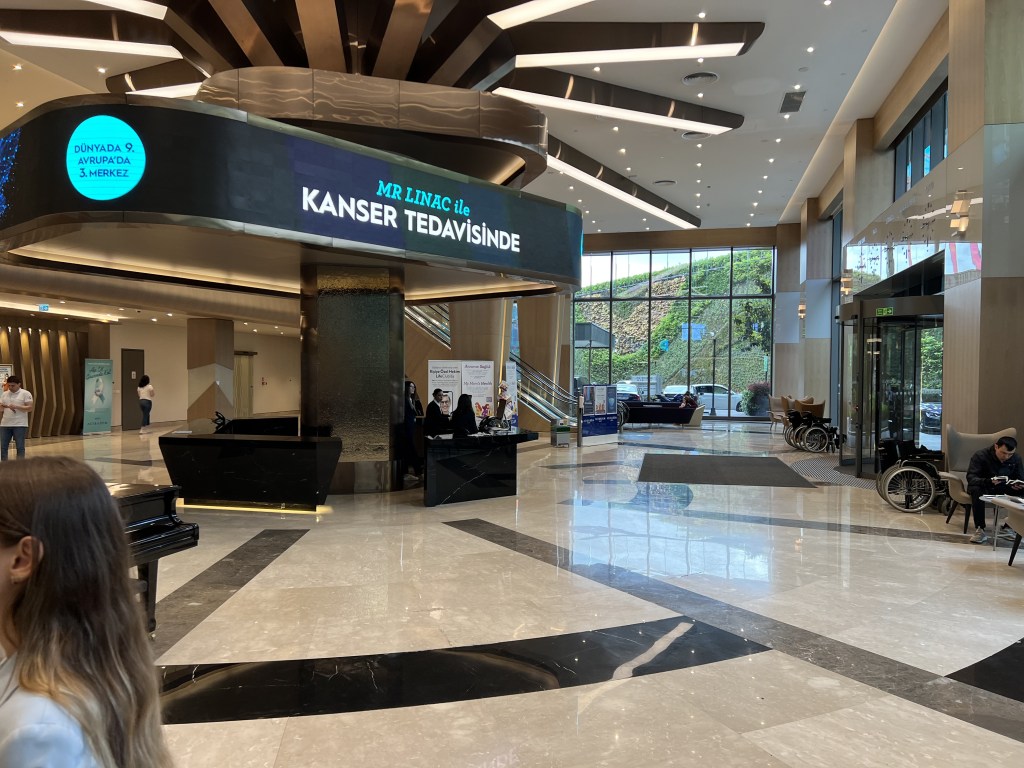
The hospitals (there are 21 in the Acibadem group) look like hotels. Each room is private. The wards are immaculate. All of the staff were incredibly attentive (and yes, spoke English).
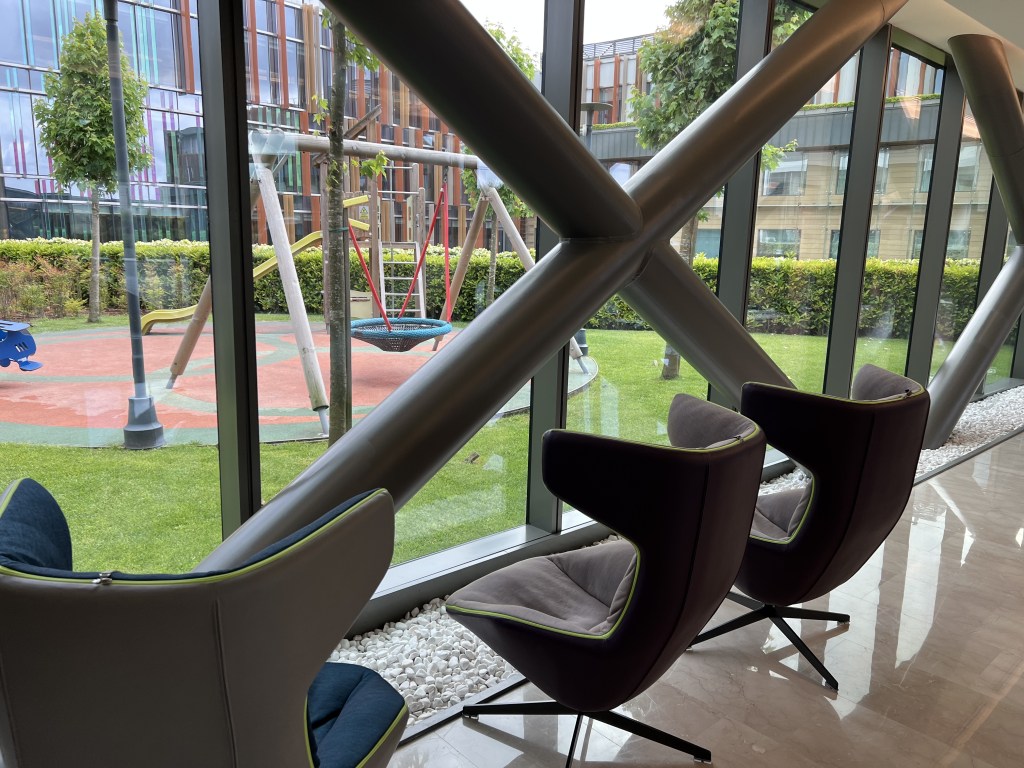
Waiting area at the hospitalInformation DeskHospital CorridorOverlooking a play area for children that is part of the hospital
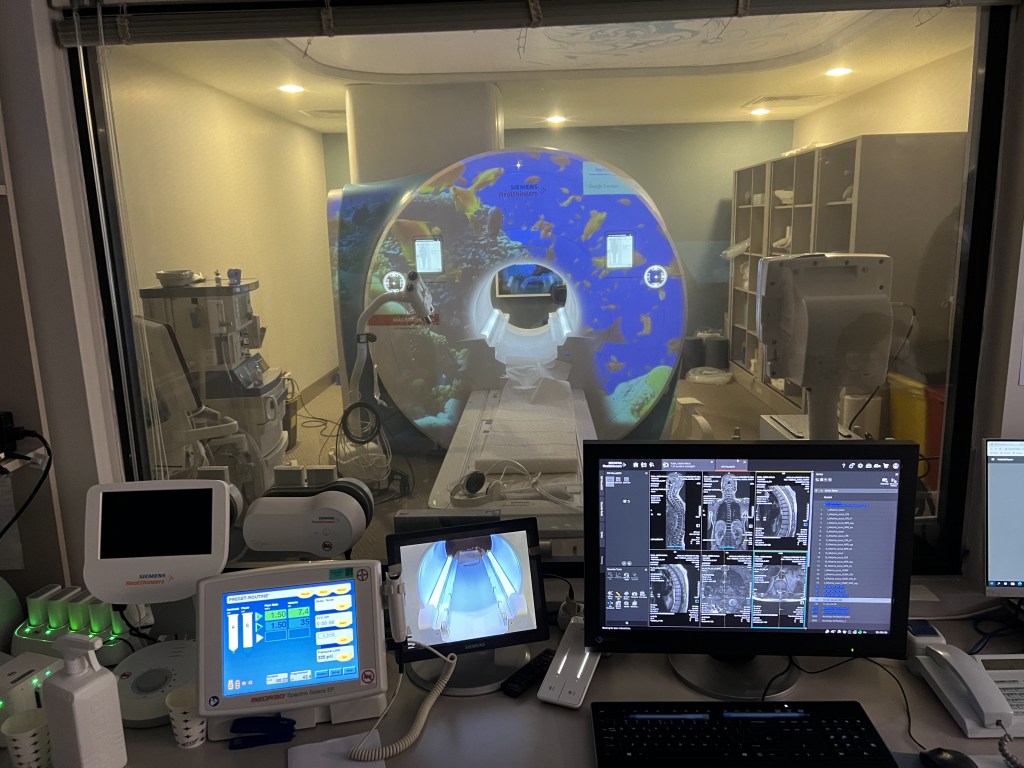
I asked to see the MRI, and the staff wanted to know which one (!). Their approximately 170 bed hospital had THREE MRIs, specialized for different conditions. This is on top of the CT scans, gamma knives (cancer treatment), PET scans etc etc. All of the equipment was brand new. I especially liked the MRI that projected a movie onto the equipment, to help children stay calm during the procedure.
This MRI projects a movie onto the surface to help children (and some adults) stay calm during a claustrophobic procedureA small selection of photos of the technology available at the Acibadem hospitals.
I also ran into a couple of top ranked Turkish footballers (soccer players) while there. The Turks are as crazy about football as we are about hockey. Their top athletes go to the Acibadem group.
But what’s more impressive than the top ranked doctors, nurses and equipment is their philosophy of how to provide health care. If you were to sadly, get cancer, you would see all the specialists you need to see (surgeon, medical oncologist, radiation oncologists etc) on the same day. Any tests you need would be organized sequentially and rapidly over the next couple of days (if not the same day). You would have a full treatment plan within a few days.
Contrast this with Canada where you have to have an appointment with one doctor, then wait x number of weeks to see another then x to see another like my patients currently do. All while the cancer continues to grow.
Also, for the record, I did wind up getting care myself at Acibadem. Bad teeth run in my family, and so I went for a dental check up. The dentist examined me, put in two fillings, got the oral surgeon to come by and took out two teeth that were beyond hope, all during the same visit. This would have taken multiple visits in Canada. You could say I put my money where my mouth is. And yes, the care was excellent.
I appreciate this sounds like an advertorial. But the reality is that more and more Canadians are getting frustrated with the long waits for health care and seeking care outside of Canada. It may have started off with people seeking lower cost cosmetic surgery, but now things like orthopaedic surgery, cancer treatments, organ transplants, dental implants and even cutting edge infertility treatments can be had for those willing to travel.
There is never a guarantee of a successful result with medical treatments anywhere (including Canada). If considering leaving the country for care, people should do their due diligence. Make sure you deal with a reputable firm and first rate hospital.
I’ve made my decision, and I know where I’ll go.
If you or anyone else would like to explore options for out of country health care, contact Medicte for a free consultation.
















































 justanoldcountrydoctor