Lots of talk on the net about how the economic model for family physicians no longer works in 2024. My own blog site has had guest posts dedicated to this issue. There has been some criticism of this position. Dr. Darren Larsen in a reply to the post linked above suggests he is “not seeing or hearing…ideas for solutions“. He further states that all paying doctors more will do is create a “better-paid, unhappy professional. Nothing has changed.”
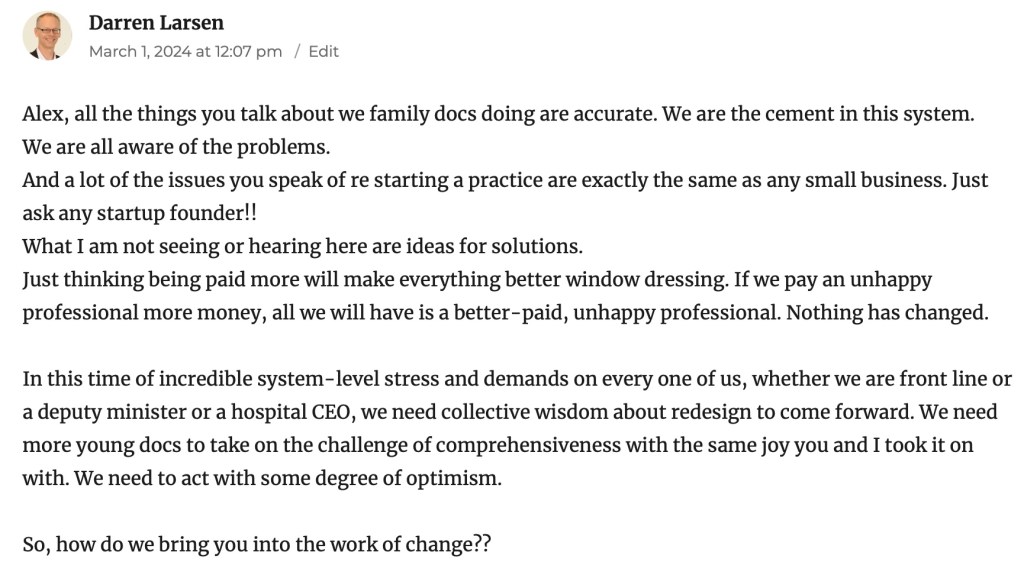
Others have made the similar comments. There is nothing philosophically wrong with the argument to reduce workload instead of raising pay. Practically speaking however, history has repeatedly taught us that the Ministry of Health (MOH) bureaucracy is incapable of delivering on that promise.
Some personal stories:
In the mid 2010s I was a Peer Lead for OntarioMD (no really!). I was frustrated by the Ontario Lab Information System (OLIS) because I had to manually retrieve all the lab work for a patient individually in their chart. Hospital Report Manager (HRM) by comparison, sends reports on all my patients directly to one inbox. (why we need two systems – and now more, is another story). The then VP of OntarioMD informed me they were working on “Practitioner Query” – which would allow me to get all my lab work from OLIS in one inbox. This was supposed to be ready in six months. That was over a decade ago.
From 2014-2018, thanks to the vision of my colleague Dr. James Lane, we developed an integrated health portal as part of our Health Links project for South Georgian Bay. For $35K a year, we were able to ensure that nursing homes could message physicians on their EMR. We dramatically reduced paperwork for physicians from nursing homes, improved health care outcomes, and reduced hospitalizations thus saving the entire health system money.
The MOH bureaucracy couldn’t wrap its head around this and wouldn’t allow it to continue.
For those of you who think I should have told people about this project, I wrote an article in the Toronto Sun about it. Afterwards, I got invited to do a presentation on this with the then CEO of eHealth Ontario and her senior team. Heck, when I was a keynote speaker at OntarioMDs Every Step conference in 2019 (no really!) I presented this project. The then head of the MOH Digital Health Team was there and heard it. Still, the bureaucracy couldn’t see their way towards allowing a project that saved physician time (and improved health care outcomes) could continue.
Ok, ok, so this blog is just for me to complain about not being listened to right? Well no, there are multiple other examples.
One workload issue for family physicians is keeping track of which of our patients get immunized for which vaccines. If only there was a central tracking system that sent the information to us directly. Wait, there is! The Covax system for tracking Covid vaccinations. Obviously the easiest and most sensible thing to do is expand the already existing system to add all the other vaccines so we get notified (eg when public health gives Gardasil). Yet 3 years after Covax, the MOH can’t even make this simple common sense change.
More? When I was on the SGFP Executive, one of our senior physicians told us the story of how he was on a working group to make the schedule of benefits (the fee schedule for Ontarios doctors) easier. After six months of meetings, they made a decision to add a comma to the descriptive sentence of one code. One comma in an 800 page schedule.
I could go on but you get the point. It’s fine for the MOH to say that that they promise to reduce the Admin burden for family docs. But frankly to these aged and cynical ears, it just sounds like them saying “This time we really mean it, honest!” – kinda like when Lucy promised to hold the football down for Charlie Brown for real this time, with predictable results.

Look, we have a five alarm crisis in family medicine in Ontario. Just about every week brings a story of another physician who is struggling with the economics of running a practice, and is considering quitting.
As with all emergencies, we need to have an effective triage system in place. Deal with the most urgent thing first, then go on to other things. We clearly can’t wait until 2034 for the MOH to implement some of the workload reducing schemes they might have (and no matter how much they promise they really mean it – it will take that long). So the first thing that needs to be done is bring financial stability to family practices so that they can continue to function while we sort out everything else.
Now, given Ontario physicians are in the midst of negotiating a new contract with the Ontario government, I expect the MOH team to say to our own negotiations team something like – “I know you guys want X% increase, but we can only give you 1/2 of that, but we promise to reduce your admin burden so you are working less hard”. I would do the same if I was them.
But, my expectation, and the expectation I think of the majority of doctors in Ontario, would be that the OMA negotiations team looks at the MOH team, and quotes the best engineer in the history of Starfleet to them.

The first step towards fixing the crisis in family medicine is a new physicians service agreement that stabilizes family practices. Once that’s done, work can begin anew on health systems transformation/workload reduction and so on. To try to do it the other way round, or even hand in hand, is a recipe for further collapse of the health care system.

















 justanoldcountrydoctor