The Appalling Treatment of Dr. Elaine Ma Is Hurting Health Care in Ontario

I’ve written about the horrific treatment that Dr. Elaine Ma has been subjected to by the bureaucrats at Ontario Health before. The situation is so ridiculous that it could be a story presented at the Theatre of the Absurd.

What happened?

Dr. Ma is a family physician from the Kingston area. During the Covid pandemic she realizes the need to immunize as many people as possible to protect the community. She organizes a number of outdoor mass vaccination clinics, which resulted in Kingston being one of the most heavily vaccinated areas of the province. For her efforts, she wins the very well deserved the praise of many, and an award from the Ontario College of Family Physicians.

There are two billing codes for providing Covid vaccinations. One for physicians who work in a vaccination clinic that someone else set up (e.g. public health). Another for those who set up the clinics themselves, and paid for staff/heating for outdoors/tents/internet etc. Since she paid for all of that, Dr. Ma bills the second code.

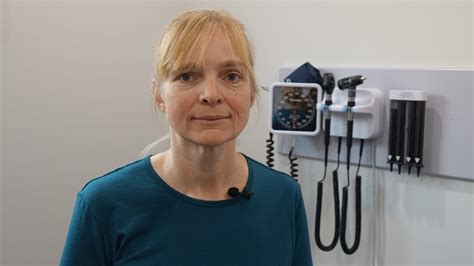
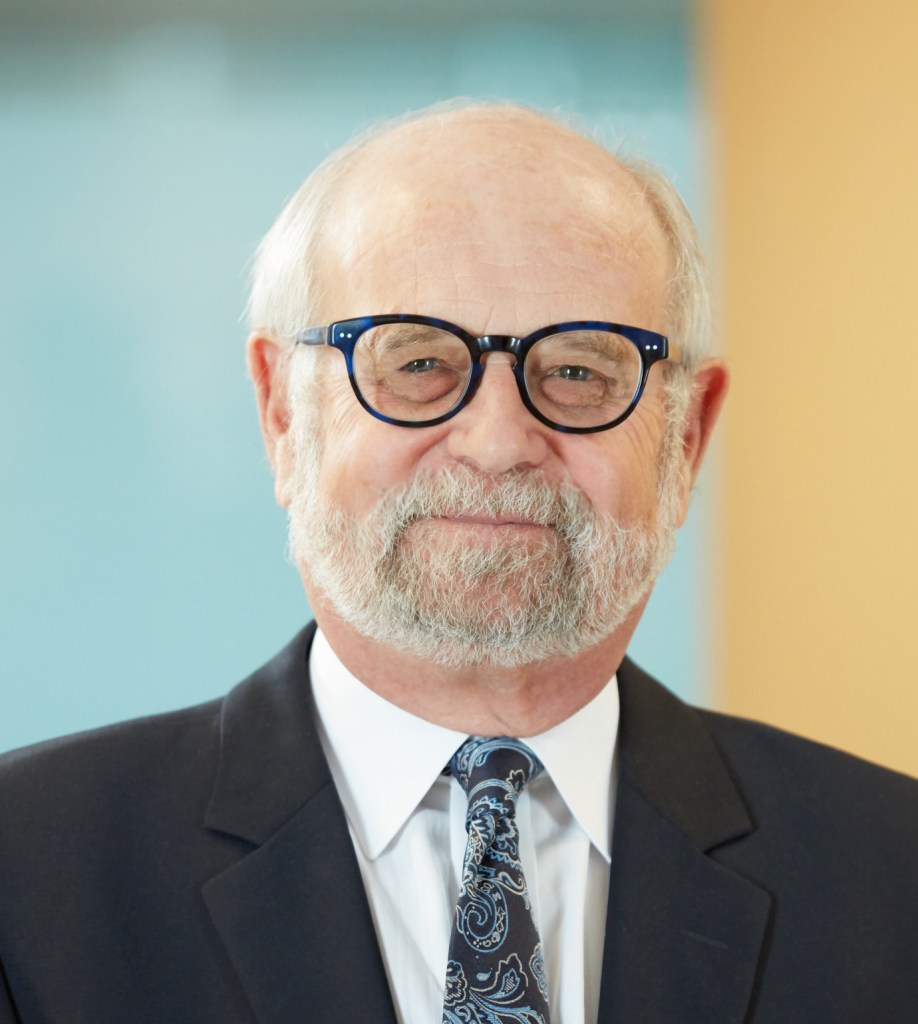
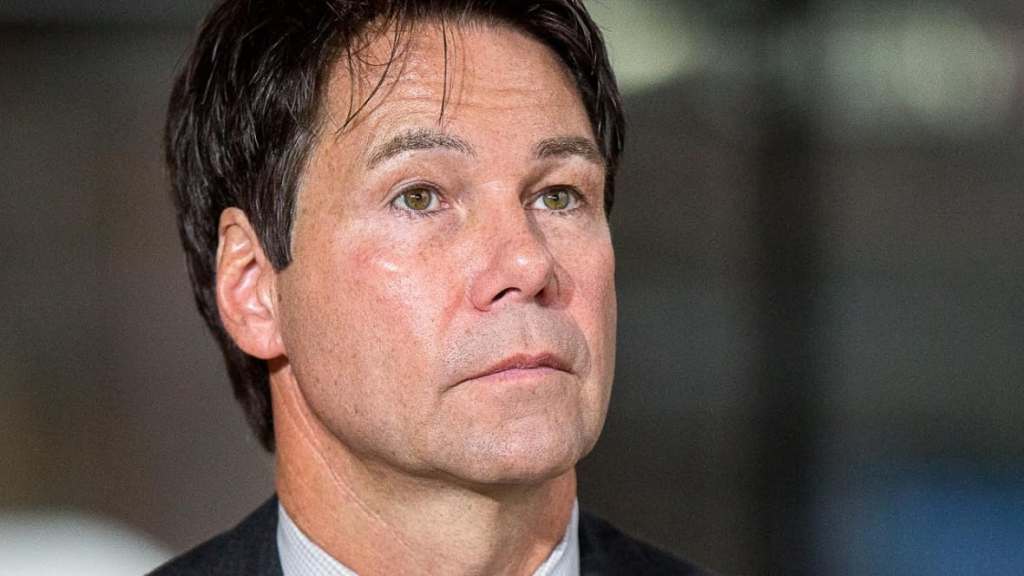
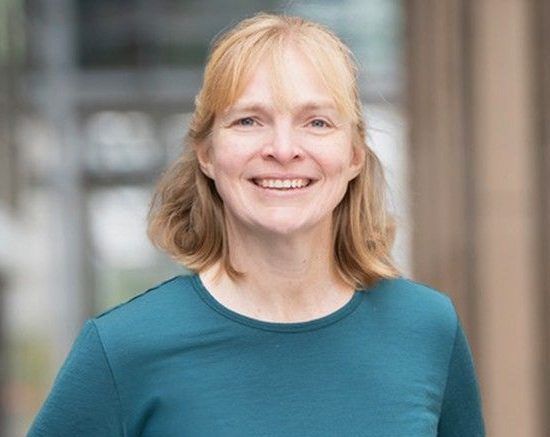
Dr. Elaine Ma

Fast forward a couple of years and the callous and unthinking bureaucrats at OHIP decide that she has billed the wrong code and demand she pay back $600,000. I won’t restate all the steps she went through to fight this. I will state that the reasons for them wanting the money paid back varied between the clinic being outdoors instead of indoors, medical students being involved and so on. But eventually the case winds up at Divisional Court.

On Dec 16, the court handed down a ruling supporting Dr. Ma. What I had failed to realize before is that the Ontario Health bureaucrats main argument appears to be that there were no extenuating circumstances during the time of the Vaccine Clinics that Dr. Ma set up. Yes, you read that correctly. The whole country was in the midst of a (hopefully) once in a lifetime pandemic. Canada was effectively shut down for business. People were not allowed to visit loved ones in hospital or nursing homes. Travel had ground to a halt. But, in the minds of the soulless and spiteful bureaucrats, none of this constituted “extenuating circumstances”.

Thankfully, Divisional Court Justices Matheson, Varpio and O’Brien were having none of this nonsense. They clearly stated the decision by bureaucrats that there were no extenuating circumstances was “unreasonable.” (I would have, and will, call that decision much worse things). The Justices pointed out the obvious. There was clearly a public health crisis at the time, and that many leaders, including politicians were calling on physicians to get the vaccinations done.

More importantly they stated something the OMA’s legal team really needs to take a deep dive into:

…”that the wording of section 17.5 does not limit relief to unpaid claims; it only requires the presence of extenuating circumstances. Since OHIP typically pays claims first and reviews them later, a restriction on unpaid claims would effectively nullify the provision. The court called this interpretation unreasonable.”

Currently OHIP pays physicians whenever they bill. Later, OHIP decides if it was reasonable or not, and if OHIP feels the situation is unreasonable, they demand the money back. The justices seem to be saying this process is not fair. Which has implications far beyond this one case. Obviously, this would not apply to clear cut cases of fraud. It is a much much needed kick to the slow, incompetent, and spiteful OHIP review process. I can’t possibly understand the potential future implications for this – but I suspect there will be many.

Finally, the justices let their displeasure be known by ordering OHIP to pay Dr. Ma $10,000 in court costs. This strongly suggests to me that they were peeved at the OHIP bureaucrats for taking it this far, and really didn’t think it should have gone there.

How is this hurting health care now?

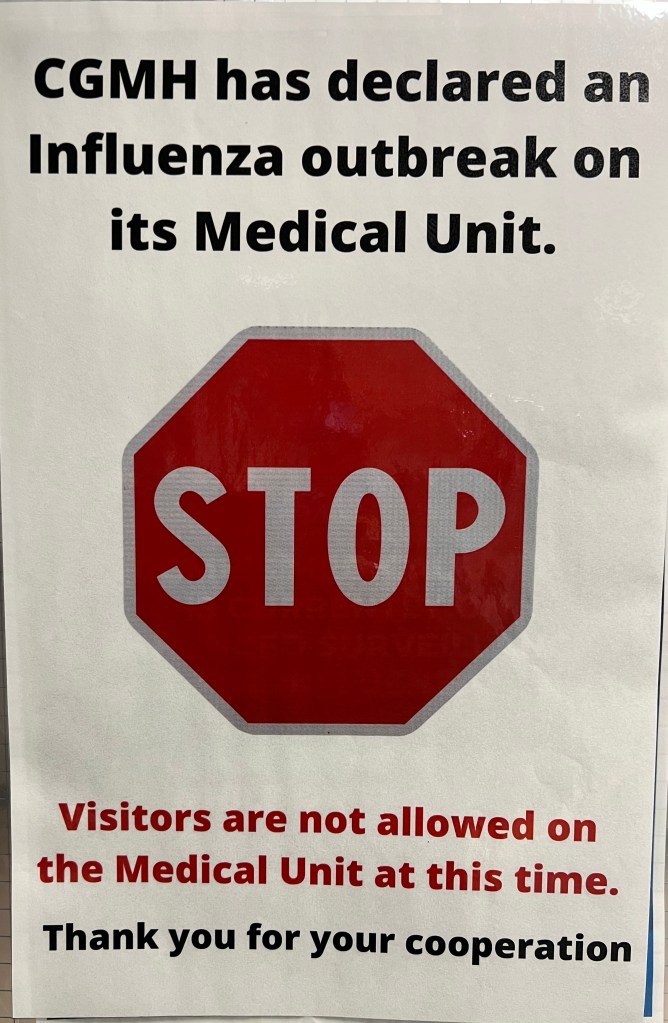
Ontario is currently seeing an unprecedented surge in flu cases. Flu season has come early. The current variant appears to be extremely strong. It is circulating at “sky high” levels among young people. Three children (at least) have died. Hospitals have declared outbreaks and wards are closed. Visitation has stopped.

Sign on the door to the Medical Ward of my Hospital

You know what would really help? If only some people would come up with some innovative ways of getting their communities vaccinated against the flu. Yes this year’s flu shot is a bit of mismatch for the current strain, but it still provides some protection and keeps you from getting really ill.

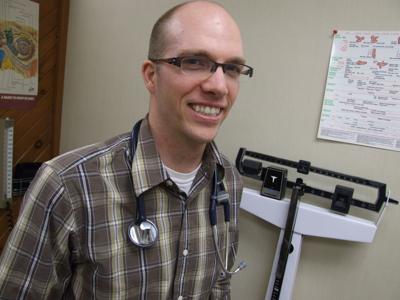
Or how about an innovative idea for where to safely look after patients like was done during the Covid crisis. My friend Dr. Bryan Recoskie set up a unique 18 bed ward in our local Legion, to look after non-covid patients while the hospital wards were shut with covid positive patients.

Dr. Bryan Recoskie

And yet, I don’t see any of that happening right now. Don’t get me wrong, doctors continue to go to work. We continue to care for the sick and continue to comfort those in need. We continue to do our best in these trying circumstances.

But I can’t find any evidence (please correct me if I’m wrong) – of where people are doing unique out of the box things to try and mitigate the currently unfolding nightmare. Given the potential exists that IF you try something unique, you may wind up undergoing two years of pure hell by bitter, ruthless and depraved bureaucrats – can you blame people for not trying?

To quote a good friend of mine, “The damage has been done. Nobody is going to stick their necks out now.”

What should happen (but won’t):

First, under no circumstances should OHIP appeal the decision from Divisional Court. The mercilessly inhumane bureaucrats need back down. Second, Health Minister Sylvia Jones needs to do what she should have done a year ago – and direct the bureaucrats not to seek any recovery at all from Dr. Ma. It’s just the right and decent thing to do.

Finally, it would really help if Minister Jones issued a formal apology to Dr. Ma for how she has been treated by the bureaucrats. It’s not just the OHIP bureaucrats. Jones’ own communications director, Hannah Jensen claimed Dr. Ma had “pocketed the funds“, a statement that clearly suggested malfeasance.

Do that, and maybe, just maybe, physicians would once again feel comfortable coming up with out of the box solutions for crises that are occurring.

Maybe.

The FHO+ Model Alone Won’t Save Family Medicine in Ontario

Disclaimer: I’ve looked through the OMA page on the FHO+ model and interpreted the data as best I can, BUT, this information should NOT be used by others for their own financial planning – they should review the data for themselves. Additionally, because this is a complex model – if the OMA’s Negotiations Task Force feels there are mistakes – I would be happy to correct those.

Last week, the OMA announced that they and the Ontario government had developed an enhanced model for paying family physicians. In Ontario, the most popular model for paying family physicians is something called the Family Health Organization (FHO). More physicians would choose it, but in typical unthinking and regressive fashion, the bureaucrats at the MOH convinced the government to limit entry into that model in the 2010s – because you know, why would you want people going into family medicine to have their preferred payment model? What were they going to do? Stop working as family doctors? Sigh…..

The OMA website states the new FHO+ is the “Future of Family Medicine” and talks glowingly about how this will “bring back the joy of family medicine, and build a foundation to support recruitment and retention”.

It’s always tough to break things down with a new model, and there are a lot of variables and enhancements to review. I encourage all family physicians to watch my friend Dr. Adam Stewart’s set of truly excellent videos on this new model.

For my part, I consider myself to have a medium sized practice. I therefore looked at Dr. “B” on the OMA’s web page to come up with my thoughts. (Note to OMA – come up with some better names for the doctors!)

  1. How much of an increase in income am I going to get?

According to the OMA site, I should expect an increase of 13% of my gross income. But it’s not clarified what the baseline for that increase is? Is it this year’s income? Last year’s? So I emailed the OMA and was given this answer:

“The base rate the parties agreed to use in our costing was FY2023/24, keeping in mind the last permanent increases were on April 1, 2023, the recent years 2.8%, 9.95% and the monthly relativity for FY2024/25 are all temporary and will end on April 1, 2026.”

Alright, some more math (my apologies). Let’s use fiscal year 22/23 to start. Let’s assume I grossed $X in that year. For FY 23/24 – that was the last year of the previous PSA and we got a 2.8% increase in fees. So I grossed $1.028X that year. FY24/25 was year I of the current PSA and we were awarded 9.95% by the Arbitrator (compounded to the 2.8%). Because there was no agreement on how to divide it up, it was distributed equally among all docs. So I grossed $1.13X.

Still with me? This year, FY 25/26, by mutual agreement, there was a relativity based increase from the original FY 22/23. FHO docs like me got 11.7% so this year, for now, I will be grossing $1.117X. This is down from last year but may change based on whatever happens in Arbitration.

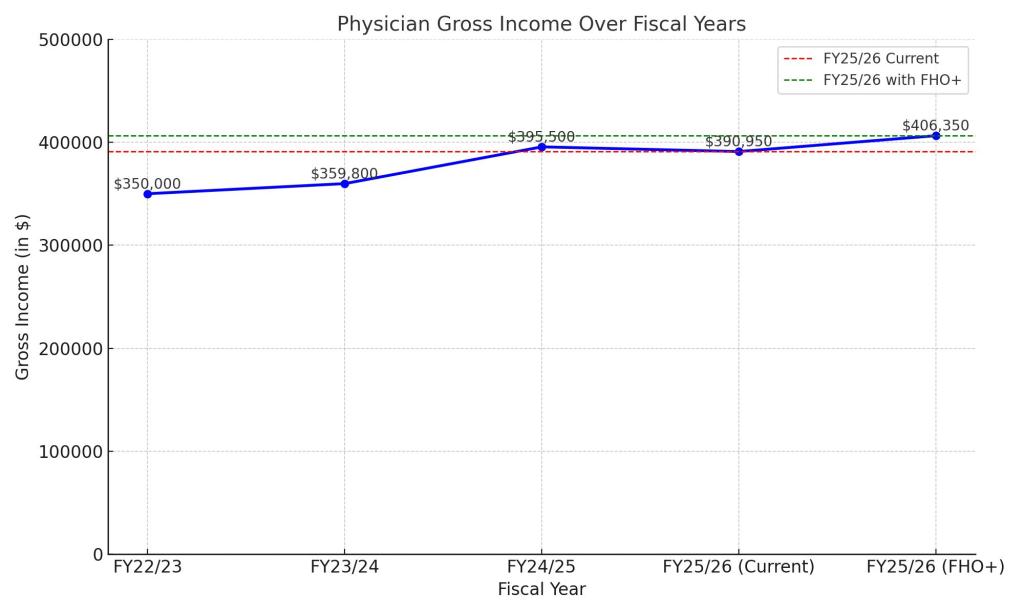
Based on the OMAs reply, if FY 23/24 is the base year they used in their calculations (when I made $1.028X) then and increase of 13% on that will translate to $1.161X. In essence, if FHO+ goes through, it will mean a 4.4% increase for me next year, compared to this year (1.161-1.117) and a mere 3% more than last fiscal year. Better than nothing? Sure. Is it the major dollar influx needed to save family medicine? I think you know the answer to that.

Graph showing a hypothetical growth in gross income for a category “B” family physician who billed $350,000 in FY 22/23

2. How will rural medicine fare?

One of the things that strikes me about this model is that effectively, rural medicine will not do as well. Now, in fairness, there are attachment bonuses for taking on new patients, and those bonuses are higher in rural areas. So there is that. But my understanding is that rural doctors are working overtime anyway and not really able to take more patients right now.

But what should be noted is that in the OMA calculations, the assumption has been made that doctors are getting at least some access bonus currently. So let’s look at Dr. Rustic and Dr. Metro, a rural and urban doc.

Let’s assume they also fall into category “B” as per the OMAs example. It is well known that urban doctors, despite how hard they work, have challenges getting the access bonus. Dr. Metro currently gets an access bonus of $0 because there are five walk in clinics with 15 minutes of her office. This is despite her group working after hours care. Dr. Rustic on the other hand, gets $25K in access bonus, mostly because his group is the only game in town.

With FHO+ the access bonus gone and repurposed to pay for other items (and that is a very good thing as my friend Dr. Mark Linder pointed out) in effect, Dr. Metro’s raise will be $25k MORE than Dr. Rustic’s. I don’t begrudge Dr. Metro the income, she deserves it. But in order to recruit in rural areas, we’re going to have to find a way to bump Dr. Rustic’s income more.

3. What exactly will the Accountability Metric be?

This is of course, the great unknown. These metrics are often presented as “reasonable” and then governments always find a way to make them unreasonable. We won’t know the answer to that until after Arbitration.

Final Thoughts

At the end of the day, I think family doctors as a whole need to realize that FFS family medicine has gone the way of the Dodo bird (I know this will upset some FFS purists). The government also seems to recognize this and as part of the agreement is increasing the number of FHO+ positions.

Dr. FFS, Family Physician

Despite some of the concerns above, I do think that FHOs should migrate to the new model. It is slightly more money, and I do wonder if by tweaking your practice more – the amount can go up. For example, I have about 200 patients whom I have not rostered because of outside use issues – I would now roster them – and this would increase my income even more. So I suspect there is potential to make more than a 4.4% increase if you manage your roster well. Looking at increased shadow billing rates also offers some potential for more growth.

However, saving family medicine requires a multi-pronged approach that requires a single, unified health information system, family practice teams with physicians clearly placed as the leaders of the teams (with funding for leadership roles) and much more than a 4.4% increase in income. So take the money for now, but don’t in anyway shape or form believe that this in and of itself will fix family medicine.

MOH Pleasantly Surprises (!) and OMA Disappoints in Arbitration Briefs

As I write this, yet another round of Arbitration has begun between the Ministry of Health (MOH) and the Ontario Medical Association (OMA). This time, the goal is to provide a contract for years 2-4 for the Physicians Services Agreement (PSA). As was pointed out to me on social media (thanks Jane and Lisa), year 2 of this current PSA cycle began on April 1, 2025. Yet again, physicians are going to be due retroactive pay for whatever the Arbitrator decides.

Lawyers from both sides have prepared rather thick legal documents called “briefs”. (Proof number 4,638 that lawyers have a rather weird sense of humour). These briefs are public.

I’d be lying if I said that I had thoroughly understood the briefs from both sides. The excruciating agony in trying to parse the language in these things would make having a kidney stone preferable. But these are my humble thoughts from trying to do so….

  1. The MOH team appears to have learned their lesson from last time.

To be abundantly clear right off the bat, the MOH offer for physicians is too low. They are clearly undervaluing doctors in their stance and if the Arbitrator was to accept their position, it would spell further disaster for health care in Ontario.

But….

As I mentioned in my last blog, offering low is what you expect from the other side. It’s part of posturing for the Arbitrator and I’m genuinely not ruffled by it. What would have been unacceptable is they had refused to recognize the severity of the health care crisis like they did last time. Or if they had once again repeated the truly stupid statement that they weren’t concerned about the shortage of comprehensive care family doctors.

Additionally, the MOH has actually agreed to enhance family medicine models through the “FHO+” program, and has agreed to spend a large chunk of the funds on family physicians, an area of the health care system that is dire need. In essence, they admit that there is a problem with a shortage of comprehensive care family doctors. (NB – I will have my thoughts on the FHO+ model sometime early next week).

To re-iterate, there are still a number of problematic issues with their arbitration proposals, including the too low wage increase, the hopelessly complex method of “accountability” in the FHO+ model, a laughable statement that attachment bonuses for Complex patients will begin on July 1, 2025 when the Arbitrator won’t even rule on this until September or October of this year.

But their position is at least not stupid, and certainly not enough to make me go off like last time.

2. The OMA Disappoints With Their Brief

Once again, to be fair, there is a lot to like in the OMA Brief. There is a good analysis of the economic picture in Ontario, a great analysis of the the delays in care, the crisis in family medicine, hard hitting information about the challenges of recruiting and retaining physicians, superb advocating to relieve the admin burden and a clear explanation of why many Alternate Payment Plans are outdated.

Alas, there is once again a “but” here…..

All of the above is what one should expect from a representative organization. One should however, also expect that organization to advocate strongly to make sure their members get their increases in a reasonable time. And it’s here that the OMA falls (badly) flat.

One of (if not THE biggest) issues for physicians these past couple of years has been the constant delays in getting the increases the Arbitrator awarded them in a timely manner. Just recently the MOH unilaterally announced a delay in paying the retroactive funds owed physicians. This is amongst a series of delays all attributed to an ancient and decrepit computer system at the government. (They’ve been making this statement for well over a decade, and very tellingly, have NEVER bothered to upgrade their system).

While the last 4 pages of the OMA Arbitration Brief does a nice job of outlining the issue for the Arbitrator, including the consequences of the MOH incompetence (physicians will simply stop doing certain procedures), the remedy the OMA seeks is milquetoast at best. From the Arbitration brief (edited):

“As a result, the OMA requests, as is normal and customary, that this Board of Arbitration remain seized with respect to any issues arising from the implementation of this Award……….

“….with the OMA reserving its right to seek appropriate remedies (e.g. interest) in the event that the Ministry fails to meet agreed upon or directed implementation dates, particularly where the Ministry is unable to provide justification for any delay, or otherwise where the delay is unreasonable and unwarranted.”

That’s it?? All this means is that WHEN (not if – we all know the MOH can’t get their act together) the next payment delays show up, all that will happen is the OMA will complain to the Arbitrator, then there will be more hearings, and those hearings will go on for months/years and then finally, the Arbitrator MAY announce penalties to the MOH. The only good that will come out of this is that a bunch of lawyers will get rich going to repeated hearings.

What’s worse is the OMA readily admits they know the Arbitrator “favours accountability measures” in their video on the new FHO+ model (around the 3:36 mark). So doctors have to be accountable to follow an agreement, but the MOH can wiggle out and delay? The OMA can’t advocate for accountability to go both ways?

EVEN worse is that in reading the MOH briefs, they actually clearly lay out what accountability measures they want from physicians. Page 92 specifically outlines what accountability they expect from family physicians in the new FHO+ model, and how the penalties will be implemented if physicians don’t meet those accountabilities. No “seizing of the Arbitration Board” or any such thing. Now I disagree wholeheartedly with the MOH stance on this – but at least they clearly outlined what remedies they are seeking without the need for further drawn out processes. The OMA couldn’t have done the same thing??

Overall, this Arbitration hearing appears less contentious than last time, and the gap in asks is smaller overall. Hopefully this means a quicker resolution. But while there is a lot of good stuff in the OMA brief, it’s hard not feel let down by the subservient, almost nonchalant attitude the OMA is taking on payment delays. Sure looks like a golden opportunity to address this was missed.

What to Look For in Next Weeks Arbitration Hearings

As I write this, it appears that once again, the Ontario Ministry of Health (MOH) and the Ontario Medical Association (OMA) have been unable to agree on a contract for physicians. We are again heading for Arbitration on June 30, with hearings all next week. A slim chance exists that a last minute deal will be struck – but I highly doubt it.

The MoH and OMA Negotiating

Up until now of course, the negotiations have been held under a strict cone of silence. There is no public knowledge of what has really been said between the two sides. But Arbitration in Ontario is public. The MoH and the OMA will have to publicly disclose what they are asking the Arbitrator to award.

Some Things to Remember:

These arbitration hearings are a continuation of last years hearings. Last year the Arbitrator only set an award for the total dollar amount to be given to physicians for the FIRST YEAR of a four year contract. This year’s hearings were originally slated for March of this year, but the Arbitrator delayed them until June. He wrote:

“The issues discussed have been far-ranging and include various implementation matters, the allocation of the Year 1 targeted funding, and complex and significant physician compensation issues for Years 2, 3 and 4.”

and:

“…the Board of Arbitration is now directing that the arbitration proceedings over any remaining Year 1 targeted allocation issues, and over physician compensation and all other issues for Years 2, 3 and 4, now take place over four days during the week of June 30. ”

These hearings will be a lot more complex than last years, and will have a lot of moving parts. Not only will the Arbitrator decide on how much of an increase will be allotted to physicians in years 2-4, but he will decide on how the targeted funds are distributed. Remember that 30% of the year one Award (approx $480 Million) was to be “targeted” for areas of health system need. Because of the malignant obstinacy of the MOH’s negotiations Team, the OMA and MOH have not arrived at an agreement on how to distribute these funds. So now the Arbitrator will rule on that.

Not only that, but there is the issue of how much of an increase each specialty should get. There was general agreement between the MOH and OMA the last couple of times that 25% of any increase would be given to across the board raises for all members, and the remaining 75% would go to relativity based increases. But the two sides have never really agreed on how the 75% would be split between various specialties. Reading the statement from the Arbitrator makes it sound like he will decide that too this time. (Of course now that I write this there probably will be yet another process announced after this which will mean more negotiation and arbitration).

Last year by my very rough count, the OMA and MOH submitted over 1,400 pages of documents (ironically called “briefs”) just to determine what percentage increase should be given to physicians. I can’t imagine how big the “briefs” will be this time. I won’t be able to go through them without gouging my eyes out but I do know what we should be looking for.

Has the Ministry of Health’s Team Smartened Up?

Look, both sides are going to “posture” for the Arbitrator. As part of that, the MOH will significantly undervalue physicians and offer a pittance. We should expect that and NOT get all worked up about it.

Unless…..

Last time, the MOH team went far beyond posturing. They showed nothing but contempt for physicians and an utter and complete lack of understanding of how health care works in Ontario. The MOH teams statement that there was “no concern” about a shortage of comprehensive care family physicians while the media was full of pictures of people lined up for hours for the mere hope of getting a family doctor, set a new bar for stupid government statements. The fact that they lied to the Arbitrator saying there was no crisis in family medicine until being forced to release documents proving otherwise made me wonder if a Court Jester was their spokesperson.

A Court Jester who, given the accuracy they present, could probably be a great MOH Spokesperson

It will also be telling when reviewing the MOH briefs exactly where they feel health care is most lacking in Ontario. Do they propose more investments in family medicine? How much for each specialty? In the last couple of negotiations the MOH has tried to alter the Family Health Organization (FHO) contracts on how family doctors are paid. What changes do they propose this time?

Finally – it will be VERY telling how the MOH wants to spend the $480 million in targeted funds. Will they try to skirt paying physicians for it? For example, will they propose to pay certain physicians to hire an allied health care practitioner, saying “well it will reduce your workload”, all the while demanding copies of proof you are paying that person in triplicate? Or some such thing.

I appreciate the above may sound far fetched, but the MOH Team has proved itself to be so incompetent and borderline vengeful that a scenario like that wouldn’t surprise me in the least.

What About the OMA Briefs?

In comparison, the OMA’s job is relatively easy. They simply have to advocate for increases that will make each of their many sections 100% satisfied and not complain……

In all seriousness, OMA briefs will also tell the profession a lot. I imagine each of the sections of the OMA will pour through the documents and send information to their members. But in short order we should all see how much of an increase the OMA has concluded each specialty warrants, and how the OMA plans to handle the perpetually thorny issue of relativity.

Additionally, the OMA has repeatedly point out that we have a shortage of comprehensive care family doctors. They’ve used the word crisis more than once to describe this. So as a family doctor, I am eager to see what changes they propose to the FHO model as well.

Most importantly, will the OMA be aggressive in defending its members? These last couple of months had seen absolutely unacceptable unilateral decisions by OHIP, delaying payments to physicians and making mistakes on their remittance . The OHIP bureaucrats blame their old outdated computers. Of course, when they plan to recoup the 9.95% they overpaid for the preventive care bonuses this past month – the OHIP computers magically managed to figure out how to get the money back immediately.

Will the OMA finally demand in their Arbitration briefs some sort of penalty for OHIP screwing up? Remember, the fee changes as a result of this contract are to come into effect on April 1, 2026. Given the Arbitrator likely won’t hand down a ruling until the fall, there is no way OHIP will get their act together in time without……..encouragement. Penalties/Interest for delayed payments should absolutely be demanded by the OMA.

All in all, next week, physicians will learn just how both the OMA and MOH feel about them. Buckle up folks……

Survey on Delayed OHIP Payments

NB: The following is a guest blog, written by the (anonymous) author of the survey I referenced in, “Will the OMA Learn Lessons from OHIPs Latest Attack on Doctors?“. While it’s true these surveys tend to attract negative responses by their nature, the rather large number of respondents (especially compared to some of the OMAs own Thought Lounge surveys), suggests the OMA really needs to pay attention to the extreme dissatisfaction this issue has caused. My thoughts follow at the end.

The purpose of this survey was to highlight to the OMA the need to take this issue more seriously and to outline the impact the delayed payments had on members. The OMA’s response to this has been tepid. At the time the survey responses were collected, the payment timeline for November and December, 2024 retroactive pay was set as November, 2025. This was changed to August, but this does not alter the fact that the MOH has repeatedly delayed payments for physicians over the years.

Even with a signed, public agreement, the MOH has not managed to uphold its obligations, yet the OMA seems resigned, on behalf of its members, to accept whatever delays happen, based on whatever excuse the MOH provides. The members are not the cause of the MOH’s problems, yet they pay, over and over, for these deficiencies.

The survey results are summarized below. As a practicing physician, my time is at a premium, so I utilized AI to summarize the main findings of the survey.

Technology willing, the full survey results are here. Survey Monkey dashboard is here.

AI-Generated Summary of the Full Survey Document:

The survey responses reveal widespread dissatisfaction among Ontario physicians regarding delayed payments, systemic issues in healthcare administration, and inadequate advocacy by the Ontario Medical Association (OMA). Key themes include the impact of late payments, financial hardship and impact to personal finances.

Many respondents reported being unable to meet financial obligations, pay taxes, or fund discretionary purchases due to delayed payments. Some had to take on debt or cancel planned expenses like maternity leave benefits, vacations, or home down payments.

Clinic Operations:

Clinic owners faced cash flow disruptions, inability to pay staff, and delayed renovations. Others mentioned the administrative burden of tracking payments and rejected claims.

Mental and Emotional Toll:

Physicians expressed feelings of moral injury, frustration, and discouragement, with some considering early retirement or leaving the province entirely. The delay has eroded trust in the Ministry of Health and the OMA.

Lack of Accountability:

Respondents described the Ministry as untrustworthy, disrespectful, and adversarial, with unilateral decisions that breach agreements. Many called for interest payments on delayed funds and legal action to hold the Ministry accountable.

Systemic Issues:

Complaints included outdated payment systems, rejected claims, and lack of transparency in billing processes.

Weak Advocacy:

Many respondents felt the OMA failed to advocate strongly for physicians, with delayed and insufficient responses to the payment issue. Some called for legal action, media campaigns, and stronger negotiation tactics.

Loss of Trust:

Physicians expressed frustration with the OMA’s perceived lack of power and transparency, with some questioning the value of membership dues.

Declining Appeal to Practicing in Ontario:

Many respondents are considering leaving Ontario or medicine altogether due to poor compensation, lack of respect, and systemic challenges. Some noted that other provinces offer better pay structures and support.

Family Medicine Crisis:

Respondents highlighted the lack of investment in family medicine and primary care, with concerns about burnout, scope creep, and inadequate funding.

Rejected Claims:

Physicians reported valid claims being rejected by OHIP , causing financial losses and administrative burdens.

Delayed Payments:

Delays in flow-through funding, parental leave benefits, and relativity-based fee adjustments were frequently mentioned.

Outside Use Penalties:

Respondents criticized penalties for outside use, especially when patients sought care elsewhere due to hospitalizations or urgent needs.

Recommendations for Advocacy:

Demand Accountability:

Push the Ministry to honour agreements, pay interest on delayed funds, and improve payment systems.

Increase Transparency:

Advocate for clearer communication about payment timelines, rejected claims, and billing processes.

Strengthen Negotiation:

Take a more aggressive stance in negotiations, including legal action and public campaigns to highlight the Ministry’s failures.

Support Physicians:

Address broader issues like rejected claims, outside use penalties, and inadequate funding for family medicine and specialists.

Conclusion:

There have been severe financial, emotional, and operational impacts of the delayed OHIP payment. There is an urgent need for the OMA to advocate more forcefully with the Ministry of Health to address late payments and systemic issues affecting Ontario physicians. Physicians are calling for immediate action, including interest payments, stronger advocacy, and accountability from the Ministry of Health and the OMA. The dissatisfaction expressed by respondents highlights the risk of losing physicians to other provinces or professions if these issues are not resolved.

An Old Country Doctors Thoughts:

While the above was written by my colleague, my personal thoughts on the survey is that I’m not really surprised by the results. I try to “keep my ear to the ground” so to speak, and there is a broad level of dissatisfaction with how the MOH repeatedly gets away with violating its own signed contracts, and the frankly abject level of incompetence at the MOH. The incompetence is unfortunately, not limited to just their payment systems/processes, but also how they run health care in general.

I’m also not surprised by the negative comments towards the OMA. Admittedly (as mentioned before) these surveys tend to cater to negative responses. However, there is a real sense of defeat on the ground about how physicians are being treated by the current government (protracted arbitration, stupid statements about the family physician shortage, and more). My sense is most physicians are resigned to defeat and are disengaging from health care – which is bad for the whole health system.

It does not help frankly, that a few short days after being told physicians would not get paid on time, OMA CEO Kim Moran was quoted in an Ontario Government News release on Primary Care saying:

“Ontario’s doctors are encouraged by this announcement and look forward to working with government to ensure that every Ontarian has access to a family doctor. We will do everything we can to accelerate this goal by collaborating with Deputy Premier and Minister of Health Sylvia Jones, and the lead of the Primary Care Action Team, Dr. Jane Philpott. It’s a long road ahead but this is a positive step forward to protecting Ontario’s valued health care system.”
Kimberly Moran
CEO, Ontario Medical Association (OMA)”

A very well respected physician from another province told me after seeing this: “It’s a bit pathetic. Screw us over and we’ll still be nice to you”. Personally I think Ms. Moran should look up “Stockholm Syndrome“.

I’ve repeatedly said you cannot have a high functioning health care system without happy, healthy and engaged physicians. These survey results suggest that that isn’t the case in Ontario.

Will the OMA Learn Lessons from OHIP’s Latest Attack on Doctors?

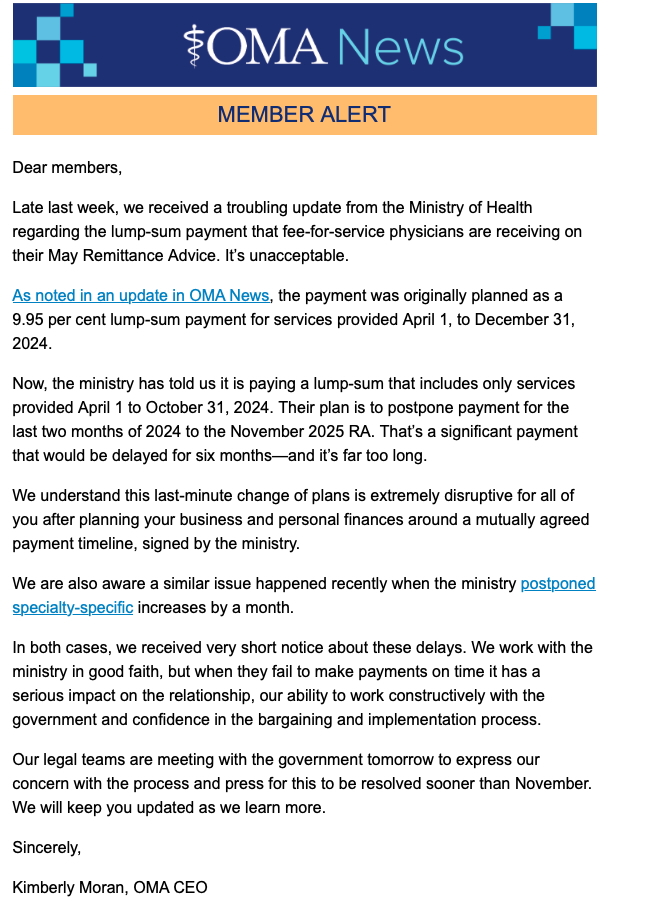
Last Friday (May 2), in what was a classic Friday afternoon bureaucratic dump, the OHIP bureaucrats at the Ministry of Health announced that they wouldn’t be paying the full amount of back pay owed Ontario’s doctors, as per the arbitration award. This was a unilateral decision on their part. It was contrary to what was in a signed agreement, and the OMA Board was notified at the last minute. (OMA CEO Kim Moran’s email is attached to the bottom of this blog). The bureaucrats promptly ran away an hid for the weekend hoping this issue would go away (kind of like how Sam Bennett cowardly hid from the press after putting an elbow to Leafs goalie Anthony Stolarz head).

This is, in my opinion, the latest attack on physicians as a whole from Ministry of Health (MOH) bureaucrats, who clearly are more interested in trench warfare than working co-operatively with Ontario’s doctors to improve health care for the citizens of Ontario. Don’t believe me? Consider the following:

The bureaucrats had the option of realizing that provinces like Manitoba/BC/Saskatchewan and even Alberta(!) recognized the need to work with their doctors and come up with a funding formula for them. Instead they chose to drag Ontario’s physicians through a protracted (going on three years now) and highly antagonistic arbitration/negotiations process.

Not only that, in response to now multiple stories of people lining up to find a family doctor in the press, their response was that there was “no concern” about the shortage of comprehensive family care physicians. (Seriously, how out of touch must they be to think that that type of Orwellian double speak is going to work in Canada).

People lined up hoping to get a family doctor in Walkerton. Photo originally posted in the farmers forum.

Frankly, this inept, combative and dismissive treatment of physicians is just par for the course for this bunch of bureaucrats. It saddens me, but it doesn’t surprise me.

No blame for this decision should fall to the OMA. They did negotiate a signed agreement (as per Ms. Moran’s email) and they clearly were not notified about the unilateral change until far too late. So the unilateral action is not their fault.

But….

What the OMA can, and should be held accountable for is how they proceed from here.

I don’t want to seem overly difficult here. If I truly was an obstinate person, I’d try to get a job at the Ministry of Health – perhaps on their Negotiations Team. The reality is that I actually have a long history of working co-operatively with government to improve health care in my neck of the woods.

I’m serious. In 2001 I helped bring in the first stage of Primary Care Reform called the Family Health Group. In 2004 I was one of the lead physicians who brought in a capitation model of payment for family physicians (it was initially a Family Health Network and it eventually evolved into a Family Health Organization). From 2007 -2013 I was the founding Chair of the Georgian Bay Family Health Team and From 2013-2015 I was the Health Links lead physician in my area.

And in each of these roles I worked closely and co-operatively with government to try to improve the health care needs of the patients in my area.

But – in those days, the bureaucrats wanted to work with doctors. They wanted to co-operate to improve health care and they were genuinely concerned about the lack of family physicians providing comprehensive care. They didn’t want to play power games with physicians or harass them or do dumb things like the current crop just did.

It’s important for the OMA to (finally) realize that there really is no hope that they can work with the current lot. They’ve already dragged us through three miserable years of negotiation/arbitration and fought us (thankfully often times stupidly – as even the Arbitrator pointed out) – for the sake of…….. I don’t know why really. Maybe it’s a power play? Maybe there are just bullies?

Recognizing the obstinance of the MOH bureaucrats is why I was proud (and still am) to have my name on an Op-Ed in the Toronto Star last year advising Family Medicine Residents to NOT start a practice in Ontario at this time. But I have to tell you the blowback from the OMA was saddening to me. I will not mention names – but one senior exec told me that the OMA was working well with the Government. Worse, one senior physician leader texted me the following:

Text from a very senior physician leader at the OMA

Remember – at the time this text was sent to me – we had already been locking horns at the negotiations table for two years and the government had done absolutely nothing to solve the family medicine crisis. Perhaps the physician leader felt the relationship was “best ever” because at least they weren’t sabotaging doctors left right and centre like the abhorrent Eric Hoskins did.

Despite all of that, there was some movement forward with arbitration. While no where near what other provinces got, it at least recognized the need to fund health care better, and provided hope for funding for offices, clinics, and frankly other badly needed resources.

Now the MOH has decided unilaterally to not pay, or pay whenever they feel like it, so we are back to – do NOT start to work in Ontario.

At any rate – as mentioned, while the OMA cannot be judged on decisions by the Ministry, what the organization does next will be telling. Will they finally recognize that the current lot of bureaucrats simply cannot be dealt with by reason? Will they recognize that physicians are essentially being bullied by these ruffians and the best way to deal with a bully is to stand up to them? Will they take legal action (according to Ms. Moran’s email – there was a signed agreement which the MoH is now in violation of)?

I don’t know the answer to any of the above. But I can only hope that the current Board recognizes that there is no hope of working in good faith with this lot of bureaucrats and that strong, frankly militant actions, are needed to support the members.

Addendum: After I published my original blog, an anonymous colleague asked that I publish a link to a survey about this issue. I’ve therefore appended my blog and ask all Ontario physicians to click on the link below and honestly reply to the questions:

https://www.surveymonkey.com/r/W2ZPMCC

Email sent by OMA CEO Kim Moran

Dear Sylvia Jones, Here’s How to Make Health Care More Convenient…

Congratulations on winning the last election and being re-appointed health minister. The health ministry is the toughest job in government. I sincerely mean now, what I wrote before, that all of us should hope you are successful. Ontario deserves the healthiest possible population.

Of course, that still won’t stop me from giving you advice (whether you want it or not)……

I’ve noticed that you place a really high value on making sure that health care is “convenient.” Your government even calls the overall program “A Plan for Connected and Convenient Care.” Your talking points in the press always mention “convenient.” Even the second major outline for health care uses that word.

I would suggest that rather a lot of your health care platform is based on making people happy by giving them what they want and making things easier for them. For example, your boss, premier Doug Ford, when talking about the expanded scope of practice that allowed pharmacists to prescribe treatments for minor ailments focused almost exclusively on the fact that it was one of the most popular things your government has ever done. The public was satisfied, so it must be a good thing.


Now I appreciate that you don’t have a health care background. If you did, you would know, that convenient health care, and patient satisfaction in health care, actually have a negative correlation with health care outcomes. Essentially, when patient satisfaction with the health care system goes up, the health care outcomes get worse. A study published in Medscape showed that focusing on patient satisfaction lead to 12% higher hospital readmission rates, 9% higher health care costs and 26% higher mortality rates.

Basically, focusing on convenience and satisfaction in health care costs more, makes people sicker and kills more people.

However, at this point, I doubt that I can get you to shift away from this philosophy. So I have an idea that will make health care much more convenient for people. Something that will reduce the amount of travelling back and forth that people do, and will allow them to quickly and easily get their health care needs taken care of in one spot.

It’s time for you to amend or revoke regulation 114/94 under the 1991 Medicine Act. This prohibits physicians from selling medications to patients. My sincere thanks to OHIPs former lawyer, Perry Brodkin, for pointing this out to me on X.

How will this be convenient? Well, right now, when a patient goes to see a physician for, let’s say high blood pressure, the patient will get assessed by their family doctor, and based on their medical history, an appropriate medication will be chosen for them. They will then drive to the pharmacy with that prescription. The pharmacy will take however long it takes for them to fill out their prescription, and after a period of waiting, the patient will get their needed medication.

By allowing physicians to have their own dispensary, a patient will now go to the physician’s office, and if a prescription medication is deemed necessary, they can just purchase it from the physicians office right then and there. It saves them an extra drive, and perhaps even parking lot fees depending on where they go. This will, of course, be extremely convenient for the patient.

What’s that you say? Isn’t this a conflict of interest? I mean, if a physician is now able to sell the drugs after making a diagnosis, wouldn’t it encourage physicians to prescribe more medications?

Um, can I ask why that didn’t seem to bother you when the pharmacists were allowed to expand the scope of their practices by you? Pharmacists now make an assessment for certain minor illnesses, get paid to do that by the government, determine what in their opinion the right treatment is, and then sell the patient the drugs at a profit. (This is what naturopaths and some chiropractors do as well, but that’s a whole other story.)

What’s that you say again? Pharmacists have to abide by a certain code of conduct from their college. They are bound by their code of ethics to act in the best interests of their patients. Um, ok. You do know that physicians also have a college that we answer to, right? You do also know that physicians also have a code of ethics? That we all took an oath to do no harm to our patients?

Might I ask exactly what the difference is between these two scenarios?

Of course, while most patients would be happy for this convenience, I imagine not everyone will be happy. I suspect (Shoppers Drug Mart bigshot) Galen Weston would be quite annoyed if you did this. But hey, look at the bright side, at least you won’t have to deal with some miserable crotchety old country doctor spouting off in the media wondering who exactly the health minister was in this province.

Galen Weston, of Shoppers Drug Mart and Loblaw fame.

Look, at the end of the day, for me, it’s health care outcomes that matter the most. I want patients to have the best possible results for themselves and health care as a whole in Ontario. But if you are going to insist on “convenience” then at least do it in a way that’s fair to all of the health care professions.

Change or amend the 1991 Medicine Act to make life a little easier for the patients.

Yours truly

An Old Country Doctor

P.S. While you’re at it, don’t forget to direct your OHIP Bureaucrats to not seek repayment from Dr. Elaine Ma. Don’t think doctors in Ontario have forgotten about this situation.

Health Care in the Ontario Election: Lots of Sound Bites, No Strong Policy

Last week, I had the opportunity to talk to Greg Brady, on his 640 am radio show, Toronto Today. The episode is on Spotify and, if you are in need of a great cure for insomnia, you can catch me starting from about the 19:30 mark:

Six and half minutes is not enough time to discuss health care in Ontario. Neither is a 1,000 word blog, but that won’t stop me from trying to expand on some of my thoughts.

The first and most prevalent thought I have is disappointment in ALL of the political parties for how they have addressed health care so far. Everyone on the front lines of health care has known for a least a decade that we need bold transformative changes in how health care is run and delivered in Ontario. Probably all of Canada.

And yet, the four would be Premiers all fail to outline a plan for such transformation. Instead, they have all resorted to that age old political vote grabbing stunt of saying “Let’s just throw more money at the problem” without actually reminding you that the money is going to come from YOUR pockets and is going to be, frankly, poorly spent.

The Conservatives hired Dr. Jane Philpott to oversee a spend of $1.8 billion in a plan to connect everyone with a “primary care provider” in the next few years. As I’ve written before, that plan, through no fault of Dr. Philpott, who I have a great deal of respect for, is doomed to failure.

The Conservatives did not start the downfall of family practice in Ontario (that was the miserable Eric Hoskins/Bob Bell duo during the wretched Kathleen Wynne years). But they sure haven’t done enough to fix the mess they inherited. Economist Boris Kralj, PhD, recently showed in the Medical Post that Ontario lost 238 family physicians in 2022/23 – the biggest loss of any province.

The Liberals for their part want to spend 3.1 Billion dollars. At least they promise everyone a family doctor and not a “provider” (and yes, there IS a difference, a BIG one between the two). However, their plan amounts to spending $1.3 billion more than the Conservatives. Spending more without changing things seems naive at best.

The NDP promise to recruit 3,500 more doctors, promise family doctors for everyone, cut red tape, establish a “Northern Command Centre” for health care (that’s actually a good idea) – all for the low low price of only $4.1 Billion dollars, a billion more than the Liberals.

The Green Party promises are actually the most detailed I could see, including lots of goodies, like recruiting more doctors, building more nursing homes, increasing nursing student spots, hiring 6,800 personal support workers and more. There is only one thing missing from the proposal (at least on their website). How much this will all cost YOU, the taxpayer.

Ontario spends $81 billion in taxpayers dollars on health care. Rather than look to see if that money is being spent wisely, and looking to transform health care, all the political parties are simply giving us sound bites. They promise to spend $83-$85 billion on the same failing system, without looking at changing things. Because spending more inefficiently will surely fix things.

OK Smart Guy – What do YOU Think Should Be Done?

Glad you asked dear reader, glad you asked. At an absolute minimum I’m looking for a party that has the political courage and wisdom to do the following three things.

First, A complete hiring freeze on all bureaucrats in health care, including not replacing those who retire, or leave for other reasons.

Currently Ontario has 10 times as many health care bureaucrats per capita as Germany. That’s too many. This means that any meaningful suggestions for change have to go through so many bureaucrats that the whole system is plagued with paralysis by analysis. Time to trim the fat.

Second, ensuring one, and only one, patient app that every resident of Ontario has, which will have access to all their health care data, and allow them to share this with the health care specialist or facility of their choice

Ontario is a digital health nightmare. Your health information often times can’t be shared if you go from one hospital to another, or one doctor to another. There are multiple inefficiencies and unnecessary repeat tests because of this mess and it should never have been allowed to occur.

It would be too expensive and too time consuming to force every health care facility to use the same electronic medical records system. What can be done however, is to force all the systems to integrate with ONE patient app. This will ensure a common standard, and moreover will allow a hospital you happen to be in, to access your out patient information (with your permission) which just doesn’t happen now.

Third, ensuring strong family physician representation at the board level of the Ontario Health Teams.

There is a lot of talk about the benefits of team based care. As someone who views one of his proudest achievements to be the founding Chair of the Georgian Bay Family Health Team, I would agree with this. The current plan for Ontario Health Teams does have merit. BUT, in order for these teams to succeed, they need strong family physician leadership at the GOVERNANCE level. That’s right, you need to put doctors (and more than just a token one) on the Boards of these teams and ensure the teams are led by them – for best clinical outcomes. I don’t see that in the plans.

Final Thoughts

My usual followers will know that I generally vote on the conservative side of the political spectrum (de gustibus non est disputandum). However, I’ve been frankly disappointed that the current Conservative government has been anything but conservative. Sadly, the other parties are really not offering the kind of transformative solutions we need in health care either. I firmly believe that we should all vote in elections, and I certainly will, but for now, call me an undecided old country doctor.

Re-Post: Hoskins Won’t Survive The Mess He’s Made Of Ontario Health Care

NB. The following is a re-print of a blog I wrote for the Huffington Post, published originally on July 10, 2017. It’s being republished here mostly for my own record keeping.

Recently, one of my medical school classmates (now a cardiologist) was awarded the Society of Thoracic Surgeons top rating for patient care outcomes. A great honour for her, and well deserved. Unfortunately for the rest of us, she practices in South Dakota, one of the many physicians who left Ontario during the protracted battles with Ontario Governments in the 1990s.

Back then, as I mentioned in my first blog, many health ministers continued to insist that physicians in Ontario were the highest paid in all of North America. Yet we lost physicians in droves. The reality is that while physicians wanted to be paid a fair wage (who doesn’t?), what they really wanted was to have a say in how health care was delivered and be able to advocate for their patients.

So when the then Ontario government of Bob “Super Elite” Rae made unilateral decisions about health care, physicians left for jurisdictions where they were paid less (according to then Health Ministers Frances Lankin and Ruth Grier). But at least they had a say in how health care was delivered.

I mention this because it appears that current Ontario Health Minister “Unilateral Eric”Hoskins and his Deputy Health Minister Bob Bell have been unable to grasp this fundamental concept. Hoskins (and, to a lesser extent, Bell) have based their whole political strategy on portraying the dispute in the media as one of doctors wanting endless sums of money. If only the doctors would take less, the health-care system would improve. They appear unable to grasp the fact that doctors VALUE the ability to advocate for their patients and contribute to health care decision making.

From a purely political point of view, the strategy had some benefits for Hoskins and Bell. They were able to pass both the Patients First Act and the Protecting Patients Act. There was muted public response because they were able to portray physician opposition to these Acts as physicians protecting their incomes. The fact that the Patients First Act does nothing but increase bureaucracy and that the Protecting Patients Act actually violates Charter Rights of all health-care workers, and will likely be the focus of a Charter challenge, meant nothing to Hoskins and Bell. Good PR in the face of mountingrepeated, ongoing evidence of the collapsing health-care system was all they wanted.

Surely the Hoskins/Bell duo thought their troubles were behind them when the OMA ratified the BA framework. Not so.

It must therefore have come as a shock to Hoskins and Bell when, after giving Physicians Binding Arbitration (BA), physicians actually increased their attacks on the Liberal Government mismanagement of the health-care system. Now to be clear, giving BA is not the same as awarding a contract. The Ontario Medical Association still has to negotiate a contract for physicians.

But central to Hoskins and Bell’s way of thinking was that all physicians cared about is money. And the spectre of BA does force both parties to negotiate fairly.

Also in fairness, it’s pretty evident that Hoskins himself didn’t want to give physicians BA. Not only did he deride physicians for asking for it and fight it in cabinet, but when the Ontario government sent a press release indicating they want to return to negotiations with the OMA with the first order of business being to develop a BA framework, it came from the premier’s office, not Hoskins’ office.

Regardless, surely the Hoskins/Bell duo thought their troubles were behind them when the OMA ratified the BA framework. Not so.

Wait Time Series: Cataract surgery patients are finding themselves on longer #waitlists as funding fails to meet demand in Ontario. #ONpolipic.twitter.com/Nh466RND1k

— Ont. Medical Assoc. (@OntariosDoctors) July 5, 2017

Since then, the OMA has become even more aggressive in its attacks on the Liberals. Have a look at their Twitter feed where they attack wait times for cataract surgery and joint replacement surgery.

Also, a grassroots group of doctors have now begun tweeting multiple barbs at the Liberals. Saying that doctors are required to put the pieces of health care together, they’ve used inventive and creative images to drive home the point that the Liberals don’t know what they are doing in health care.

Finally, OMA President Dr. Shawn Whatley openly wrote in his blog that physicians need to be champions, not doormats, and fight for health care for their patients. Surely poor Hoskins and Bell never expected this when they actually gave the OMA a path to a fair contract via BA. Goes to show you just how much they misjudged physicians’ desire to advocate for their patients and for a fair health-care system for all of us.

Hoskins and Bell are now, as the old joke goes, officially “post turtles.” This joke compares a (usually inept) politician to a turtle balancing on a fence post. You know he didn’t get there by himself, he doesn’t belong there, he doesn’t know what to do while he’s up there, and you just want to help the poor thing get off the post.

Ontario Premier Kathleen Wynne basically has little choice now. Hoskins and Bell are just too easy targets for the mess that they’ve made of health care and the way they’ve badly misread physicians passion for protecting their patients. The differences are irreconcilable.

Hoskins is the easier of the two to deal with. Wynne needs to shuffle her cabinet and move Hoskins on to minister of sanitation or something.

Bell, being an employee, has certain rights and can’t just be fired. However, the anonymous surveys done by Quantum Transformation Technologies indicating how unhappy his own bureaucrats are should be enough evidence for Wynne to order a formal administrative review of the senior management team at the ministry of health. Maybe they can be salvaged with administrative coaching.

But what’s clear is that as the health system fails, Wynne needs front line physicians to help put its pieces back together. Wynne needs to regain their trust. The way to do that is to bring tangible change to the leadership of the ministry of health.

Arbitration Part IV: What to Make of the New, Updated Payment Schedule

Disclaimer: The payment schedule below is based on my personal analysis of information from the OMA as of December 6, 2024. It would not surprise me if there were more changes. Do NOT use this as your sole source of planning. Contact info@oma.org with any questions.

On Nov. 1, 2024, OMA Board Chair Dr. Cathy Faulds announced an update on how the arbitration award for Year I of our PSA (Fiscal 2024/25) is going to be paid out. The plan was to have final numbers in a couple of weeks. Follow up information didn’t come until December 6 in an OMA news alert. Some things never change.

Wait old country doctor! Didn’t you already do a blog on the Arbitration Award?

Yes, parts two and three of my Arbitration analysis did say what was planned. But the blogs were filled with with statements like “allegedly” “supposedly” and chances of some of the changes happening were “slim to none”.

So we read all your previous work for nothing?

At the risk of sounding somewhat less than humble – most to the stuff I wrote about has come to pass – including splitting the increase with 75% of the amount going towards relativity, and 25% for across the board (ATB) raises.

Well what changed then?

There are a couple of delays (of course) to some of the retroactive payments. But the big change is changing the amount of your increase based on your specialty. I don’t know who came up with the idea of doing this, and suggested it to the OMA’s Negotiations Task Force, but whoever it was deserves the thanks of our profession.

This method is not perfect, because some billing codes are used by more than one speciality. For example, I’m a family physician, but I do joint injections. So do orthopaedic surgeons and rheumatologists. But the billing code (and thus payment) for doing a joint injection is the same. Applying an increase to that code will affect at least three specialties. Therefore, by given specialty specific increases instead, some of the lower relativity specialists will get more of an increase sooner.

The “permanent” changes to the fee codes will now not happen until April 2026 (!!). So expect your income to fluctuate some more then.

Don’t tell me you’re are going to toss large numbers and calculations at me!

I’m going to toss large numbers and calculations at you.

Here are numbers I needed to understand the contract. Numbers rounded for simplicity.

  • Fiscal Year 2022/23 is the base year for calculations. Physicians budget was $16 billion.
  • 2.8% increase agreed to for 2023/2024 (from last PSA) = $448 million
  • 9.95% awarded by arbitrator for 2024/2025 when compounded with 2023/2024 – total value =$2.085 billion
  • The plan was to spend 70% on fee increases, and 30% on “targeted” investments. For 2023/2024 this would be $314 million for fee increases, $134 million for targeted investments. For 2024/25 – $1.460 billion for increases, $625 million for targets.
  • Finally, as of now, it appears that we are going to stick to 25% of the total for fee increases (not the targeted money) will go to across the board (ATB) raises, and the rest based on relativity.

Wait a minute Old Country Doctor – didn’t everyone get the same percentage increase this year?

Yes. Under the terms of a previous agreement, if the OMA and government were not able to sort out how to divide the money for a fiscal year, ALL of it would be paid ATB on a temporary basis. Emphasis on temporary. So we all got a 2.8% increase for 2023/2024 (you should have gotten the retroactive pay in November). Additionally your monthly remittance should be 2.8% higher beginning on the MAY 2024 statement (The increase took effect April 1, but of course, that gets paid out on May 15).

For this fiscal year (2024/25) the OMA and government have conceded they won’t come up with a plan on how to divide the funds, and so everyone will get an ATB of 13%(1.028 x 1.0995). The way it’s paid out will be a mix of monthly increases and some retroactive pay.

However for fiscal 2025/2026, there will be specialty specific increases. Each physician will get another temporary increase in their billings, based on their specialty. The OMA and government will continue to argue negotiate. Probably need arbitration for this. The exact fee code changes are scheduled to be in place April 1, 2026 (!!)

You’re going to bring back Drs. Alpine and Valley to explain this aren’t you?

Of course dear reader. It helps to put a “face” to the numbers. However, on this occasion, let’s assume Dr. Alpine is an ophthalmologist (speciality chosen only because they appear to get the lowest increase) and Dr. Valley is a family doctor in a capitation model (for reasons that will become clear shortly).

Screenshot

I won’t restate the assumptions for my calculations (please refer to my previous blog on this issue). Assuming that Drs Alpine and Valley see the exact same number of patients every year – this is what their gross income will look like.

Time PeriodDr. AlpineDr. Valley
Monthly billings 22/23$100,000$30,000
Monthly billings 23/24 (increase not applied yet)$100,000$30,000
Monthly billings April 2024 till Dec 2024 (2.8% finally applied)$102,800$30,840
Nov 15, 2024 (retroactive pay added)One time payment of $33,600 in retroactive pay for 23/24One time payment of $10,080 in retroactive pay for 23/24
Jan 15, 2025 – 2.8% lowered to 2.55% as part of agreement to use funds to increase HOCC$102,550$30,765
Feb 15, 2025- April 15, 2025 – OHIP will finally given 1.0995 on top of the 1.0255 now$112, 754$33,826
May 15, 2025 retroactive pay for April -DecemberOne time payment of $89,583One time payment of $27,549
May 2025 – April 2026 monthly billings $102,452$33,525

WAIT A MINUTE! Capitated Family Doctors gross will go down as well??

Yes. As mentioned above, for 2023/24 and 2024/2025 the OMA and government could not agree how to divide up the now $2.085 billion, so it was given ATB on a temporary basis. This was meant to get some money into doctors hands sooner otherwise Allah/God/Yahweh only knows how long we would have to wait for the process to complete.

However, 30% of the $2.085 billion (or $626 million) was meant for “targeted funds”. The expectation is either through negotiation (very unlikely IMO) or through arbitration, a decision will be made on where to spend that $626 million for fiscal 2025/26.

Therefore, there is only $1.459 billion for general increases for 2025/26 (plus whatever increase the arbitrator gives us). Of that, 25% ($365 million) will go ATB. So everyone will get 2.03%. The remaining $1.094 billion is distributed via relativity.

With less money to distribute – well, there is less of an increase. Now of course the possibility exists that some of the targeted funds will be spent on captitated family medicine too, but who knows at this point? This is why virtually every specialty sees a decline in 2025 when you look at the OMA’s spreadsheet.

Keep in mind the fee increases for April 1, 2025 to March 31, 2028 have yet to be negotiated (more likely arbitrated) so there will be more money in the future – we hope.

I’m not a family doctor or an ophthalmologist- how do I find out my numbers?

I suggest you go to the table that the OMA has prepared for you. Use your base 2022/23 monthly income to figure out your projected numbers. If you have specific questions about your situation, I urge you to contact info@oma.org. The organization can’t really answer questions if they don’t know what they are. Also please register for the live Zoom Webinar on this process, and ask your questions there.

So this is the final word on this issue?

Nope. I suspect there will be more to come. And that it will be just as confusing.

You’re just a bundle of joy Old Country Doctor.

I aim to please dear reader. I aim to please.