On September 18, 2026, Arbitrator William Kaplan handed down an award for Ontario physicians in their ongoing and seemingly never ending negotiations process. I imagine rather a lot will be written about this. There are already lots of comments on social media, and many rushes to analysis, sacrificing accuracy for expediency. This is sadly true for any hot button news topic these days. I’m going to take my time to review the ruling in detail and probably have some more thoughts on it later. I would prefer to be accurate, not quick.

One thing I will say is that physicians are going to be locked into a perpetual negotiations/arbitration process for the next few years. In a previous blog I had commented that all outstanding arbitration issues would be resolved with this ruling. I based that on comments made by the OMA, and by the arbitrator himself. Being a victim of Murphy’s Law on many occasions, I did go on to say that:
“Of course now that I write this there probably will be yet another process announced after this which will mean more negotiation and arbitration”
Unfortunately, it appears that last part is indeed the case. All this ruling really does is set a (too low) dollar value ruling for how much of an increase (general and targeted) physicians are entitled to for the fiscal years April 1, 2025-March 31, 2028. It doesn’t deal with rather a whole lot of implementation issues.
For example, what exactly is going to be the dollar value of each fee code as of April 1, 2026?. The Ontario Medical Association (OMA) has long stated that current fee codes/billing are temporary and the new permanent values for codes will be implemented this coming April 1. The award defers that to the ongoing Physician Payment Committee (PPC) process that is supposed to have fee codes ready by then.
Additionally, the Award mentions the targeted funds for things like Hospital On Call (HOCC)/Unbundling Surgical Codes/Alternate Payment Plans and more – > but not the specifics of how those funds are going to be distributed or billed. Even the OMA’s own “agreed issues document” doesn’t really offer an agreement. For HOCC for example, it states:
“The parties shall conclude negotiations on the revised burden-based HOCC system bilaterally….If agreement cannot be reached by January 1, 2026, either party may refer the matter to mediation/arbitration ….”
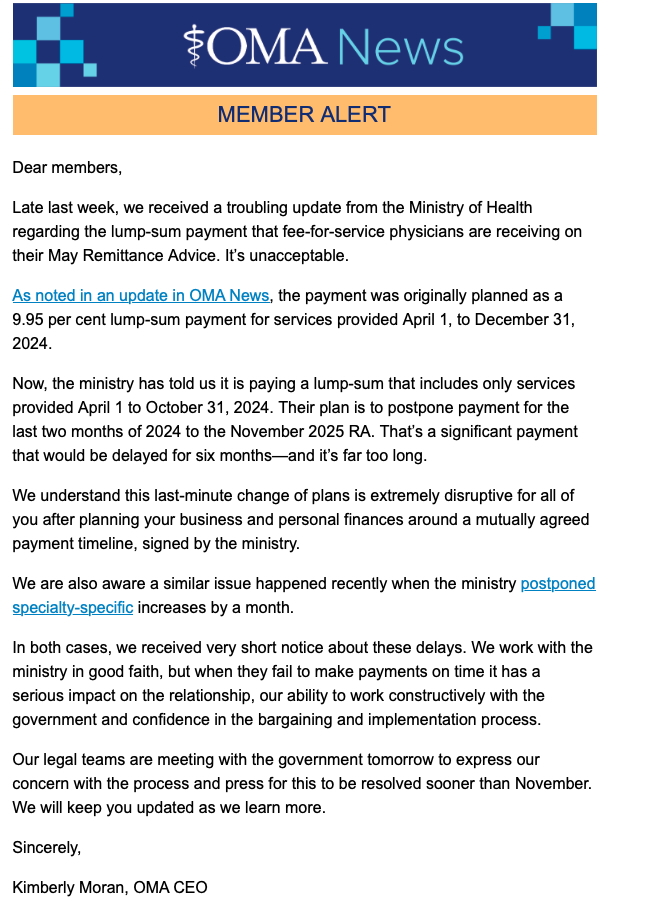
Ok – what about things like the constant delay in physicians getting paid for work they do, supposedly due to the inefficient and ancient OHIP computers. The Award doesn’t set out a specifically penalty. It simply directs the OMA/MOH to make it a priority to fix this issue and if they can’t :
“This Board will remain seized in the event that the parties cannot reach agreement, with either, party having the right to return to this Board after January 1, 2026”
Yup, more negotiations and arbitration if the OMA asks for penalties for delayed payments. I hope there’s a good legal reason the OMA didn’t ask for specific penalties in their Arbitration briefs, otherwise it was dumb of them not to. The MOH asked for penalties in the new FHO+ model for family doctors, and that was awarded.
There’s also the fact that this award has funds that should have been already paid to us on April 1 of this year. The award does provide some guidance in terms of saying the increases should be paid retroactively on a lump sum basis, but once again – if the parties can’t agree to the relativity splits for that money – it goes back to……..more Arbitration.
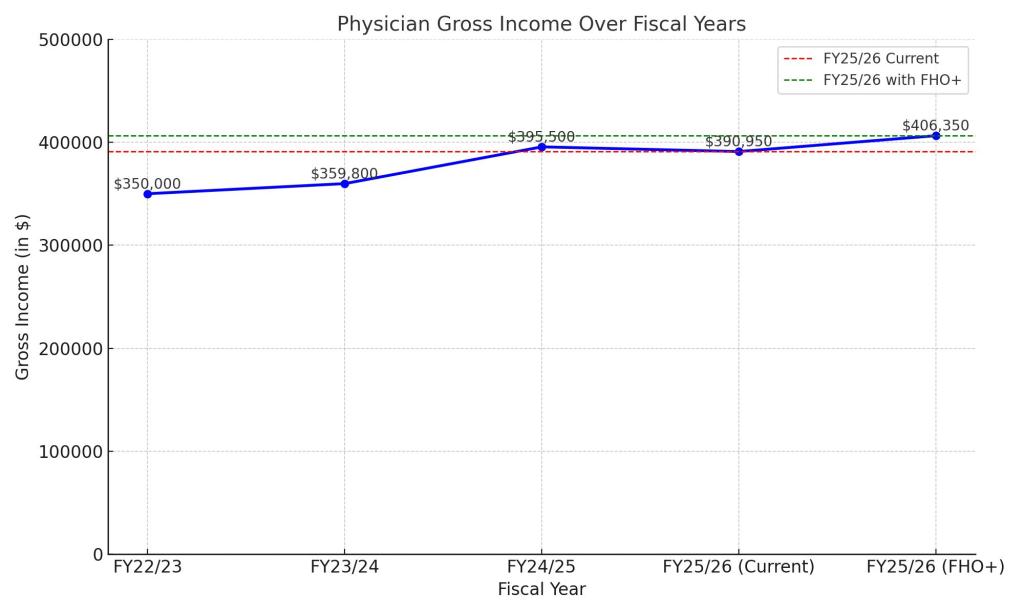
Essentially the award says physicians as a whole are to get 7.3 percent in general increases and 2.2% in targeted increases. The MOH and OMA are to figure out how to split that (mostly through the PPC) – and then go back to the Arbitrator if they can’t agree.
Now the PPC itself is, you guessed it, a bilateral committee of the OMA and the Ontario Government. In fairness to them, they have been working quite hard all this time from what I can tell. They may be further along than we think. But I’m guessing that the government members will have a different overall agenda than the OMA. All it takes is for the government to put their foot down on one issue and the whole thing goes back to Arbitration.
The lawyers are gonna get really really rich……
I will once again state that this Arbitration process is still preferable to having unilateral actions imposed upon physicians by governments. Those of us who lived through the Eric Hoskins/Bob Bell years realize just how much worse things would be with the government acting unilaterally.
BUT – never also forget that this protracted process is also because the current government doesn’t really have the capacity to understand the complexity of the health care system (and the complexity of how physicians get paid). Rather than have a bold vision for transforming health care, and making it clear how they will invest funds to promote that vision, they have opted to simply drag out the contractual process. If the MOH had come to the table in a constructive spirit, all the implementation could be rapidly done. The MOH’s absolute insistence on doing everything in the most drawn out way, regardless of the worsening health care crisis, is where they are really failing the people of Ontario.
Politically, of course, it makes some sense. Instead of negotiating a fair contract right from the start and then getting up and defending that from the usual critics, the government instead has chosen to simply let the Arbitrator make all their decisions . Then the government case say “we did what the Arbitrator told us” and shrug their shoulders if things go bad.
I’m acutely aware that to a certain extent the process benefits the OMA as an organization as well. Look at the new FHO+ model for paying family physicians. Because a couple of elements of the program couldn’t be negotiated – that issue went to Arbitration. Because it’s gone there, family doctors don’t get a chance to actually vote on the model like they would if there was a negotiated tentative agreement. So the OMA can kind of impose a model of payment they feel is acceptable on family physicians, rather than promote it in a free and fair vote.
The unfortunate thing is that I actually do think the FHO+ is a small step forward (not as big as the OMA is making it out to be) and likely would have passed if given to members to vote on. I would have voted for it myself despite my criticism of some aspects of it.
So what does this all mean for physicians? It means that for the next three years (at least) we should all get used to living in an era of constant ongoing negotiations and constant Arbitration, with continual delays in payments because of an intransigent government.
Sigh…

















 justanoldcountrydoctor