Bureaucratic Stupidity in Covid Vaccine Clinic Case Will Have Far Reaching Consequences

I’ve repeatedly been told that I am too unkind and too harsh to Ministry of Health (MOH) bureaucrats. A senior staff member at the OMA once suggested I was “out of line” to a very sharp (but necessary) scolding I gave an MOH bureaucrat at a bilateral meeting we had. About a month later, that same senior staff person, when on a voice conference call with the same bureaucrat, got up and wrote “This is a waste of time” on a chalkboard at OMA headquarters. But I digress.

Yet every time I try to pull back, these same bureaucrats go and do something that is so incomprehensibly stupid that I once again wonder about the talent level and frankly intelligence of the bureaucracy as a whole at the MOH.

On this occasion, I’m referring to the Ontario Health Insurance Plan’s (OHIP) relentless persecution of Dr. Elaine Ma. The whole mess has been extensively reported and you can read all the details in the links, but I will summarize key points below:

October 25, 2024

Dr. Ma’s clinic in Kingston suddenly cancelled its October 26 drive thru flu/covid vaccine clinic. Over 600 patients had registered with more pending. The reason is that OHIP had notified her that she would not be paid to vaccinate patients at the clinic. Why? Because she was going to have medical students (who would be supervised) vaccinate. According to a 2001 bulletin OHIP pulled out, students are not employees and so she can’t delegate to them. (OHIPs story keeps changing and you’ll see that further down the blog). It also emerged that OHIP was attempting to recoup funds paid to her for running similar vaccine clinics in 2021.

October 30, 2024

It was now reported that OHIP was demanding Dr. Ma repay $600,000 that she billed to run outdoor vaccination clinics. She ran a number of mass Covid vaccinations clinics that gave over 35,000 shots. These were set up by her in response to the provinces call to “get shots in peoples arms“at the height of the Covid pandemic. Dr. Ma was widely lauded for her efforts at the time – and won the Ontario College of Family Physicians award of Excellence. Her area became the most vaccinated area of the province, something that should be celebrated.

OHIP now claims that she didn’t follow the rules for billing. Their excuse this time? That clinic was outdoors and not in a doctor’s office. (I told you OHIPs story would keep changing). Yes, you did read that right. In the middle of a pandemic caused by an airborne virus, OHIP wanted the vaccination clinics to be held in crowded indoor spaces!

November 1, 2024

Dr. Ma had rapidly gained the public support of the local medical officer of health (there was likely background support previously). She also had the support (previously background now public) of her MPP, the OMA and many others. She did not get the public support of Dr. Jane Philpott. Dr. Philpott, in her role as Dean of Queens Medical school was full of praise for the clinics. I suspect Dr. Philpott has 550,000 reasons to stay quiet publicly now. Hopefully she can influence behind the scenes.

OHIP now stated that the concern was that Dr. Ma used some of the funds to pay the staff who worked there. You read that right. They were worried because a physician billed OHIP (gasp!) then took the funds to pay overhead (double gasp!!). The horror!

Hannah Jensen, the Minister of Health’s Communications Director initially simply parroted the line that OHIP bureaucrats fed her about being ineligible to bill because of using medical students and it being outdoors. But she was rapidly exposed as being completely out of her depth when the Kingstonist questioned her about dates, which doctor, which clinics, how she arrived at figures and so on.

Additionally, her tone took a seriously ugly and aggressive turn. There was an accusation that Dr. Ma “pocketed the funds” which essentially is an accusation of theft. (No law enforcement is involved….yet).

November 7, 2024

The story hit the national news and it was reported that not only was OHIP asking Dr. Ma to pay back $600,000, but they were demanding $35K in interest as well (!). Who knew OHIP bureaucrats moonlighted as loan sharks??

November 8, 2024

Dr. Hijazi, leader of the Ontario Union of Family Physicians was interviewed by the CBC . He obviously was supportive of Dr. Ma demanded that the Ministry apologize to her. The Ministry issued an utterly and completely delusional statement to CBC radio stating that claims Ontario can’t get family physicians are “fictitious”. (Listen to the last 30 seconds at the link). 2.5 million people can’t get a family doctor in this province because doctors don’t want to work comprehensive care is “fictitious”????

Nothing much to see here. Just a fictitious clinic in Kingston, where fictitious people without a family doctor lined up hoping to get a doctor because a fictitious family doctor announced a new practice..

What consequences are there to this?

To0 many to mention, and they are all awful. Perry Brodkin, OHIPs former lawyer was quoted extensively in the articles about process. He pointed out that before attempting to recoup these funds, the bureaucrats would have run it up the chain to the deputy minister if not the health minister. There is therefore no doubt that this egregious action is one of the bureaucracy as a whole as opposed to one rogue bureaucrat. This cements the feeling that many physicians increasingly have had that bureaucrats as a whole are malicious (especially after the nonsense they claimed during arbitration).

It also badly threatens medical teaching. If the appeal that Dr. Ma filed is unsuccessful, then it essentially means that physicians would not get paid for teaching medical students. Which would effectively end teaching in Ontario. How exactly do you plan to replace the current supply of physicians as they age out, if no one will teach new ones?

With the story hitting the national news on CBC, it also will significantly impair attempts to recruit physicians from out of province. We are already losing younger doctors to provinces like BC and Manitoba where they see a co-operative relationship between government and physicians. Why would any of them come to a Province where you are called a hero one day, and then publicly embarrassed, harassed and vilified over a clearly outdated memo that needed to put aside during a once in a lifetime pandemic?

What SHOULD happen next (but probably won’t)

Unfortunately, Brodkin also points out that at this point there is nothing that will influence the appeal board. The process could have been stopped earlier before the hearing, but Sylvia Jones and her staff chose not to. But, if Dr. Ma wins, the government should immediately announce they will not appeal the decision to the courts. Additionally, Hannah Jensen needs to publicly apologize for her…..out of line…..comment on “pocketing” funds. And Sylvia Jones should also offer up an apology to Dr. Ma for the failure of her bureaucrats to recognize that rigid adherence to minutiae in a time of crisis is completely unacceptable.

Finally, what badly needs to be done is that the entire Ministry of Health bureaucracy needs to be given a very large enema to clear out the…….

Sunday Snippets – November 17, 2024

Another in a weekly series of brief snippets of health care stories that bemused, intrigued and otherwise beguiled me over the past week along with my random thoughts on the matter.

Item: New reports show that marijuana use is linked to thinning of brains in adolescents.

My thoughts: It’s not just adolescents. And it’s not just brains. I’ve seen a marked rise in people with significant mood issues ever since marijuana was legalized. There has also been a significant rise in people with stomach/bowel issues in my practice that all other tests turn up negative for. Patients with these issues are invariably marijuana users and the blunt reality is they won’t get better until they stop. I continue to be in favour of decriminalizing marijuana and other illicit street drugs if and only if we do it the way Portugal did it and not the haphazard way it is being done in Canada. But we really need to re-think the full on legalization of it.

Item: A survey in Medscape showed that there were two factors critical to reducing family medicine burnout. First would be to reduce the Electronic Health Record burden, particularly the number of times family physicians have to chart from home. Second would be to build stronger physician/nurse teams. Crucially, the teams need to be led by the family physician and NOT a bureaucrat or some other team member.

My thoughts: I hope this finally gets the Canadian Medical Association (which despite over $2 billion dollars in their bank account is amazingly growing increasingly irrelevant to front line physicians) to SHUT UP ABOUT SICK NOTES ALREADY. That’s not going to solve burnout (even though I like every other doctor hate doing them). To paraphrase a political slogan – “It’s the Electronic Health Record, stupid.” My second thought is that I remain extremely concerned that while I do feel Dr. Jane Philpott is well intentioned in her new role (to lead a primary care action team) – the bureaucrats at Ontario Health will sabotage her. They will see “teams help”, then create teams that have the assistant to the secretary to the aide to deputy minister’s attache for the Primary Care Secretariat’s deputy vice president run them. That will be a disaster. Teams need to be led by family physicians. Full stop.

Dr. Jane Philpott, head of the new “Primary Care Action Team” designed to give everyone access to primary care in 5 years.

Item(s): The family physician crisis in Ontario continues to worsen. Tillsonburg lost four family physicians. Wallaceburg is launching a large physician recruitment program to deal with their shortage. Brantford is taking a more hands on role to get more family physicians. Brockville is hiring a consulting firm that employs former health Minister George Smitherman to help tackle their shortage.

My thoughts: It’s sad that we are in a seeming “Hunger Games” of one community fighting another for the precious resource that is a family doctor. If only someone had warned people a crisis was coming. Oh, right.

Dr. Nadia Alam, who, like others, warned that the crisis in family medicine (and health in care in general) was coming ten years ago, and was ignored by governments.

Item: Premier Ford promises to correct the mistakes at Ontario Health at Home that led to a large amount of suffering for patients. He also stated that the people who “messed this up” will be “held accountable”.

My thoughts: I’ll believe it when I see it. When I wrote about mismanaged bureaucracy in health care (back in 2015!) I pointed out that no decision seems to get made by bureaucrats without continuously “circling back” to one committee or another. The reason I’ve discovered, is because this way, no individual gets blamed for (the very many) bad decisions made in health care. I’ve yet to see a health care bureaucrat fired – and I’ve met many who deserved to be. I really hope that the comments by Premier Ford signal a return to the old Doug Ford who promised to end the “gravy train” and famously said:


What drives me crazy is when you have a supervisor in government, and they report into 12 other supervisors. That’s unacceptable.

Doug Ford, Premier of Ontario for almost 7 years, and the gravy train in Ontario Heath continues unabated

Item: Male doctors are working less hours in a week than they used to. They are still working more than the average Canadian worker, but there has been an unmistakable decrease in how many hours they work

My thoughts: Finally! Proof that men are getting smarter! There’s more to life than work, and good for the younger docs – all of them – for seeking balance in their lives.

Item: A young Ontario mother died of cholangiocarcinoma (cancer of the gall bladder), after encountering multiple road blocks getting a new treatment (Pemigatnib) approved for her.

My thoughts: This story is absolutely infuriating and encapsulates what is wrong with our health care system. Look, there is no guarantee that she would have survived if she had gotten the treatment (it’s an awful cancer she had). BUT – look at all the regulatory agencies involved in getting the drug approved. Health Canada approved the drug in 2021. But the Canadian Agency for Drugs and Technology in Health said the evidence wasn’t clear. (So why then did Health Canada approve it?). Furthermore there are multiple provincial drug agencies involved, which means she could have gotten it had she been a resident of Quebec, but not Ontario (two tier medicine anyone?). It’s the bureaucracy and double speak from having too many agencies involved that angers me greatly. A wholesale streamlining of the process for medication approvals is desperately needed.

That’s all for this week. Back next week (probably) with more.

Sunday Snippets – November 10, 2024

Another in a weekly series of brief snippets of health care stories that bemused, intrigued and otherwise beguiled me over the past week along with my random thoughts on the matter.

Item: An article in the College of Family Physicians of Canada Journal suggests that “recycling” physicians would help address family physician shortages. This includes “Physicians who have had successful careers in general surgery, emergency medicine, family medicine, hospitalist practices, and other specialties…”

My thoughts: Sigh. I get that the Journal is trying to be open to all views to stir discussion. I get that we are in a family practice crisis in all of Canada right now and looking at unique ways of helping. But seriously – you want to turn a retired general surgeon into a pseudo family doctor? Do you realize just how much you are denigrating family physicians by writing that a good chunk of their jobs can be replaced by people who haven’t done the residency? Some ideas belong in the trash heap and this one deserves to go there. Comprehensive care family physicians CANNOT BE REPLACED by anyone other than another properly trained comprehensive care family physician.

Item: It seems that Quebec is looking to find ways to force doctors to stay in the province and work in their public health system. They are even willing to as far as considering to use the Notwithstanding clause in the Constitution (which they would have to, as their initial position impinges on freedom of movement/assembly to make this happen).

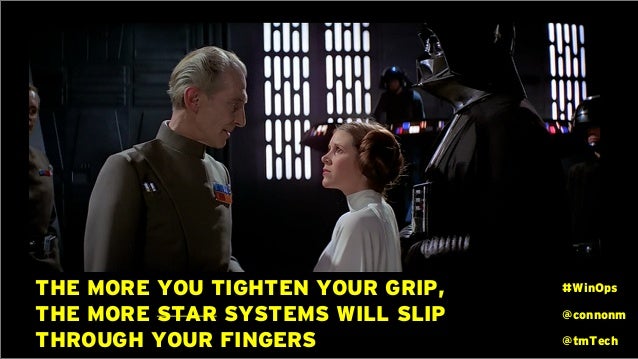
My thoughts: It really does kill me to use Star Wars memes instead of Star Trek ones (really and truly). But once again, for this issue – I’m going to quote Star Wars character Princess Leia:

I honestly don’t know what to do with politicians anymore. There is ample, repeated, overwhelming evidence that whenever they pick fights with physicians, they inevitably lose and health care suffers. And yet they keep doing it.

Item: Dr. Corli Barnes (who I was honoured to have as a guest blogger) wrote in McLean’s Magazine (cover story no less!) about why she moved to Madoc, Ontario and the incentives they provided. I understand she took less than what is listed in the article’s headline, but there were incentives.

Dr. Corli Barnes

My thoughts: I’m happy for Dr. Barnes. I’m happy for the people in her community as well, as they are going to get healthcare from a dedicated family physician and their well being will improve as a result. But I really do wish that our system was no so fragmented and that all communities could offer a consistent level of support to their family physicians.

Item: Premier Doug Ford told patients with minor illnesses not to go to the ER. In response, Drs. Drummond and Venugopal had an op ed where they point out that the Premier is not qualified to determine what is an Emergency.

My thoughts: This will surprise some of you who know that I personally favour the Tommy Douglas model of health care, which supports user fees to dissuade misuse of the health care system. However, that is frankly up to the patients to decide for themselves. Drs. Drummond and Venugopal are correct in saying that politicians are not qualified to hand out medical advice, and should not be saying stuff like this.

Item: A study out of Michigan suggests that more virtual care will not lead to more unnecessary testing. A huge concern has been that if you cannot see a patient in person to assess this, a physician would be more likely to order a test “just to be sure”. This study suggests no.

My thoughts: I think the big flaw of this study is that it looked at patients who were in existing practices getting virtual care from their own physicians. There is a HUGE difference between getting care from your own physician virtually, or getting it virtually from someone you have never met before on some fancy looking app. The two are not the same and it would be very interesting to see how many unnecessary tests are done when there isn’t a pre-existing physician/patient relationship.

Item: Amina Zafar had an excellent piece in the CBC writing about how poorly managed your medical information is. She builds on the story of Greg Price, an unfortunate 31 year old who died of testicular cancer, when he probably shouldn’t have. She writes how this mismanagement of health care information is common in Canada.

My thoughts: Yes, yes, yes, a thousand times yes. As far as I’m concerned, the mismanagement of health IT should be the number one issue to be addressed in health care. It creates countless inefficiencies in our health care system. It creates all sorts of admin burden. It leads to much higher expenditures and duplicate testing. This needs to get fixed ASAP.

Item: The Ontario Medical Association (OMA) announced that nominations are open for their annual election periods. Up for grabs are four Board Director positions and many other District and Section positions.

My thoughts: Physicians in Ontario desperately need a strong OMA. The only way that can happen is if front line physicians stand up and take positions. I’ll be frank (and will offend a bunch of people) – but when I was on the Board there were too many Board Directors who clearly were in it for their own self interest and were not thinking of their colleagues. The same could be said for some other elected reps. We will get the OMA we deserve, but only if front line docs take a leading role.

We Know How to Save Family Medicine. Why Aren’t We Doing It?

I’m honoured to have Dr. Mark Linder guest blogging for me today. I first met Dr. Linder during our time advocating against Dr. Eric Hoskins unilateral cuts to health care. He’s exceptionally well spoken and articulate . He’s a former ER doctor and now full time family physician and clinic owner. His other claim to fame is that got fired from the Kaplan MCAT teaching course after one session – which apparently was a first.

I just wrote this in a flurry this morning. I see stupider and stupider proposals from the government and from newspaper editorials. I see our new grads learn from their teachers that they need to stay away from this job. I then see the  domino effect this has on recruitment, job satisfaction and reinforced by absurd government initiatives to save the system. I watch the OMA get pulled in every direction to try and please everyone. So apologies in advance -this is just my take really-and mostly to get it off my chest-not that it will lead anywhere. So thanks for reading.

The Family Health Organization (FHO) is what saves family medicine. It has done it before and it can do it again.

In 2006 something unprecedented happened. It hasn’t happened before or since. And perhaps we didn’t quite appreciate how unique it was. The provincial Liberal government, under Dalton McGuinty and Health Minister George Smitherman, introduced an upgraded payment model for Family Medicine. It built on the existing capitation based Family Health Network (FHN) model to enhance it.

What was so unique about this? It stands out as one of the only times a government has thought beyond their 4 year term to the ultimate health of their population as well as their economy down the road when they may no longer be in power.  Sure, it was going to make them look good if everyone got a family doctor out of it-but it was a big expensive risk, a risk based on an assumption that family medicine was critical to the system, AND that practitioners need to be paid fairly for their work if they wish to retain these doctors in the future. A different time to be sure!

It worked. Look at the stats from 2008 to 2018. Look at how many Family Doctors gladly embraced the new system. Look how the number of orphaned patients dropped. 

The system had flaws. I mean this was the second iteration of what was described as an experiment. The “outside use” enforcement rule made little sense in most cases. The calculation of capitation payments wasn’t always a fair representation of how much work it took to look after the patient in front of you. Certain “in the basket” fees were bizarre and should never have been part of the package.  Doctors were actually more incentivized to send people to the ER over a walk in clinic!!! But all in all, it was a great innovation, a great idea, and saved family medicine. It also, no doubt saved the province millions in treatment dollars and ER visits as family doctors made themselves available to look after patients.

And then, In 2015 Kathleen Wynne and Eric Hoskins, the health minister at the time, effectively shut down enrollment in FHOs And that was the beginning of the end. I presume they just wanted to control the immediate budget – paying for family medicine up front meant huge savings down the road. But it resulted in a pretty big chunk of budget going out the door NOW. And the Wynne liberals didn’t have a health care crisis, didn’t heed the warnings that we as physicians laid out pretty starkly at the time, and decided, nah, we’ll just “pause” the experiment.

Which they did. And the fall out was obvious. As a clinic owner and a family doctor, I had a front row seat.  The residents and new grads had all been trained in the new system, and now were unable to access it. If they wanted to work, they’d be taking a tremendous risk setting up a clinic in a Fee For Service environment using a Schedule of Benefits that had failed to keep up with inflation for 20 years. They were screwed.  The aging Family Doctor population continued to retire at a predictable rate, and the aging population continued to get more desperate to find doctors with increasing difficulty.

By the time the FHO’s opened up again in 2021, it barely mattered–The reputation of family medicine among new grads had been thrashed for 6 years. 
With the new rules, new grads would have to gather 6 like-minded individuals (instead of just 3 like in the old days), or find a bigger FHO that was already established and could fit them in. Not so easy. Opening up your own shop had become increasingly more expensive with post pandemic inflation, so the debt would be crippling just to get started if you wanted your own clinic. And these are graduates who already had a huge amount of debt coming out of school.

Couple this with the insane increase in administrative burden as we become more and more efficient at having hospitals and labs forward us copies of paperwork. In theory, amazing, in practice hugely burdensome, time consuming and unpaid. Arguably, if the FHO rates had increased at the level of inflation, there’d be no complaints about this additional work. But the FHO rates had more or less remained static relative to the cost of doing business. Still better than FFS, still paid a lot less than the actual market value of doing the job as proven by the lack of uptake that continues today.

The thing is: The FHO is still the answer. It absolutely needs some significant tweaks. The rates need to go up. The outside use concept needs to go. Minimum size and shared EMR requirement needs to be softened so that smaller groups can join together in nearby geographic areas. Some sort of separate funding will be essential to help clinic owners to keep up with inflation.  But it still achieves by far the best mix of physician autonomy, clinic management, and long term government savings. And it’s evidence-based! We have a recent history we can look back on to demonstrate efficacy!

Other solutions, such as having lesser-trained individuals diagnosing and managing patients give the appearance of short term gains at a huge future cost as more referrals to specialists are made and more referrals to the ER are made. Another concept of having government run all clinics is clearly so expensive as to be dead at the gates-Doctors currently pay for rent, administration and their own retirements out of their incomes. It’s not great for us, but it’s a heck of a lot cheaper for the taxpayer to do it that way, and simply pay the doctors more.

I recognize that my FFS colleagues are not helped at all by an enhancement and advocacy for the FHO approach. And I’m sorry. I obviously think there’s a lot of work that could be done to improve FFS rules and individual payments. No doubt.


But we actually have the evidence that the FHO saved family medicine when it was introduced. It was stunningly effective, and if nursed back to health, will absolutely work again.

Sunday Snippets – Oct. 27, 2024

I was away last week but I’m back with another in a weekly series of brief snippets of health care stories that bemused, intrigued and otherwise beguiled me over the past week along with my random thoughts on the matter.

Item: There was significant growth in the number of physicians in Alberta in the third quarter.

My Thoughts: Alberta is kind of a funny province. There are some very strange goings on with their health care policy. But it can’t be denied that despite all of that, if you provide incentives to attract younger physicians it will help. Having said that, it can all be easily undone if they don’t get on with it and implement the compensation for family physicians they promised, and for some reason appears to be delayed.

Item: The province of Nova Scotia has launched a physicians retirement fund initiative, helping physicians to retire well.

My Thoughts: What’s that you say? You mean ensuring that physicians have peace of mind about their retirement might actually help recruit (gasp!) and even retain (double gasp!!) physicians? Who would have thunk it?? In all seriousness, given the way the Federal Liberal government of our effete Prime Minister really screwed physicians with the recent tax law changes – this is a necessary move and I hope will get copied by all provinces. It really will help improve morale and reduce some of the burnout.

Item: John Richards and Tingting Zhang, from the CD Howe Institute wrote an op-ed in the Financial Post encouraging more use of nurse practitioners since they can “do almost everything an MD can”.

My Thoughts: El Toro Poo Poo. (This is a PG rated blog so that’s all I could get away with). I work with Nurse Practitioners and I have seen them help patients and I firmly believe they have a role in health care. But that role is not to replace physicians. The studies that show they can “do almost everything” are done based on what scope of practice suggests they can do. The blunt reality is nurse practitioners drive up costs and worsen care if used in settings as these characters suggest. The studies that show that NPs are cheaper ONLY look at the actual income an NP gets and compare it to a physicians income, as opposed to looking at the work that is actually done/number of patients seen/and number of tests ordered. The FP article isn’t even fit to be used for toilet paper.

Item: The crisis in Home Care supplies, first reported by Avis Favaro on X (formerly Twitter) continues. Home care nurses are reporting heartbreaking stories of patients buying their own supplies on Amazon since home care couldn’t provide them. Dr. Drew Moore and Dr. Hal Berman should be lauded for going public with their concerns. (I’ve met both of them and they are both mensches).

My Thoughts: I’m old. I’ve seen a lot of government screw ups in my time, especially in health care. But I have yet to see bureaucrats who screw up be truly held accountable and fired. Ever. They just get shuffled off to some other department. It it too much to ask that if someone makes a mistake at their job (and this is a BIG one) they get held accountable?

Item: Quebec is attacking family doctors for some reason. First they suggested they would link people to non-family physicians for care and even remove patients who were “healthy” from their own family physicians. Then they presented erroneous data suggesting that family doctors basically don’t work hard enough.

My Thoughts: There are 9 other provinces and 3 territories that would love to have these doctors.

Item: Penn State Medical Residents unionized, went on strike and got significant benefits (despite being driven off the hospital grounds by hospital security!)

My thoughts: Unionization of physicians is going to happen eventually. Whether through the long gestating Charter Challenge (yes my Ontario peeps – it is still working its way through the courts) or some other mechanism. The younger physicians clearly seem to want this model of representation and at some point in the not too distance future, physicians will be unionized.

Item: The Ontario government announced plans to effectively bar foreign students from attending medical school in Ontario.

My thoughts: My thanks to Am640 News for interviewing me on the topic, and my thoughts on this can be heard below. (This short version – this is populist rhetoric that will do nothing to help with the health care crisis):

Ontario Government to Family Doctors: The Beatings Will Continue Until Morale Improves

That we have a family medicine crisis in Ontario is indisputable. That the numbers of family doctors leaving comprehensive care family medicine continues to rise and is expected to leave over 4 million people without a family doctor in the next couple of years is irrefutable. That the need to recruit and retain comprehensive care family doctors has never been more urgent especially as competition from provinces like British Columbia, Manitoba and others increases is unquestionable.

All of this is self evident to anybody following health care.

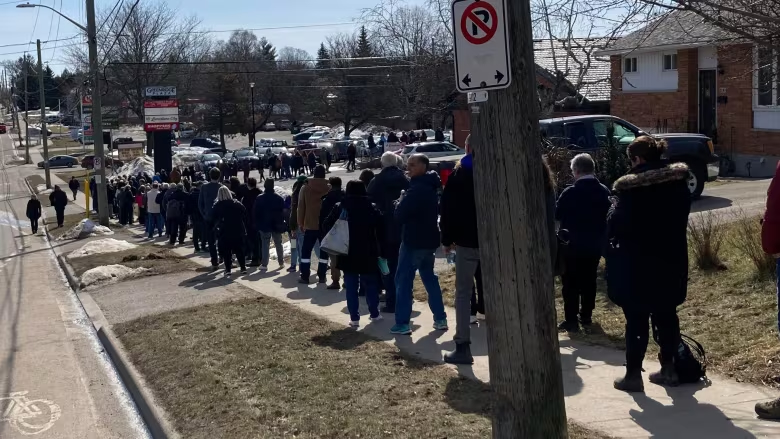
People lined up in Kingston desperately hoping to get a family doctor when a new clinic opened (image first put out by the CBC)

Except of course, the Ontario Government, and their Ministry of Health Bureaucrats. As far as they are concerned, now is actually the perfect time to attack family doctors. Because, you know, the way to improve burnout, morale and encourage them to take on new patients is to ambush people who are already under siege with overwhelming workloads.

Here’s what happened. About 6,000 family doctors in Ontario practice under what is called a Family Health Organization (FHO) model. Think of it as a base salary plus performance bonuses. As part of working in that model, the family doctors have to sign a contract agreeing to deliver a basket of services, including, a certain amount of after hours care.

Because we have so many rural areas in Ontario, where family doctors do a whole bunch of other work (emergency department, hospital on call, palliative care, long term care on call and more), there is a provision in the contract that says if you have X number of family doctors doing this kind of work already, then the amount of after hours care you provide as a FHO can be reduced. There’s a somewhat complicated formula but that doesn’t really matter – it’s the principle that counts. Essentially, if you are already doing after hours work – then you are not asked to do more after hours work.

Unless of course you are a Ministry of Health bureaucrat, taking the guidance of your bellicose negotiations team that said there was “no concern” about a shortage of family physicians. This allows you licence to use a stick against family physicians.

Then, you send letters to 75 FHOs telling them they are not meeting the terms of their contract, based on made up metrics. The letters (I’ve seen a few of them) all allege that the doctors in the FHOs are not living up to the terms of their contract.

Let’s be 100% clear on this. If a physician signs a contract as part of a FHO, they should hold up their end of the bargain. You should read the contract, go in with your eyes open, and make sure you are capable of meeting all of the terms that you agreed to.

BUT.

It appears what the Ministry is arbitrarily and unilaterally determining how to decide if a physician is meeting the terms. For example, one FHO letter I saw suggested that that FHO was not performing as well as its “peers” and was therefore targeted. Two things though. First the Ministry unilaterally decided who the peers were. Second, performing up to the standards of your peers was not part of the original contract.

Another letter I saw alleged that the doctors who do call for their hospital or their nursing home, don’t qualify because……they don’t bill enough for going into the hospital. The ministry unilaterally decided that in order to claim after hours work, you couldn’t just be on call, but you had to keep going into the hospital when on call, a certain number of times (this number was never up for discussion before).

I’ll use myself as an example. Last Wednesday I was on call for my hospital. I got three calls (one at 4:00 am!) and managed all the patients over the phones. I DID perform the task I agreed to (being on call). But the bungling bureaucrats won’t acknowledge that. They want me go to the hospital (even if I can handle it over the phone) and then bill OHIP for the service (which would drive UP the cost!!) to be recognized – a decision they seemingly made on their own, without consultation.

My two loyal fans and one non-fan regular reader know that I’ve long maintained that Star Trek is a far better franchise than Star Wars. But in this case, I will concede the Ministry’s actions are most appropriately compared to this fellow:

Normally when a government changes the terms of an agreement unilaterally, one would expect the Ontario Medical Association to step in and advocate for their members. However, the response from the OMA, in a letter sent to all its members was, frankly, pathetic. The letter basically told doctors to “notify the Ministry” about the circumstances around your group. Try to reason with Darth Vader as it was. No dedicated email or legal team staff member either. Just contact the general help email.

I guess specialists who had expressed concerns on Social Media about too many family doctors on the OMA Board have nothing to worry about. Clearly the OMA, between allowing the across the board increases to the arbitration award this year and not dedicating resources to tackle this issue cares nothing about family medicine. (They talk a great game on social media, but it’s the actions that count).

I imagine the issue will eventually sort itself out after many rancorous meetings and back and forth – all of which will take up physicians time and prevent them from doing minor and inconsequential things like, say, seeing patients. The Ministry will continue to claim that we have more family doctors than ever before – but let’s face it, if they keep behaving like this, those doctors won’t practice comprehensive care medicine. It just seems so ridiculous, and indicative of a Ministry that truly doesn’t understand or value family medicine.

And that should frighten the general public more than the Death Star ever did. (Drat, made ANOTHER Star Wars reference).

The original Death Star from Stars Wars, Episode IV: A New Hope

The Arbitration Award: The Good, The Bad, The Ugly

On Sep 12, Ontario Medical Association (OMA) Board Chair Dr. Cathy Faulds announced that the Kaplan Board of Arbitration awarded Ontario’s doctors 9.95% for the first year of their Physicians Services Agreement (PSA).  Sounds straightforward right? Nope – it’s actually ridiculously complicated.

I’ve looked at the award.  I may have some of this wrong (copious documents found on the OMA website induced catatonia, hypersomnolence and cluster headaches).  But this is my take.

A simplified (I have a small brain) set of numbers first:

Total award:  10%, approx value $1.6 billion dollars

Amount for general feel increases: 7% or $1.12 billion dollars

Amount for “targeted funding”: 3% or $480 million dollars.

In the past the OMA and Ministry agreed 1/4 of the raises would be across the board, the rest done with “relativity in mind”.  IF we do that again then $280 million (1/4 of $1.12 billion) will be in across the board increases.  Every specialty would get a 1.75% raise. The rest of the money ( $840 million) would be for raises based on relativity. So all specialties would get 1.75% + X as a raise.  The “X” would vary. It would be more for low income specialties, and the X would be lower or even zero, for the high income specialties.

The Good.
There’s a raise.  The MOH Team stated that Bill 124 should not impact the deal. The arbitrator disagreed and felt that we were unfairly treated because of Bill 124 stating:

“Bill 124 directly impacted the bargaining even though physician compensation was not subject to its terms.”

Hence, the MOH Team completely lost their argument that there should be no redress, and there was a 6.95% redress given.

There was a recognition that family practice is in crisis.  In his ruling the Arbitrator said:

“We accept on the evidence that there is a physician shortage. Somewhere between 1.35 million and 2.3 million people in the province are not attached to a family doctor. These are real numbers. The Ministry’s own documents – which we ordered disclosed–demonstrate that there is a problem to address.”

The arbitrator had to order the Ministry to disclose this?? Jeez. Additionally, the Arbitrator noted:

“Clearly, more family doctors are needed as are more doctors practising comprehensive longitudinal medicine…..it is obvious that the citizenry is ageing – the Government acknowledges this brings with it increased complexity…”

Contrast this with the Ministry’s absolutely laughable position that there is “no concern” about a shortage of doctors.  This is frankly a warning shot, and a welcome one, to the MOH’s negotiations team to not say such stupid things again, and to change their position in future rounds of negotiations.

In another shot to the now obviously inept MOH Negotiations Team, the Arbitrator agreed that admin burden also needed to be addressed with, you know, money. He stated:

“We have reached the conclusion that targeted increases – not necessarily baked in – should be allocated to the reduction and redeployment of administrative work that can best be performed by others or through digital or other measures.”

Finally, It was quick.  OMA Board Chair Cathy Faulds had told us not to expect an award until the end of September.  Who knows why Kaplan put the award out so quickly.

The Bad.

This will not be enough.  The OMA asked for a 22.9% increase. They got less than half of that. This is not really the big win the OMA is portraying it as.

A 10% increase in gross billings for family medicine will not be enough to stop the haemorrhaging of doctors from comprehensive family practice. The “X” for family medicine (see above) needs to be high, and much of the targeted funding needs to go to family medicine too.

And, while it’s true that the Arbitrator recognized there was a crisis in family medicine, the award given did not really do anything in and of itself to stabilize family medicine.  It’s true that was not part of the scope of the arbitrator for this round (this round was for a fee increase). The fact that some practical guidance in how to resuscitate family medicine is missing is still bad for all Ontarians.

The Ugly

The implementation of this award is going to be a nightmare.  As I write this, there is no indication that the MOH and OMA have agreed on how to divide up the $1.12 billion in general fee increases based on relativity.  In fact, indications are that the MOH will continue to fight the methodology, meaning it could be a very long time before fee increases for specialties are set.

Worse, the OMA and MOH have not been able to agree on how to distribute the $480 million in targeted funds.  Which means….more mediation and arbitration.  I continue to concede that the OMA states arbitration and mediation will be done by mid- March 2025. I continue to not hold my breath.

Even uglier is that one solution being proposed would be to give “everyone” a 9.95% increase right now, until the relativity and targeted funding is sorted out.  But that would mean that some of the higher paid specialties would see a 9.95% for a bit, only to have a relative cut once the final fees are sorted out (also to be arbitrated by March 3-7, 2025).  No matter how you message this to warn people – this will cause problems when people see a decrease in income after a rise.

All of which means that the retroactive pay for this year may not come for over a year. If you are a physician who has some decisions to make (eg do you renew the lease on your office at the higher rates the landlord is demanding) – you are going to be awash in uncertainty.

The ugliest part of all of course, is that a bunch of lawyers are going to get really rich as their billable hours go through the roof during this process.

There is a better way.

The government’s main concern should be about expenditures. That decision has now been made for them.  The PSB will go up by $1.6 billion.  That money will have to be paid one way or another.  

The government can now, especially after being told off by the Arbitrator back off from their polarizing and obstructionist path, accept the OMA proposals for implementing the award. They cover what the government states it wanted (pay lower paid specialist more of an increase than higher paid ones).  They also covers issues around admin burden which the Arbitrator acknowledged exist, and the shortage of family physicians (which the arbitrator also acknowledged). 

The total amount spent by the government is going to be $1.6 billion regardless. Getting rapid agreement on the distribution of those funds will decrease the uncertainty about how much goes where and will shorten the time it takes doctors to get paid, which will stabilize the health care system.

Then, for the love of Allah/God/Yahweh/Great Universal Consciousness – the government now needs to realize that you can’t fix health care without working co-operatively with your doctors.  Go look at other provinces. Copy them and get a fair deal for years 2-4 of this agreement.

Or the government can continue to obstruct, obfuscate, delay and impede any real progress towards working together with more protracted, internecine mediation and arbitration. The ball is in their court.

What should doctors do?

The above represent my personal interpretations of the documents I read. I encourage all Ontario physicians to register for the OMA live session on Tuesday Sep 17 from 7:30 – 8:30 pm to hear more details about this agreement.

CFPC Blows it AGAIN. Insults All Ontario Physicians.

Jeez. I thought the Board of the College of Family Physicians of Canada (CFPC) had learned its lesson following the ham fisted attempt to raise members dues and extend the residency to three years. In the aftermath of that debacle, CFPC President Dr. Mike Green promised a full review of the organization, and stated that the CFPC will be a “humbler and more transparent organization” going forward.

Turns out that letter was worth as much as an IOU from Donald Trump. The CFPC has once again insulted a good chunk of its members, and showed an incredible disconnect between those who run the organization, and the front line members whose dues pay them.

I’m referring of course, to the incredibly insensitive and frankly, downright insulting decision on the part of the CFPC to ask Dr. David Price to be one of the keynote speakers at the Family Medicine Forum (FMF). The FMF is their biggest continuing medical education event.

Screenshot

I will certainly agree that Dr. Price can be credited with a whole list of accomplishments. His resume alone would exceed the self imposed word count on my blogs. I would also completely agree that as someone who has done a lot work studying primary care models, he would, in fact provide some thought provoking ideas. While I wouldn’t agree with all of them, I would find them worth discussing.

But.

He is also a member of the Ontario Governments negotiations team. This is the team that has refused to provide a reasonable proposal for compensation for family doctors (and specialists) and has instead referred the matter to a protracted arbitration process.

Worse yet, the public proposal that the team put forth at the Arbitration hearing could very charitably be defined as inadequate. Not being in a charitable mood, I would rather describe their proposal as what it really is, insulting, out of touch with reality and frankly, downright offensive. Since Price has chosen to continue to be on that team, the blunt reality is that he is beholden to support the governments arbitration position. (Members of teams like this often will have varying view points internally – so who outside of him knows what he really thinks – but externally – he has to toe the party line).

The CFPC has taken the position that family doctors need to get paid more (good on them), and has lauded provinces like British Columbia who have chosen to do just that. Yet they invite someone whose team has told Ontario physicians that all they deserve (despite the runaway inflation of the past two years) is 3 per cent more.

The CFPC has also strongly advocated for a reduction in the admin burden and health system transformation (good on them). Yet the team Price is part of has essentially refused to acknowledge these as big issues. They’ve refused to pay for admin work. And those 2.5 million people without a family doctor in Ontario alone? The official position, which again, Price has to support as a team member, is that there is “no concern” about the supply of doctors in Ontario.

Yes, that’s correct. Publicly, Price has to say:

  • 3 per cent raise is enough for all doctors (despite inflation being 15% from 2020-2023)
  • no retention or recruitment bonuses
  • no payment for admin time
  • no recognition of the harm caused to physicians morale by such an offer
  • no significant investments in Primary Care
  • there are enough family doctors for Ontario

As I wrote previously, his position is a slap in the face to Ontario physicians.

It’s no secret to the general public that Ontario physicians are demoralized and burnt out. It’s no secret that more and more comprehensive care family physicians are closing their practices and that most are finding joy elsewhere. It’s no secret that many are leaving the province.

But apparently, all of this is either a secret to the CFPC Board and the FMF Team, or they just don’t care. By blindly ignoring the harm that the Ontario Governments Negotiations Team is doing, and inviting David Price to talk anyway, the CFPC and FMF team are basically giving the finger to all of their Ontario doctors.

It just amazes me that when even a young physician can realize that the position that Price’s team is taking is repugnant and shows disdain for family physicians, how can the CFPC Board not seen that??

What’s worse, usually keynote speakers at events get a stipend (having been a keynote speaker I can tell you it’s pretty nominal) and their travel/accommodations paid for. Well where does the CFPC get the money to pay Price? You guessed it, from the very dues collected by the members for whom Price’s negotiations teams has shown nothing but contempt.

Talk about rubbing salt in the wound.

It would be different if Price was not on the Negotiations Team. (If I was on that team and been forced to accept their proposals publicly, I would have resigned in disgust. Only Price can answer why he chooses to continue to stay on). Then, even though many will disagree with Price’s views, it would be fair to have a robust discussion about his ideas and why they may or may not work.

But to invite him to talk despite his association with the negotiations team shows that the complete disconnect between the Ivory Tower mentality of the CFPC and its hardworking frontline members persists despite the embarrassing fiasco of last year. One can only wonder what it will take for them to realize that as a membership driven organization, the CFPC really needs to be more sensitive to the feelings of their members.

Never Ending Arbitration a Sign Government Does NOT Want to Work with Doctors

News Item #1: Prince Edward Island agrees to a contract with its doctors. Amongst other things, the deal recognizes that family medicine is a specialty (finally!) and increases compensation to reflect that. It also introduces strong measures to reduce red tape and administrative burdens, and adds what appear to be retention bonuses. PEI joins British Columbia, Manitoba, Saskatchewan and even Alberta (!) in working co-operatively with their doctors.

Dr. Krista Cassell of Medical Society of PEI with Health and Wellness Minister Mark McLane and Health PEI CEO Melanie Fraser

News Item #2: Ontario Medical Association (OMA) Board chair Cathy Faulds announced last week that the Kaplan Board of Arbitration will not deliver a ruling on the fractious contract dispute between Ontario’s doctors and the Ministry of Health (MOH)at the end of August as expected. It is delayed until at least the end of September, if not longer.

Now you, dear reader, are probably wondering why I refer to a one month delay as “never-ending”. Firstly, because I’m not convinced it’s only one month. I don’t recall the Arbitrator ever giving us a timeline for when he was going to give a decision when I was on the OMA Board. Timelines for meetings and hearings, sure – but for the decision, no.

But more importantly, even if there is a ruling in September, it’s nothing but a mere step in a protracted, convoluted process that, at the end of the day, does nothing more than show that the government would rather not engage the OMA in providing solutions for our health care crisis. To understand why, one needs to first appreciate the prolonged nature of the current arbitration process, and just how tortuous it is. (I will do my best).

First, the current arbitration process is ONLY for one PART of the first year of what is supposed to be a four year contract. It will cover April 1, 2024 to March 31, 2025. BUT, it will only cover a percentage increase for that one year. It will not set specific fees for different specialties. Instead, there was general agreement (last I heard) that 70% of the increase would go towards fee increases and the other 30% would go towards targeted areas of high need.

Sounds simple enough to sort out right? If the deal is worth, say $2 billion (this number is totally made up and Mr. Kaplan, if you are reading, this number is much less than the increase should be), then $1.4 billion would go towards fee increases, and $600 million would be targeted towards areas of need.

The problem is that the fee increases are to be distributed along what’s know as a “relativity model”. Essentially lower paid specialists are to be given a bigger raise than higher paid ones. Unfortunately, the OMA and MOH can’t agree on how those raises are to be distributed amongst the various specialties. Worse, they can’t agree on how to distribute the 30% that was earmarked for “targeted funds”.

Which means…..you guessed it, ANOTHER round of arbitration with yet another set of decisions to be ruled upon by the arbitrator. This additional protracted process won’t begin until the arbitrators first ruling and further negotiations and mediations. The information on the OMA website suggests arbitration for those issues won’t happen until March 3, 2025.

But wait, didn’t I say that this was only for the first year of the four year contract? Why yes, yes I did. Which means that after this, we now start arbitration AGAIN for years 2-4 for the doctors contract. And yet again, not only do decisions needed to be made on the percentage increase, but on how that increase is divided up. Which means…….potentially many more rounds of arbitration.

I would concede the OMA websites suggests all of the year 2-4 arbitration, and left over issues from year one can be done at the same time (March 3-7, 2025). However, I will refrain from betting the mortgage on that actually coming to fruition. We are one early election from this timeline being thrown into chaos. The cynic in me thinks that by the time arbitration is all done for this supposed four year cycle, it will be time to start negotiating (and yes more arbitration!) for the next four year cycle.

The government will most likely abide by the initial arbitration award (it’s doubtful they would reject an award prior to an election call). Ontario Health Minister Galen Weston Sylvia Jones will frame this as part of the process for coming to an agreement. She will (probably) claim that by abiding by the award the government is “working with” physicians to benefit the health care needs of the province.

She will be wrong.

I’ve mentioned this before, arbitration is preferable to the days when governments could unilaterally cut physicians income at the whim of the health minister. However, that doesn’t change the fact that arbitration should be viewed as a necessary evil, with emphasis on the evil. Not only can it demoralize people who are going through it, the spill over effects have wide reaching consequences.

What does this mean for the general public? The OMA has come up with some solutions for the various crises our health care system is facing (2.5 million without a family doctors, worsening health care catastrophe in Northern Ontario, overwhelming bureaucratic burden etc). The reality is that many of the solutions require changes that need to be made in a contract with Ontario’s doctors. But we don’t have one, so none of these will be implemented.

Instead of working co-operatively with the OMA to come up with solutions in a fair contract, the current government seemingly prefers to leave it all to the arbitrator. And as a result, patients will continue to suffer.

The government of Ontario has a choice. Follow the lead of BC, Manitoba, PEI and so on and work with the doctors to help patients. Or set up a perpetual conflict with them.

Over to you Minister.

Ontario Health Minister Sylvia Jones, who can start to fix things tomorrow, if she wants.

Reflections on Leaving Family Practice

My thanks to Dr. Ramsey Hijazi, founder of the OUFP, and one of the strongest advocates for improving family medicine that I know, for guest blogging for me today. Unfortunately, the government didn’t listen to Dr. Hijazi, and as a result he left family practice earlier this year. In this blog he reflects on how his life has changed since.

It was a busy Saturday morning at my daughter’s dance competition in April 2024. The family had all got up at 5am to get ready for the day. The morning was hectic getting the kids and dog dressed and fed, making sure we didn’t forget supplies for the day, packing snacks and then rushing across the city to Hull for the competition.

My wife helped bring my daughter and her sister backstage to get dressed and prepare for practice. I watched my 2 year old son run tirelessly down the hall of the venue screaming in pleasure. I watched with a sense of calm and patience that I hadn’t felt in a very long time. More than I can remember I felt….present. The previous day I had left my family practice to pursue a position as a hospitalist. In less than 24 hours (and to my own disbelief) I noticed a distinct difference in my frame of mind.

Leaving family practice was not an easy decision. It is a rewarding and challenging career where you can make a positive difference in the lives of your patients. You get to know your patients better than anyone else in the medical system as you care for them from birth to old age. Their journeys in the medical system can remain with you forever. I became a family doctor because I loved family medicine and I am grateful for having had the opportunity to practice and take care of my patients. It is also part of the reason I started the Ontario Union of Family Physicians in July 2023 to help advocate for changes to improve the working conditions of family doctors. I had hoped to continue this work.

However, over the last several years the landscape of family practice has deteriorated significantly. The administrative or paperwork burden in family medicine has ballooned to almost 20 hrs/week. It is a constant barrage of work that is being downloaded or dumped on to family doctors from specialists, insurance companies and pharmacies. There’s also the extraordinary duplication of lengthy and sometimes irrelevant hospital reports that come in daily for review.

In essence, you supervise every single step all of your patients take in the medical system whether you have seen them recently or not. You ensure that tests and follow ups are completed and that nothing falls through the cracks. If my patients did not have me overseeing their journey in the system, countless tests and follow ups would get missed and never take place.

Like it or not, family physicians have been unofficially assigned the responsibility to make sure things actually get done when no one else will. It is mentally exhausting. There were days I would come home from work feeling so overstimulated I could do nothing more than sit on the couch and keep silently to myself for the rest of the night (although young kids make that a difficult reality to realize).

In an age where patients can simply email their family doctor you are never unplugged from your job. Despite trying to convince myself that I wouldn’t think or worry about work on vacation, I couldn’t help but have intrusive thoughts that occupied my mind. I would drift away from the present moment I was trying to enjoy. Often I would use the first and last days of my vacation as a desperate attempt to try and be caught up.

On weekends when not much was happening, such as watching TV with the kids or supervising them in the backyard I also couldn’t help but have the same intrusive thoughts of thinking my time could be better spent trying to catch up on the paperwork that was piling in. I very much resented having these thoughts.

Now add this to the stress of running a family practice. Business expenses have steadily increased with a dramatic spike in the last 3-4 years without any real increase in OHIP revenue. Running a business can be a stressful, but worthwhile endeavour. Unfortunately, this couldn’t be further from the reality of running a family practice. Revenue from OHIP continues to pay less year over year relative to inflation and expenses.

The OMA has kept track of OHIP rates relative to inflation to show current rates are only 37% of what OHIP used to pay physicians to run their practice. For the newer family doctors entering practice the future stability of the profession is truly grim. They enter practice with huge loads of debt and an almost guarantee they will take home less and less money every year despite the workload contrarily increasing year over year. With no pension, benefits, paid sick time or vacation to top it off, the reality for recent grads is that without significant changes to help the profession, it is no longer a viable career option.

Many family doctors work side jobs to help financially subsidize their practice. Granted, the entire medical system is plagued with poor working conditions, underfunding and increasing burdens of work, however, the situation is particularly magnified in family medicine. But you don’t need to take my word for it, just look around to see what is going on in your community and in our province. Despite the OMA showing statistics that we have more doctors trained in family medicine per capita than ever before, we are in one of the worst shortages ever.

Family doctors simply don’t want to do family medicine any more.

Changing my career path to work in the hospital as a hospitalist was a big risk and required a leap of faith (I hadn’t worked in a hospital since I finished residency). But unfortunately, in family medicine I had become increasingly unhappy professionally and personally. As it turns out, becoming a hospitalist was the best decision I could have ever made. Working in hospital means I am responsible only for the patients on my ward and not 1500 patients in the medical system. I must round on and see each patient to review their medical problems, perform examinations and order any tests or investigations. I follow up with family when needed and appropriate for medical updates. At the end of the day unless I am on call, I walk through the door to go home and my work is done until I arrive again the next morning. There is no appointment schedule to rigidly follow and I can take as much or as little time that is needed for each patient. If something unexpected occurs, I can deal with it and get back to my work without the worry or stress of being behind schedule and having irritated patients. It is also challenging and extremely rewarding.

No longer do I have all the stresses of running a business or see up to 40% of my OHIP billings go towards business expenses. No longer do I need to reconcile rushing several patients in and out of the clinic for appointments to stay on schedule and maintain a reasonable availability while also trying to give the appropriate time to address their concerns. No longer do I leave work at the end of the day, eat dinner with the family and go back to the computer to tackle the never ending pile of paperwork. No longer do I need to worry and stress while on vacation about all the work that is piling up in my absence. No longer do I have the intrusive thoughts of working on paperwork while watching the kids ride their bikes or to watch my son run down that venue hall aimlessly in pleasure.

I am more present and at peace. I am a better person, husband and parent because of my decision to leave family practice and that is perhaps the saddest and scariest thing about this entire journey.