
Actually, Ontario Does NOT Have a Shortage of Family Physicians….

You’re probably wondering if I’ve lost my mind. The media is currently littered with stories about how 2.3 million people in Ontario don’t have a family doctor and how that number is expected to double in two years. Family practices are closing down. In Sault Ste Marie – over 10,000 people are about to be orphaned (left without a family doctor). The Ontario Union of Family Physicians just held an event geared towards helping family doctors leave the profession.

How out of touch must I be to make the assertion, as I did on CTV news recently, that we don’t have a shortage of family doctors?

Yours truly on CTV News

Truth be told, there is an important distinction that has to made, which is key to solving the orphaned patient crisis. There are family doctors, and there are family doctors who are willing to work in a comprehensive care family practice like I do. 

According to the Ontario Medical Association (OMA) website, there are over 15,000 members of the Section of General and Family Practice. These doctors have got their medical licence, are qualified to practice in Ontario, and are able to practice family medicine without any further regulatory hurdles (like getting foreign doctors licensed would entail). There are likely many more as some doctors with a family practice billing licence don’t choose a section – but let’s go with 15,000.

What’s really telling is that only about 9,300 are in what’s called a PEM (Practice Enrolment Model – where a formal agreement exists to run a family practice). The number that are in Fee For Service alone (without an agreement) but still run a practice, is likely only a couple of hundred. So at most we have 9,500 comprehensive care family doctors. The other 5,500+ do something else (hospital only work, clinical associate work, walk in, etc).

From the OMA website. PEM + APP is about 9,300. This would be the number of docs with a formal agreement to run a family practice. 

There’s a myriad of reasons why comprehensive family practice is so unappealing, but let’s look at the two main ones.

1)Decreasing net incomes over the years. It is of course, unpopular to talk about the money doctors make. The OMA has historically felt that the general public views doctors as “fat cats” and “part of the rich elite.” So they’ve shied away from talking about physicians incomes or trying to positively frame that discussion – with predictable results.

As Boris Kralj (PhD in Economics, Adjunct Asst. Prof at McMaster and former Staff at the OMA) points out, net income for family physicians has fallen drastically over the past 20 years.

My thanks to Dr. Kralj for allowing me to share his graph.

2) Increasing Admin Burden. I think everybody has heard how family doctors now spend up to 19 hours a week doing administrative work, ON TOP of the time they spend seeing patients. This work is unpaid of course (there is no fee code for admin work). On a personal note, in about 2004, my office, which was already electronic, got a vpn (virtual private network). This allowed me to connect to he office from anywhere in the world. Initially, I thought it was great. I would go on vacation, spend 20 minutes a day taking care of messages and when I got back from vacation – I would not have the backlog of messages to deal with. 

This past summer, I went on a hiking trip with one of my sons. He pointed out that I was now spending over two hours a day going through labs and messages. Essentially, family doctors don’t have any vacation now. I don’t care what your job is or who you are, a life without any breaks is unsustainable.

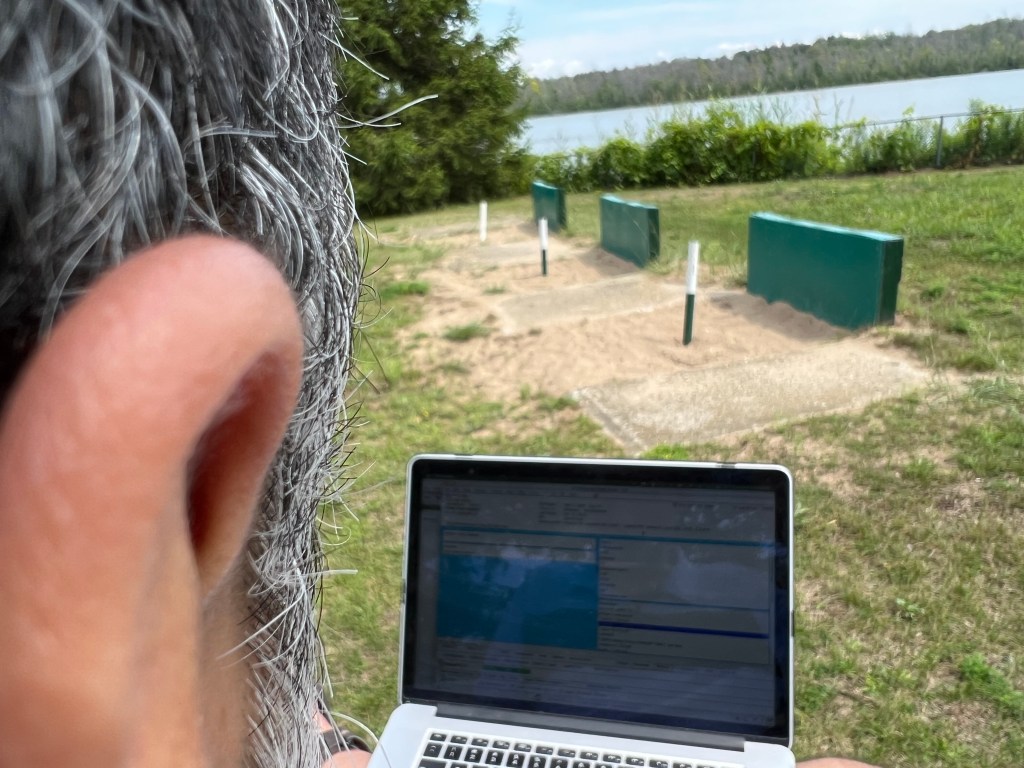
Me last summer, by a lake, on vacation, checking my office messages and lab work (dummy chart)

What can be done about this? How does one make family medicine more appealing? This may rub some people the wrong way but the first step is simple. Pay family physicians more. In Ontario, the most common fee billed by a family physician is about $37. (The last time I got a haircut, I paid $40). Out of that $37 the family doctor has to pay their nurse, receptionist, rent, cleaning, supplies and so on. Gets used up pretty quickly. 

Additionally, you need to pay physicians for admin work. If there is 19 hours of admin work that needs to be done – it’s only fair that work is paid for. There are people who are skeptical this will work. To them I would point out that British Columbia has gotten 700 more family doctors since increasing the pay to family physicians. 

You mean if you increase the income for a job, more people will apply for it? Who knew?

B.C. isn’t even the province that pays physicians the most. That’s arguably, as I have written before, Manitoba. Saskatchewans new deal is also much better than what Ontario offers.

The second aspect is to reduce the admin burden for all physicians. Many experts suggest this is a process that will take time. They are the same experts that oversaw the increase in Admin work for physicians with “oh it’s just one extra click or it’s just a simple form”. 

To reduce the Admin burden significantly, one needs to drastically revamp digital health care. Get rid of eHealth Ontario and OntarioMD, and run all decisions through the Digital Health Branch of the Ministry of Health. It’s too late to unify all of our electronic medical records, but you can approve one (and only one) patient app that will allow patients to access and transfer their records to the physician of their choice to reduce duplication and waste. That’s the kind of bold steps that we need to take, not just crowing about the fact that doctors don’t have to sign hearing aid forms any more.

Look we already have 5,500 licensed family physicians in Ontario able to open up a practice. If 40 per cent did so, it would end this crisis immediately without having to resort to years long plans of modifying licensing and training requirements for foreign graduates (who in fairness are generally very good).

Do our leaders have the boldness and vision to do the right thing?

Dr. Soni Reflects on the Delays in Emergency Rooms

Dr. Deepa Soni, and Emergency Room physician for over twenty years, reflects on the case of a young woman with appendicitis, and the delays in getting her care.

NB: Recently, Julia Malott spoke out on X (formerly known as Twitter) about how terrified she was about Canada’s health care crisis. She wrote how her daughter had not eaten in 18 hours as she continued to wait for surgery for appendicitis. She expressed concern about the lack of the beds and wondered if her daughter would get surgery before the appendix ruptured.

My friend Dr. Soni, who has worked in an Emergency Department for over 20 years, had, as usual, a very thoughtful and well spoken X thread of her own. (Dr. Soni was NOT involved in the care of this young woman). I thank her for allowing me to reproduce her thoughts here.

The only way these stories (about long delays in Emergency rooms) will stop being the norm, is when patients start sharing their experience like this mother did. Only voters can make federal and provincial governments change because votes are the only currency that matter. Doctors and nurses have been raising alarm bells for years without success.

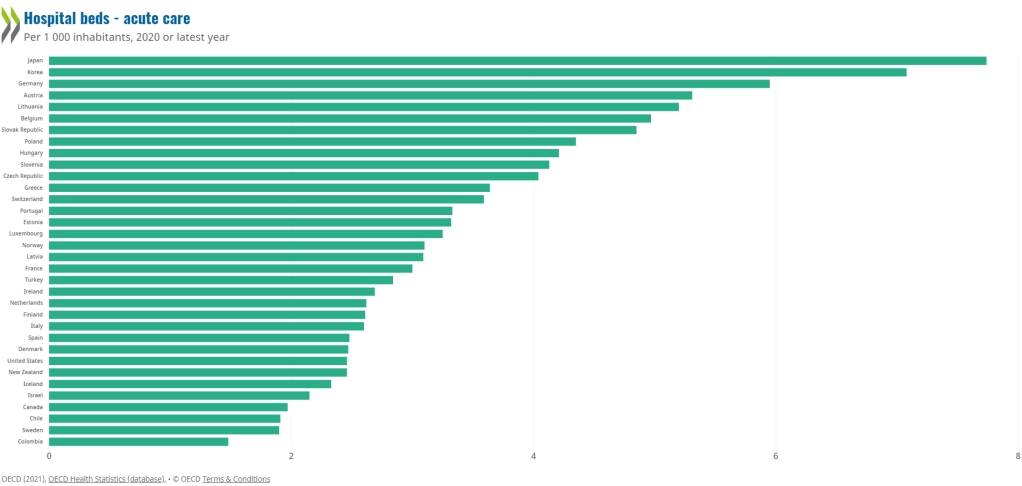
Canada has one of the lowest number of hospital beds of all the OECD countries, around 2.3/1000 people. In comparison countries like Japan, Korea and Germany are around 13/1000.

Graph showing how Canada fourth from the bottom (!) in hospital beds per capita.

Why does this matter? Having low hospital bed numbers means that words like “flu surge“, and “winter surge” — which have been used for decades to explain away long wait times and hallway medicine, are actually not “surges.” Rather, they are the expected backlog in a system that lacks adequate beds and resources.

The population of Canada is increasing and aging. We are about to enter a silver tsunami where a large cohort of our population will be over the age of 65 and many over the age of 85. This will place unprecedented pressures on our health care system.

What happens when the hospital bed capacity is outstripped by the numbers of patients needing care? It means that the elderly patient who needs admission to a hospital bed to recover from a heart attack has no bed to go to and spends days “admitted” in the emergency department. Bureaucrats call these “unconventional spaces.” What they really are, are stretchers.

When the vast majority of the emergency department beds are being used to take care of hospital patients, that means that patients that are waiting in the emergency department waiting room, will wait for hours for care, much like this story is describing.

Media needs to scratch beyond the surface and hold government to account. Real solutions are going to require thinking beyond the four-year election cycle. What will our system look like in 20 years? How do you plan for that?

It’s going to require recognizing the backbone of our healthcare system is primary care. Family doctors are overwhelmed by administrative burden, trying to run their offices and taking care of large practises in the community without adequate resources.


Build community infrastructure with resources like palliative care so that people can remain in their homes comfortably in their last days; and sufficient homecare services so that patients can receive antibiotics and other intravenous treatments at home to ease the pressure on hospitals. These services are vastly underfunded and do not have enough staff to properly provide care for everyone that needs it in the community.

It’s going to require building more nursing homes, retirement homes, seniors services and dementia care programs, as our elderly population will be the largest it’s ever been in this country.


Incentivize and properly pay hospital nurses so that we can recruit and retain them to be able to run departments and programs properly. Currently, agency nurses make at least two times as much as a hospital nurse, and this has created instability in the workforce. Governments need to show that they value nurses and the important work that they do.

Creative solutions like interprovincial licensing of doctors and nurses and a National Pharmacare program will help. While the idea of recruiting from other countries sounds like an easy quick fix, it will not solve anything if those newly obtained doctors and nurses find themselves overworked and burning out soon after arriving to Canada. The system problems are going to impact them just as they have impacted those who are already working in the system. This type of strain is what contributes to moral distress and burn out.

The backlog in the emergency department is a reflection of multiple failing areas that create an overall system that is strained beyond capacity. With each passing year, Canada’s healthcare system has become more and more stretched, trying to provide more care to more people, with fewer resources. Throwing Band-Aids at it is like trying to mop up the floor under an overflowing sink instead of trying to figure out how to turn off the tap.

Stories like this one are happening every day in Ontario and all of Canada. Most patients and families are too busy dealing with the acute health problem to take the time to write to their MP/MPP or to go to the media. But when people take the time to bring these stories to light, a critical tipping point will eventually occur where they can no longer be ignored by government. Because votes matter.

No one who went into healthcare wants to work in a system that makes patients feel like this story illuminated. But we need more voices bringing their stories out in the open. It will improve the system for the people working in it, and for the people receiving care within it. And that is better for everyone.

What Would I Do if I Got Sick? I Would go to Turkiye.

NB. I am a consultant for Medicte, a medical tourism firm that connects people with the Acibadem Health Group in Turkiye. I appreciate my two loyal fans may read this to be an “advertorial” – but it does represent how I feel. 

Yours truly at an Acibadem Hospital in Turkiye with their team and representatives from Medicte

Recently, Leger released the findings of a survey that polled Canadians on their thoughts about the health care system. 70% of Canadians worried about not being able to get high quality health care. Surprisingly, only 37% thought the health care system was poor – did 63% not need medical care recently? But the number that should demoralize all of us is that only 17% feel the system will improve.

Like everyone else of a certain age, I’m coming to the realization that the one fight I won’t win, is the battle against time. More of my friends and colleagues are developing health issues. While I’m blessed to be in good health, like 83% of Canadians, I realize that the current health care system (which doctors call horrific and inhumane ), will not provide the access and care we should expect as standard in this country. I can only see things getting worse in the near future.

It does not help that I live in the health system every day. I’ve watched patients I really care about suffer in ways that I would not have imagined possible. Young people with cancer not getting treatment for three months. People with joint pain waiting a year for surgery. Patients developing complication after complication while on wait lists to access necessary treatments. 

Most heartbreakingly, I see the toll that the burnout of working in such a hellishly damnable health care system is taking on doctors, nurses and other allied health care professionals on a daily basis.

That’s why I recently made the decision that if I, or someone in my family needed health care, I would seek care outside of Canada. I am not alone in this. The data is hard to get at, but going back as far as 2014, between 52,000 to 217,000 Canadians were seeking health care outside of Canada annually. 

There are a variety of reasons to seek care outside of Canada, and specifically Türkiye:

  1. Getting immediate care. I could get hip surgery next week, not next year. Cancer patients get all the tests they need done within a week, not three months like I’ve seen. 
  2. Getting treatments that are not available in Canada. Canada offers a host of great medical treatments, but many are not covered by government plans. Lap Band surgery is one. New, emerging radiation therapies for pancreatic cancer is another. There are more. All of these are available in Türkiye.
  3. Getting better allied health care support. Canada has GREAT nurses and other allied health care workers. But the system does not let them care for patients the best. Last time I was on call at my hospital, I overheard the nurses talking about how they each had 7 patients to look after for the shift. The safe number for an acute care hospital ward is 5 patients per nurse. We have excellent nurses but if you are constantly working at 40% over capacity, things are not going to go well. At the Acibadem hospitals in Türkiye, they have 4 nurses for 15 patients (3.75 patients per nurse).
  4. More cost effective care. I’m fortunate I can afford to pay out of pocket for care if needed. Worst comes to worst I’ll put off retirement for a couple of years to pay for things if necessary. But even I would have trouble with $200,000 (U.S.!) that B. C. resident Allison Ducluzeau spent on her cancer care. Costs in Türkiye for most procedures I looked at are generally less than half of what it costs in the U.S.
  5. First World Standards for Health Care Treatments. All of the Acibadem hospitals are JCI Accredited (the global leader in health care accreditation agencies). This puts them on par (and in some cases better) than top European hospitals.
  6. Türkiye is a well sought after Medical Tourism destination. Medical Travel Market recently highlighted 12 reasons why Türkiye was so well sought after including cost, world class facilities and cutting edge treatments. 1.2 million people went to Türkiye for medical tourism in 2022, mostly from Europe.

As part of my consulting work, I went on a fact finding tour to Türkiye and visited the Acibadem hospitals. To say my jaw dropped would be an understatement.

The team and I reviewing the process for orthopaedic care with their top spine surgeon.

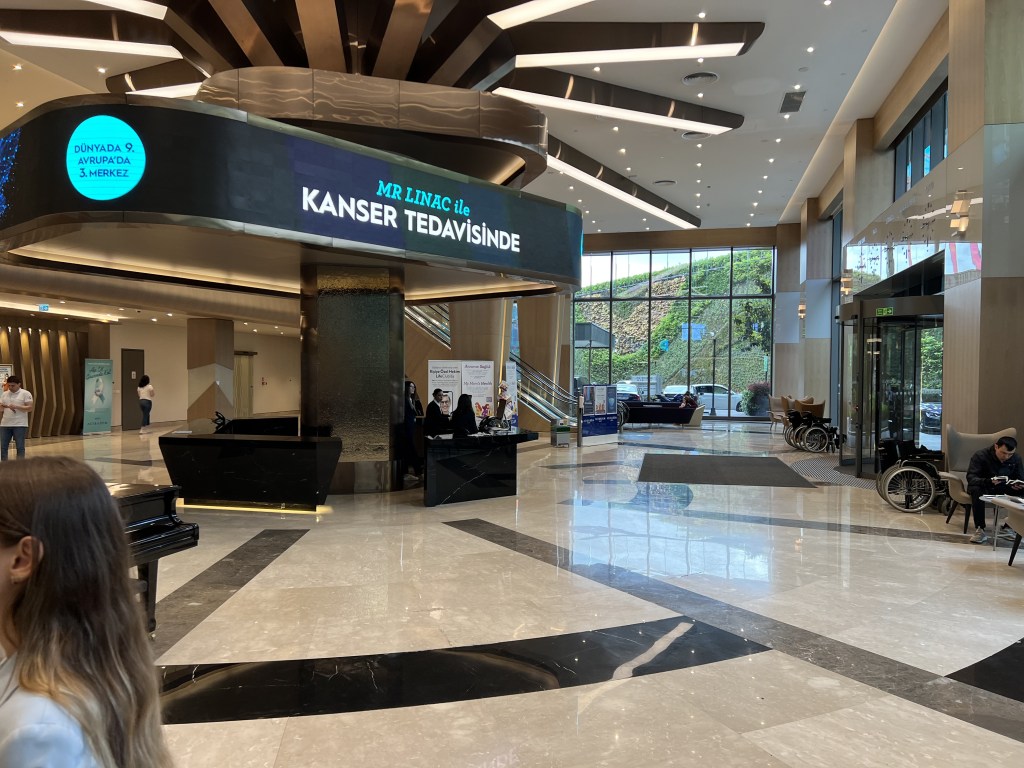
The hospitals (there are 21 in the Acibadem group) look like hotels. Each room is private. The wards are immaculate. All of the staff were incredibly attentive (and yes, spoke English). 

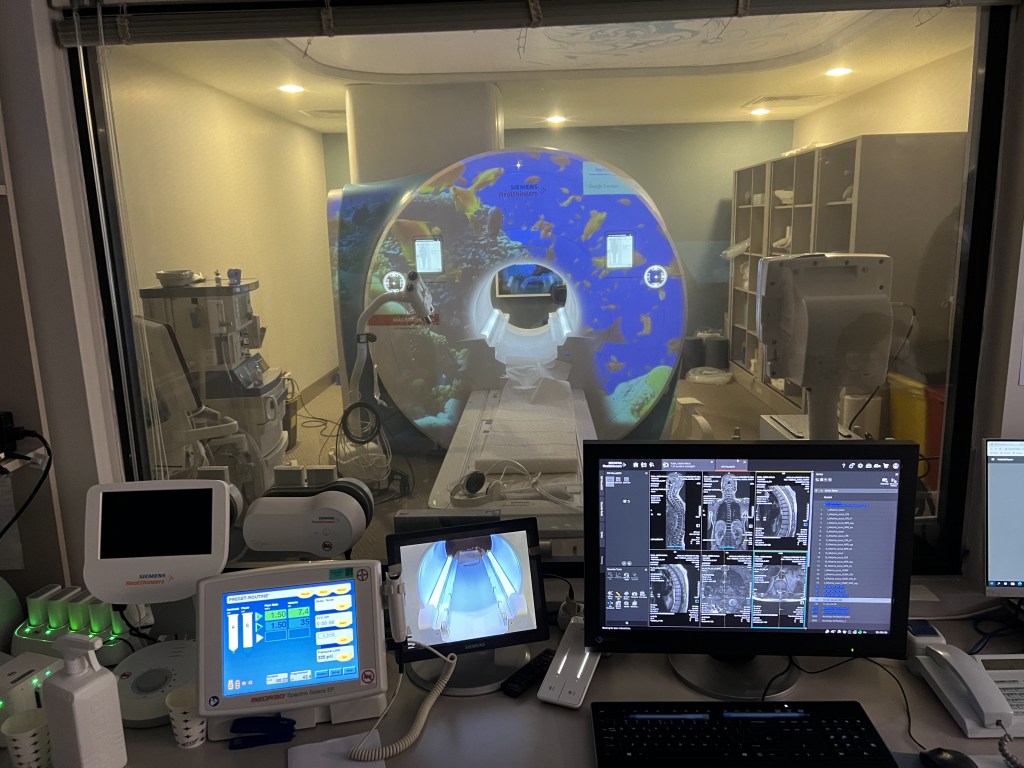
I asked to see the MRI, and the staff wanted to know which one (!). Their approximately 170 bed hospital had THREE MRIs, specialized for different conditions. This is on top of the CT scans, gamma knives (cancer treatment), PET scans etc etc. All of the equipment was brand new. I especially liked the MRI that projected a movie onto the equipment, to help children stay calm during the procedure.

I also ran into a couple of top ranked Turkish footballers (soccer players) while there. The Turks are as crazy about football as we are about hockey. Their top athletes go to the Acibadem group.

But what’s more impressive than the top ranked doctors, nurses and equipment is their philosophy of how to provide health care. If you were to sadly, get cancer, you would see all the specialists you need to see (surgeon, medical oncologist, radiation oncologists etc) on the same day. Any tests you need would be organized sequentially and rapidly over the next couple of days (if not the same day). You would have a full treatment plan within a few days.

Contrast this with Canada where you have to have an appointment with one doctor, then wait x number of weeks to see another then x to see another like my patients currently do. All while the cancer continues to grow.

Also, for the record, I did wind up getting care myself at Acibadem. Bad teeth run in my family, and so I went for a dental check up. The dentist examined me, put in two fillings, got the oral surgeon to come by and took out two teeth that were beyond hope, all during the same visit. This would have taken multiple visits in Canada. You could say I put my money where my mouth is. And yes, the care was excellent.

I appreciate this sounds like an advertorial. But the reality is that more and more Canadians are getting frustrated with the long waits for health care and seeking care outside of Canada. It may have started off with people seeking lower cost cosmetic surgery, but now things like orthopaedic surgery, cancer treatments, organ transplants, dental implants and even cutting edge infertility treatments can be had for those willing to travel. 

There is never a guarantee of a successful result with medical treatments anywhere (including Canada). If considering leaving the country for care, people should do their due diligence. Make sure you deal with a reputable firm and first rate hospital.

I’ve made my decision, and I know where I’ll go. 

If you or anyone else would like to explore options for out of country health care, contact Medicte for a free consultation.

OMA Needs to Communicate Better About Status of Negotiations

Negotiations between the Ontario Medical Association (OMA) and the Ministry of Health (MOH) on a new Physicians Services Agreement (PSA) began this past fall. The first set of bilateral meetings were in mid-October. This years negotiations present a particularly complex challenge as not only is the OMA trying to negotiate a new four year agreement for physicians, but it also has to determine how much of an increase physicians will get this year (more on that later).

Given that we are a few months into the process – I think the OMA as an organization is really not doing a very good job of communicating the status of the Negotiations with its members.  The OMA really needs to increase some of the transparency around the negotiations process.

In fairness, there are somethings about negotiations that simply can’t be divulged (and I fully support this and members do need to accept this):

  • The mandate for negotiations must be confidential, to prevent the other side from knowing what our bare minimum acceptable increase is
  • The detailed discussions between the Negotiations Task Force (NTF) and the MOH must also be confidential (a lot of stuff that goes back and forth is hypothetical – and to protect the integrity of the process – you can’t disclose this to 40,000 + people)
  • The briefings presented to the Board and the Section Chairs must stay confidential as well (for the same reasons above).
  • NB – If we wind up in arbitration, the asks at arbitration are public.

So what should the OMA be informing members about then, given what’s usually a “cone of silence” around negotiations? Well, put simply, there are a number of things that are part of the negotiations process, outlined in public documents readily available to all members. The OMA needs to recognize some members (not just me) will read and wonder about these. (Although I’m probably one of the few loudmouths who’ll publicly write about it).

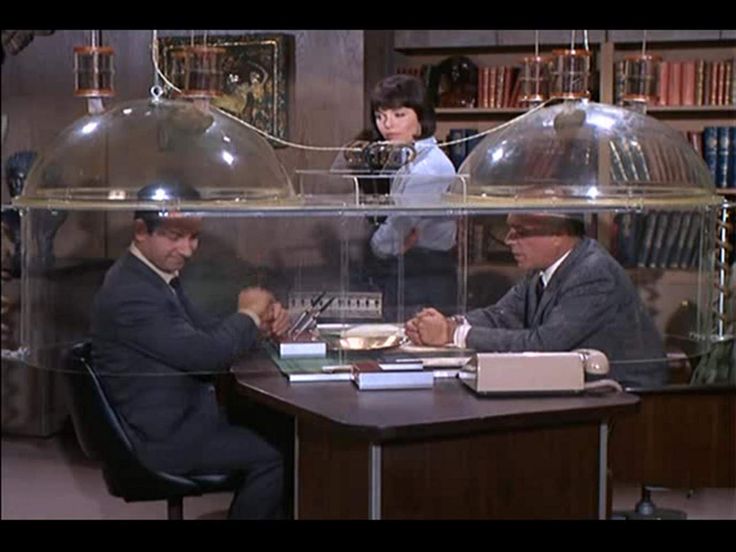
The Cone of Silence, from the classic series, “Get Smart”

For example, the Binding Arbitration Framework, under which negotiations are now held, is posted on the OMA website for all physicians to see. The framework is pretty clear. After 60 days of negotiations, either side can ask for mediation. They don’t have to, but they can. 

We are over 60 days. Perhaps mediation is not needed yet (which would be a good thing). But the OMA can, without compromising the negotiations tell members something like “while we have been negotiating for x number of days, at this time the process continues and we neither side has called for mediation.” It would at least let members who follow this closely know what the stages are.

Similarly, it would be quite reasonable for the OMA to list the dates of the meetings with he MOH and a general list of what they are talking about. Eg Oct 19 met with MOH to discuss Primary Care models, Oct 21 to discuss backlog in radiology etc. (I have no idea when the meetings with the MOH were or what they talked about btw – I’m just pointing out what could be said).

Finally, there appears to be radio silence about the part of the last contract that directly affects this year. This contract was completed and ratified by members and is public knowledge. The parts of concern are:

21. ….the parties will establish a committee that will meet on a quarterly basis…..to review the expenditure calculations. Through this committee, the parties will agree to a best estimate of the year 3 (2023- 2024) PSB expenditures in accordance with paragraph 6 by December 15, 2023.

22. Any agreements reached by the Government with respect to any new physician payment program or addition to an existing program which was not the subject of a proposal by the OMA during the negotiations leading to the agreement for the 2021-2024 PSA will not be included in calculating the total PSB expenditure …..”

It’s obviously past December 15, 2023. Which means we should have an agreement on the PSB expenditures by know. This information is critical to determining how much of an increase we get this year. The OMA had told us that:

“Conservative OMA projections indicate an expected Year 3 increase of 2.8 per cent, with a range of 2.1 per cent to 3.6 per cent”

But if the expenditures are too high, then we potentially get a zero percent increase. My friend Paul Hacker did an EXCELLENT job of explaining this here:

Paul Hacker’s Analysis

As an aside, some of you wondered why I endorsed him for OMA Board Director. It’s because of stuff like the above link. He knows the Board needs to provide proper oversight on the process and ensure it’s explained to members.

Anyway, perhaps this date got pushed back. This wouldn’t surprise me. The MOH Negotiations team was never able to get data on time in the past (there was always an excuse, except for the truth – that they are generally incompetent).

But the OMA should simply tell members this. Remember last year when it was announced to primary care docs that the repurposing of the preventative care bonuses couldn’t be mutually agreed on, and so was delayed for a year? Do the same thing and say the deadline couldn’t be met and you continue to work on it. But don’t just ignore the deadline and hope no one will notice.

Communicating better would also be beneficial for the NTF. There is no task force at the OMA that is more controversial, and gets more….attention…from members than the NTF. Yet what’s missed is that the NTF works really really hard. I remember some of the 18 hour days they put in when I was in various roles at the OMA. 

But when communication about the process, and the work they are doing is substandard, members won’t appreciate all that. They’ll simply blame the NTF for what goes wrong (e.g. if we were to get zero percent this year). It would be foolish in the extreme to suggest everyone will love the NTF if they just communicated better. But better communication would at least blunt some of the criticism that will come their way.

Hopefully, the OMA as an organization will recognize this.

Will Medical Political History Repeat Itself in 2024?

“The Wheel of Time turns, and Ages come and pass, leaving memories that become legend. Legend fades to myth, and even myth is long forgotten when the Age that gave it birth comes again.”
The Eye of the World, Book I of the Wheel of Time Series of Novels.

One of the advantages (?) of being old, is that you can see when history is about to repeat itself. Having followed medical politics for over three decades now (!), I continue to be amazed at how things keep circling, just like in the Wheel of Time series of novels. Unlike those books however, the Wheel in Medical Politics (WIMP?!?) would seem to come around every decade.

Case in point is the current crisis in family practice. I won’t bore with you the details yet again since this issue is all over the news. But I will bore you by pointing out that this is currently the third major health care crisis in my career.

In the late 1990s, there was a significant shortage of family physicians (sound familiar?). The shortage was made worse by poor payment for family physicians and poor working conditions. The Ontario Medical Association (OMA), which was supposed to represent all physicians, was widely viewed by the members at the time to be sorely lacking in helping family physicians. This led a few physicians (among them Drs. Sharla Lichtma/Rochelle Schwarts/Suzanne Strasberg) to form the Coalition of Family Physicians (COFP).

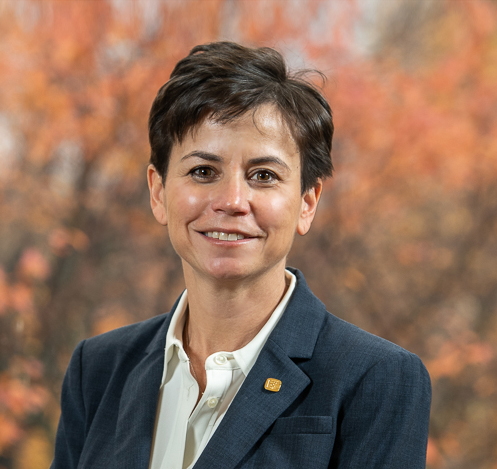
Dr. Suzanne Strasberg, former member of COFP, Past OMA President and current CMA Board Chair (and the only one of the COFP members whose photo I could find online)

Being politically savvy, they went out to the media and said things that the OMA, for whatever reason, did not. Not only did they get the attention of the press, they were (regardless of whatever revisionist history may suggest) instrumental in forcing the government of the day to institute Primary Care Reform and bring in the capitation models of funding for family practice. 

Their leaders also ran for OMA positions, with one of them, Dr. Suzanne Strasburg, eventually becoming the OMA president. It would be erroneous of me to suggest the OMA suddenly became an organization that had the undying love of its members, but the reality was that there was a noticeable shift in tone of their messaging when various members of the COFP got elected to the OMA Board.

Fast forward to the mid 2010s, and, once again there was a (you guessed it) crisis in medicine. This time, the crisis was created by militant Health Minister Hoskins, who was hell bent on doing things his own way. It’s not without reason that one grumpy old coot coined the moniker “Unilateral Eric” for him. 

Hoskins and his belligerent deputy Minister Bob Bell were so certain that what they were doing is right that they never bothered listening to the many intelligent people who tried to help them. Shockingly for most of us, instead of defending doctors, the OMA got into bed with Hoskins and Bell (aack! now I can’t get that image out of my head) and actually agreed on a tentative contract that stabbed doctors in the back.

Once again, when the OMA couldn’t deliver for physicians, a breakaway group of doctors got organized on Social Media. They were led by a strong crew of doctors that included the likes of Drs. Nadia Alam, Paul Hacker, Silvy Mathew and advised by people like Dr. Paul Conte and too many others to named. Despite being weighed down by an ancient, crotchety bugger they went and said and did things that the OMA couldn’t. They caught the eye of the media and the hope of the membership. Eventually, some of them (you guessed it) wound up on the OMA Board. 

Once again, while the OMA hardly became beloved by members, there was a noticeable shift in the tone from the OMA. Remember the ”Not a second longer” ads? 

And yes, Dr. Alam (and the guy who came in on her coat tails) both eventually wound up being President of the OMA.

As we head into the mid-2020s (!), the Wheel of Time is turning, and the Age is now being reborn. Once again the crisis in Family Medicine is in the forefront. Once again, the OMA is seen by many to be lacking in defending the profession.

N.B. I really do appreciate the work of most of the staff at the OMA but the reality is that the OMA has spent much of the past couple of years pushing their “Prescription for Ontario.“ To be fair, it’s a very good document with many positive ideas for change. But the blunt reality is that no one in government asked for it, any similarity to what government is doing is purely co-incidental and not because they are listening to the OMA, and the unrelenting focus on it makes members feel as if you the organization is not advocating for their own personal well being.

And of course, we now have the Ontario Union of Family Physicians. A breakaway group that has gone out and said and done things the OMA can’t. Led by Drs. Ramsey Hijazi, Britt Harrison, Vakar Khan, Alex Duong and too man others to name, the group has, in very short order:

  • set up an incredibly slick and well functioning website
  • been active in the media talking about why family physicians are quitting and not being afraid to mention that poor pay is (along with the admin burden) a root cause.
  • Began a job action campaign that the OMA can’t
  • and yes, one of their own, Dr. Ramsey Hijazi, is now running for OMA Board (along with Drs. Paul Conte and Paul Hacker). Full disclosure – I’m voting for all three of them, and you should too – and no, they didn’t know I would endorse them in this blog.
Dr. Ramsey Hijazi, a founding member of the OUFP, and a candidate for the OMA Board.

It’s easy to get cynical about medical politics when one sees how things keep circling. Truth be told, I’ve had my own moments of pessimism where I’ve wondered why things don’t change permanently. But the reality is that any big organization will have a tendency towards inertia. That’s just life.

But what’s also reality is that these organizations also significantly benefit from having people who are widely viewed as outsiders, or “disruptors” come in and shake things up. This is a healthy thing (whether the organizations thinks so or not). And it seems, in 2024, we may get that again.

DFCM at Temerty Faculty of Medicine’s Stunt is DANGEROUS for Physicians AND Patients

I’ve been involved in medical politics for some time and in health care for much longer. I’ve seen a lot of foolish things. And yet, I confess, I’m still dumbfounded when some really smart people come up with a really stupid ideas. I guess I’m just a slow learner.

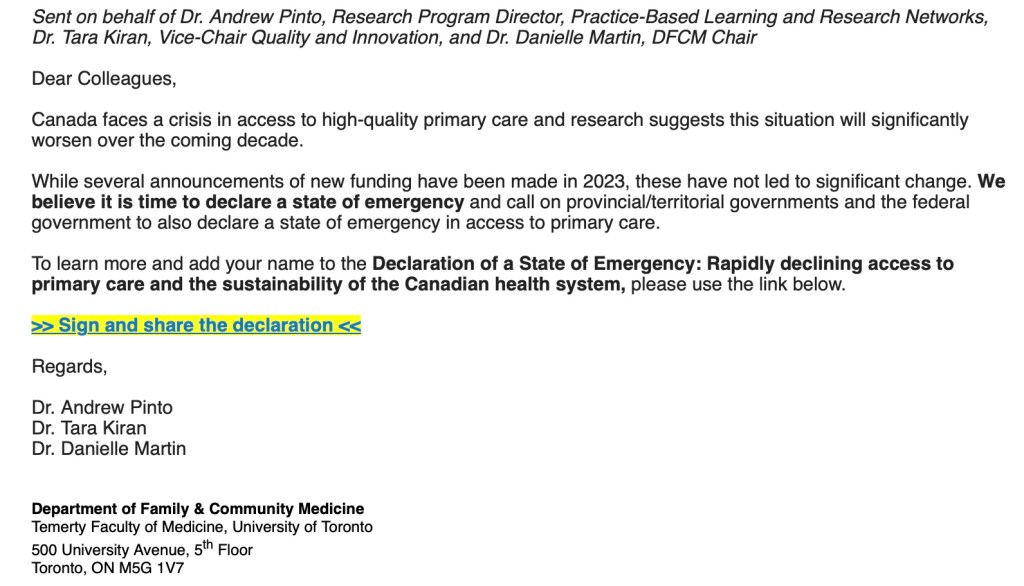
The most recent of these ideas comes from the Department of Family and Community Medicine (DFCM) at Temerty Faculty of Medicine. (Temerty is the name for the University of Toronto Medical School – and no, I have no idea when or why they changed their name to Temerty). In an attempt to address the crisis in Family Medicine, Drs. Pinto/Kiran and Martin would like the governments to declare a state of emergency in access to primary care.

Do I understand wanting to draw more attention to the crisis in Family Medicine? Of course I do. Family Doctors are planning to leave the field in droves. Compensation for family medicine has failed to keep up with inflation much less given them a raise. The admin burden makes one feel like Sisyphus (In Greek mythology Sisyphus was dammed by the gods to roll a boulder to the top of a hill only to have it roll suddenly back down to the bottom when it got close to the top and thus be forced to roll it up again. A more apt description of the family medicine paperwork burden I have never seen).

Heck across the country our whole health care system is in crisis, not just family medicine. Patients are not getting timely specialist care (some even choosing euthanasia as a result) as well as family practice care, resulting in worsening health care outcomes for all Canadians. We should be screaming about this.

But I honestly don’t think Drs. Pinto/Kiran/Martin (who combined have more letters after their name than the entire alphabet) could possibly have thought this recommendation through. Frankly, I’m genuinely left wondering if they even know what the government declaring “a state of emergency” means. The only way to enact this, is to invoke the Canada Emergency Act.

This Act clearly lays out what governments can do to solve a crisis in any particular area. And it’s not pretty. It includes:

  • giving the government the “ability to make orders or regulations that are believed, on reasonable grounds, to be necessary…”
  • Directing specified persons to render essential services…
  • Regulating the use of specified property, including goods…
  • The imposition of fines or imprisonment for contravening on any of the measures declared..

In short, having the government declare a state of emergency gives them a whole lotta power to do a whole lotta things. I guarantee you not all of those things will be smart.

No one in their right minds is going to argue with the issues identified in the letter three doctors wrote about:

The crisis in family medicine is real. There has been a lack of investment in primary care. This will get worse. This will cost the health system more money in the future if we fail to fix the problem. And yes, thank goodness somebody other than a cranky cynical old country doctor wants a significant overhaul and feels that “modest changes are not enough”.

But – to tell the government to enact a state of emergency, giving the same bureaucrats who have completely screwed up the health care system for the past thirty years almost unfettered power is not the solution. Let’s look at some of the goals of these three doctors:

If there is a state of emergency – do you know how these pointed headed bureaucrats will take “decisive action” to “ensure every person in their jurisdiction has equitable access”? You think they will licence more physicians? You think they will allow Ontario Health Teams (OHTs) to have strong physician leadership (which is the ONLY thing that has been proven to work in accountable care type organizations like these OHTs)?

I got news for you. The pointy headed bureaucrats will simply mandate zones, unilaterally determine how many patients a doctor must roster, and will make decisions in the interests of “urgency” given the new powers they just got from a state of emergency to show they are doing something.

Say for example the recent situation when Royal Victoria Hospital had to close down their obstetrics service. Hell that Gandhi fellow delivered babies 20 years ago, he probably hasn’t forgotten what to do – send him there to cover so it doesn’t close, he’s only 45 minutes away. Or a hospital about close their ER again – force a local doc who hasn’t worked in ER for 15 years to do so. 7,000 patients without a doctor in a certain town? Have each family doctor take a couple hundred more – even though those docs are already working night and day. (Trust me – these ideas will not sound outlandish to bureaucrats.)

Drs. Pinto/Kiran/Martin know that to make inroads into solving the primary care crisis you need to do three things:

  • increase the payment to family physicians to reflect the work they do. Decades of sub inflationary wage increases (cuts by another name) have made it untenable to run a family physicians office. Pay family docs more and don’t be afraid to say so.
  • The OHTs actually have potential for improving health care, but they need strong family physician leadership – not any other health care professional (and certainly not bureaucrats) – family physicians need to lead this. (The OMA has plenty of evidence on this and has shared with the government and will share with you).
    • Interchangeable IT technology that allows easy access to patient data and thus minimizes the admin burden.

The only reason I can think of for doing this is some sort of political stunt to embarrass the politicians. Heck I agree politicians should be embarrassed for how badly they’ve messed things up. But to do it in a way that gives them more power (not less) instead of demanding a true collaboration with family physicians doesn’t strike me as a very smart move at all.

OMA, CMA and CCFP Should put MEMBERS, not the Corporation, First

My thanks to Dr. Paul Hacker, pictured here, for his contributions to this blog. Dr. Hacker is a former Vice-Chair of OMA Council and a former member of the SGFP Executive. He’s a strong advocate for physicians interests, exceptionally well versed in governance and bylaws, and good friend.

As we approach election season for the Ontario Medical Association (OMA), many members have regularly brought up one issue to me. Is it true that the the Board Directors for the OMA are all asked to sign “an oath of loyalty to OMA central and not the members?”. The question is usually asked with incredulity and a tone suggesting a disappointing response.

The OMA is a corporation, as is the Canadian Medical Association (CMA) and the College of Family Practitioners of Canada (CFPC). There are many, many good reasons for these organizations to be incorporated, including preferential tax rates, some indemnification for members from assuming the debts of the corporation in case of financial difficulty and a requirement that bylaws and Boards adhere to certain standards.

If you think your membership fees are high now – just wait till you see what they would be if these organizations did not incorporate.

Good corporate governance demands that Board Directors of any corporation put the fiduciary interests of the corporation first. So yes, when I became an OMA Board Director, I did have to sign an agreement saying I would act in the best interests of the corporation. “Oath of loyalty” is a bit hyperbolic, but Directors are legally bound by their fiduciary duties.

In order to help educate Board members on their role, governance training is provided to them when they assume their role at the OMA. I assume this is also the case for the CMA and CFPC. The governance training is usually provided by some hot shot consultant (we got some guru from Rotman Management). Given the consultant’s list of degrees/publications after their name, there was an understandable (but still irksome) tendency for the staff at the OMA to value their opinions on Board matters over some Directors.

But this whole thing is frankly a crock when we are dealing with a membership representing organization (I told our consultant that). Fiduciary responsibility as Director of a for profit corporation whose goal is to increase share value is fine. But it’s quite another when the raison d’être of a corporation is to be a non-profit whose purpose is to advance the interests and needs of the members.

Let’s look at some examples.

I previously wrote about the atrocious 2016 tPSA between the OMA and the Ontario. What I didn’t mention is that that tPSA was actually really good for the OMA as a corporation.

No seriously. The agreement, if passed would have ended a period of internecine warfare between the dismal Kathleen Wynne Ontario government and the OMA, saving a bunch of money. More importantly, that agreement also created some bilateral tables where the OMA could be a joint partner and “co-manage” aspects of the health care system with the government.

There was to be a table on recommendations on physician supply and distribution. One to “co-manage” expenditures of the Physicians Services Budget. A commitment to work together on health reform and much more. In short, that agreement would have given the corporation of the OMA more power and a say in the health care system. All the OMA had to do was ruthlessly stab its members in the back.

Yet look what happened in the aftermath. The then Board was thoroughly repudiated in the ensuring vote. The first non-confidence motion in a OMA Board Executive occurred. Multiple special meetings were called. The resignation of the executive led to a protracted period where the OMA had no leadership or spokesperson. This is good for the corporation?

Want more? Let’s look at the Canadian Medical Association (CMA). In 2018 the CMA surprisingly announced that it was selling MD Management, which many of its members had relied on for their retirement planning. It’s hard not to see why they did it. The CMA got upwards of $2 billion dollars for the deal. The corporation of the CMA clearly benefited significantly and, unless it is financially managed by the same crew that ran Enron (remember them?) – will never go bankrupt and will live in perpetuity.

All it had to do is, you guessed it, stab its members in the back in a move that was widely viewed with a sense of betrayal. The outcome? In 2018 when Dr. Gigi Osler took over as president of the CMA, it boasted 85,000+ members. When Dr. Lafontaine took over in 2022, that number dropped to 68,000. I asked a friend of mine who is quite high up the chain at the CMA what that number is now and she told me she tried to find out, but apparently “they don’t give that number out any more.” Hmm.

NB: I realize correlation does not equal causation, but I find it interesting that the CMA stopped saying how many members it had after a grumpy miserable old coot pointed out the drop in numbers last year. The Medical Post often reprints my blogs – perhaps one of their intrepid reporters could ask the CMA how many members they have today.

Once again, the question needs to be asked, how does a drop in members truly benefit the CMA? How can they honestly say they “champion the medical profession” when they have fewer and fewer doctors as members?

We are seeing the same thing unfold with the College of Family Physicians of Canada (CFPC). They recently announced the truly idiotic suggestion that it was fair to raise their membership fees by 7 %, and the even dumber suggestion that the residency should increase to 3 years from two. They are now embroiled in a serious controversy over this and their annual meeting promises to be a mess. (Both of these moves would benefit the corporate CFPC of course – but not the members or the public).

The pattern is abundantly clear. When Directors of membership corporations don’t put members first (not the corporation), the corporation will suffer. I hope whoever runs for Director of the OMA has the intestinal fortitude to politely confront whatever “governance consultant” is brought on, and tell them just that.

How To Stop the CFPC’s Plan to Increase Residency to Three Years

PLEASE NOTE: This blog has been updated with new information, and to remove an unfortunate aspersion that was cast on the administrators of the PFI Facebook group.

Recently, the College of Family Physicians of Canada (CFPC) announced plans to increase the Family Practice residency to three years. This is, in my opinion, the stupidest decision they have made in my 31 years of practice. They should fix the current residency program instead. They also announced plans to increase the fees that family doctors pay by 7%, at a time when most family doctors are struggling to stay afloat. This would be the second stupidest decision the CFPC has made in my 31 years of practice.

There is, however, some hope. Some members have gotten some private members motions onto the agenda for the CFPC Annual General meeting. If enough ordinary members vote for those motions, it will pressure the CFPC Board into doing the right thing and stopping the implementation of these changes. In typical Ivory Tower fashion, the CFPC has made the voting process exceptionally convoluted. It’s so labyrinthine that it made we wonder if it was done on purpose to discourage members voting. Ivory Tower types don’t usually like listening to the masses.

However, a step by step detailed set of instructions on how to vote down these proposals were posted by Dr. Liz Zubek on her Facebook page. Dr. Zubek stresses that this is an accumulation of information gathered by many doctors and she herself has copied and pasted much of it to form the final set of directions.

Dr. Liz Zubek, family physician from Maple Ridge BC. Dr. Zubek posted instructions on how to vote at the CFPC Annual General meeting.

Dr. Zubek forwarded to me the detailed instructions that the CFPC doesn’t want you to see on my blog. Here’s how to vote ONLINE and IN ADVANCE of the Annual General Meeting. You do not have to attend in person and can do it from your comfy (?) office chair.

From Dr. Zubek’s Facebook page:

There is an ability to vote down the 3rd year of residency with private member motions buried in the agenda for the upcoming CFPC AGM, plus the ability to vote for transparency asking the CFPC to post something as simple as board and committee minutes, so we can actually see how they come to their decisions that make no sense to us …..and we can also vote on their wish to increase our yearly fees. But it isn’t easy to vote!

These are instructions for how to vote by proxy in advance in the CFPC annual member meeting taken from another post: How To Vote, CFPC 2023

1. Find the two emails from Oct 11th called “1 of 2” and “2 of 2” (search “Participate CFPC” if you’ve already deleted them). Click where it says “Register here”:

2. That will take you to a new page. The “control number” to enter here is in the “2 of 2” email from October 11th . You may have to type it in because copy and paste hasn’t worked for a number of people.

3. Once you hit “Login”, it will take you to a new screen. Here, select “Yes, I wish to appoint a proxy”. This means you are registering your vote ahead of the meeting and don’t have to attend the meeting. (If you do end up attending, you are allowed to change your vote):

4. After you press “continue”, it will thank you and then send you two more emails that will take 20-30 minutes to arrive. NEW INFORMATION: Despite doing this 12 hours ago (as of this writing), I have yet to get a second email. Some physicians have told me it is now taking up to 24 hours to get an email. Many are complaining that they are having difficulty logging in in the first place.

5. Open the new “1 of 2” email and click on the weird looking “lumimeet” link and use the password that’s in the new “2 of 2” email to log in. Again, you may have to type it in because copy and paste hasn’t worked for a number of people.

6. You’re almost there! On this page, you can now click to read all the motions if you like. When you’re ready, you click the “Voting” tab at the top and you can…vote!

7. In the interest of democracy, I will not tell you how to vote. However I will tell you that I voted “no” to the fee of increase and “yes” to the next four motions for greater transparency, information as to how the 3rd yr decision was made, a financial impact report of the 3rd year, and to put a hold on 3rd year implementation. Hope this is useful! Now go and vote!! It’s so important.”

You MUST vote by MONDAY OCTOBER 30, 2023 at 5:00 pm!

My two cents:

This grumpy old country doctor intends to vote exactly like Dr. Zubek did. No to the fee increase. Yes to the next four motions. It’s unclear at this time whether these motions are binding on the CFPC Board. But at the very least, us ordinary members have to say our piece.

My initial blog, which I do believe was factual, commented on the fact that this post had been deleted from the Facebook group PFI by the administrators. The author had also been removed from the group. The way I wrote about it unfortunately cast aspersions on the administrators of PFI. That was inappropriate on my part and for that I am truly sorry. My goal was to comment on the fact I felt (and do still feel) it was inappropriate to remove a member without warning, but the initial way it was written suggested something more. That was wrong of me. My apologies again.

But one thing at time. Vote to stop the 3 year residency and fee increases first. Then let’s find out how the situation became so unseemly so quickly.

We Should Return to the Health Care Model Tommy Douglas Envisoned

In 2004, the CBC surveyed Canadians to see who would take the title of “The Greatest Canadian.” The winner was former Saskatchewan Premier Tommy Douglas. Douglas is widely, and correctly viewed as the founder of socialized health care in Canada.

His selection speaks not only to the dramatic impact he has had on this country, but just how much Canadians value health care. I will dispense with calling it “free health care” because that just isn’t true. Our tax dollars pay for it. But those dollars are supposed to provide care for all those who need it.

Tommy Douglas, the Greatest Canadian, and the founder Medicare.

As our health care system continues to collapse all around us, it’s worthwhile, I think, to look back at the type of health care that Douglas envisioned. The truth of the matter is, that it is quite a bit different than what we have today. And I think, is not at all what Douglas would want.

According to “The Canadian Encyclopedia“, Douglas’ views on health care were shaped by a number of events in his early life.

As a six year old, Douglas fell and cut his knee. Unfortunately, he developed osteomyelitis ( a bone infection) and the consequences hampered him for his entire life. He had numerous operations and at one point doctors in Winnipeg considered amputating his leg. Fortunately, a well know orthopaedic surgeon (Dr. R. J. Smith) offered to operate for free, so long as Douglas allowed medical students to watch. This saved Douglas’ leg, and helped convince him that health care should be readily accessible to everyone.

Later, as a young man, he moved to Weyburn Saskatchewan, and was dismayed by the complete lack of medical care. He buried a 14 year old girl who died of a ruptured appendix because she couldn’t get medical care. He also vividly told of burying two young family men in their 30s, who simply couldn’t afford to get medical care.

These experiences helped to shape his belief that we could do better as a country. I would suggest that all Canadian should share the belief that one should not have to choose between going bankrupt (or dying) and getting basic medical care.

As premier of Saskatchewan, he implemented the Saskatchewan Hospital Services Plan covering the needs of patients admitted to hospital. In 1961, he implemented the Saskatchewan Medical Care Insurance Act, that provided medical insurance for all residents of Saskatchewan. This of course eventually led to other provinces and the Federal Government adopting similar programs.

The wording is important, and I think speaks to what Douglas was trying to achieve, and frankly, where I believe we need to go back to. The plan was “Insurance”. With all the benefits, AND RESPONSIBILITIES that go along with insurance.

Here’s the thing. In Canada, ever since the Canada Health Act, we have really deviated far from what Douglas really envisioned. He never ever wanted a system where you could go to any health care provider and get assessed without any responsibility on your part. Indeed, he spoke to that quite eloquently in the Saskatchewan Legislature on October 13, 1961:

“I want to say that I think there is a value in having every family and every individual make some individual contribution. I think it has psychological value. I think it keeps the public aware of the cost and gives the people a sense of personal responsibility. I would say to the members of this House that even if we could finance the plan without a per capita tax, I personally would strongly advise against it. I would like to see the per capita tax so low that it is merely a nominal tax, but I think there is a psychological value in people paying something for their cards. It is something which they have bought; it entitles them to certain services. We should have the constant realization that if those services are abused and costs get out of hand, then of course the cost of the medical care is bound to go up.”

Douglas intuitively grasped that if people perceive something as “free” they will start to lose their sense of using it responsibly. That’s why the initial Medical Insurance Act was just that. A form of insurance funded by the taxpayer, and like all forms of insurance, there was a deductible and reasonable limitations.

People were able to now access health care, for a small fee that allowed them to recognize that they too had to take some responsibility for how they used the system. They also had to realize that not everything was covered. Basic health care yes. Options like wanting, say, a private room instead of a ward bed in hospital – well that would be an extra.

There are many problems with the Canada Health Act. But the most fundamental is that it is based on the premise that you can endlessly get something (in this case health care) for nothing. Gutless politicians (from all parties) continue to promote this mantra in never ending attempts to woo votes as opposed to, you know, actually telling the people the truth. Namely, that people should take some responsibility for how they use the health care system.

By continuing to perpetuate the the lack of accountability, our cowardly politicians have created a culture of entitlement instead of a culture of empowerment. Many (not all) people believe that they should be able to get all manner of testing because it’s “free”. I’ve been blessed to have a very pragmatic practice in general, but even I have had to tell people that I will not be ordering the serum rhubarb levels their naturopath wanted because it would be “free” if I ordered it instead of them, or the full body MRI that some “wellness consultant” asked for.

It’s time to bring some patient accountability back to health care. And the first step in that would be to go back to the model that Tommy Douglas had proposed all along.

Dear OMA Board Member, About That Mandate for Negotiations

Dear OMA Board Member,

I read, with interest Ontario Medical Association (OMA) Board Chair Dr. Cathy Faulds update last Friday. There’s the usual information in there about the goings on at the OMA (which sadly not enough members pay attention to, though they should). Critically for most members however, was this comment by Dr. Faulds:

“The board will hold a special meeting at the end of September to finalize the negotiations mandate for use by the Negotiations Task Force (NTF)..”

This is a big step in the negotiations process and to truly understand that, members need to understand what a “mandate” is. Allow me to briefly expand on what Dr. Faulds wrote. The short version is that a mandate is the minimum offer the NTF can accept from the government. If the government offers an increase that is equal to or exceeds the mandate, then the NTF will automatically accept that offer on behalf of the Board.

The corollary to that, which some Board members did not understand when I was on the Board, is that if the mandate is met, and the NTF accepts – then it will automatically mean that you as a Board have to accept the offer as well. As per Board rules, you will then have to endorse the government offer to the membership. You can’t very well tell the NTF “you must achieve XYZ”, and if they do achieve XYZ, turn around and say it’s not enough.

Therefore, it is incumbent on you as a Board, to make sure the mandate is sufficient for the membership as a whole, given the times we live in, and the environment around us.

To that end, without spilling specific secrets, I will state that there was quite a lot of discussion about what an acceptable mandate was during my time on the Board. There were some Board Members who wanted to be “reasonable” and some who wanted to take a hard line and keep the mandate high.

I would, respectfully, point out that for the most part, mandates are never met. Usually the NTF comes back to the Board with “we tried – but this is the best we could get” and presents that to the Board. To be clear, I’m referring to all labour negotiations in general, not just physician ones. Negotiations Legal Counsel told us this last time, just ask them. Whatever you (or any Board) sets as the initial mandate, there is a strong chance the NTF will come back to you later and ask you to lower that mandate.

You will need to keep that in mind when setting your mandate.

To that end, I would encourage you to recognize that the time really has never been better to set the bar extremely high for the NTF mandate. It’s not just that physicians are considering leaving the profession. It’s not just that health care is collapsing all around us. It’s not just the ongoing problems with not just recruiting, but retaining physicians. You already know about all of those issues in excruciating detail.

No, the reality is that we now also have some significant competition for physicians within Canada from other provinces. And I mean strongly significant.

Not sure how many of you have seen this summary form the recently approved Physicians Services Agreement (PSA) in Nova Scotia. On the surface there would appear to be a fairly minimal 10% raise over four years. A deep dive however shows significant add ons like improved parental benefits, funding for overhead, funding to hire allied health care professionals, funding for admin work, enhanced FTE and income stabilization for specialists and so on. That plus a retirement fund!

Similarly, in Manitoba, their recent agreement was widely hailed as a landmark and a game changer. I spoke to a friend of mine from Manitoba who confirmed that it too contains things like a retention bonus ($21,000 and higher for those in rural communities), funding for admin time, funding for new models of care, additional funding for those patients who are older and an equity lens applied to fees. In short, the increase is widely viewed to be in the double digits percentage wise per year.

Look, I know the NTF knows all the stuff I’m pointing out (but others who read my open letter may not). I also would acknowledge that Dr. Mizdrak is a fine chair for the NTF and is (in a very good way and said with total admiration on my part) a real pitbull on behalf of the profession. I also have full confidence that the NTF did it’s due diligence in reviewing the many asks by the leaders of all the specialties.

But at the end of the day, it is up to you, dear Board Member to set the minimum acceptable deal (mandate) and it is up to you dear Board Member to ensure that Ontario remains a competitive place to attract physicians.

To that end, you must ensure that if there is a negotiated agreement, it must at least equal the increase in Manitoba or Nova Scotia (whichever is higher). Anything less would, quite frankly, be rightly viewed as the Board selling the profession out. (If we wind up going to arbitration, that’s a different story – but at least we will have gone there because the Board refused to take a sub optimal deal).

All of which is a long way of saying that since it is quite likely that an initial mandate may not be met, it is incumbent on the Board to set a mandate for the NTF that is HIGHER than what was achieved in Manitoba/Nova Scotia. This will allow for the usual process of the NTF having to come back and say what parts can be achieved and what can’t, and allow some wiggle room.

If you set the bar lower, well, frankly, I have to wonder how you can justify saying that you are advocating for the Doctors of Ontario.

Yours truly,

An Old Country Doctor.