
Most Health Care in Canada is Publicly Funded, Privately Delivered

NB: My thanks to Dr. Hemant Shah, who inspired the title of this blog with his statements on health care delivery in Canada.

Well, here we go again. Yet another kerfuffle caused by absolutist ideologues who are so hell bent on forcing their immovable views on the rest of us that they are resorting to fear tactics.

Ontario Health Minister Won’t Rule out Privatization as Option to Help ER Crisis” – screams the headline in the Toronto Star (a newspaper known for its extremely biased reporting on health care). The article comes after Ontario Health Minister Sylvia Jones had a press scrum. The only problem is that’s not quite what she said.

Here’s the tweet from Mark McAllister, who embarrassingly reached a similar conclusion in his summary:

At no point does the Minister say she is going to privatize Emergency Rooms. Her quote is:

“Look, we’ve always had a public health system in the province of Ontario and we will continue to do so.”

Exactly what part of this screams “privatization”? Even the snippet after where she refers to looking at “options” she clearly mentions other jurisdictions in Canada, where, you know, you have public health care.

The reality is that public health care is for the most part, privately delivered in Canada. Take your family doctor for example (assuming you are lucky enough to have a family doctor). Supposing you go to your doctor to get assessed. In Ontario, your family doctor will likely get paid $36.85 (see page A5 on the Schedule of Benefits). Out of that $36.85, your doctor will allot some of it for the receptionist, the nurse, the cleaners, the rent, the computers and so on. The remainder is the profit, which you family doctor will keep for themselves.

Your family doctor is a private business.

The infuriating thing about this kerfuffle is that this kind of absolutist, hyperbolic nonsense has prevented real advances in health care over the past twenty years. Every time there is a new proposal on how to look at health care differently, some nitwit politician screams out that we are opening the door to two tier American style health care. The new idea gets shut down without taking a thorough look at its merits.

It’s the rigid, inflexible thinking by geniuses like Jagmeet Singh that prevent any such exploration of new ideas. Just have a look at our hospitals. We currently have a crisis with our hospitals over capacity and many waiting in ERs for beds. Yet we still do procedures in hospitals that could be done elsewhere, and free up hospital capacity.

For example, there is ample evidence that independently operating cataract surgery clinics are more efficient and can cut cataract surgery waiting lists. In Canada, these clinics would have to be funded by public health insurance. All absolutists like Singh see is that procedures will be done in a “private” clinic, and are therefore un-Canadian and Tommy Douglas must be rolling in his grave to hear of such a possibility.

Fun fact: Tommy Douglas supported user fees for health care.

Singh and his absolutists would rather you go blind on 2 year wait lists than have publicly funded health care done in a way they don’t approve.

To be completely fair, there are some legitimate concerns about doing procedures in independent clinics. For example, there was concern that colonoscopies in outpatient settings were suboptimal. However, those concerns were addressed by some needed changes made by the College of Physicians and Surgeons of Ontario, with the setting of minimum standards and inspections. As a result of that, there was a strong feeling that colonoscopies could be done safely and efficiently outside of hospitals.

And let’s face it, it’s not as if public institutions are without issues either. Remember the time there was concern the Niagara hospital mishandled a c.difficile outbreak? Or the public nursing home that has been shut to new admissions for over a year? In fact there’s a suggestion that harm to patients in public hospitals costs $1 Billion a year.

No matter if public or private, so long as human beings are involved, mistakes will get made. What’s really needed is a way to do appropriate inspection and review of facilities that are funded by the public purse, so that mistakes are minimized. Then let them get on with their jobs.

What I don’t get is how these folk don’t recognize the hypocrisy of their views. In their mind, it is okay for a family doctor to bill OHIP for a blood pressure check, then use that money to pay for their clinic and keep the profit. But it’s not okay for a gastroenterologist to bill OHIP for a colonoscopy in a health facility (which is safe to do), and use that money to pay for their clinic and keep the profit. Or for an ophthalmologist to bill OHIP for a cataract removal out of hospital (also safe to do) pay for their clinic and keep the profit. And they accuse Sylvia Jones of promoting two tiered approach to medicine???

What about the fact that these private clinics charge patients for some things? Um…..have you ever gone to your family doctor for a Driver’s Medical? You know it’s not covered by public health insurance right? And you have to pay your family doctor for it? How about a sick note? An employment form? The reality is that ALL clinics will charge you for things that public health insurance won’t cover.

As our health care system continues to collapse all around us, we need to take a thoughtful, intelligent and open minded look at how we deliver health care. Yes it should be paid for by the public purse. But we need to recognize the reality that appropriately funding private clinics (with levers to ensure high quality care) is the most effective way start clearing the immense backlog of health care cases.

As for absolutists who snarl at the mere mention of the phrase “private”. While everyone with a modicum of intelligence recognizes that Star Trek is a much better franchise, let me leave them with this from the other, weaker franchise:

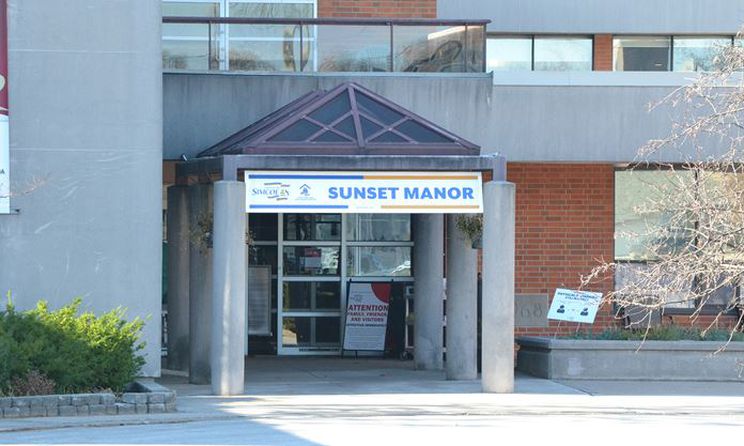
What is Going on at Sunset Manor?

Full Disclosure: Sunset Manor is a public, long term care facility in Collingwood, Ontario. I don’t have patients at Sunset Manor. The only interaction I have with Sunset Manor is when I am on call. My personal experience is that the nature of those calls from them has been no different than those from other long term care homes. All the information in my blog is based on what has been publicly reported in the media (with links attached as appropriate).

In June of 2021, the Ministry of Long Term Care issued an order to stop admissions immediately, to Sunset Manor in Collingwood. According to the CTV News Barrie report:

  • The Ministry stopped admissions because of a belief “that there is a risk of harm to the health or well-being of residents in the home or persons who might be admitted as residents.”
  • Sunset Manor received “several written notifications and compliance orders” for not following requirements highlighted after inspections between July 2018 and April 2021.
  • What shocked me the most – the Ministry stated “There are reasonable grounds to believe that the licensee cannot or will not properly manage the long-term care home or cannot do so without assistance.”

Bureaucrats generally tend to use bland, inoffensive language to avoid controversy. That last sentence jarred me. I’ve lived through some pretty bad health care facility situations in my time and have never seen a sentence that strong.

As I write this blog, Simcoe County’s website lists Jane Sinclair as the General Manager of Health and Emergency Services for Sunset Manor, which would make her the admin person in charge of the place.

The CTV News report stated:

  • Jane Sinclair called the ministry’s report “excessive,” adding,  “We don’t agree with the level of severity of these ministry findings.”

Over a year later, Sunset Manor still isn’t allowed to accept new patients, and an exclusive article on Collingwood Today suggests why. You can read the whole article for more details but briefly, Sunset Manor is alleging that the investigations were tainted because an ex-employee of Sunset Manor, Katy Harrison, was part of Ministry Inspection team. Jane Sinclair swore out an affidavit that she told the Ministry the termination of the ex-employee was “not amicable”. Sinclair further states she complained to the Ministry in 2019 about having an ex-employee do an inspection of the home stating she “could not conduct a fair and impartial inspection of the home.”

However, the Ministry elected to have her continue inspecting Sunset Manor as a “junior” member of the team. They state the allegations of bias are “spurious and unsupported by evidence” and that multiple officials inspected Sunset Manor, not just Harrison.

There’s a whole set of details about the inspection process in the Collingwood Today article that I won’t bore you with. But I will note that the article points out there have been four further inspections of Sunset Manor since last June, none by Harrison, and the facility remains closed to new admissions.

Generally speaking, the admin person at an LTC would report to the representative of the owners (in this case the County of Simcoe) to inform them how things are going. As I write this blog, the County of Simcoe’s website indicates that person is one Mark Aitken, the CAO. The website further states one of his responsibilities is overall management for Long Term Care and Seniors Services. Yet another wrinkle thrown into this mess is that Mark Aitken is married to Jane Sinclair. (Yes I know it was a letter to the editor, but it has gone un-retracted which the press would do if it was challenged).

In summary, Sunset Manor has been repeatedly investigated by the Ministry of health over the past four years. One of the investigators was an ex employee whom the Manor feels was biased. As a result of investigations, Sunset Manor has not been allowed to admit new residents to the facility for over a year. The Administrator answers to the owner (or in this case, the owners representative) who happens to be her husband. The response of the owners is to sue the ministry alleging the inspections were biased and unfair.

Here’s my take.

1) I think it was wrong of the ministry to allow ex-employee to investigate Sunset Manor. I’m in no way suggesting that Miss Harrison acted inappropriately. The reality however, is that optics matter. If you’re going to level the most serious punishment possible to a long-term care facility you need to make sure that there’s absolutely no margin for people to think that that punishment is anything other than completely justified.

2) Similarly the administrator of Sunset Manor should not be reporting to her husband. The Administrator may have handled the situation perfectly, but again optics matter. The public needs to be reassured that if the Administrator made a mistake, appropriate action would be taken, and people won’t believe that if your spouse is your boss. (ADDENDUM: While the Simcoe County Website continues to list Mr. Aitken as the person responsible for LTC – please see the first comment below from Mr. Manary – who wrote the initial letter stating Mr. Aitken and Ms. Sinclair were married. At this time I’m simply putting the information out there, but if there is a factual correction to be made by someone in authority at County of Simcoe – I will do so).

3) You know how there are people like Dr. Samir Sinha who write articles that we must stop private nursing homes? Or that tweet the incessantly that public long term care facilities are better? Sunset Manor is public.

This situation has been allowed to drag on for over a year to the point where according to Collingwood today there are now 43 empty beds at Sunset Manor. While four compliance orders have been lifted, the home was fined another $5,500 for failing to comply with medication management.

The frustrating thing is it it should never have come to this. It’s a travesty when we have so many people waiting for long-term care beds. I recently had a patient wait over 90 days in hospital for one. Getting Sunset Manor open again would really help our community.

I don’t know who’s right and who’s wrong here, but hopefully whatever needs to be done there gets done, and our seniors can once again get the care they deserve, in the location they need.

All Ontarians Should Hope New Health Minister Sylvia Jones Succeeds

New Ontario Health Minister Sylvia Jones

Sylvia Jones is now Ontario’s Minister of Health, the largest, most volatile ministry in government. The Ontario Medical Association’s (OMA) correctly tweeted about this:

My first thought when I saw this was a somewhat flippant “should have sent her condolences instead.” Minister Jones has a whole lot of headaches going forward. To succeed, she pretty well needs to be perfect. A cursory glance at the issues she faces is mind boggling.

Should she support further lifting of Covid-19 restrictions? This will make some doctors mad. Should she instead support re-introducing mask mandates and tightening of Covid-19 policies? This will make other doctors angry. Worse, both sides have credible experts, so the whole “listen to the experts”can’t apply when the experts themselves are saying different things.

There is a Health Human Resources crisis unfolding in Ontario (and Canada). Hospital ERs are being closed due to staffing crises and there does not seem to be a quick solution. As more health care workers plan on retiring or leaving the profession early, finding replacements is going to be exceptionally challenging.

The Long Term Care (LTC) situation is equally dire. Wait times for LTC beds in Ontario are skyrocketing. In 2017 I wrote about how we needed 26,000 hospital beds right away, and another 50,000 by 2023. More beds are being built by the Ford government, which is great, but they will take time to arrive.

A quick solution to ease the burden would be to allow older homes who had ward beds in their facilities, open them up again. Rules were changed under covid to no longer allow 4 residents per room. However, if you do that, people will scream you are committing gerontocide. (This is despite the fact that just about all residents in nursing homes have got four covid shots now).

Need more? (As if that wasn’t enough). Over 20 million medical procedures were delayed due to the pandemic. Many of these procedures are early detection screening tests for cancer (sooner you catch, the sooner you cure and, cold-heartedly, the less cost to the health care system).

How about wait times? Wait times for medically necessary procedures continues to rise. MOH bureaucrats like to refer to these as “elective” procedures. But the reality is that if you are suffering from knee pain every day, and have to wait a year to get a knee replacement, it’s not elective, it’s necessary.

All of which makes me realize just how courageous Minister Jones is to take on the Health Portfolio. Allah/God/Yahweh/(insert deity of your choice) knows I wouldn’t want the job. But if I may, I would suggest the Minister should focus on a few things in the first year, as even improvements in a couple of areas will have benefits across the health system.

A word of caution first. She should take what bureaucrats tell her with a grain of salt. There were a few times when I was on the OMA Board when it became obvious that the MOH Bureaucrats had NOT fully informed then Health Minister Christine Elliot about some issues around physicians that caused needless kerfuffles. The bureaucracy has a certain way of thinking that is rigid, ideological and focussed on self perpetuation as opposed to making meaningful change.

I don’t always agree with columnist Brian Lilley of PostMedia, but he hit the nail on the head when he wrote:

“…Ford and his team shouldn’t rely on the Ministry of Health for solutions. These are the people who got us into this mess and who have been failing upward for years..”

and

“..Ford has a real opportunity to change health-care delivery, to speed up access to services, to do away with wait lists and all without changing the single-payer system that Canadians rely on..”

The last comment lines up nicely with the first part of the OMA’s Prescription for Ontario, where they recommend developing outpatient surgical clinics to move simple operations out of hospitals and free up beds. The bureaucracy will oppose it because they are incapable of new ways of thinking and are beholden to hospitals. But at least the Minister will have the support of Ontario’s doctors to work through some of the blowback (there’s always blowback to anything new).

The other easy win is to develop a digitally connected team of health care providers for each patient (also an OMA recommendation). We have something similar in the Georgian Bay Region for the past 12 years and I cannot stress how much it has improved patient care. If I have a patient in need of increased home care, all I have to do is message the home care co-ordinator directly from their chart and ask for help, and they usually respond within 24 hours among other benefits.

This also ties in with a project I was pushing hard for during my term on the OMA Board that got sidetracked mostly by the pandemic but also with some political issues around OntarioMD. I remain convinced that had that project gone forward there would be people alive today that aren’t because of the improved communication it would have provided. But at least preliminary work on it has been done, and with a nudge from the Health Minister this could potentially be restarted to give patients a digitally connected health care team.

NB- this is another area where the Digital Health Team at the Ministry of Health is going in the wrong direction. Their plans are (in my opinion) needlessly complex and won’t result in the kind of robust digital health infrastructure that is absolutely essential to a high performing health care system.

In short, Minister Jones has a monumental task ahead of her. Someone will will criticize her no matter what choices she makes (it’s no secret that health care is referred to as the third rail of politics). If however, she can set, say, three attainable goals in her first year (my suggestions would be open LTC beds, start building outpatient surgery clinics and get the digital infrastructure done), while keeping the bureaucrats in check, then real progress can be made in improving the health system.

All Ontarians, regardless of political stripe, should hope she succeeds. Our crumbling health system depends on it.

What Role Should Nurse Practitioners Play in Health Care?

A recent look at some of the news stories around health care do not paint a pretty picture for Family Medicine. In Ottawa, a truly wonderful 41 year old Family Physician (whom I had the pleasure of meeting when I was OMA President) is closing her family practice due to burn out. The BC government is on the defensive over the shortage of Family Physicians. Medical School graduates are avoiding Family Medicine. The list goes depressingly on, but the point is clear.

Family Medicine is in crisis.

Jumping into this environment is former Ontario Deputy Health Minister Bob Bell and his colleagues. To fix Family Practice, they recommend expanded use of Nurse Practitioners (NPs), allowing them to work independently to replace much of what family doctors do. They claim that NPs can independently provide care for rosters of 800 patients, and collaborate with Family Doctors only for more complex patients. The authors reference a British Medical Journal (BMJ) study that suggests this will be “cost-saving.”

Bell doubles down on his beliefs that NPs can replace family doctors on Twitter by cherry picking data, in this case a Cochrane review:

One wonders if Bell and his colleagues bothered to read the reviews. If they had, they would have seen that the BMJ study on “cost-effectiveness” admitted:

“…it was not possible to draw conclusions about the cost-effectiveness of the complementary provider specialized ambulatory care role of nurse practitioners because of the generally low quality of evidence.

And that the “authoritative” (Bell’s words not mine) Cochrane review also stated:

We are uncertain of the effects of nurse‐led care on the costs of care because the certainty of this evidence was assessed as very low.

For those of you not versed in medical literature those phrases are the author’s way of saying they did studies where the results couldn’t be relied upon to be reproducible. Using these to promote a belief that allowing NPs to work independently to replace family docs is…….puzzling.

Bell’s belief that Family Docs are easily replaceable is nothing new. He planned on actually ending his career as a general practitioner. Apparently he thought he could easily slide back into it after having done it for a couple of years early in his career, then gone on be an orthopaedic surgeon for another few decades before getting involved in health administration and the MOH:

I don’t personally attribute any malice to his statement (though others on that thread did), I’m not sure that that Bell realized just how much he insulted every single GP in Canada with his seeming belief that he could simply suddenly switch gears after 4 decades of not being in primary care, and go back to being a GP without at least a residency. Hate to tell you this Dr. Bell, but Family Medicine has changed a LOT since you last practiced it. We have more than just beef or pork insulin for diabetes for example.

More to the point however, is there data out there that actually looks at the kind of system that Bell and his colleagues would propose? One where NPs scope of practice is drastically increased allowing them to work independently, and they replace the bulk of work that Family Doctors do? Turns out, there is.

In South Mississippi, the Hattiesburg Medical Clinic, an Accountable Care Organization that is very similar in structure to the proposed Ontario Health Teams (OHTs), did exactly what is Bell and his colleagues are proposing. Fifteen years ago, based on ongoing shortages in Family Physicians, NPs and Physician Assistants (collectively referred to as Advanced Practice Providers or APPs) were hired and allowed to work separately and independently with physician colleagues.

Did this work? In a word: Nope.

A comprehensive analysis of their findings (minimum of 11 years of data over a large patient population) was published in the Journal of the Mississippi State Medical Association. You can read the details for yourself but here are some highlights:

  • the cost for looking after patients who did not have end stage renal disease (i.e. were on dialysis) or were not in nursing homes was $43 a month higher per patient for those who were looked after by APPs than family docs
  • when the data was adjusted for complex patients, the cost of having an APP look after them, rather than a family doc was $119 per month higher (!)
  • these costs were attributed to ordering more tests/more referrals to specialists and MORE emergency department use (yes MORE)
  • Physicians performed better on 9 out of 10 quality metrics in the review

In short, doing what Bell and his colleagues are suggesting led to poorer overall health care outcomes at an increased cost.

Now to be completely clear, I personally have worked with NPs in a number of ways. I strongly believe they are an essential part of the health care team and provide a valuable service. In my practice, they have assisted me in providing care to my patients. When I had a couple of “cardiac kids” in my practice, I dealt exclusively with the NPs on the cardiology team at the Hospital for Sick Children (never once spoke to a Cardiologist or Cardiovascular Surgeon). When the Royal Victoria Hospital in Barrie had NPs on their oncology service, I discussed issues around cases with them exclusively. The NPs were at all times incredibly helpful to me and my patients. NPs definitely have a role to play.

I would also point out that the Hattiesburg Medical Clinic feels the same way. They strongly valued their NPs, and still have them on staff. But they have modified the way they provide care to ensure that all patients now have a Family Doctor but the visits to the clinic now alternate between the Doctor and the APP. On days when only an APP is in house, telemedicine back up by physicians is provided.

We need to build a better Family Practice system. In order to do so, NPs can and should play an essential role. That role however, is not taking on independent rosters of patients. It is working as valued members of a team that looks after a patient population, where each patient has a Family Doctor.

Why I’m Going to Vote “Yes” to the PPSA

Recently, the Ontario Medical Association (OMA) announced a Proposed Physicians Services Agreement (PPSA) with the MOH. The agreement is a year overdue, one of many delays caused by the Coronavirus Pandemic. It outlines a 3 year framework (retroactive to April 1, 2021) for funding patient services that are provided by physicians.

Like every single agreement between physicians and government in my almost 30 year career, it is basically something out of a Clint Eastwood movie.

The Good:

Increasing the number of family physicians who can be in a captitated model (salary + performance benefits). Increasing/improving the number of Alternate Funding Plans for specialists. Increasing/improving the number of Hospital On Call plans. Continue support for Malpractice Insurance. No Hard Cap. Improved parental benefits. A few others.

The Bad:

Some “aspirational” targets that seek to control physicians offices (particularly family physicians). I have absolutely no doubt that these “aspirational” goals will be mandatory goals in the governments opening position for the next round of negotiations. Just look at the governments position for Arbitration the last time around. The current aspirational goals will seem eerily familiar to those who have been following negotiations in detail.

Additionally, there seem to be a whole lot of fairly ambitious goals laid out to try and develop new processes, and redistribute funds at very aggressive timelines. It’s debatable to my mind whether these timelines will be met. (To be clear it is ALWAYS the Ministry team that is unable to meet the time lines, the OMA staff gets things done in time).

The Ugly:

One per cent increase per year?? In a time when inflation is 5.7%??

I suggest physicians access the contract and reading materials the OMA staff has put together. The staff have done an excellent job explaining the agreement and putting together a list of FAQs for you to review.

Additionally, if you are interested in more of a “big picture” approach about how to review the agreement as a complete package, my friend Paul Hacker has put together a truly excellent, easy to read, and for him quite short, document here.

I’m not going to write about any of that stuff. Rather, I’m going to write about the process to reach the agreement, and why after considering that, I personally am going to vote in favour. However, I do reserve the right to pinch my nose while doing so.

The negotiation process between physicians and government is laid out in the Binding Arbitration Framework (BAF). The short version is that it requires the government and OMA to start negotiating at least six months before a current agreement expires. It also sets guidelines for minimum time limits for how long negotiations can go on before moving to the next stage (e.g. mediation and arbitration). This time round of course, none of those timelines could be met because of the Covid Pandemic. Everything got pushed back (by mutual consent of both parties).

What is it about the process this time round that makes me want to support the PPSA? Let’s face it, nobody out there, myself included, is calling this a great agreement. So why support it?

Firstly, the government once again opened negotiations with a pretty lowball offer. Not sure how much I can say about the confidential negotiations process, but given the OMA negotiations team has already indicated there was a wide gap to start, and given we didn’t reach an agreement until invoking mediation, well, let’s just say there was a pretty big difference between the two sides to start.

Second, the Mediator (Mr. William Kaplan) is also the Arbitrator if we turn down the agreement, and head to Arbitration. I know, I know, the BAF states that there has to be an Arbitration “panel.” But the reality is the panel has a government appointee (Kevin Smith) and an OMA appointee (Ron Pink) and lastly Kaplan himself. I think it’s obvious who would make the final decision in such a circumstance.

In the 2018 negotiations, the government and OMA were unable to agree to an acceptable deal even through mediation. So we had no choice but to go for Arbitration. On this occasion, while many will argue that the OMA should have held out for more, the reality is that the OMA’s team also spent a lot of time with Kaplan. Got a sense of what he’s thinking, and what he’s looking at.

There’s no guarantee of what he would do in Arbitration of course. I’ve met Kaplan. I think I’d have more luck interpreting the emotions of a stone wall than him. He’s a tough guy to read. That’s probably an important skill to have when you are a mediator/arbitrator. But the OMAs negotiations team is really good at “reading the room” based on decisions Kaplan has made (e.g. extending the timelines and so on) during this process.

The choice then, to my mind, is pretty simple. We can vote for this agreement, as unpalatable as it may seem to many, and get on with implementing some of the benefits. Live to fight another day.

Or we can reject the PPSA. Which means we go to Arbitration. At which point both sides will likely revert to their opening positions in negotiations. Thing is, we already, by virtue of the having a mediated PPSA, have some insight into what the Arbitrator is thinking. To my mind, rejecting this agreement will simply kick things down the road six months (or more) at which point we will not get anything better.

My personal feeling is it’s time to move on. I’m going to vote in favour. I encourage all of you to read the briefs from the staff, and make your own decision.

Covid is Not Over – and It Won’t EVER Be

As provinces across Canada begin to lift restrictions from the Covid pandemic, there is a plethora of opinions raging about this. Some physicians feel the restrictions are being lifted too slowly. Others feel that it is just right. In Ontario at least, the most outspoken group are the physicians who demand ongoing restrictions. They have taken to using #Covidisnotover on Twitter.

Obviously, when dealing with a once in a century pandemic that has truly decimated patients and health care workers alike, there are still going to be unknowns going forward. But personally speaking, I think we have to realize a couple of things. First, Covid is not over. Second, and most importantly, it never will be.

Is the flu over? Is HIV over? Heck, are measles and RSV over? The answer to all of those is no. The viruses are still around, they are still infecting people and are mutating all the time (that’s why we need an annual flu shot).

There are always a certain amount of these viruses in the ecosystem. Why would Covid be any different? We are not going to completely eradicate Covid.

Given this – the question becomes, what do we do as a society?

One option, and certainly one that is promoted by the #covidisnotover types, is to continue ongoing restrictions, for much longer. Be it mask mandates, enforced vaccine passports, or continued limits on indoor capacity, the message from them seems to be to keep imposing restrictions for……well, I couldn’t really find consensus on an end date.

The most common argument for continuing restrictions (in Ontario anyway) is the continued positive case load. There are more positive cases than ever before, so why should we stop restrictions now?

Well, the short version is that while it is absolutely true that our case load is higher now than in, say October of 2020, many other factors have changed. In October of 2020, there were no vaccines. There were no oral medications that could help treat those who were infected. Guidance on the fact that Covid is airborne was still (shockingly) lacking.

In comparison, in March of 2022 over 90% of the adult population of Ontario has two covid vaccines, and are well on the way to their third. Evidence is clear that the vaccines are remarkably effective at preventing serious complications of Covid. There is now a strong emphasis on good ventilation as a way to reduce the Covid burden. The government is providing funding for Hepa filters in schools and child care settings. A protocol for rolling out the new oral medications exists, and, like all things, supply of the medications will increase with time.

So to compare just case numbers from October 2020 to March 2022, quite frankly is just comparing apples to oranges. We need to take all these other factors into account.

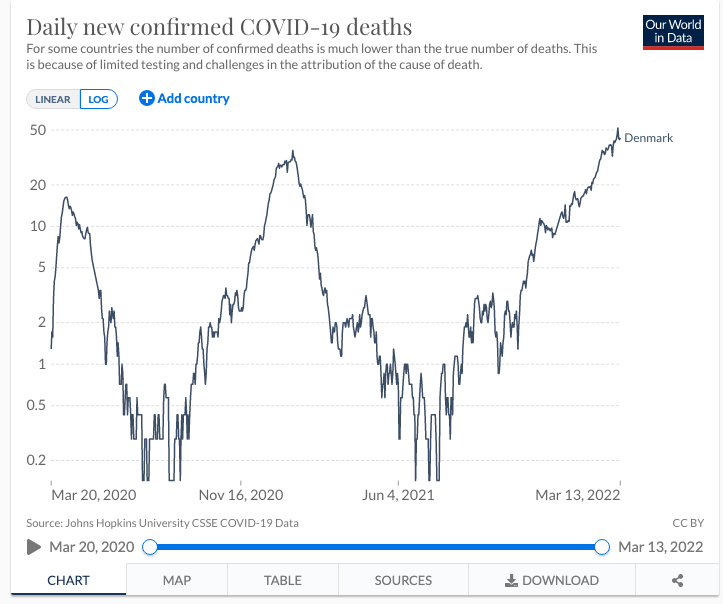
The other common argument is essentially “Look at Denmark!“. Pro restriction types point to the fact that Denmark lifted all Covid restrictions on February 1st, 2022, and now seems to have an exploding number of cases and mortality. Graphs like the one below are designed to shock people into thinking there is a catastrophe in Denmark:

But the graph doesn’t tell the whole story, and in fact a much more nuanced approach requiring a deep dive into the data is needed. I was going to try but I can’t do a better job of it than Michael Petersen did in his twitter thread:

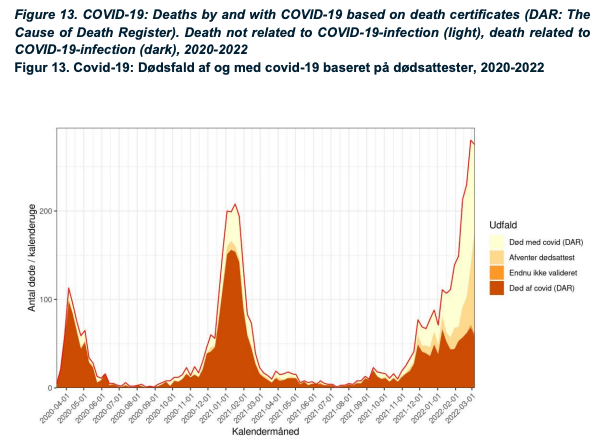
The short version is that because so many people have Covid now, we need to do a better job of determining who died because of a covid infection (usually a covid pneumonia) vs who died of other causes, but incidentally happened to have Covid at the same time. A better graph showing the Denmark situation (taken from Petersen’s thread) taking this into account is here:

Before people start jumping all over this, let me also point out that I am acutely aware that there is a significant spike in deaths in Denmark recently, even if not specifically caused by Covid. We clearly need to do a deeper dive into why there were excess deaths. But part of that deeper dive must include whether deaths were caused by the restrictions themselves (delayed care, depression and mental health issues leading to people just giving up etc). In essence, is the cure (restrictions) causing more harm than the disease (Covid)?

Look, lockdowns and restrictions were initially necessary. There is good evidence that they helped to blunt the course of Covid. But there is also evidence that they have harmed society as well. The economic impacts with record government deficits that will tax our great grand children are well known. However, there are also other health care impacts.

In Ontario, we have a back log of 20 million health care services, leaving many patients feeling forgotten. There are consequences to delayed care and I have seen that in my own practice, and expect to see much more in the coming year. Yes, those consequences sadly will include deaths.

All of this is before we even consider the collateral damage done to mental health especially in our pediatric population. As Dr. Jetelina points out in her excellent sub stack, there has been a world wide increase in paediatric mental health issues. A 24-31% rise in children presenting with mental health issues and a shocking 69-133% (depending on age group) increase in children presenting with suicidal thoughts to Emergency Departments.

What does all this mean?

My personal feeling is that while we cannot ignore Covid (it’s a bad disease) and we need to continue to encourage vaccinations (they work), we need to start looking at the health care system as a whole. Should we mask in high risk areas? Sure. But should we continue to isolate people socially and restrict interactions in a lower risk population, when that clearly causes other harms? I would argue no.

We have been making decisions for a long time based on Covid numbers alone. There are other illnesses and disease that are out there, many of which have been worsened by the restrictions Covid has forced on us. We need to start basing our health care decisions on what’s best for overall population health, not just Covid.

Crisis at Trillium Health Partners Demands an Intervention

Over 20 years ago, I and a number of other physicians were involved in a significant dispute with our local hospital administration. The specifics don’t really matter now (it’s ancient history). But in general terms physicians like myself felt strongly that we were fighting for patient care against an administration that didn’t value our input or opinion. Administration at the time undoubtedly felt differently. Eventually, both sides became entrenched and the Ministry of Health had to send in a team to sort this out, after we went public with our concerns. The MOH bureaucrat even fashioned a new phrase, referring to their team as “Interveners”.

All of which is to say I still get nightmares when I hear of in house disputes at a hospital being made public, most recently at Trillium Health Partners in Mississauga. Not working at that hospital, all I can go on is what CTV News reported. 40 physicians at Trillium Health Partners have hired a lawyer alleging:

  • physicians “are targets of an abusive and unprofessional behaviour of the hospital administration.”
  • “terrified for their livelihoods”
  • “fearful to go work”
  • a physician was called “crazy”
  • “a toxic culture rooted in harassment, intimidation and threats”
  • an environment where “physicians are afraid to practice medicine”

All of this certainly brought back my own PTSD at the events that led myself and my colleagues to take action over two decades ago.

As mentioned, I don’t know the specifics there. But I can say a few things in general from not only my previous experience, but from other institutions where I’m aware of doctors speaking out.

First, doctors in general hate speaking to the media and going public about internal conflicts. It’s one thing to talk about medical issues that pertain to the health care needs of the population as a whole. But to go out and air dirty laundry? It’s not in their nature. For something to reach this point, it usually means that every possible avenue has been exhausted, and there is a real concern for patient care.

Second, every hospital has multiple processes for addressing concerns. There’s a Medical (or Professional) Staff Association that advocates for the needs of their professional staff. There are numerous committee structures and depending on the concern the issues can be brought there. There are internal complaints processes and various Human Resource department protocols. There are chiefs of departments whose role includes addressing concerns fairly. Basically a lot of ways to bring problems to the attention of the higher ups.

Third, doctors in general put up with a lot of bureaucratic non-sense just so they can get the job of looking after patients done. Whether it’s ludicrously difficult hospital IT systems, policies that require us to duplicate our efforts, or any number of roadblocks, physicians complain privately about the working environment, but put up with it because we want patients well looked after.

In that context – to see physicians do what they’ve done, and write to the Minister demanding she appoint a supervisor (essentially someone to take over the administration of the hospital) signals a complete failure of all of the internal processes, and a dramatic escalation. This only happens when the two sides are entrenched.

What next?

What’s Likely to Happen:

Usually, administrations in such a situation tend to circle the wagons and go on the defensive. Attempts are made to minimize the concerns or denigrate the physicians as a small group not representative of the whole. Evidence is produced suggesting the concerns were appropriately reviewed and dealt with.

As an aside, Trillium has already done this by having their own lawyer investigate the complaints and, surprise surprise, the lawyer Trillium pays found Trillium did nothing wrong. I would have thought for issues of this magnitude it would be appropriate to bring in an external person to review. Maybe Trillium didn’t do anything wrong. But surely having an external person say that would carry more weight.

Then, if physicians make enough noise, the issues continue to percolate, the general public expresses concern and politicians get scared. In our area, the issue became so toxic that enough physicians decided to resign their privileges and our Emergency Department was in danger of shutting down part time.

After months of agony, somebody at the MOH (plus/minus political intervention) realizes they have to do something and appoints a third party with the power to actually do something and make some necessary changes.

What Should Happen:

Why go through additional months of grief? There’s clearly a crisis there. The residents of the catchment area of the hospital must surely have concerns about the care they will receive when they read the articles from CTV News. Having doctors who are fearful of the working environment simply cannot contribute to good patient care.

The MOH appointed their “Intervener” in my hospital and the Intervener had the power to tell both Administration and Physicians when they were offside. I personally got told I was going too far offside by him during the process, and I know Admin was also told they had to back down on some things. At least he was fair.

I don’t know who’s right and who’s wrong at Trillium, but patients at Trillium need to know that something is being done to address these concerns and ensure there is safe environment for the caregivers. To that end, the MOH needs to appoint an independent third party to help the situation sooner, rather than later.

For a link to CTV News’ follow up report on the issues that includes comments from yours truly, click here.

Corporatization of Medicine Continues Unabated

Last week, a story came across my feed that seems to have been almost completely ignored by most who are in/or follow medicine and health systems. WELL Health technologies announced that it has purchased 100% of CognisantMD, the developers of the Ocean platform. For those who don’t know, Ocean is a platform that links to various EMRs and allows for securely emailing patients, eReferrals, filling out forms online, and a bunch of other features.

Full disclosure, my practice uses Ocean as well (for now). Personally I find it somewhat clunky and not as smooth as advertised, but there are some positive features to it.

What’s the problem then? It’s a friendly corporate takeover. Happens all the time in the business world.

To understand the concerns, let’s look at what WELL Health does. According to their own website, WELL Health offers a wide array of digital health care solutions. But they also state they are “Canada’s largest outpatient medical clinic owner-operator and leading multi-disciplinary telehealth service provider”. In essence, they run the clinics, and physicians work for them.

A further dive into their strategy, under the “Reinvest” tab states:

“Acquisition of cash generating companies leads to increased cash flows which are re-invested to make additional new cash generating acquisitions.”

Pure and simple – WELL Health is a private, for profit corporation. There is of course, nothing wrong with private corporations. Most people who follow my twitter feed know that I am generally pro-business, and on most issues land on the right side of the political spectrum. I firmly believe we need more, not less, businesses in this country and we need to make it easier for businesses to function.

BUT – acquisitions like these, and the continued take over of clinics by corporations should make us ask legitimate questions about protection of individual health care data. It is no secret that the reasons that companies like Google and Facebook have become so successful is that they found a way to monetize personal data. In much the same way, personal health care data has enormous economic value to companies. Whoever can find a way to properly monetize this, will be the next Jeff Bezos/Mark Zuckerberg and so it’s no wonder that companies are extremely interested in getting into this field.

As I mentioned in a previous blog, Shoppers Drug Mart, for example, recently acquired a stake in Maple, a leading virtual care only provider for $75 million. They continue to advertise on their website (as of Dec 6, 2021) the ability to diagnose strep throat virtually (which personally I find questionable) and then to send antibiotics to a pharmacy near you (I’m guessing there is going to be a Shoppers Drug Mart near you).

Screen shot as of Dec 6, 2021

In a circumstance where a patient contacts Maple, the doctor or NP gets paid to virtually assess a patient, Maple gets a percentage of the fee to cover overhead – which presumably will be reflected in shareholder value to Shoppers. If a prescription gets sent to a Shoppers, well, they make a profit there too. Neat business model.

But it’s not just companies that already have an interest in providing health care related services that are trying to get involved in this field. Amazon is jumping into health care with a telemedicine initiative. Google has long planned to get into health care, and while not terribly successful yet, I doubt they will stop trying. Heck even Uber (!) wants to get involved in health care.

It’s easy to see why everyone wants in. There is a lot of money and potential profit in health care. And while I am all for companies making a profit, that doesn’t mean that we can’t ask some hard questions about the protection of personal health care data such as:

  • How secure is the data that is being held in the servers owned by these corporations?
  • How do we ensure personal health data doesn’t go where it’s not authorized? (eg. supposing the parent company owned a family practice clinic AND an disability insurance company)
  • How do we ensure personal health data is not to be used to monetize other aspects of a business (eg. supposing a walk-in clinic was owned by a pharmacy. A patient attends there for a renewal of cholesterol medications, and then gets ads offering, say, flax seed oil capsules that are helpfully sold by that same pharmacy).
  • How do we ensure aggregate health data housed in those servers is only used to help the community at large (eg. finding communities that may need extra resources for, say opiod addiction).
  • If a physician stops working at a clinic owned by MegaCorp Inc. for whatever reason, how does that physician access their charts after the fact (I’m aware of a number of cases where access to patient records were cut off immediately upon the physician leaving such a clinic).

I’ve just posited a few questions. I’m sure there are many more. I believe that most Canadians strongly value health care privacy. As more and more businesses attempt to get involved in health care delivery, it is vital that we have a framework for oversight that ensures that patients have the absolute right to protect their personal health information. Sadly, I don’t see any organization/government agency out there asking these important questions.

Pharmacies Must Put Corporate Interests Aside to Give Flu Shots

October is just around the corner. Leaves will soon be turning magnificent colours. Pumpkin Spice treats will flow in abundance from many cafe’s. Plans to have a safe Halloween will be afoot. And – the inevitable cry of “when can I get my flu shot?” will be increasingly heard at many physicians offices.

Last year, there was a significant rise in the number of people who got a flu shot. While our flu season was mild last year (likely because of a combination of all the social distancing/mask measures and the higher vaccination rates) – there is concern this season may be more severe. In order to minimize the severity of this years flu season, we need to continue the trend of more people getting flu shots.

But last year was also the year that there was a lot of confusion around flu shots, and the year that the increasing commercialization of flu shots by the corporate head offices of pharmaceutical chains raised big concerns for me.

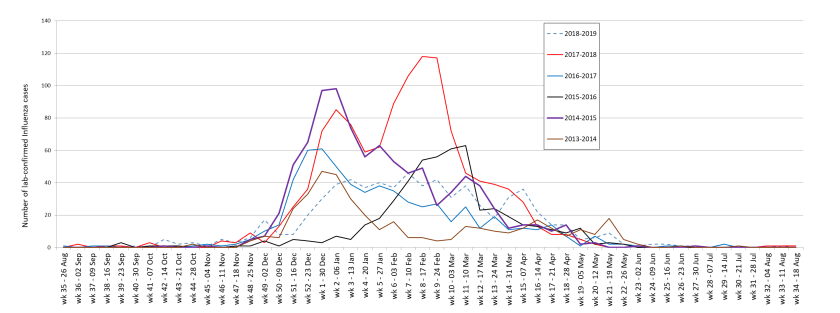
First, the timing of the flu shot is always going to be key. As I wrote last year, the best time for most of us to get flu shots is in November. The trend for the last few years (see picture below) is for flu season to begin sometime in December and taper off in March.

Thank you Ottawa Public Health for this excellent graph

BUT, the flu shot only starts to work two weeks after you get it, and its effectiveness starts to wear off after a couple of months. Timing is everything with the flu shot, and getting the shot in October is (for most of us) a bad choice. The shot will wear off before flu season is over.

Yet last year, my radio station/twitter feed/even Facebook page had numerous ads from Pharmacies advertising flu shot clinics in October (and buy your groceries at the same time!). This appeared to be driven by a desire to get a “customer” in the store soon rather than what was best from a health perspective (i.e. wait till November).

Additionally, there was all sorts of confusion around the high dose vs the standard dose flu shot last year. I wrote about this last year too. At the end of the day it does not matter which flu shot you get. Just get one! The effective difference between the high dose trivalent (three strain) flu shot and the regular dose three strain flu shot was 0.5%. This difference does not merit the hype around the high dose shot.

Furthermore, in Ontario we had a quadrivalent (four strain) regular strength flu shot. There was no study comparing the high dose three strain vs regular dose four strain shot that I could find. So really, there was no justification for the advertising from pharmacy ads that essentially said “high dose flu shots in stock, come quickly before we run out.”

This year, the choice of flu shots is going to be even more complicated. Have a look at a screen shot of an email I got from my local public health unit:

Six (!) different brands of flu shots covering a variety of strains (3 vs 4) and dosage strengths (high vs low). But again, to be clear, the difference between these are likely minimal. What’s far more important is that people actually get the shot (in November) rather than pick and choose and wait for one.

Yet if history repeats itself (and it seemingly always does), we can once again expect pharmaceutical chains advertising early in October that they have a “high dose” or “extra strength” or “added potency” or whatever shot, but you must book now! Hurry! Before they are all gone! And if you come real soon, you can even get 500 bonus points!

This level of consumer hucksterism has no place in health care. Health care decisions should be made based on evidence, appropriately done studies, and what’s in the best interests of the patient and society. They should not be made based on some marketing guru’s attempts to get people into a store (where conveniently they can get their milk and eggs too).

Most pharmacists I know are good and decent people who want to do what’s best for their patients. I actually applaud their willingness to give flu shots. The easier we can make it for everyone in society to get a flu shot, the better it is for all of us, and the less potential strain there will be on our health care system this winter.

But the corporate head offices that come up with these schemes (seriously, bonus points for get a flu shot??) need to think of what’s best for the health care needs of society first. That means NOT giving flu shots until November and NOT trying to promote one flu vaccine over another in an effort to create perceived demand and drive people to their stores.

Let’s see see if they act in the best interests of society, or in the best interests of their shareholders wallets this year.

Time for the OMA Board to Invoke Arbitration in Stalled Negotiations

While most front line physicians continue to deal with the ongoing Covid-19 pandemic, and the resultant backlog of care, the OMA has continued to perform it’s most important function, that of trying to negotiate a Physician Services Agreement (PSA). A quick summary of what has already been disclosed:

  • The Binding Arbitration Framework (BAF) between the Ontario Government allows for negotiating a Physician Services Agreement (PSA) every four years. The last one was for 2017-2021 . We should already have had an agreement for 2021-2025 but the Covid Pandemic got in the way and delayed negotiations.
  • Negotiations for a PSA are supposed to start the year before expiry of a PSA. There is a framework that allows for a minimum of 60 days for negotiations following which either side can call for mediation. After a minimum of 60 days of mediation, either side (or the mediator) can call for Arbitration.
  • IF Arbitration does occur, the Arbitrator must hand down a ruling within 60 days of the conclusion of the arguments presented at Arbitration. After the ruling is handed down, the work of implementing the Award (or if by some chance an agreement is reached – the PSA) begins, and that in itself can take several months to a year. Those of us who were involved in the last implementation process in any way likely still have nightmares about how complex and fraught with challenges it was – I know I still do.

For the current negotiations, we know the following:

  • Negotiations began in October of 2020. The OMA Board gave the Negotiations Task Force (NTF) a mandate for negotiations. A mandate is essentially a confidential, bare minimum set of asks that the NTF must get from the government before accepting a deal. Considering there is no deal, the NTF clearly has not met that minimum. And no, the members can’t know what that is, it would significantly compromise the negotiations process.
  • Mediation began on April 9, 2021. “A large gap” remained between the OMA’s asks, and the MOH’s offer as of June 2021. As I’m no longer on the OMA Board, I have no idea what the gap is like now. Obviously, if there was no gap, we would have a deal by now.

Why should the OMA Board move to Arbitration now? Why not follow the mediator Mr. Kaplan’s recommendation, and wait till January 25, 2022 to go to Arbitration? Wouldn’t going against his recommendation run the risk of adversely affecting the outcome of a potential award?

Because health care is political in Canada. Being political, the time for governments to attack physicians is always, always, always early in their new mandate. In 1991, the NDP government of Bob Rae imposed a hard cap on the physicians budget (first year in power). In 2015 in the first year of Kathleen Wynne’s government, she also imposed unilteral cuts to physicians and in 2018 the Doug Ford government tried to take away binding arbitration.

The short version of the above is that I’m old, and I’ve been screwed by the government of every political party. It doesn’t matter who wins the provincial election of June 2022, the government that is in power will be sorely tempted to revoke any arbitration award if it seems to meet their short term interests. (Yes I know, the BAF is “evergreen” – meaning the process should continue in perpetuity, but the reality is that governments do stupid things all the time, and if one government has tried to take away a BAF process from physicians to suit their interests, then we can be sure another will as well).

And NO, having Arbitration currently as scheduled for Jan to March 2022 is not good enough. Finishing Arbitration hearings at the end of March gives the Arbitrator until the end of May for a ruling. By that time the election campaign will be in full gear, and Ministry bureaucrats will do absolutely nothing to implement any award as they wait for the outcome of the election.

Obviously, going to Arbitration now entails some risks. The NTF will likely argue that the Arbitrator himself recommended waiting till January, and we should try our best to seem reasonable to him. I have a great deal of respect for the NTF for the job they’ve done for the doctors of Ontario, in particular the negotiation of the BAF. But they are paid a lot of (well deserved) money to let the Arbitrator know of legitimate concerns of the membership.

I’ve met the Arbitrator and I have no doubt he will hand down a fair decision, whether in December or March. But members have every reason based on history to fear politicians of all stripes, and it’s the job of the NTF to let him know that that’s a legitimate concern.

Moving to Arbitration immediately, means the Arbitration hearings end likely by the end of December. An Award is announced (likely) by March. At that point, the government is faced with accepting the award, or revoking it three months before an election, and risking the type of anti-government ads the OMA did so well last time. By the time the election is over, whoever wins, the MOH bureaucrats will be well on the way to implementing the award and any “noise” that the award is too much (there will always be noise) will have gone away.

From the OMA’s Negotiations Page

The OMA’s main responsibility is to negotiate a fair PSA for members. The BAF is the best tool they have for not only keeping the government honest, but for political use to reduce the risk of awards being overturned. (NB- There’s no guarantee of anything, politicians do stupid things all the time. This is simply about risk reduction).

Will the OMA Board stand up for members and direct the NTF to immediately move to Arbitration, as we are now legally allowed to? I guess we’re going to find out.