
Federal-Provincial Health Care Deal Fails Canadians

This blog has been updated to reflect that the fact that the offer from the federal government has been accepted by the provinces.

Lots of chatter about what is an agreed upon funding formula for Health Care between the provinces and the federal government. Some astronomical dollars are being thrown around and called investments in health care. But at the end of the day, will this deal mean better health care for Canadians? The sad answer, is likely no.

One of the advantages(?) of being old is that you’ve lived through lots of things, and can see the past repeating itself. Case in point, in 2004 then Prime Minister Paul Martin introduced a health care “accord” that was designed to “fix health care for a generation“. Essentially the federal government ponied up an eye watering amount of money then, and the provinces were to implement targeted programs that would:

  • Reduce wait times
  • reform Primary Care
  • Develop a National Home Care program
  • Provide a National Prescription Drug Program (by 2006!)

Now Primary Care reform did happen in Ontario, with the development of capitation based payments to family physicians. Think of it as a salary with performance bonuses and you get the gist. There was also the implementation of some Family Health Teams. I’m unaware if any of these were implemented in other Provinces. I do note with interest that British Columbia is only now getting around to reforming primary care with their own new payment model for family physicians.

But both of these programs in Ontario were summarily slashed by then Health Minister Eric Hoskins and his servile deputy Health Minister Dr. Bob Bell in 2015. Indeed their unilateral freezing of the capitation model significantly damaged primary care in Ontario, and the effects of their folly are still being badly felt today by the 2 million residents of Ontario without a family doctor.

OMA Board Vice Chair Audrey Karlinsky put it best on Twitter.

Wait times for surgical procedures however, continued to rise, and I have no idea whatever happened to the National Home Care program.

For those of you paying close attention, the same Eric Hoskins who stopped Primary Care reform in Ontario, went on chair a federal advisory council with the goal of creating a National Prescription Drug Program……….in 2018. Which hasn’t been implemented yet. I suppose being 17 years overdue is not bad by government standards.

By the way, this whole process is basically recycling a failed politician to recycle a failed government promise. And politicians seriously wonder why average Canadians like me are so cynical??

So now, 19 years later, Canadians are being told that the provinces have accepted a federal government proposal to put an eye watering $196 billion into health care, according to Prime Minister Trudeau. But wait they were committed to $150 billion anyway so it’s really only $46 billion more, but wait, when you take out the planned budgeted increases it’s only $21 billion more. Whatever.

In return, for however much money it really is, Trudeau promises there will be “tailored bilateral agreements to address“:

  • Family Health Services
  • Health workers and the backlog of health care
  • Mental health and substance abuse
  • Modernized health care system

Our politicians need to study Albert Einstein a bit more.
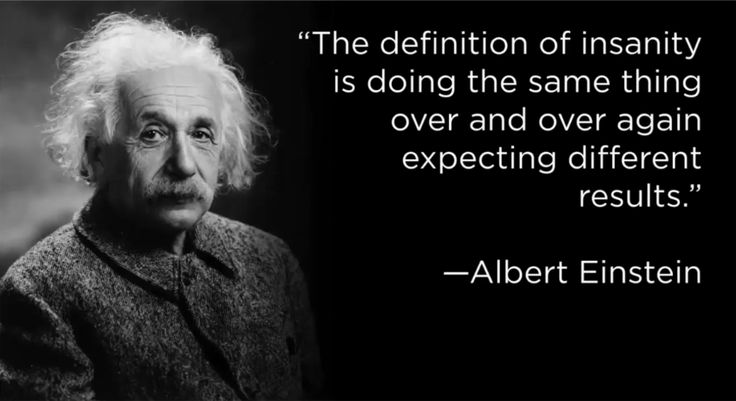
Here’s the sad truth about our health care system that no politician, of any political stripe seems to be willing to admit. The system is dying and in need of radical surgery. It needs a bold, transformative vision that will completely change the way we deliver health care and will leverage technology appropriately. Anything less is simply more of the same, and will not stave off the inevitable collapse of the system.

How then do we achieve this transformation that is essential to the well being of Canadians? I will go into some further thoughts about this in future blogs, but first I would implore our political leaders to stop listening to old voices who have been advising for decades (if their advice had been good we wouldn’t be in this mess). It’s time to seek out some newer voices who have bright ideas on how to restructure health care delivery in Canada.

It’s also time to wrest control of health care data management from the current group of bureaucrats in charge of it. We can’t transform health care in Canada without a robust health care IT infrastructure and the current group simply is not getting it done.

As mentioned, I will put some more though into how, in my opinion, health care can be transformed in the future. But for now, just know that whatever the numbers or promises being tossed around, the blunt reality is that it all amounts to trying to spend you way out of trouble.

When has that ever worked out well?

RePost: Ontario’s Heading For Another Family Doctor Shortage

This is the follow up blog to my last one, originally published in the Huffington Post on June 13, 2017. Reprinted here so that I can keep track of my old blogs, and also to once again point out how warnings of a crisis in Family Medicine were ignored for years.

The Barer-Stoddart report. Ask any physician of a certain age and the immediate reaction is likely to be disparaging. Written in 1991, it purported to help chart the course of the physician workforce into the 21st century. 

While it’s true that much of the report was ignored by the Ontario government of Bob “Super Elite” Rae, it’s still widely remembered for suggesting that the number of physicians in Ontario needed to be cut by 10 per cent. To accomplish this, medical school enrollment was slashed in the early 1990s.

Given that the population of Ontario continued to grow and age, the result was completely predictable. A massive doctor shortage (particularly in family medicine) hit the province at the end of the decade. It has taken the last 15 years to come close to correcting that. We’re not there yet (we still have fewer doctors per capita than Mongolia), but we were improving.

Alas, Ontario Health Minister “Unilateral Eric” Hoskins and Deputy Health Ministerย Bob Bellwere unable to remember the old saying, “Those who cannot remember the past are condemned to repeat it.”

Former Health Minister Dr. Eric Hoskins

Last week I blogged about how Hoskins and Bell need to support family medicine. Because they are not doing so, many physicians who graduate from family medicine residencies are not starting comprehensive family practices. Instead, they are doing things like hospitalist work, sports medicine and even medical marijuana clinics.

However, the situation is even worse than I thought. It was pointed out to me after my blog was published that the number of medical students applying to family medicine programs has dropped considerably this year. In Canada, to become a practicing physician, you first have to graduate from medical school, then do a residency (essentially a training program) in the specialty of your choice. To choose a residency, you apply to CARMs — which is a Canada-wide program that matches medical school graduates to the residency of their choice.

This year’s CARMs match shows some alarming results for family medicine in Ontario. Ideally, we should have 45 to 50 per cent of all graduates from medical school apply to family medicine for a sustainable workforce. However, only the Northern Ontario School of Medicine achieved that goal. While it’s a great school, it’s still the smallest of Ontario’s six medical schools.

By comparison, only 24 per cent of graduates of University of Toronto applied to family medicine, 27 per cent of Queen’s graduates, 32 per cent of Ottawa’s graduates, etc. Multiple studies show that comprehensive family medicine is responsible for decreased health-care costs, more efficient utilization of the health system, better patient outcomesand decreased hospitalizations. It is essential for a sustainable health-care system to have a strong family medicine component. The fact that so few medical school graduates chose family medicine, on top of the fact that recent graduates are not opening practices, should be setting off alarm bells.

So, why is this happening? First and foremost, it’s because Hoskins and Bell have refused to support family medicine. They have talked loudly about how they want to cut payments to higher paying specialties so that they could fund family medicine. Hoskins even went to the trouble of doctoring (pun intended) a chart to accuse specialists of overbilling. 

(Seriously, see the picture in this article. Notice how he made the pie chart on the right larger — the whole circle, not just the wedge showing percentage of billings. Makes the red area look LARGER than it really is, and makes the specialists look they are billing disproportionately more than they are.)

Unfortunately, while Hoskins and Bell were saying this in public, what they were actually doing is cutting family physicians. They unilaterally cut the number of physicians who could apply to the capitation (salary plus performance bonus) models of funding that I mentioned last week. This is the preferred method for paying physicians for newer graduates, and also for health care bureaucrats who like a predictable budget. Additionally, they cut a number of the performance bonuses family physicians got for looking after complex patients.

Medical students are not dumb. They saw all of this going on, and realized that family practice was no longer preferred by Hoskins and Bell. So they made career choices accordingly.

Currently, the Hoskins/Bell legacy is not a pretty one. It’s one of internecine disputes with doctors, laid-off nurses, hospital deficits, patients in stretchers for days and egregious wait times. At least with family medicine, they have an opportunity to begin to correct this mess by once again allowing new physicians to enter the capitation model, and restoring the various performance bonuses.

Failure to do so will mean that many years from now, as patients struggle to find a family physician, Hoskins and Bell will be remembered with the same disparaging legacy as Barer-Stoddart.

Will Pharmacy Prescribing Improve Health Care?

Pharmacists do a great job as part of a health care team. In hospital and nursing homes, I get expert guidance on dosages of potentially dangerous medications. I am also fortunate to have community pharmacists on a secure electronic messaging platform to discuss issues around medication complications/interactions/dosages and so on for my patients.

But, will it improve health care to let them treat minor conditions?

I expressed my displeasure on Twitter about the recent move to allow pharmacists to treat certain minor ailments:

A few pharmacists were not amused. It was pointed out to me that Ontario is one of the last provinces to allow this, and that it has “worked well” in other provinces.

But what exactly is the definition of “working well”? Politicians love it, mostly because it allows them to say “see we are taking steps to make your life easier.” Patients love it because they can say, “Jee, I think I have a bladder infection, now I can just get the antibiotic when I want.” Of course patient satisfaction will be high.

Unfortunately, as I wrote about a few years ago in the Huffington Post, patient satisfaction does NOT correlate with good health care or outcomes. As counter intuitive as it may seem, higher patient satisfaction scores correlate with a 9% higher cost per patient AND a 12 percent higher hospital re admission rate. Patient satisfaction should not be used as a metric to determine any health care policy.

On Twitter, Nathan McCormick suggested that pharmacists have a lot to offer and linked to an article from New Brunswick on how it’s worked well there. Unfortunately (and I stand to be corrected) the article suggests the diagnosis of urinary tract infections was made without a urine culture, or even a urine dipstick test (which is less accurate but still something). So there’s no way to sort out how many people had a true bladder infection, or simply “felt” like they did, which happens. The article also puts a strong focus on patient satisfaction and convenience, which as mentioned above, is not the same as good health care.

Nardine Nakhla asked me to familiarize myself with an article she wrote about how Ontario developed the process. There’s a lot to like in what’s written there:

  • A recognition of overprescription of antibiotics as a world wide problem
  • a focus on ethical standards based behaviour by pharmacists
  • A minimum amount of training for pharmacists before treatment minor ailments
  • The requirement for pharmacists to contact the family doctor or nurse practitioner when treating a minor ailment

Once again this doesn’t really reflect true health care outcomes. It also references the aforementioned New Brunswick article and specifically stated there was high patient satisfaction there.

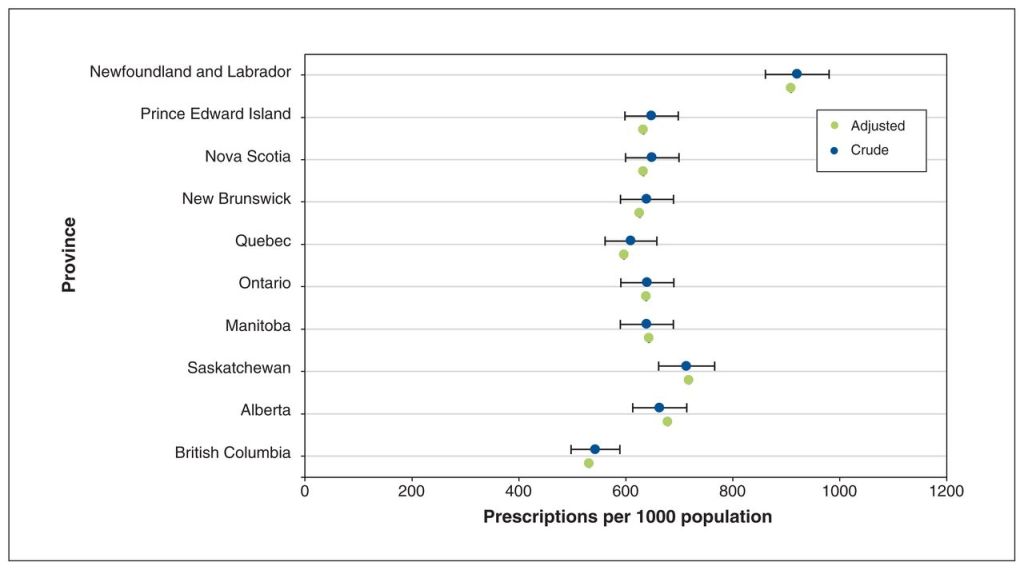
Letโ€™s look at just one area of concern, antibiotic usage.ย ย Global overprescription of antibiotics is a world wide concern.ย ย It leads to increasing antibiotic resistance and the formation of new, drug resistant bacteria.ย ย A look at Canadian data shows that there is intra provincial variation in the number of antibiotic prescriptions.ย ย Newfoundland, where pharmacists have been treating minor ailments for years, has the highest rate of antibiotic prescriptions. British Columbia, where pharmacists are expecting an expansion of their scope this spring, had the lowest.ย ย 

From CMAJOpen: Interprovincial variation in antibiotic use in Canada, 2019: a retrospective cross-sectional study

World wide , of the ten countries with the most antibiotic use, Cyprus, Romania, and Greece allow them to be purchased directly from pharmacies. (I stuck to EU countries with more modern health systems for examples).

Kristen Watt wrote a piece in the medical post criticizing physicians for complaining about these new powers and asked me on Twitter to provide evidence from other locations.  She stated that Ontario was “15 years behind the trailblazing Alberta”. And yet the data in the CMAJ article above shows that Alberta has a higher rate of antibiotic prescriptions per capita.

One area I do agree with her is when she wrote:

“the government roll-out video, shot in a noticeable big box pharmacy, didnโ€™t help us”

That big box is Shoppers Drug Mart, and their CEO Jeff Leger is seen promoting this change on the video.   Shoppers Drug Mart recently invested $75 million in Maple, a virtual care company.  Mapleโ€™s home page still shows the following:

Screenshot from Maple as of Jan 12, 2023

Gee, if you think you have a sore throat, you can just call a company (that Shoppers invested in), and get an antibiotic without a throat swab (who cares if itโ€™s really strep) and lo and behold, there just happens to be Shoppers nearby that will deliver it to you. Yes, I know patients can request the pharmacy of their choice, but….

Look โ€“ there are other aspects of this process that need review.  Accurate diagnosis of a rash for example (several of the new pharmacist powers are for skin ailments). Or communication with the patients family physician about the treatments given.  Probably more.

I WANT pharmacists to help.  I really truly am grateful that so many are willing to step up in a time where our health care system is collapsing faster every day. But I want pharmacists to help in ways that support good health care outcomes.

 Might I offer three suggestions for how pharmacists can do that:

  1. As a group, they can petition Shoppers Drug Mart to put pressure on Maple to change the example on their website.  It’s great marketing (focusing on convenience) but terrible health care.
  2. Get involved with Choosing Wisely, Canadaโ€™s leading group looking at all ways to pick the right health care treatments.  There doesn’t appear to be a pharmacist in looking at their leaders.  I think pharmacists could provide extremely valuable information on not just anti-biotic stewardship, but also overall medication management (eg. reducing pill burden in the elderly)
  3. Strongly lobby the government for a unified integrated electronic health system that will allow them secure communication with physicians and access to limited health care data (eg creatinine clearance).ย ย Weโ€™ve got this in my neck of the woods, and itโ€™s a huge benefit to physicians, pharmacists and most importantly patients.

In order to save what’s left of our health care system (if that’s even possible now) we need to focus on health care outcomes, and ensuring proper an appropriate care. Doing the three things I listed above would be a big help in that direction.

Euthanasia (MAiD) Activists Put A Dollar Value on Human Life

Recently, a patient of mine who I was really fond of, chose euthanasia. The politically correct would prefer to call it Medical Assistance in Dying (MAiD) since it sounds “softer.” But the fact of the matter is we are killing people (presumably to relieve suffering) which is the clear definition of euthanasia. Let’s call it what it really is.

My patient was a nonagenarian, had fairly advanced cancer with probably about 6-9 months left to live. They were still walking (albeit in some discomfort) and toileting independently. They did their own taxes, and anyone who can do their own taxes is mentally competent if not a genius. They looked at the natural course of their illness and, said to me:

“You mean I’m going to spend the last 3 months of my life, likely bedridden with some stranger changing my diapers and wiping my butt?”

And they chose euthanasia, which was provided to them this past year.

The above scenario represents exactly what most Canadians believed they were getting when euthanasia was legalized in 2016. Truth be told, even people like myself, who have qualms about the concept of healers taking lives, completely understand why my patient felt that way. It’s impossible to argue against the autonomous wish of a competent individual.

However, almost as soon as the euthanasia was legalized in Canada, physicians were warning that this was going to open up a slippery slope of ever loosening criteria and increasing permissiveness for euthanasia. Pro Euthanasia types derided these arguments for using “the fear of the unknown“. And yet, six years later, as a nation, we are now on the verge of expanding criteria for euthanasia to include:

And finally, we have a report promoting what many all along thought was the real reason for allowing euthanasia. Basically, that it is cheaper for the health care system.

To be fair, one of the authors of the report, Dr. Aaron Trachtenberg does state that the work is meant to be “theoretical.” He also goes on to state:

“We are not suggesting that patients or providers consider costs when making this very personal and intimate decision to request or provide medical assistance in dying.”

But the blunt reality is that the authors put out a report broadly suggesting to the general public that there are cost savings if, you know, you did the decent thing and just ended it all when you became a burden on the rest of us. Intentional or not, the implication is clear that there is a monetary worth to your life and at some point, you dear patient, are no longer “worth it.” Reminds me of the Star Trek The Next Generation episode “Half a Life“, where the intrepid crew of the Enterprise meets a planet where everyone commits suicide at age 60.

It’s not only people like myself (who have been demanding conscience rights because we saw this coming) that are upset about this. The Toronto Star had a column saying Canada was going too far with euthanasia and warning of the dangers of abuse. The Canadian Society of Palliative Care Physicians has been expressing concern about euthanasia for some time. The Council of Canadians with Disabilities points out that the disabled cannot access supports to live a dignified life but can now access euthanasia. (I’m guessing Dr. Trachtenberg’s report did nothing to ease their concern). Dr. Sonu Gaind, a psychiatrist who himself has done euthanasia assessments has expressed significant concerns about the many flaws in the guidelines for those seeking death when their sole reason is mental illness.

Most tellingly, the National Post reported on a “crisis” in supply of doctors willing to provide euthanasia. Among the reasons cited are the “increased โ€œlegal risk and moral hazardsโ€ related to ever-widening eligibility.” Also a noted was that many euthanasia providers were curtailing and limiting their practice to those patients for whom the law was originally intended. You know you have a problem when even providers of euthanasia are telling you the rule changes are going too far.

Now perhaps some of the recommendations (like the one around babies) won’t make it through to legality, but the blunt reality is that the slippery slope that was warned about when euthanasia was legalized has come to pass. Its due a combination of lack of foresight and the ineptness of the initial legislation that we are at this place.

It was one thing to allow competent people (like my patient above) to self determine what to do in the face of an incurable illness or suffering. But it’s quite another to recklessly expand criteria . And it the case of those with disabilities, or mental illness, to not provide adequate supports as an option seemingly pushes them in the direction of choosing euthanasia.

Is this really what Canadians wanted?

As for the dollar value of a human life. The study authors write:

“we expect that net health care costs would be reduced by $33.2 million per year if 1% of deaths are due to medical assistance in dying”

This was based on their estimate of about 2,700 cases a year (there were over 10,000 last year). Based on their numbers however, your life is now worth $12,296.30

What Backlogged Health Care Looks Like and How to Fix It.

Dr. Silvy Mathew guest blogs for me today. She is hands down one of the smartest people I know. She writes about her experience in visiting the ER to help a family member. Dr. Mathew has been a strong advocate for health system reform and it is a loss for all Ontario residents that her warnings about the impending crisis in health care were not heeded by Health Ministers dating back to Eric Hoskins.

A few days ago I was in the Emergency Room (ER) with a family member. The ER was slammed. The paramedics were lovely and about four teams that I could see were stuck in waiting room, waiting for their patients to be triaged. We were on a stretcher by the front sliding doors. Almost outside.

We were there for urgent imaging, and possibly consultation. We tried to do this in the outpatient setting, but lack of access to both urgent images and consults for urgent care makes that impossible. So we go off to ER by EMS (needed for transport).

I’m fortunate. I am able to fill in gaps. I can advise triage what issue is, as they can’t do physical exam in the waiting room in front of what seems like hundreds of people. I can provide medical information on relevant questions. I can monitor the patient status for changes.

I did remind staff after several hours to check blood sugar as my relative is an insulin dependent diabetic, now off food/fluids. I did remind about necessary medications to be given. Of course, if I wasn’t there, they may have reviewed the chart closer but they were clearly slammed and trying to manage.

And we weren’t in distress. My family member was unable to advocate for themselves. We got imaging about six hours in, and I watched the imaging staff, working with 50% less nursing staff, literally just running in and out moving people. Doing their best.

We had excellent care from people busting their butts. But so many potential falls through the cracks and errors. Twelve hours later, we got home, luckily without any new issues from ER. And we had a plan. And we had a specialist who called first thing in the a.m. to ensure we have close follow-up.

The system in Ontario has relied for decades on individuals and work-arounds making things work (like above) when the system design is archaic. Successive Ontario governments have refused to participate in strategic multi-pronged co-design, instead of piecemeal band-aids.

I have worked for 15 yrs in Ontario health care. I’ve witnessed how far things have fallen and how none of our work arounds previously used are available now after the Covid 19 pandemic, for multiple reasons. I’ve participated with the Ontario Medical Association and sat on bilateral committees with the government to try to advocate for system change.

I’ve witnessed how siloed and unaware most people outside of primary care are. Family Medicine is the canary NOT the Emergency Department. The issues that have caused this system collapse have been occurring since 2012. Many of us, especially Dr. Nadia Alam, tried to be loud and warn.

Last year, in 2021, we gave up. It was obvious to us it was too late. We heard for years from our mid-career colleagues about how they couldn’t do this anymore. How they wouldn’t work in a system that didn’t allow them ANY joy or success while taking more and more from them personally.

Covid-19 just pushed the dial a bit faster. The family doctors who were hanging on from retiring have chosen to live now (not leave, but LIVE). The mid-career family docs are struggling as mentioned above and also choosing to leave family medicine if possible, because nothing is working in it. Obviously, new graduates are terrified.

And so here we are, and the CCFP answer to this is to ADD a third year to residency. Because somehow they think adding more school, asking people to take on more debt, delay starting their lives longer, while having less non-academic preceptor support will somehow help?

What it will do is: add even more fuel to the family medicine crisis and shortage. It’s not gonna teach you how to run a business (last I checked real life experience mattered more). It’s not going to teach how to manage complexity in real life. It WILL drive more people out of family medicine residency.

What we REALLY need is a re design of the health system. You want people to do this job? LET them. You want family doctors to work at the top of their scope? ENABLE them. Support access to resources OUTSIDE of hospital and provide help to coordinate.

Stop advocating for more debt and school CCFP, and advocate for real life mentorship, group practices and shared care. You want Emergency Rooms to not house people? Fund home care and long term care. Fund resource teams to support those in seniors neighborhoods already. Use a community approach.

While we are at it, stop spending all the money on pharmacology. Fund allied health, encourage exercise programs and healthy meals because that’s WAY more useful than the hundreds of thousands of dollars of Botox we spend on contractures AFTER they occur. Keeping people mobile keeps them out of hospital and long term care.

The Canadian media can stop asking if health care has collapsed, anyone working in it knows it has. It will show in a year or two, when the numbers of late-diagnosed cancers, life expectancy and other markers of care get affected. But in real-time we are seeing it now.

If we don’t have some real leadership here and some true innovation, we are in for some truly sad times in the next decade. End.

Does Ontario’s Digital Health Strategy Meet Our Needs?

That the health care system is currently in a state of crisis is no secret. That we need to look at bold, radical transformation of the health care system is no secret. That fixing health care means fixing family medicine first is well known. But in order to do all of this, we must finally fix the mess that is digital health infrastructure in Ontario (indeed, all of Canada).

If you speak to any health care worker about Digital Health/Electronic Medical Records(EMR)/Health Information Systems(HIS) you are most likely to elicit a loud, pain filled groan. EMRs have long been cited as a leading cause for physician burnout. Incredibly, 7 out of 10 physicians (!!) have some form of EMR induced stress.

Even the Surgeon General of the U.S. stated that EMRs needed to be fixed (Dr. Glaumcoflecken’s “there are so many clicks” is the exact response you’d get from me):

The reality however, is that there is a bad way of implementing a digital health infrastructure and a good way.

A bad way would be what the four hospitals in my neck of the woods did last year. Implement Meditech Expanse with it’s cumbersome modules, painful clicks, restrictive algorithms and emesis inducing user interface. Better yet, force doctors to learn this odiously inhumane system in the middle of a pandemic when they were already burnt out. The obvious result? At Collingwood Hospital (where I still have privileges but may not after this blog), many family doctors are leaving citing this as a main cause. (Piss off people who are already burnt out, and they leave, who knew?)

A better way of doing things would be to set things up the way my colleague Dr. James Lane did in (ironically enough) the Georgian Triangle region of which Collingwood is a large part. Set up a system where the whole community is on one EMR. Then allow limited information sharing with allied health care providers. Start with pharmacists, then add in home care providers. As a result, there is secure information sharing between health care providers allowing the optimization of patient care.

Some recent examples from my practice:

  1. I renew a prescription for amiodarone. The pharmacists messages me back on the patient’s chart (no faxing, no finding the chart etc) letting me know that the cardiologist had actually reduced the dose of the amiodarone, and I immediately correct the prescription.
  2. The wife of a patient with dementia is concerned her husband is deteriorating. I send a message via my EMR to the Home Care case manager assigned to my practice. I get a response by end of day saying she’s contacted the wife and will arrange for an in home assessment. (This doesn’t solve the problem of actually finding staff to do the work of course, but at least I know that the referral hasn’t been lost).
  3. I send a CT requisition to radiology for staging of a newly diagnosed cancer patient. The local radiologist has questions so he accesses the chart to look at some of the pathology reports to inform his report of the CT.

There’s many more examples but you get the point. These kind of things can not only enhance patient care, but reduce the admin burden of co-ordinating between different agencies. (I cringe when my friends in other centres talk about how hard it is to get home care to acknowledge that they received a referral much less to do something about it).

But this can only happen if the Digital Health team at the Ministry of Health has the vision, the boldness and the fortitude to force these changes and frankly, I’m not sure they do. I had meetings with some of the Digital Health team when I was OMA President. They are well meaning people who want to improve things. But the strategy they are choosing is doomed to failure.

I probably shouldn’t mention this as it was a closed meeting, but I don’t care any more, and besides, what can they do to me? Stop me from running for OMA President again? One of the senior members of the Ministry’s team explained their strategy to me like this:

“If I want to buy a pair of shoes, I have three apps on my phone that allows me to compare different prices from different vendors, and then I choose the best price. Patients should do that when they access health care.”

Now this fellow was in his 40s, and a university graduate. Clearly he can access multiple apps. Good for him.

But the highest users of any health care system are the seniors and the reality is that they are not as technologically able as our friendly government bureaucrat. Do we really expect an 80 year old with multiple medical problems to flip through three apps if they need health care? What if the apps only access part of the system? You’d need one app to access their family doctor, another to access the hospital and a third to access home care. Would anyone want to do this?

All this will do is increase the plethora of software out there, cause more confusion and a deteriorate the communications between health care providers and add to the work load of physicians (because, you know, we are not already doing enough clerical work).

What about OntarioMD? Aren’t they supposed to advocate for change that will help physicians? I had issues with OntarioMD when I was on the OMA Board. (Long story for another day).

But I do note with interest that OMA Board Chair Dr. Cathy Faulds announced in her Board Report that there is a new mandate for OntarioMD that includes end to end proof of concepts on policy. I personally won’t hold my breath (one bitten, twice shy) but I do acknowledge it’s a step in the right direction. Maybe they can finally get on with some of the work that I advocated for during my term and relieve some of the burden that physicians deal with.

It’s the 21st Century. We still can’t fix the health system without fixing family medicine. But we can’t fix family medicine without fixing digital health. Here’s hoping the powers that be finally realize that.

CMA Should Do What’s Necessary – Advocate for Pensions for Physicians

Both of my loyal readers will know that I have not always been a fan of the Canadian Medial Association (CMA). I was one of the vocal critics of the infamous Vision2020 plan that the CMA developed. Vision 2020 suggested that the main role of the CMA should be to empower patients (and here I thought they were supposed to be a physicians advocacy organization). I also wasn’t really impressed by the sale of MD Management to Scotia Bank either.

Interestingly enough I note that the original links in my blog to the articles on Vision 2020 and the MD Management sale have been deleted from various CMA websites. Such scrubbing suggests the CMA would rather we all forgot about these things too.

It would seem that I am not the only physician who was upset with the CMA. Buried deep in the CBC article on the election of Dr. Alika Lafontaine to the role of CMA President is this line:

“As CMA president, he’ll oversee more than 68,000 member physicians and trainees.”

When Dr. Gigi Osler took over as president in 2018, this Globe and Mail article stated the CMA had 85,000 members. A drop of 17,000 members in four years shows that rather a lot of physicians felt that the CMA betrayed them, not just a loud mouthed old country doctor.

In fairness, since 2018, the CMA has done some things very well for physicians. First, the CMA has had some truly excellent Presidents in Dr. Gigi Osler and most recently Dr. Katharine Smart. While I completely understand the significance of Dr. Alika Lafontaine taking over as President, I was saddened about losing a voice as effective for physicians as Dr. Smart. However, I will say that Dr. Lafontaine knocked it out of the park during his inauguration speech and if he keeps that up it will good news for physicians across Canada.

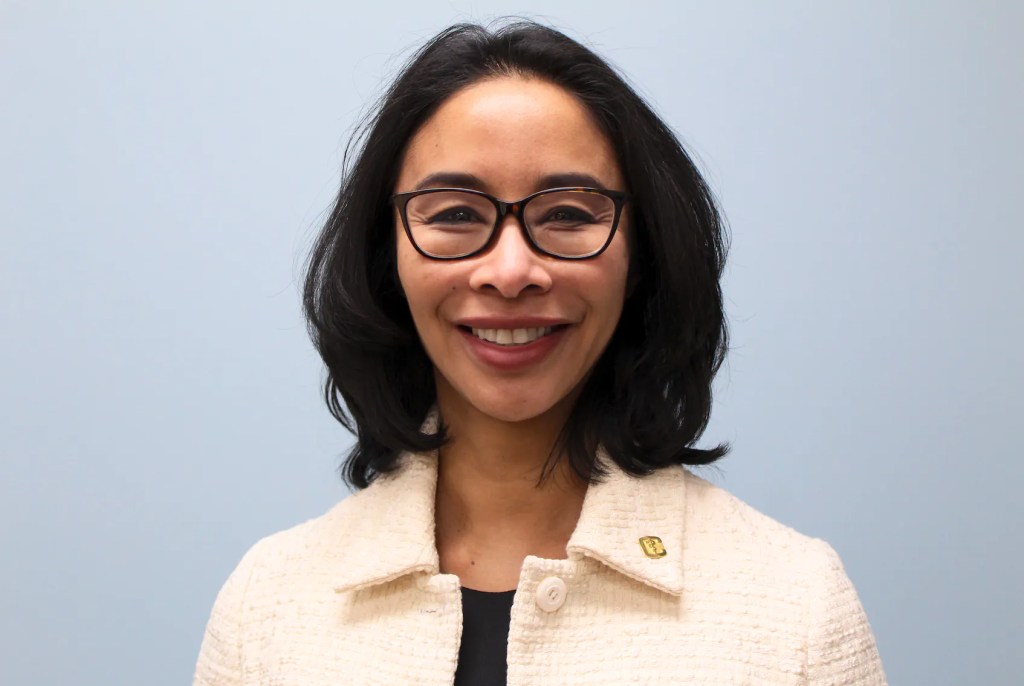
Drs. Gigi Osler, Katharine Smart and Alika Lafontaine

Secondly, the CMA seems to be making its main priority these days the issue of physician burnout. A brief look at their twitter feed shows them reaching out to multiple media outlets to raise awareness of the alarmingly high burnout rates in the profession.

This is good work and shows an organization that maybe has realized that indeed, there is nothing wrong with advocating for physicians. You cannot have a high functioning health care system without happy, healthy and engaged physicians.

As part of the approach to alleviating the stress on physicians and the broader health care system, the CMA also is advocating for a national licence for physicians. The CMA feels this is a priority and a glance at an advanced search of their twitter feed suggests that they feel this will improve virtual care, increase the ability of physicians to support remote communities and reduce burnout.

Now to be clear, I support a national licence for physicians. But the reality is that this is going to be nigh on impossible to do in the short term. I suspect that this will require an amendment to the Canadian Constitution as Health Care is provincial responsibility. Amending the constitution is a dizzyingly complex process. I suspect that Premiers of what may be considered “have-not” provinces would balk at this, fearing that national licensure would lead to more physicians leaving their provinces for greener pastures.

Instead, I would ask that the CMA employ the philosophy espoused by St. Frances of Assisi:

“Start by doing what’s necessary; then do what’s possible; and suddenly, you are doing the impossible.”

The CMA should advocate for immediate Tax Code changes to allow physicians to have pension plans. This is both necessary and long overdue.

I do feel compelled to point out that it is possible for physicians to set up either retirement plans or individual pensions through corporations. However these programs are extremely variable, not easy to implement, and carry high administrative burdens. They also add to physicians workload to set up, at a time when physicians are so tired from a days work that they don’t really have time to think about such things. I don’t know about you, but when I get home, I want to turn my brain off for a couple of hours (before I log back on to my EMR to review lab work and finish charting). I don’t have the mental bandwidth to think about corporate pension schemes.

Making a few changes to the Tax Code is easy. It can be done at the federal level without involving the Provincial Premiers. Doing it will send an immediate message to physicians by the Federal government that they are doing something right here, right now to make life easier for physicians and reward them for all the extra hours they have worked during the pandemic. It will significantly improve physician morale. As physicians realize that there will be an element of security in retirement planning, it will also reduce the stress level of physicians.

Even better, some provinces have already started retirement planning programs. Ontario for example, has the truly excellent OMA Insurance Advantages Program. (NB – if you are an Ontario physician, you really need to strongly consider enrolling in this program. It’s simple, straightforward and really can take a lot of the usual retirement worry away). If tax code changes came into effect, I’m sure a few lawyers and accountants could convert these programs into true pension plans.

The CMA is a national advocacy organization for physicians. They have made much progress since 2017 in supporting physicians. The next, easiest step for them to make would be to push for physicians pensions. It’s relatively easy to do. If successful, maybe they can turn around the trend of declining membership in their organization.

All Ontarians Should Hope New Health Minister Sylvia Jones Succeeds

New Ontario Health Minister Sylvia Jones

Sylvia Jones is now Ontario’s Minister of Health, the largest, most volatile ministry in government. The Ontario Medical Association’s (OMA) correctly tweeted about this:

My first thought when I saw this was a somewhat flippant “should have sent her condolences instead.” Minister Jones has a whole lot of headaches going forward. To succeed, she pretty well needs to be perfect. A cursory glance at the issues she faces is mind boggling.

Should she support further lifting of Covid-19 restrictions? This will make some doctors mad. Should she instead support re-introducing mask mandates and tightening of Covid-19 policies? This will make other doctors angry. Worse, both sides have credible experts, so the whole “listen to the experts”can’t apply when the experts themselves are saying different things.

There is a Health Human Resources crisis unfolding in Ontario (and Canada). Hospital ERs are being closed due to staffing crises and there does not seem to be a quick solution. As more health care workers plan on retiring or leaving the profession early, finding replacements is going to be exceptionally challenging.

The Long Term Care (LTC) situation is equally dire. Wait times for LTC beds in Ontario are skyrocketing. In 2017 I wrote about how we needed 26,000 hospital beds right away, and another 50,000 by 2023. More beds are being built by the Ford government, which is great, but they will take time to arrive.

A quick solution to ease the burden would be to allow older homes who had ward beds in their facilities, open them up again. Rules were changed under covid to no longer allow 4 residents per room. However, if you do that, people will scream you are committing gerontocide. (This is despite the fact that just about all residents in nursing homes have got four covid shots now).

Need more? (As if that wasn’t enough). Over 20 million medical procedures were delayed due to the pandemic. Many of these procedures are early detection screening tests for cancer (sooner you catch, the sooner you cure and, cold-heartedly, the less cost to the health care system).

How about wait times? Wait times for medically necessary procedures continues to rise. MOH bureaucrats like to refer to these as “elective” procedures. But the reality is that if you are suffering from knee pain every day, and have to wait a year to get a knee replacement, it’s not elective, it’s necessary.

All of which makes me realize just how courageous Minister Jones is to take on the Health Portfolio. Allah/God/Yahweh/(insert deity of your choice) knows I wouldn’t want the job. But if I may, I would suggest the Minister should focus on a few things in the first year, as even improvements in a couple of areas will have benefits across the health system.

A word of caution first. She should take what bureaucrats tell her with a grain of salt. There were a few times when I was on the OMA Board when it became obvious that the MOH Bureaucrats had NOT fully informed then Health Minister Christine Elliot about some issues around physicians that caused needless kerfuffles. The bureaucracy has a certain way of thinking that is rigid, ideological and focussed on self perpetuation as opposed to making meaningful change.

I don’t always agree with columnist Brian Lilley of PostMedia, but he hit the nail on the head when he wrote:

“…Ford and his team shouldnโ€™t rely on the Ministry of Health for solutions. These are the people who got us into this mess and who have been failing upward for years..”

and

“..Ford has a real opportunity to change health-care delivery, to speed up access to services, to do away with wait lists and all without changing the single-payer system that Canadians rely on..”

The last comment lines up nicely with the first part of the OMA’s Prescription for Ontario, where they recommend developing outpatient surgical clinics to move simple operations out of hospitals and free up beds. The bureaucracy will oppose it because they are incapable of new ways of thinking and are beholden to hospitals. But at least the Minister will have the support of Ontario’s doctors to work through some of the blowback (there’s always blowback to anything new).

The other easy win is to develop a digitally connected team of health care providers for each patient (also an OMA recommendation). We have something similar in the Georgian Bay Region for the past 12 years and I cannot stress how much it has improved patient care. If I have a patient in need of increased home care, all I have to do is message the home care co-ordinator directly from their chart and ask for help, and they usually respond within 24 hours among other benefits.

This also ties in with a project I was pushing hard for during my term on the OMA Board that got sidetracked mostly by the pandemic but also with some political issues around OntarioMD. I remain convinced that had that project gone forward there would be people alive today that aren’t because of the improved communication it would have provided. But at least preliminary work on it has been done, and with a nudge from the Health Minister this could potentially be restarted to give patients a digitally connected health care team.

NB- this is another area where the Digital Health Team at the Ministry of Health is going in the wrong direction. Their plans are (in my opinion) needlessly complex and won’t result in the kind of robust digital health infrastructure that is absolutely essential to a high performing health care system.

In short, Minister Jones has a monumental task ahead of her. Someone will will criticize her no matter what choices she makes (it’s no secret that health care is referred to as the third rail of politics). If however, she can set, say, three attainable goals in her first year (my suggestions would be open LTC beds, start building outpatient surgery clinics and get the digital infrastructure done), while keeping the bureaucrats in check, then real progress can be made in improving the health system.

All Ontarians, regardless of political stripe, should hope she succeeds. Our crumbling health system depends on it.

What Role Should Nurse Practitioners Play in Health Care?

A recent look at some of the news stories around health care do not paint a pretty picture for Family Medicine. In Ottawa, a truly wonderful 41 year old Family Physician (whom I had the pleasure of meeting when I was OMA President) is closing her family practice due to burn out. The BC government is on the defensive over the shortage of Family Physicians. Medical School graduates are avoiding Family Medicine. The list goes depressingly on, but the point is clear.

Family Medicine is in crisis.

Jumping into this environment is former Ontario Deputy Health Minister Bob Bell and his colleagues. To fix Family Practice, they recommend expanded use of Nurse Practitioners (NPs), allowing them to work independently to replace much of what family doctors do. They claim that NPs can independently provide care for rosters of 800 patients, and collaborate with Family Doctors only for more complex patients. The authors reference a British Medical Journal (BMJ) study that suggests this will be “cost-saving.”

Bell doubles down on his beliefs that NPs can replace family doctors on Twitter by cherry picking data, in this case a Cochrane review:

One wonders if Bell and his colleagues bothered to read the reviews. If they had, they would have seen that the BMJ study on “cost-effectiveness” admitted:

“…it was not possible to draw conclusions about the cost-effectiveness of the complementary provider specialized ambulatory care role of nurse practitioners because of the generally low quality of evidence.

And that the “authoritative” (Bell’s words not mine) Cochrane review also stated:

We are uncertain of the effects of nurseโ€led care on the costs of care because the certainty of this evidence was assessed as very low.

For those of you not versed in medical literature those phrases are the author’s way of saying they did studies where the results couldn’t be relied upon to be reproducible. Using these to promote a belief that allowing NPs to work independently to replace family docs is…….puzzling.

Bell’s belief that Family Docs are easily replaceable is nothing new. He planned on actually ending his career as a general practitioner. Apparently he thought he could easily slide back into it after having done it for a couple of years early in his career, then gone on be an orthopaedic surgeon for another few decades before getting involved in health administration and the MOH:

I don’t personally attribute any malice to his statement (though others on that thread did), I’m not sure that that Bell realized just how much he insulted every single GP in Canada with his seeming belief that he could simply suddenly switch gears after 4 decades of not being in primary care, and go back to being a GP without at least a residency. Hate to tell you this Dr. Bell, but Family Medicine has changed a LOT since you last practiced it. We have more than just beef or pork insulin for diabetes for example.

More to the point however, is there data out there that actually looks at the kind of system that Bell and his colleagues would propose? One where NPs scope of practice is drastically increased allowing them to work independently, and they replace the bulk of work that Family Doctors do? Turns out, there is.

In South Mississippi, the Hattiesburg Medical Clinic, an Accountable Care Organization that is very similar in structure to the proposed Ontario Health Teams (OHTs), did exactly what is Bell and his colleagues are proposing. Fifteen years ago, based on ongoing shortages in Family Physicians, NPs and Physician Assistants (collectively referred to as Advanced Practice Providers or APPs) were hired and allowed to work separately and independently with physician colleagues.

Did this work? In a word: Nope.

A comprehensive analysis of their findings (minimum of 11 years of data over a large patient population) was published in the Journal of the Mississippi State Medical Association. You can read the details for yourself but here are some highlights:

  • the cost for looking after patients who did not have end stage renal disease (i.e. were on dialysis) or were not in nursing homes was $43 a month higher per patient for those who were looked after by APPs than family docs
  • when the data was adjusted for complex patients, the cost of having an APP look after them, rather than a family doc was $119 per month higher (!)
  • these costs were attributed to ordering more tests/more referrals to specialists and MORE emergency department use (yes MORE)
  • Physicians performed better on 9 out of 10 quality metrics in the review

In short, doing what Bell and his colleagues are suggesting led to poorer overall health care outcomes at an increased cost.

Now to be completely clear, I personally have worked with NPs in a number of ways. I strongly believe they are an essential part of the health care team and provide a valuable service. In my practice, they have assisted me in providing care to my patients. When I had a couple of “cardiac kids” in my practice, I dealt exclusively with the NPs on the cardiology team at the Hospital for Sick Children (never once spoke to a Cardiologist or Cardiovascular Surgeon). When the Royal Victoria Hospital in Barrie had NPs on their oncology service, I discussed issues around cases with them exclusively. The NPs were at all times incredibly helpful to me and my patients. NPs definitely have a role to play.

I would also point out that the Hattiesburg Medical Clinic feels the same way. They strongly valued their NPs, and still have them on staff. But they have modified the way they provide care to ensure that all patients now have a Family Doctor but the visits to the clinic now alternate between the Doctor and the APP. On days when only an APP is in house, telemedicine back up by physicians is provided.

We need to build a better Family Practice system. In order to do so, NPs can and should play an essential role. That role however, is not taking on independent rosters of patients. It is working as valued members of a team that looks after a patient population, where each patient has a Family Doctor.

Covid is Not Over – and It Won’t EVER Be

As provinces across Canada begin to lift restrictions from the Covid pandemic, there is a plethora of opinions raging about this. Some physicians feel the restrictions are being lifted too slowly. Others feel that it is just right. In Ontario at least, the most outspoken group are the physicians who demand ongoing restrictions. They have taken to using #Covidisnotover on Twitter.

Obviously, when dealing with a once in a century pandemic that has truly decimated patients and health care workers alike, there are still going to be unknowns going forward. But personally speaking, I think we have to realize a couple of things. First, Covid is not over. Second, and most importantly, it never will be.

Is the flu over? Is HIV over? Heck, are measles and RSV over? The answer to all of those is no. The viruses are still around, they are still infecting people and are mutating all the time (that’s why we need an annual flu shot).

There are always a certain amount of these viruses in the ecosystem. Why would Covid be any different? We are not going to completely eradicate Covid.

Given this – the question becomes, what do we do as a society?

One option, and certainly one that is promoted by the #covidisnotover types, is to continue ongoing restrictions, for much longer. Be it mask mandates, enforced vaccine passports, or continued limits on indoor capacity, the message from them seems to be to keep imposing restrictions for……well, I couldn’t really find consensus on an end date.

The most common argument for continuing restrictions (in Ontario anyway) is the continued positive case load. There are more positive cases than ever before, so why should we stop restrictions now?

Well, the short version is that while it is absolutely true that our case load is higher now than in, say October of 2020, many other factors have changed. In October of 2020, there were no vaccines. There were no oral medications that could help treat those who were infected. Guidance on the fact that Covid is airborne was still (shockingly) lacking.

In comparison, in March of 2022 over 90% of the adult population of Ontario has two covid vaccines, and are well on the way to their third. Evidence is clear that the vaccines are remarkably effective at preventing serious complications of Covid. There is now a strong emphasis on good ventilation as a way to reduce the Covid burden. The government is providing funding for Hepa filters in schools and child care settings. A protocol for rolling out the new oral medications exists, and, like all things, supply of the medications will increase with time.

So to compare just case numbers from October 2020 to March 2022, quite frankly is just comparing apples to oranges. We need to take all these other factors into account.

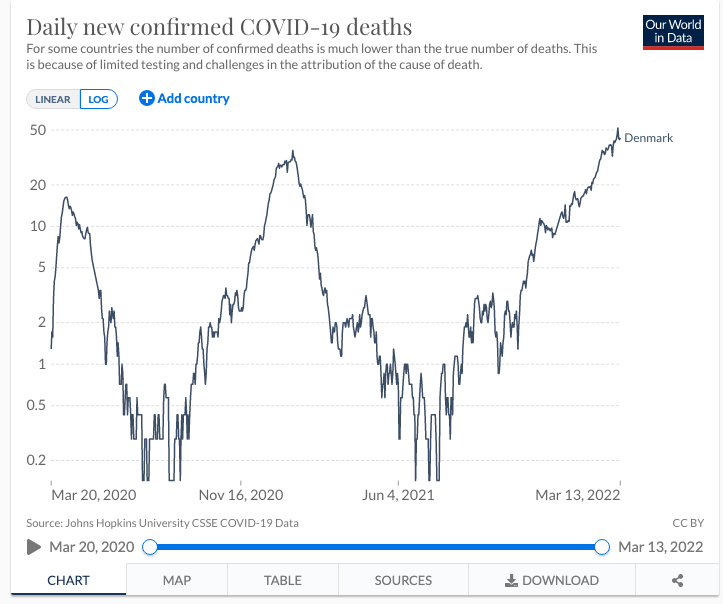
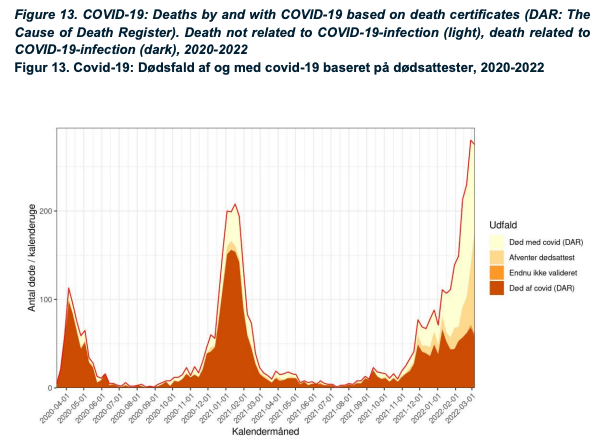
The other common argument is essentially “Look at Denmark!“. Pro restriction types point to the fact that Denmark lifted all Covid restrictions on February 1st, 2022, and now seems to have an exploding number of cases and mortality. Graphs like the one below are designed to shock people into thinking there is a catastrophe in Denmark:

But the graph doesn’t tell the whole story, and in fact a much more nuanced approach requiring a deep dive into the data is needed. I was going to try but I can’t do a better job of it than Michael Petersen did in his twitter thread:

The short version is that because so many people have Covid now, we need to do a better job of determining who died because of a covid infection (usually a covid pneumonia) vs who died of other causes, but incidentally happened to have Covid at the same time. A better graph showing the Denmark situation (taken from Petersen’s thread) taking this into account is here:

Before people start jumping all over this, let me also point out that I am acutely aware that there is a significant spike in deaths in Denmark recently, even if not specifically caused by Covid. We clearly need to do a deeper dive into why there were excess deaths. But part of that deeper dive must include whether deaths were caused by the restrictions themselves (delayed care, depression and mental health issues leading to people just giving up etc). In essence, is the cure (restrictions) causing more harm than the disease (Covid)?

Look, lockdowns and restrictions were initially necessary. There is good evidence that they helped to blunt the course of Covid. But there is also evidence that they have harmed society as well. The economic impacts with record government deficits that will tax our great grand children are well known. However, there are also other health care impacts.

In Ontario, we have a back log of 20 million health care services, leaving many patients feeling forgotten. There are consequences to delayed care and I have seen that in my own practice, and expect to see much more in the coming year. Yes, those consequences sadly will include deaths.

All of this is before we even consider the collateral damage done to mental health especially in our pediatric population. As Dr. Jetelina points out in her excellent sub stack, there has been a world wide increase in paediatric mental health issues. A 24-31% rise in children presenting with mental health issues and a shocking 69-133% (depending on age group) increase in children presenting with suicidal thoughts to Emergency Departments.

What does all this mean?

My personal feeling is that while we cannot ignore Covid (it’s a bad disease) and we need to continue to encourage vaccinations (they work), we need to start looking at the health care system as a whole. Should we mask in high risk areas? Sure. But should we continue to isolate people socially and restrict interactions in a lower risk population, when that clearly causes other harms? I would argue no.

We have been making decisions for a long time based on Covid numbers alone. There are other illnesses and disease that are out there, many of which have been worsened by the restrictions Covid has forced on us. We need to start basing our health care decisions on what’s best for overall population health, not just Covid.