Sunday Snippets – November 3, 2024

Another in a weekly series of brief snippets of health care stories that bemused, intrigued and otherwise beguiled me over the past week along with my random thoughts on the matter.

Item: AI is now inventing things no one ever said. It turns out that AI can “hallucinate” (no really, that’s what they are calling it). Apparently the AI invents commentary that includes things like racial comments/violent rhetoric (!) and even medical mis- diagnoses.

My thoughts: My group is actually looking at AI to help with our Admin burden. While the technology shows promise – this is a useful reminder that we should all read what software generates before logging off. You will probably still save some time, just not as much as hoped.

Item: A new lung cancer vaccine that uses mRNA technology is entering trials. Somewhat ironically, this is what mRNA technology was being studied before the COVID pandemic, and its use for the COVID vaccines. The technology shows great promise to greatly reduce the side effects of cancer treatment, and provide more targeted therapy.

My thoughts: The “vaccine” term is probably going to need refining, because it’s not really preventing lung cancer (which is what most people associate with the term vaccine). Additionally, social media is still awash in mis-information about mRNA technology. So probably better to avoid that term. But at the end of the day I would agree what we are really in a remarkable time for cancer therapy with so many new treatments available. (Still better not to get cancer of course – so if you do smoke – quit!).

Item: Dr. Elaine Ma, a physician who went over and above the call of duty to organize mass vaccination clinics in the Kingston area at the height of the Covid Pandemic is asked to pay back the billings generated during those clinics. (Note I did not say income – Dr. Ma would have used a good portion of those billings to pay staff, supplies and other overheads).

My thoughts: I’ve been (frequently) told I’m too hard on bureaucrats in health care. That I come across as somewhat insulting and “un-presidential” when I complain about them. And every time I think to myself “I really need to take a deep breath and be hard on the problem, not the people” – along comes yet another example of rigid bureaucratic thinking and frankly bureaucratic stupidity that I wind up reverting to my old habits. I will say this, the residents of the Kingston area are a whole lot better off because of Dr. Ma , and the sooner the OHIP bureaucrats get this, the better. As for the OMA’s silence on the matter, it’s pretty disappointing.

Addendum: after writing this blog the OMA has confirmed that they have been helping behind the scenes. I’m glad to hear that they have been helping Dr. Ma, but I would state for the sake of their members that they need to be SEEN to be helping….

Item: The Registered Nurses Association of Ontario blasted the government for not embracing nurses as a central to solving the primary care crisis.

My thoughts: I admire the RNAO for advocating for their members (no really, that’s kind of what a member organization is supposed to do). They’re wrong of course. Using Nurse Practitioners to replace physicians (as opposed to complementing them) will only massively drive up the cost of health care and worsen outcomes. But unlike certain organizations- see above – the RNAO stands up for its members.

Item: Walking pneumonia rates in the United States – and probably Canada – are spiking, particularly in young children.

My thoughts: It’s always awful to see children sick, and as clinicians we should be on the look out for this. BUT – thankfully the vast majority of cases appear to be mild, and if treated appropriately people are recovering. They may have a persistent cough for several weeks – but they are getting better.

Item: Collingwood’s newest physician says that the profession is endangered until the province ante’s up better pay. Disclosure – Dr. Ladda has joined my Family Health Organization and I feel we are lucky to have him.

My thoughts: Read my full blog tomorrow – written by a guest blogger so at least it will be coherent.

Item: A columnist in the Ottawa Citizen basically says that Premier Ford is outsourcing the family medicine problem.

My thoughts: A good friend of mine says it much, much better than I could. “We need the political leadership to step beyond name calling and giving token titles to people to win an election. If you want this province to thrive, rebuild and lead Canada again, it requires more than what we have seen for 20 years from ALL political parties .”

That’s it for this week’s Sunday Snippets. As mentioned above, watch out for a really superb guest blog tomorrow on how to fix family medicine.

Sunday Snippets – Oct. 27, 2024

I was away last week but I’m back with another in a weekly series of brief snippets of health care stories that bemused, intrigued and otherwise beguiled me over the past week along with my random thoughts on the matter.

Item: There was significant growth in the number of physicians in Alberta in the third quarter.

My Thoughts: Alberta is kind of a funny province. There are some very strange goings on with their health care policy. But it can’t be denied that despite all of that, if you provide incentives to attract younger physicians it will help. Having said that, it can all be easily undone if they don’t get on with it and implement the compensation for family physicians they promised, and for some reason appears to be delayed.

Item: The province of Nova Scotia has launched a physicians retirement fund initiative, helping physicians to retire well.

My Thoughts: What’s that you say? You mean ensuring that physicians have peace of mind about their retirement might actually help recruit (gasp!) and even retain (double gasp!!) physicians? Who would have thunk it?? In all seriousness, given the way the Federal Liberal government of our effete Prime Minister really screwed physicians with the recent tax law changes – this is a necessary move and I hope will get copied by all provinces. It really will help improve morale and reduce some of the burnout.

Item: John Richards and Tingting Zhang, from the CD Howe Institute wrote an op-ed in the Financial Post encouraging more use of nurse practitioners since they can “do almost everything an MD can”.

My Thoughts: El Toro Poo Poo. (This is a PG rated blog so that’s all I could get away with). I work with Nurse Practitioners and I have seen them help patients and I firmly believe they have a role in health care. But that role is not to replace physicians. The studies that show they can “do almost everything” are done based on what scope of practice suggests they can do. The blunt reality is nurse practitioners drive up costs and worsen care if used in settings as these characters suggest. The studies that show that NPs are cheaper ONLY look at the actual income an NP gets and compare it to a physicians income, as opposed to looking at the work that is actually done/number of patients seen/and number of tests ordered. The FP article isn’t even fit to be used for toilet paper.

Item: The crisis in Home Care supplies, first reported by Avis Favaro on X (formerly Twitter) continues. Home care nurses are reporting heartbreaking stories of patients buying their own supplies on Amazon since home care couldn’t provide them. Dr. Drew Moore and Dr. Hal Berman should be lauded for going public with their concerns. (I’ve met both of them and they are both mensches).

My Thoughts: I’m old. I’ve seen a lot of government screw ups in my time, especially in health care. But I have yet to see bureaucrats who screw up be truly held accountable and fired. Ever. They just get shuffled off to some other department. It it too much to ask that if someone makes a mistake at their job (and this is a BIG one) they get held accountable?

Item: Quebec is attacking family doctors for some reason. First they suggested they would link people to non-family physicians for care and even remove patients who were “healthy” from their own family physicians. Then they presented erroneous data suggesting that family doctors basically don’t work hard enough.

My Thoughts: There are 9 other provinces and 3 territories that would love to have these doctors.

Item: Penn State Medical Residents unionized, went on strike and got significant benefits (despite being driven off the hospital grounds by hospital security!)

My thoughts: Unionization of physicians is going to happen eventually. Whether through the long gestating Charter Challenge (yes my Ontario peeps – it is still working its way through the courts) or some other mechanism. The younger physicians clearly seem to want this model of representation and at some point in the not too distance future, physicians will be unionized.

Item: The Ontario government announced plans to effectively bar foreign students from attending medical school in Ontario.

My thoughts: My thanks to Am640 News for interviewing me on the topic, and my thoughts on this can be heard below. (This short version – this is populist rhetoric that will do nothing to help with the health care crisis):

My Interview on AM640 About the Current Crisis in Home Care

Was pleased to be interviewed by Ben Mulroney today discussing the current crisis in Home Care in Ontario. Unfortunately, the Ontario Health bureaucrats have really mucked up the process of ordering supplies for vulnerable patients at home, leading to immense suffering for patients at home and their loved ones.

Click below to hear more:

https://podcasts.apple.com/au/podcast/shortage-of-medical-supplies-needs-an-urgent-fix/id1677003384?i=1000673744931

Sunday Snippets – Oct 13, 2024

Another in a weekly series of brief snippets of health care stories that bemused, intrigued and otherwise beguiled me over the past week along with my random thoughts on the matter.

Item(s): CBC new is reporting that with more food insecurity, physicians are being urged to be on the lookout for scurvy (!!). Similarly, Canada Health Network reports that ferritin (iron) levels are being re-visited to help better identify those with iron deficiency. More concerning studies on the link between erythritol and heart attacks. While there have been no randomized control trials, the number of studies correlating having too much of this very common artificial sweetener to blood clotting disorders (heart attacks, pulmonary emboli, strokes) is very concerning. And finally Medscape published a study showing eating Ultra Processed Foods leads to weight gain.

My thoughts: I’ve long maintained the North American diet is garbage. It’s embarrassing that first world countries like Canada and the US put so much crap in our food. The US for example has over 10,000 chemicals that it allows in its food. Compare this to Europe where they are much more stringent in their food standards – and of course, Europeans are slimmer. A good first step would be for Canada and the United States to immediately adopt European food regulations. The big multinational food companies already have to make products meeting European Union standards anyway. Just have them make all their products that way.

For more watch this (hilarious but salty) video of Comedian Leslie Jones on her trip to Europe, where it turns out a peach actually tastes like, you know, a peach.

Item: Doctors Manitoba issued a joint task force report on reducing admin burden for family physicians. The report not only include steps that need to be taken, but clearly lists the progress on each step.

My thoughts: I should move to Manitoba. The amount of progress they’ve made is impressive. Compare that to the utter and complete joke that is in Ontario. For the un-initiated: The Ontario Government and Ontario Medical Association formed a task force to reduce paperwork for family medicine. The result of said joint task force (after over a year of work)? An announcement made on Jan 29 of this year that hearing aid forms (which take about 10 seconds to fill out) no longer need to be signed by family doctors. With no announcement of any further progress. Worse it turns out that the College of Audiologists refused to let “hearing aid specialists” sign the hearing aid forms, it had to be only Audiologists. But most hearing aid clinics are run by hearing aid specialists.

I got four forms to sign last week….

Item: New Brunswick PC party leader Blaine Higgs insists that “business acumen” is needed to run health care and that efficiencies can be found in the system.

My thoughts: Yes, yes and more yes! I don’t know what the New Brunswick health care budget is, but we spend over $80 billion dollars on health care in Ontario. That’s more than enough. So much is wasted on bureaucratic silos and inefficient methods of care that it’s embarrassing. A hard business approach is needed.

Item: A study conducted by OntarioMD showed that there was a 70% reduction in time spent on patient encounter documentation when using an AI scribe (in this case the study was limited to Well Health’s software).

My thoughts: The AI scribe most commonly used in my neck of the woods (I don’t use one) is very very poorly received. It’s clunky, cumbersome and requires a lot of clicks. Can AI help? Of course it can and hopefully the Well Health one (which I have not seen) is better. But the software needs strong physician input to develop to ensure user friendliness – or it will wind up like EPIC – one of the main hospital IT systems, which, well, is best described by none other than Dr. Glaucomflecken himself:

Item: Ontario Medical Association President Dr. Dominic Novak spoke to the Standing Committee on Finance and Economic Affairs at Queen’s Park. While he talked about the admin burden driving physicians out of running a comprehensive care family practice, what people seemed to be talking about was the focus on eliminating sick notes.

My thoughts: I’m glad Dr. Novak is speaking about the admin burden. But seriously, can we move the focus off the sick notes? They take me one minute to do, and I get $25 for them. The real admin burden that is driving people out of family medicine is the constant reviewing of lab data, downloading reports, re-categorizing mislabelled reports (my personal feeling is EPIC is really a problem for this) and so on. I don’t get any money for doing that. Keep your eye on the big picture.

Item: Bill 121 the “Improving Dementia Care in Ontario Act” had more readings at various committees in provincial parliament. The bill seeks to help the estimated 315,000 people in Ontario with dementia right now (a number that is expected to triple by 2050).

My thoughts: It’s overall a good Bill. We certainly need to support and care for our elderly. The true measure of the strength of a society is reflected in how well they care for the weakest among them. I just hope that we look at some of the novel models of elder care in Europe as well, to give our seniors the compassionate, dignified care they deserve.

Item: Health Journalist Avis Favaro published on X (formerly Twitter) that there is a dire shortage of supplies in Home Care. Some sort of issue with the new supplier for the Home Care system. She mentions that the shortage is being described as a “crisis” internally. Without the supplies (syringes, needles) patients are unable to get needed medications and treatment at home.

My thoughts: I have not seen this personally myself. But I’ve heard some horror stories from my colleagues. I hope this gets resolved ASAP.

That’s it for this week. I’m away next week and will return with Sunday Snippets in two weeks.

Sunday Snippets – October 6, 2024

Another in a weekly series of brief snippets of health care stories that bemused, intrigued and otherwise beguiled me over the past week along with my random thoughts on the matter.

Item: Ontario nurses are leaving the profession in droves. This article from the Seeker states: “Ontario ranked third, with 35.1 young nurses leaving for every 100 entering in 2022. This is 83 per cent higher than in 2013.” The overall numbers for Canada aren’t pretty either, with an expected shortage of over 115,000 nurses by 2030.

My thoughts: Who can blame them? Most of the nurses that I work with are really excellent at their jobs and try their best. But, much like with family physicians, they are now relegated to data entry clerks for EMRs that require a PhD in software programming to understand, bear the brunt of patients frustrations and suffer high rates of workplace violence. Yet more reason to implement drastic health care reform now.

Item: The Ontario Federation of Labour met in Sudbury, and have come out with some pretty strong statements about the state of health care in the north. The article is damning with condemnations just how broken our health care system is in Ontario.

My thoughts: I get that Sudbury is a union town and not really a Conservative stronghold, so there is bound to be criticism of the Conservative government there. I also get all the talk about potential early elections and strong results in by-elections pointing to another victory for Ford. But if meaningful steps to fix health care aren’t taken now, this issue is going to haunt the Conservatives in the next election (whenever that is).

Item: The National Post ran a harrowing account about Christine Tizzard and how she paid almost $100,000 US for out of country care when our health system failed her. CBC reported on a woman who likely will have to wait three years to have her surgery.

My thoughts: When I wrote that if I were to get a serious illness, I would go to Turkiye for my health care needs, I was met with blowback. Some of that was because I consult for a medical tourism firm (I did disclose that in the blog and am quite open about it). Some of that was because I seemed to be taking a somewhat “un-Canadian” stance on health care. But the more of these stories that come out, the more I’m convinced I’ve made the right decision.

Item: Dr. Michelle Cohen writes about the letters that the Ontario Ministry of Health sent to (by my rough count) several hundred family physicians last week. They were in 75 group practices called Family Health Organizations (FHOs). While it’s true I wrote about this last week as well, she did a much better job and I encourage you to read her blog.

My thoughts: She’s a great writer.

Item: The Annals of Internal Medicine published an article showing significant benefits to intermittent fasting (or time restricted eating) for health.

My thoughts: I’m a big fan of intermittent fasting. I think it’s the simplest and most straightforward lifestyle change to make and has huge benefits.

Item: A new Angus Reid poll suggests the current Conservative government increased its potential votes share despite it getting terrible ratings on government performance. In particular, 80% of those polled thought they were doing a terrible job on health care. The numbers on housing and affordable living were even worse.

My thoughts: As mentioned above, just because it looks like another Conservative win, doesn’t mean it will be. There is an awful lot of dissatisfaction out there. Several months or a year are an eternity in politics. I wouldn’t be so sure of the results of the next election without meaningful improvement in those numbers.

Item: New Covid-19 vaccines are available at pharmacies. But there is rather a lot of concern about “vaccine fatigue” and also around the fact that messaging around these vaccines has been poor.

My thoughts: Get vaccinated. Get your flu shot as well. And if you are in a high risk group – get your RSV vaccine as well. The fact the messaging around vaccines has been poor will be little solace to you if you wind up with a bad preventable infection that hospitalizes you and leaves you with long term complications.

Item: The Toronto Star reports yet another nursing home decided to close, rather than go through the upgrade process to meet 2024 standards. North Park has 75 residents, all of whom will need a new place to stay. Additionally this comes while it is well known that the demand for nursing home beds will only increase (44,000 people on the wait list right now according to the article). The article pointed out that 25 Toronto area nursing homes have their licences set to expire in July 2025 and there is no guarantee these will be renewed.

My thoughts: The current government has pledge to build 30,000 new nursing home beds by 2028. Good for them. But I worry that with so many others closing this will not be enough. We need to start looking at alternatives for our seniors, such as various living at home programs so that they can be cared for with dignity and compassion. I also hope the new nursing homes will follow the “Butterfly Model” of care for the aged.

That’s it for this week. More snippets hopefully next Sunday.

Ontario Government to Family Doctors: The Beatings Will Continue Until Morale Improves

That we have a family medicine crisis in Ontario is indisputable. That the numbers of family doctors leaving comprehensive care family medicine continues to rise and is expected to leave over 4 million people without a family doctor in the next couple of years is irrefutable. That the need to recruit and retain comprehensive care family doctors has never been more urgent especially as competition from provinces like British Columbia, Manitoba and others increases is unquestionable.

All of this is self evident to anybody following health care.

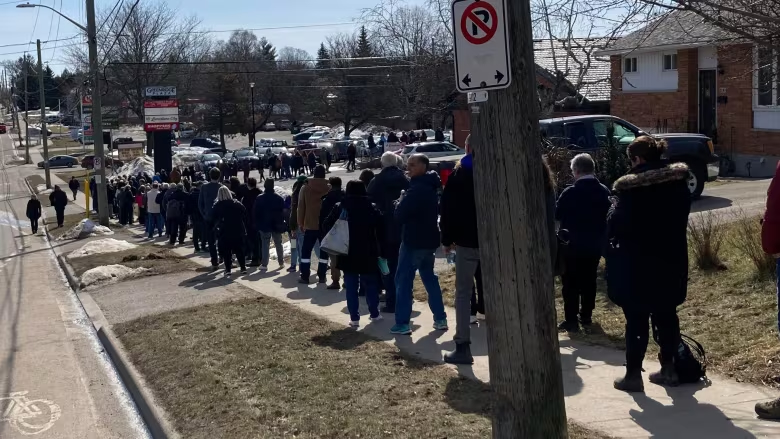
People lined up in Kingston desperately hoping to get a family doctor when a new clinic opened (image first put out by the CBC)

Except of course, the Ontario Government, and their Ministry of Health Bureaucrats. As far as they are concerned, now is actually the perfect time to attack family doctors. Because, you know, the way to improve burnout, morale and encourage them to take on new patients is to ambush people who are already under siege with overwhelming workloads.

Here’s what happened. About 6,000 family doctors in Ontario practice under what is called a Family Health Organization (FHO) model. Think of it as a base salary plus performance bonuses. As part of working in that model, the family doctors have to sign a contract agreeing to deliver a basket of services, including, a certain amount of after hours care.

Because we have so many rural areas in Ontario, where family doctors do a whole bunch of other work (emergency department, hospital on call, palliative care, long term care on call and more), there is a provision in the contract that says if you have X number of family doctors doing this kind of work already, then the amount of after hours care you provide as a FHO can be reduced. There’s a somewhat complicated formula but that doesn’t really matter – it’s the principle that counts. Essentially, if you are already doing after hours work – then you are not asked to do more after hours work.

Unless of course you are a Ministry of Health bureaucrat, taking the guidance of your bellicose negotiations team that said there was “no concern” about a shortage of family physicians. This allows you licence to use a stick against family physicians.

Then, you send letters to 75 FHOs telling them they are not meeting the terms of their contract, based on made up metrics. The letters (I’ve seen a few of them) all allege that the doctors in the FHOs are not living up to the terms of their contract.

Let’s be 100% clear on this. If a physician signs a contract as part of a FHO, they should hold up their end of the bargain. You should read the contract, go in with your eyes open, and make sure you are capable of meeting all of the terms that you agreed to.

BUT.

It appears what the Ministry is arbitrarily and unilaterally determining how to decide if a physician is meeting the terms. For example, one FHO letter I saw suggested that that FHO was not performing as well as its “peers” and was therefore targeted. Two things though. First the Ministry unilaterally decided who the peers were. Second, performing up to the standards of your peers was not part of the original contract.

Another letter I saw alleged that the doctors who do call for their hospital or their nursing home, don’t qualify because……they don’t bill enough for going into the hospital. The ministry unilaterally decided that in order to claim after hours work, you couldn’t just be on call, but you had to keep going into the hospital when on call, a certain number of times (this number was never up for discussion before).

I’ll use myself as an example. Last Wednesday I was on call for my hospital. I got three calls (one at 4:00 am!) and managed all the patients over the phones. I DID perform the task I agreed to (being on call). But the bungling bureaucrats won’t acknowledge that. They want me go to the hospital (even if I can handle it over the phone) and then bill OHIP for the service (which would drive UP the cost!!) to be recognized – a decision they seemingly made on their own, without consultation.

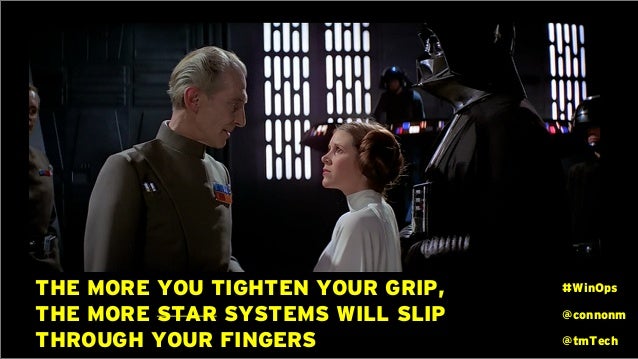
My two loyal fans and one non-fan regular reader know that I’ve long maintained that Star Trek is a far better franchise than Star Wars. But in this case, I will concede the Ministry’s actions are most appropriately compared to this fellow:

Normally when a government changes the terms of an agreement unilaterally, one would expect the Ontario Medical Association to step in and advocate for their members. However, the response from the OMA, in a letter sent to all its members was, frankly, pathetic. The letter basically told doctors to “notify the Ministry” about the circumstances around your group. Try to reason with Darth Vader as it was. No dedicated email or legal team staff member either. Just contact the general help email.

I guess specialists who had expressed concerns on Social Media about too many family doctors on the OMA Board have nothing to worry about. Clearly the OMA, between allowing the across the board increases to the arbitration award this year and not dedicating resources to tackle this issue cares nothing about family medicine. (They talk a great game on social media, but it’s the actions that count).

I imagine the issue will eventually sort itself out after many rancorous meetings and back and forth – all of which will take up physicians time and prevent them from doing minor and inconsequential things like, say, seeing patients. The Ministry will continue to claim that we have more family doctors than ever before – but let’s face it, if they keep behaving like this, those doctors won’t practice comprehensive care medicine. It just seems so ridiculous, and indicative of a Ministry that truly doesn’t understand or value family medicine.

And that should frighten the general public more than the Death Star ever did. (Drat, made ANOTHER Star Wars reference).

The original Death Star from Stars Wars, Episode IV: A New Hope

Sunday Snippets – Sep 29, 2024

Gonna try something a little different. Over the years I’ve often found that there are a number of small stories that happen in a a week that are not worthy of a blog, but worth disseminating. So every Sunday (fingers crossed) I’ll try to collate (briefly) some stuff that happened in the past week in health care, along with my thoughts.

Item: Government of Manitoba announces a large number of health care workers (including 116 NET new physicians – a new record) have moved to the province in the past year.

My thoughts: It just goes to show you how a province and its residents benefit when government’s treat physicians fairly and come to a deal rather that dragging things out through an acrimonious arbitration processes. The second thought is it goes to show the political spin around health care will never end. It was the previous Conservative government of Heather Stefanason that signed the agreement with Doctors Manitoba that has bolstered their physicians population. New Democrat Premier Wab Kinew taking credit for this is somewhat laughable, but let’s face it, if the situation was reversed, the party in power would do the exact same thing.

Item: Private physician social media sites are complaining about some sort of change at the Pharmacy and Administrative level at Ontario Health around processing orders for palliative patients. It’s taking much longer for symptom relief kits, pain pumps, subcutaneous medications and the like to arrive. Hasn’t affected me or my patients yet, but apparently new process means that you have to have all your orders in place by 1:00 pm for them to get done on the same day, and stories are popping up in physicians facebook groups about patients suffering and nurses not having the tools to do their jobs.

My thoughts: It’s not a problem. I’ll just tell all my palliative patients that they are not allowed to de-compensate after 1:00 pm on weekdays and never on weekends. That’ll fix it.

Item: Yet another excellent op/ed written about how difficult it is to get a family doctor in Ontario and how you shouldn’t need a “golden ticket” to get one.

My thoughts: Honestly don’t know what it’s going to take for the government to take some action on this issue at this point. Or for the public to march on Queen’s Park daily.

Item: Vice-Chair of the Ontario Pharmacists Association terminates her agreement with PrescribeIT over a funding dispute. I gather there is some sort of transaction fee now for pharmacists.

My thoughts: There are, huge benefits to having a completely integrated digital health system. I’ve referenced countries like Turkiye and Estonia before about this. Reality is thatmost advanced countries have integrated electronic health care (except the United States). The government should fund this – the savings will far outweigh the costs, if done properly.

Item: Dr. David Price responds to the criticism of him being chosen as a keynote speaker by the College of Family Physicians of Canada for their Family Medicine Forum.

My thoughts: I found it odd that his response included internal Ministry NTF processes. My understanding is that stuff was supposed to be ultra secret. In particular he mentioned a proposal was coming well before presented and announced. He didn’t specifically mention numbers per se. But he also seemed to back off supporting the 3% increase (which he isn’t allowed to do under team rules) or at least suggest it wasn’t his idea. If he was on the OMAs NTF he probably would have been kicked off for saying this stuff, but I guess the government, as always, plays by different rules. And saying he would be happy to not give the Keynote was……..strange. Oh well, at least it gave the chance to do this (and yes you can re-post from here if you want):

Screenshot

I continue to encourage all family physicians to sign the petition asking the CFPC to remove Dr .Price as a keynote speaker by clicking on this link.

That’s it for this week’s Sunday Snippets. A blog on how the Ontario government continues to attack family physicians coming in the next day or two. See you (hopefully) for more snippets next Sunday.

Arbitration Part III: When and How Much Will Docs Get Paid?

Disclaimer: The information is based on my personal analysis and should not be your sole source of information. The payment schedule below is based on what we were told was “PLANNED”. Being a firm believer in “Murphy’s Law“, I would suggest that changes to the below may come at any time. Contact info@oma.org with any questions.

After writing why the Arbitration Award will be bad for patients and doctors, it seems my three loyal readers were unhappy that I couldn’t say when docs would be paid. Being a demure, sensitive, and eager to please sort, I feel compelled to try my best to explain when money is coming.

Once again, my two examples are Drs. Alpine and Valley. Both had 13 years of post secondary education (4 years for a BSc, 4 years for medical school and 5 years for residency). Dr. Alpine does a lot of procedures and can see more patients than he could 20 years ago due to improved technology. Dr. Valley spends a lot of time with intensively sick patients, so she sees the same number of patients as 20 years ago.

What assumptions am I making for the Calculations?

Drs. Alpine and Valley will each provide same number of OHIP services yearly from 2023 – 2026. We have to assume that the entire 2.8 % increase from last year, and the 9.95% award this year will be given across the board (ATB) until April 1, 2025. (The OMA and MOH could reach an agreement on distributing the funds more fairly- but I highly doubt it). We’ll also assume that the schedule for payments the OMA provided at their webinar will be met – I remain very skeptical.

Let’s assume Dr. Alpine billed OHIP an average of $100,000 a month for fiscal 2022/23 and Dr. Valley billed OHIP $30,000 a month. This time period is the base rate for OMA calculations, and hence mine. (Physicians who read this blog can put their average 2022/23 monthly billings into the calculations below to find out their own numbers).

What happened for April 1, 2023 to March 31, 2024?

The OMA and MOH agreed to a 2.8% increase in fees that was to be divided into across the board (ATB) increases and relativity increases. Because the agreement came late, and the OHIP Computers couldn’t be updated (sigh), Drs. Alpine and Valley continued to bill OHIP at the same rate as 2022/23.

What happened on April 1, 2024?

The OHIP computers finally updated to reflect the previous year’s increase. Since the two sides didn’t agree on a relatively formula, the 2.8% was given ATB. Dr. Alpine’s gross income went to $102,800 a month. Dr. Valley’s went to $30,840. Both increases showed up on the May Remittance. Doubtful Dr. Valley even noticed her increase.

What will happen on the Nov. 2024 Remittance ?

Well, finally all the reviewing and rejecting and re-submitting of claims for the year April 1, 2023 to March 31, 2024 will have happened. The computers will then pay the retroactive 2.8% amount of this year to the doctors. Dr. Alpine will get an additional $33,600 (1.028 x $100,000 x 12) on his remittance for retroactive pay. Dr. Valley will get $10,080 (1.028 x $30,000 x 12).

Isn’t there a drop beginning in December 2024?

The increase drops to 2.55% and the funds saved are dedicated to enhancing the Hospital On Call Coverage program (HOCC). Dr. Alpine will now see $102,550 (1.0255 x $100,000 and Dr. Valley will start to get $30, 765 (1.0255 x $30,000).

What happens for the January – March 2025 Remittance Advice?

Allegedly, the OHIP computers will be able to apply the 9.95% increase for this year now (I’ll believe it when I see it). The word “prospective payment” was used in the webinar, but I don’t know what that means. This increase is compounded to the now 2.55% from the previous year. As a result, starting with the January remittance, Dr. Alpine will now get $112,753.73 ( 1.0255 x 1.0995 x $100,000) a month from OHIP. Dr. Valley will be at $33,826.12 a month.

What is supposed to happen on the March 2025 Remittance?

What’s that you say? Wasn’t the 9.95% increase supposed to start on April 1, 2024? So what happened to all that money? Well, according to the OMA you will get a lump sum payment for April to December in the March remittance. Dr. Alpine can expect to see a one time retroactive payment of $89,583. 57 ($112,753.73 that he should have gotten subtracting the $102,800 that he did get, multiplied by 9 months) and Dr. Valley will get $26,875.08. This is in addition to their usual remittance.

OK, What Happens After April 1, 2025?

Well at this point the new ‘permanent’ fees are supposed to kick in. Up until now, everyone has been given ATB increases. Whatever is negotiated or arbitrated, is supposed to start now. However, the base rate will be the 2022/23 rates. In a previous blog, I assumed that we would carry on the process of giving 1/4 of the increase as ATB and 3/4 via relativity. IF this is done (not sure if it will be) then every speciality will get 2.46% (0.7% for last year + 1.75% this year, compounded) plus X percent – with the X varying from speciality to specialty based on relativity.

Let’s assume Dr. Alpine’s speciality got an X=0% and that Dr. Valley’s got X = 17.54%. In that case Dr. Alpine will now get $102,460 a month:

  • $100,000 base rate from 2022/23 x (1.0246 ATB increase + 0 for relativity).

Dr. Valley on the other hand will get $36,000 a month:

  • $30,000 base rate from 2022/23 x (1.0246 ATB +.1754 for relativity).

I imagine Dr. Alpine will be annoyed.

What are the chances of the new fees being ready on April 1, 2025?

Slim to none. Militancy on the part of the MOH and incompetence on the part of bureaucrats in charge of OHIP are two constants as sure as death and taxes.

Um…well what happens to our monthly incomes after April 1, 2025?

I honestly can’t figure that part out (and not for lack of trying). The procedural agreement states:

“Any unexpended portion of the targeted price increases will continue to be paid to physicians as a separate payment on the monthly Remittance Advice until such time as each targeted increase is implemented or unless the parties agree otherwise.” 

This is the part that I think most people have missed (including, frankly, the OMA Board that approved this agreement – and yes I know it was an attempt to get real money in the hands of physicians). It’s one thing to accept 2.8% ATB. But to accept 12.75% ATB (2.55% from last year compounded with 9.95% from this year) is a bit much. You really have to wonder if there wasn’t a fairer way to spend this money, especially with so many Dr. Valley’s struggling. Time will tell what happens here.

Geez old country doctor, all you’ve done is fuzzify the muddification!

I aim to please dear reader. I aim to please.

SPECIAL MESSAGE FOR FAMILY PHYSICIANS ONLY

Those of you who have read my blogs know that I (and many others) are really really upset with College of Family Physicians of Canada for inviting Dr. David Price to be a keynote speaker at the Family Medicine Forum. I view it as a slap in the face to family physicians, given his role on the Ontario Government’s Negotiations Team.

The Ontario Union of Family Physicians would seem to agree with me. They are asking all family physicians to sign the petition below to have Dr. Price removed as a Keynote speaker. PLEASE click on this link to read and I encourage you to sign.

Arbitration Part II: Award Implementation Will Hurt Physicians/Patients

Disclaimer: The information below is based on what a non-lawyer (i.e. me) was able to sort out after reading the OMA and Ministry’s 2024-2028 Procedural Agreement, the OMA Legal Counsel’s summary of the award, and attending the OMA Zoom session on the award. This may not be accurate (and I will correct the blog if more relevant information becomes available). I encourage all OMA members to contact the OMA directly with specific questions (info@oma.org) and not rely on this blog as your sole source of information.

The Numbers

First, let’s again review the numbers (approximated for simplicity).

Physician Services Budget, fiscal year ending March 2024: $16 Billion +

Arbitration Award: 9.95% – approximately $1.6 billion

OMA/MOH agreement on split of funds: 70% ($1.12 Billion) to fee increases and 30 %( $480 million) to targeted programs.

Previous contract (no guarantee this will repeat): 25% of the fee increases ($280 million) would go to across the board (ATB) fee increases for entire profession. The remainder ($840 million) would be distributed on the basis of relativity (giving more of a raise to low earning specialties and less to higher earning specialties). IF this pattern repeats, this equals a 1.75% increase for everyone. Then each specialty would get assigned an additional percentage (let’s say X) based on relativity. Ergo everyone should get 1.75% + X, where X varies from zero (for high billers) to higher (for lower billers).

The Implementation

According to the OMA webinar, the OMA and Ministry have yet to agree how to distribute the award. Mediation starts early October and all of this might wind up in Arbitration in March of 2025. My sense from watching the webinar is they are not close on an agreement.

So what happens to the money for this year? We are all supposed to get a raise now right? Well, that’s when the procedural agreement takes effect. It states (sorry for the legalese):

The Year 1 price increase will be implemented as follows:
a. The entire price increase under the Year 1 2024-28 PSA will be implemented
prospectively as an across-the-board increase to the fee-for-service payments
identified in paragraph 1a above, with a target date of the RA in the month 90
days following the issuance of the arbitration decision, and will flow through to
non-fee-for-service payments as soon as practicable.
b. A lump sum payment equal to the entire increase awarded for Year 1 for the
earlier period from April 1, 2024 through to the implementation date under
paragraph 12(a), will be paid as soon as practicable following the arbitration
award with a target date of October 2024.
c. To the extent practicable, the permanent year 1 non-targeted price increases
will be implemented at the same time as the April 1, 2023, price increases
under Year 3 of the of the 2021-24 PSA i.e. April 1, 2025, and in any event no
later than October 1, 2025. These increases will be calculated on a base of
2023-2024 expenditures …… The distribution as between across the board increases and relativity increases will be determined in such manner as the parties agree or, failing agreement, as the board of arbitration awards….

OMA staff confirmed at the webinar that this is in fact what will happen. They even had a complex schedule of prospective payments/lump sum payments/retroactive payments and so on that left me, frankly in need of high doses of Zofran.

To try and simplify things, let’s look at how this will affect two doctors.

Meet Drs. Alpine and Valley

Dr. Alpine and Dr. Valley both completed four years of an undergraduate degree. They then completed four years of medical school, and each did a five year residency in the field of their choosing. Dr. Alpine was always someone who liked to “do stuff”. He wound up in a speciality that does a lot of procedures and as technology has improved, has been able to treat more patients in a day than his specialty could 20 years ago.

Dr. Valley, who is no less smart, really enjoys patient interaction. She chose a specialty that requires more intensive time with patients, and as such, is not able to see more people in a day than someone in her field could 20 years ago.

With our aging population and increasingly complex health care needs – both Dr. Alpine and Dr. Valley are swamped and have long waiting lists.

Dr. Alpine, was able to bill OHIP $1 million for fiscal year ending March 2024. This represents his gross income, and to be fair, his office has a lot of leased medical equipment, along with staff that he has to pay for out of that $1 million. Dr. Valley billed OHIP $350 thousand for fiscal year ending March 2024. She too has staff and other overhead expenses, but not as much equipment.

What happens to Dr. Alpine and Dr. Valley under the procedural agreement? While the schedule for payments for the award is a convoluted mess, the reality is that for the fiscal year ending March 2025 – Dr. Alpine will gross $1.1 million, and Dr. Valley will gross $385,000.

Now the OMA states that the goal is to have new permanent fees in place based on relativity and targeted funding for April 1, 2025. The ONLY way this could happen is if the government negotiations team completely capitulates its positions in the next couple of weeks. Seriously people, the schedule shows that if there is no agreement this thing goes to Arbitration in early March 2025. IF that happens, it’s part and parcel of Arbitration for the 2-4 years of the contract. So the Arbitrator probably won’t even make a ruling until September 2025. Then another six months to re program the ancient OHIP computers and while the fees may be retroactive to April 1, 2025, you likely won’t see the money until Spring 2026.

Let’s assume that the arbitrator follows the precedent set where 1/4 of the increase ( $280 million) should indeed be ATB, and then distributes the rest based on relativity. And let’s assume that Dr. Alpine’s speciality was assigned an X of 0% and Dr. Valley got an X of 18.25%. Therefore Dr. Alpine for the fiscal year ending March 2026 will gross $1.0175 million – a reduction of $82,500 dollars from the year before. While Dr. Valley will get bumped to $420,000.

No matter how often the OMA reminds people that the increase for the first year is one time only, and NOT a permanent increase, the reality is that many members will have budgeted around their increase, and Dr. Alpine will, be very miffed at a $82,500 reduction in income for doing the same work.

But it’s not all that great for Dr. Valley either. She will have missed one year of a substantial increase that should have gone to her earlier. Not only that, but her offices cost pressures and admin workload have been skyrocketing. She needs the stability a relativity based formula provides right now, not in March of 2026.

Because of the delay in stabilizing her practice, she actually chose to leave her practice and do a different kind of medicine. Her patients now have to go back on a waiting list, and who knows when they can find someone to take over their care.

I understand why this procedural agreement was put in place. It was to ensure that doctors got a much need cash injection sooner rather than later. But unfortunately there are unintended consequences of this and those are coming to fruition. Specialists like Dr. Valley who need the relativity increases right now will not be able to hold out and may leave their practices. Dr. Alpine will be understandably miffed at the yoyoing of his income.

And all of this uncertainty will do nothing to help the health care system.

The Arbitration Award: The Good, The Bad, The Ugly

On Sep 12, Ontario Medical Association (OMA) Board Chair Dr. Cathy Faulds announced that the Kaplan Board of Arbitration awarded Ontario’s doctors 9.95% for the first year of their Physicians Services Agreement (PSA).  Sounds straightforward right? Nope – it’s actually ridiculously complicated.

I’ve looked at the award.  I may have some of this wrong (copious documents found on the OMA website induced catatonia, hypersomnolence and cluster headaches).  But this is my take.

A simplified (I have a small brain) set of numbers first:

Total award:  10%, approx value $1.6 billion dollars

Amount for general feel increases: 7% or $1.12 billion dollars

Amount for “targeted funding”: 3% or $480 million dollars.

In the past the OMA and Ministry agreed 1/4 of the raises would be across the board, the rest done with “relativity in mind”.  IF we do that again then $280 million (1/4 of $1.12 billion) will be in across the board increases.  Every specialty would get a 1.75% raise. The rest of the money ( $840 million) would be for raises based on relativity. So all specialties would get 1.75% + X as a raise.  The “X” would vary. It would be more for low income specialties, and the X would be lower or even zero, for the high income specialties.

The Good.
There’s a raise.  The MOH Team stated that Bill 124 should not impact the deal. The arbitrator disagreed and felt that we were unfairly treated because of Bill 124 stating:

“Bill 124 directly impacted the bargaining even though physician compensation was not subject to its terms.”

Hence, the MOH Team completely lost their argument that there should be no redress, and there was a 6.95% redress given.

There was a recognition that family practice is in crisis.  In his ruling the Arbitrator said:

“We accept on the evidence that there is a physician shortage. Somewhere between 1.35 million and 2.3 million people in the province are not attached to a family doctor. These are real numbers. The Ministry’s own documents – which we ordered disclosed–demonstrate that there is a problem to address.”

The arbitrator had to order the Ministry to disclose this?? Jeez. Additionally, the Arbitrator noted:

“Clearly, more family doctors are needed as are more doctors practising comprehensive longitudinal medicine…..it is obvious that the citizenry is ageing – the Government acknowledges this brings with it increased complexity…”

Contrast this with the Ministry’s absolutely laughable position that there is “no concern” about a shortage of doctors.  This is frankly a warning shot, and a welcome one, to the MOH’s negotiations team to not say such stupid things again, and to change their position in future rounds of negotiations.

In another shot to the now obviously inept MOH Negotiations Team, the Arbitrator agreed that admin burden also needed to be addressed with, you know, money. He stated:

“We have reached the conclusion that targeted increases – not necessarily baked in – should be allocated to the reduction and redeployment of administrative work that can best be performed by others or through digital or other measures.”

Finally, It was quick.  OMA Board Chair Cathy Faulds had told us not to expect an award until the end of September.  Who knows why Kaplan put the award out so quickly.

The Bad.

This will not be enough.  The OMA asked for a 22.9% increase. They got less than half of that. This is not really the big win the OMA is portraying it as.

A 10% increase in gross billings for family medicine will not be enough to stop the haemorrhaging of doctors from comprehensive family practice. The “X” for family medicine (see above) needs to be high, and much of the targeted funding needs to go to family medicine too.

And, while it’s true that the Arbitrator recognized there was a crisis in family medicine, the award given did not really do anything in and of itself to stabilize family medicine.  It’s true that was not part of the scope of the arbitrator for this round (this round was for a fee increase). The fact that some practical guidance in how to resuscitate family medicine is missing is still bad for all Ontarians.

The Ugly

The implementation of this award is going to be a nightmare.  As I write this, there is no indication that the MOH and OMA have agreed on how to divide up the $1.12 billion in general fee increases based on relativity.  In fact, indications are that the MOH will continue to fight the methodology, meaning it could be a very long time before fee increases for specialties are set.

Worse, the OMA and MOH have not been able to agree on how to distribute the $480 million in targeted funds.  Which means….more mediation and arbitration.  I continue to concede that the OMA states arbitration and mediation will be done by mid- March 2025. I continue to not hold my breath.

Even uglier is that one solution being proposed would be to give “everyone” a 9.95% increase right now, until the relativity and targeted funding is sorted out.  But that would mean that some of the higher paid specialties would see a 9.95% for a bit, only to have a relative cut once the final fees are sorted out (also to be arbitrated by March 3-7, 2025).  No matter how you message this to warn people – this will cause problems when people see a decrease in income after a rise.

All of which means that the retroactive pay for this year may not come for over a year. If you are a physician who has some decisions to make (eg do you renew the lease on your office at the higher rates the landlord is demanding) – you are going to be awash in uncertainty.

The ugliest part of all of course, is that a bunch of lawyers are going to get really rich as their billable hours go through the roof during this process.

There is a better way.

The government’s main concern should be about expenditures. That decision has now been made for them.  The PSB will go up by $1.6 billion.  That money will have to be paid one way or another.  

The government can now, especially after being told off by the Arbitrator back off from their polarizing and obstructionist path, accept the OMA proposals for implementing the award. They cover what the government states it wanted (pay lower paid specialist more of an increase than higher paid ones).  They also covers issues around admin burden which the Arbitrator acknowledged exist, and the shortage of family physicians (which the arbitrator also acknowledged). 

The total amount spent by the government is going to be $1.6 billion regardless. Getting rapid agreement on the distribution of those funds will decrease the uncertainty about how much goes where and will shorten the time it takes doctors to get paid, which will stabilize the health care system.

Then, for the love of Allah/God/Yahweh/Great Universal Consciousness – the government now needs to realize that you can’t fix health care without working co-operatively with your doctors.  Go look at other provinces. Copy them and get a fair deal for years 2-4 of this agreement.

Or the government can continue to obstruct, obfuscate, delay and impede any real progress towards working together with more protracted, internecine mediation and arbitration. The ball is in their court.

What should doctors do?

The above represent my personal interpretations of the documents I read. I encourage all Ontario physicians to register for the OMA live session on Tuesday Sep 17 from 7:30 – 8:30 pm to hear more details about this agreement.