

The Appalling Treatment of Dr. Elaine Ma Is Hurting Health Care in Ontario

I’ve written about the horrific treatment that Dr. Elaine Ma has been subjected to by the bureaucrats at Ontario Health before. The situation is so ridiculous that it could be a story presented at the Theatre of the Absurd.

What happened?

Dr. Ma is a family physician from the Kingston area. During the Covid pandemic she realizes the need to immunize as many people as possible to protect the community. She organizes a number of outdoor mass vaccination clinics, which resulted in Kingston being one of the most heavily vaccinated areas of the province. For her efforts, she wins the very well deserved the praise of many, and an award from the Ontario College of Family Physicians.

There are two billing codes for providing Covid vaccinations. One for physicians who work in a vaccination clinic that someone else set up (e.g. public health). Another for those who set up the clinics themselves, and paid for staff/heating for outdoors/tents/internet etc. Since she paid for all of that, Dr. Ma bills the second code.

Dr. Elaine Ma

Fast forward a couple of years and the callous and unthinking bureaucrats at OHIP decide that she has billed the wrong code and demand she pay back $600,000. I won’t restate all the steps she went through to fight this. I will state that the reasons for them wanting the money paid back varied between the clinic being outdoors instead of indoors, medical students being involved and so on. But eventually the case winds up at Divisional Court.

On Dec 16, the court handed down a ruling supporting Dr. Ma. What I had failed to realize before is that the Ontario Health bureaucrats main argument appears to be that there were no extenuating circumstances during the time of the Vaccine Clinics that Dr. Ma set up. Yes, you read that correctly. The whole country was in the midst of a (hopefully) once in a lifetime pandemic. Canada was effectively shut down for business. People were not allowed to visit loved ones in hospital or nursing homes. Travel had ground to a halt. But, in the minds of the soulless and spiteful bureaucrats, none of this constituted “extenuating circumstances”.

Thankfully, Divisional Court Justices Matheson, Varpio and O’Brien were having none of this nonsense. They clearly stated the decision by bureaucrats that there were no extenuating circumstances was “unreasonable.” (I would have, and will, call that decision much worse things). The Justices pointed out the obvious. There was clearly a public health crisis at the time, and that many leaders, including politicians were calling on physicians to get the vaccinations done.

More importantly they stated something the OMA’s legal team really needs to take a deep dive into:

…”that the wording of section 17.5 does not limit relief to unpaid claims; it only requires the presence of extenuating circumstances. Since OHIP typically pays claims first and reviews them later, a restriction on unpaid claims would effectively nullify the provision. The court called this interpretation unreasonable.”

Currently OHIP pays physicians whenever they bill. Later, OHIP decides if it was reasonable or not, and if OHIP feels the situation is unreasonable, they demand the money back. The justices seem to be saying this process is not fair. Which has implications far beyond this one case. Obviously, this would not apply to clear cut cases of fraud. It is a much much needed kick to the slow, incompetent, and spiteful OHIP review process. I can’t possibly understand the potential future implications for this – but I suspect there will be many.

Finally, the justices let their displeasure be known by ordering OHIP to pay Dr. Ma $10,000 in court costs. This strongly suggests to me that they were peeved at the OHIP bureaucrats for taking it this far, and really didn’t think it should have gone there.

How is this hurting health care now?

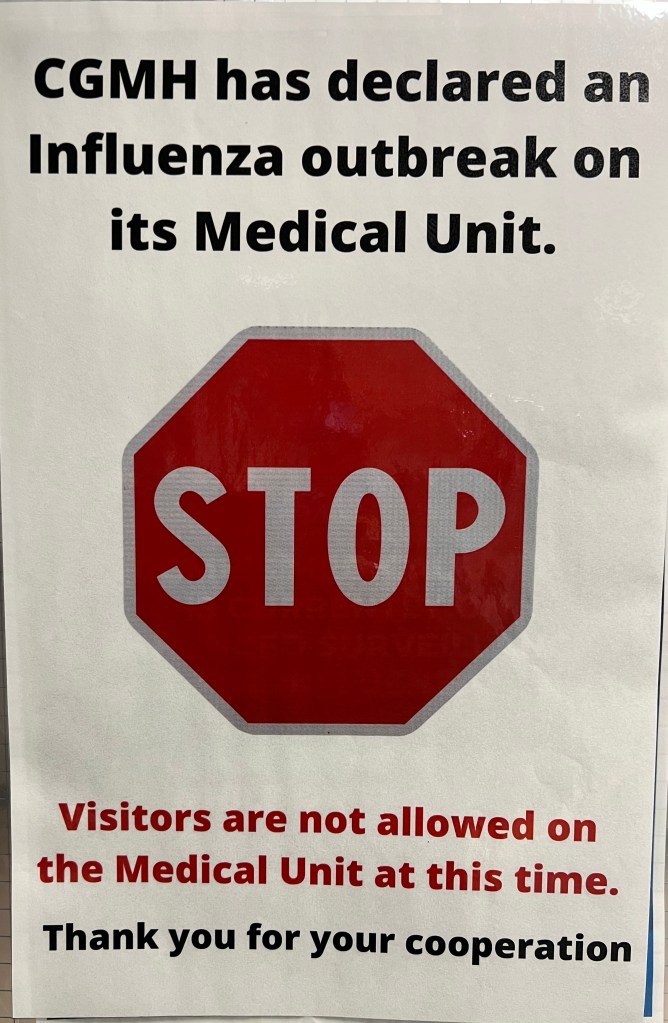
Ontario is currently seeing an unprecedented surge in flu cases. Flu season has come early. The current variant appears to be extremely strong. It is circulating at “sky high” levels among young people. Three children (at least) have died. Hospitals have declared outbreaks and wards are closed. Visitation has stopped.

Sign on the door to the Medical Ward of my Hospital

You know what would really help? If only some people would come up with some innovative ways of getting their communities vaccinated against the flu. Yes this year’s flu shot is a bit of mismatch for the current strain, but it still provides some protection and keeps you from getting really ill.

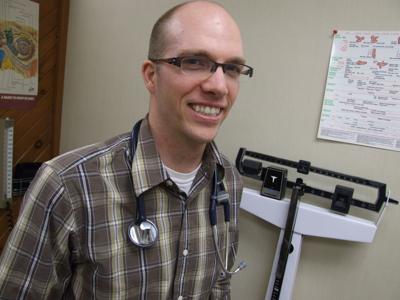
Or how about an innovative idea for where to safely look after patients like was done during the Covid crisis. My friend Dr. Bryan Recoskie set up a unique 18 bed ward in our local Legion, to look after non-covid patients while the hospital wards were shut with covid positive patients.

Dr. Bryan Recoskie

And yet, I don’t see any of that happening right now. Don’t get me wrong, doctors continue to go to work. We continue to care for the sick and continue to comfort those in need. We continue to do our best in these trying circumstances.

But I can’t find any evidence (please correct me if I’m wrong) – of where people are doing unique out of the box things to try and mitigate the currently unfolding nightmare. Given the potential exists that IF you try something unique, you may wind up undergoing two years of pure hell by bitter, ruthless and depraved bureaucrats – can you blame people for not trying?

To quote a good friend of mine, “The damage has been done. Nobody is going to stick their necks out now.”

What should happen (but won’t):

First, under no circumstances should OHIP appeal the decision from Divisional Court. The mercilessly inhumane bureaucrats need back down. Second, Health Minister Sylvia Jones needs to do what she should have done a year ago – and direct the bureaucrats not to seek any recovery at all from Dr. Ma. It’s just the right and decent thing to do.

Finally, it would really help if Minister Jones issued a formal apology to Dr. Ma for how she has been treated by the bureaucrats. It’s not just the OHIP bureaucrats. Jones’ own communications director, Hannah Jensen claimed Dr. Ma had “pocketed the funds“, a statement that clearly suggested malfeasance.

Do that, and maybe, just maybe, physicians would once again feel comfortable coming up with out of the box solutions for crises that are occurring.

Maybe.

Only 25% of members said fees are worth it in 2022. The CFPC hasn’t asked since

My thanks once again to Dr. Greg Dubord (pictured inset) agreeing to post this on my site, (and doing most of the writing). Dr. Dubord is the founder of CBT Canada (www.cbt.ca) and a leading advocate of medical CBT. He completed his training under CBT’s Founder Dr. Aaron T. Beck and was the first Canadian Fellow of the Beck Institute. He has provided medical CBT workshops at many Family Medicine Forums. This blog originally appeared in the Medical Post.

Only 25% of CFPC members believe their fees are worth it.

That devastating verdict emerged from the College of Family Physicians of Canada’s own 2022 member satisfaction survey—unfortunately the last one they’ve published.

When three-quarters of your captive membership says they’re not getting value for money, you’d expect urgent reform and rigorous tracking of improvement. Instead, the CFPC did something remarkable: they stopped asking.

The survey, published by the CFPC’s own CEO Dr. Francine Lemire and executive director Eric Mang in Canadian Family Physician, contained another brutal statistic: Only 39% felt the CFPC was “listening to the opinions and needs of members.” More than 3,000 respondents delivered this indictment of their own professional organization—then watched the CFPC go silent on member satisfaction for three straight years.

Twenty-five percent is not a satisfaction score—it’s a vote of no confidence. In any other context, that number would trigger not just immediate crisis response, but deep organizational commitment to demonstrable change. A product with 25% customer satisfaction gets pulled from shelves. A restaurant with 25% customer approval likely ends up closing. A professional association with 25% approval hemorrhages members unless, of course, membership is mandatory.

When three-quarters of your customers—especially mandatory, captive customers who can’t leave—believe they’re not getting value for money, that’s not a minor problem requiring tweaks. That’s an existential crisis for the CFPC demanding comprehensive reform and continuous monitoring to track whether changes are working. Management guru Peter Drucker put it bluntly: “You can’t manage what you don’t measure.”

The CFPC instead chose this two-part treatment: 

  1. stop measuring whether members think fees are worth it; and
  2. ask for more money. No survey in 2023—but a 7% dues increase proposal that 83.86% rejected. No survey in 2024. No survey in 2025—but another fee increase attempt, also rejected.

Imagine asking your boss for a raise while refusing to do your performance review. That’s essentially what the CFPC keeps doing. 

This pattern becomes more revealing when you consider the CFPC’s demonstrated survey capabilities. During 2020 to 2022, the College conducted and published multiple iterations of COVID-19 impact surveys—2020, 2021 and June 2022—each with detailed, comprehensive reports and full datasets publicly available. These surveys served important functions, documenting physician challenges and supporting advocacy with government and policymakers.

The CFPC clearly has the infrastructure and expertise for longitudinal research. Yet member satisfaction—the metric showing only 25% believe fees are worth it—gets measured once, summarized briefly, then abandoned. When surveys document external challenges, members receive full transparency and accountability.

Although the CFPC’s 25% rating was horrible, it’s almost certainly a lot worse now. That survey was conducted before the PGY-3 controversy, and before the governance crisis that prompted our ten reform motions.

This brings us to one of our ten governance reforms for the 2026 AGM: Member satisfaction survey transparency. This motion would require annual CFPC member satisfaction surveys with published methodology, response rates and complete results (not curated summaries).

Healthy organizations that genuinely serve their members practice what the Japanese call kaizen—continuous improvement through regular measurement. When Toyota faced acceleration problems, they didn’t just stonewall—they analyzed data, implemented fixes, and reported progress transparently to regulators. 

The CFPC has a rather unique accountability problem: membership is mandatory for most, and the dissatisfied can’t leave. Captive dues payers are left to brux in high frustration while wondering if anything will change. Economists call this “moral hazard.” When an organization is insulated from the consequences of poor performance, accountability diminishes. This structural accountability gap—and potential solutions—will be explored in detail in upcoming articles in this series.

Our transparency motion is straightforward: the CFPC will be required to measure member satisfaction annually, publish complete results and let members judge whether their mandatory fees produce acceptable value. If the CFPC is delivering excellence, the data will prove it, and they will have every right to feel proud of it. However, if they’re failing, members deserve to know—with implications for the legitimacy of dues.

Our earnest hope is that this upcoming year we’ll see a highly member-responsive CFPC make genuine changes that demonstrably impact member satisfaction, and they’ll proudly make that public.

Open Letter to Premier Francois Legault

The Honourable François Legault, M.L.A.
Premier of the Province of Quebec
Édifice Honoré-Mercier, 3e étage
835, boul. René-Lévesque Est
Quebec QC G1A 1B4

Dear Premier Legault,

You probably don’t know who I am, and are wondering what propelled me to write an open letter to you. I decided to write to you after doing a radio interview with Greg Brady on his show Toronto Today. During the interview, Greg asked me to comment on the strife between you and the physicians in your province. He brought up the fact that in the past couple of weeks, 263 physicians from Quebec have applied for a licence to practice medicine in Ontario.

Now, I certainly don’t pretend to be an expert in how the health system functions in Quebec. Nor would I assume to know all of the intricacies of Bill 2, the legislation that you’ve introduced that has your physicians so angry. And no, I’ll say right off the bat, I don’t know what negotiations between you and the representative bodies of physicians in Quebec (FMSQ and FMOQ)have been like.

But I will tell you that my very first blog ever (in the Huffington Post) was an open letter to Ontario’s then health minister, Dr. Eric Hoskins. I wrote that blog because his government was talking unilateral actions against physicians (sound familiar?) In it, I warned Dr. Hoskins that acting in a unilateral manner would result in chaos for our health system:

“We cannot return to a system where there are three million or more people without a family doctor, or wait times to see specialists (already too long in my area) get prohibitively longer.”

I also warned of the political consequences of proceeding with unilateral actions and how this would hurt Liberals in the 2018 election. You perhaps know they were absolutely decimated in that election. While its true a large part of that defeat was because the feckless Premier Kathleen Wynne was so widely disliked, I maintain to this day the Liberals could at least have maintained official party status had they not botched health care so badly.

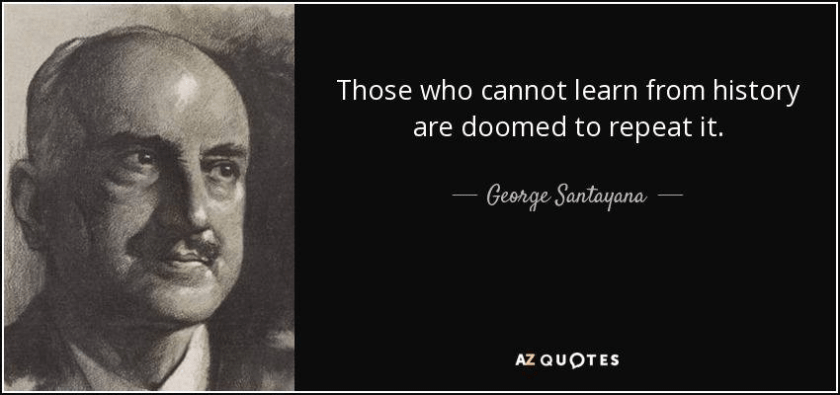
The reason I could make those statements in my blog with such absolute certainty, and have them proven right in the end was not because of any prescience on my part. It’s because I followed the advice of Santayana:

Look, I understand that some of the specifics of the policies and legislation that you are bringing in are different from what Dr. Hoskins tried to do. But at the end of the day, it amounts to you as a government saying that you know how to run healthcare. You don’t need advice or co-operation from doctors. You’re going to impose the changes you want.

I’d encourage you to go back and read the letter I wrote to Dr. Hoskins. I pointed out to him that he was repeating the mistakes (unilateral actions) of the Bob Rae NDP government in the 1990s. They destroyed health care by those actions and were wiped out in the 1995 election, never to see power again.

Take a look at the Jason Kenney PC government of 2019. The went to war with Alberta Medical Association in 2020. The only way they were able to salvage a victory in the next election after that, was to dump their leader, Jason Kenney. (It’s true unhappiness with how he handled the Covid pandemic played a role – but again, the point is there was no saving grace for him – if he had kept health care functioning…..)

Want more? Look at the actions of the Gordon Campbell British Columbia government. Between 2001-2002 they unilaterally tore up an arbitration agreement between the BC government and their doctors. Years of discord including a Charter Challenge (that the BC Government eventually lost), political strife, a strike vote by physicians and a vastly reduced majority followed. Eventually, given a failing health system caused by their own arrogance, the BC government had to come to an agreement with their doctors in 2002, and again in 2006 that restored binding arbitration and was viewed as extremely generous at the time.

As I pointed out to Dr. Hoskins the message is simple. Any government that takes on unilateral action will run the risk of losing doctors from that province. When that happens, the healthcare system suffers. When that happens patients suffer, wait times go up, care deteriorates. When that happens, people don’t blame the doctors, they blame the politicians.

In short, a government that imposes unilateral actions on physicians not only hurts the patients of their province, they always pays a political price. They always have to pay more in the long run than if they just worked fairly with their physicians in the first place.

Look, I don’t particularly care about you or your government. I could not care less whether you win or lose your next election. But I happen to care a lot about my physician colleagues and I know that they are very very angry (and rightfully so). I also care about the residents of Quebec, and I know that they are going to suffer a lot because of your actions. As of now, 28% of your population does not have a family doctor. Can you imagine what will happen if 263 leave? And do you really think any doctor with half a brain will actually come to Quebec when your government behaves like this?

Trust me on this one, if you don’t immediately reverse course, and start to work with your doctors – the harm done to your health system and the people you are supposed to serve will be enormous.

And if you don’t believe me – go read that quote from Santayana again.

Yours truly,

An Old Country Doctor

Lettre ouverte au premier ministre François Legault

L’honorable François Legault, député
Premier ministre du Québec
Édifice Honoré-Mercier, 3e étage
835, boul. René-Lévesque Est
Québec (Québec) G1A 1B4

Monsieur le Premier Ministre,

Vous ne me connaissez probablement pas, et vous vous demandez sans doute ce qui m’a poussé à vous écrire une lettre ouverte. J’ai pris cette décision après avoir fait une entrevue à la radio avec Greg Brady, dans son émission Toronto Today. Durant l’entrevue, Greg m’a demandé de commenter la chicane entre vous et les médecins de votre province. Il a mentionné que, dans les dernières semaines, 263 médecins québécois ont fait une demande de permis pour pratiquer en Ontario.

Je ne prétends certainement pas être un expert du fonctionnement du système de santé au Québec. Je ne me permettrais pas non plus de dire que je comprends toutes les subtilités du projet de loi 2, la législation que vous avez déposée et qui met vos médecins en colère. Et non, je vais le dire d’emblée : je ne sais pas comment se déroulent vos négociations avec les organismes représentant les médecins du Québec (la FMSQ et la FMOQ).

Mais je peux vous dire que mon tout premier billet de blogue (dans le Huffington Post) était une lettre ouverte adressée à l’ancien ministre de la Santé de l’Ontario, le Dr Eric Hoskins. J’avais écrit ce billet parce que son gouvernement parlait d’imposer des mesures unilatérales contre les médecins (ça vous rappelle quelque chose?). Dans ce texte, j’avertissais le Dr Hoskins que des actions unilatérales allaient engendrer le chaos dans notre système de santé :

On ne peut pas retourner à un système où trois millions de personnes et plus n’ont pas de médecin de famille, ou encore à des délais pour consulter un spécialiste (déjà trop longs chez nous) qui deviennent carrément intenables.

J’avais aussi prévenu qu’il y aurait un prix politique à payer en allant de l’avant de façon unilatérale, et que cela nuirait aux libéraux lors de l’élection de 2018. Vous savez peut-être qu’ils ont été complètement anéantis à cette élection-là. Même si une bonne partie de leur défaite s’explique par l’impopularité de la première ministre Kathleen Wynne, je maintiens encore aujourd’hui que les libéraux auraient au moins pu conserver leur statut de parti officiel s’ils n’avaient pas magané le système de santé à ce point.

La raison pour laquelle j’ai pu écrire ces avertissements avec autant d’assurance — et avoir raison au final — ce n’était pas de la clairvoyance de ma part. C’est simplement que j’ai suivi le conseil de Santayana :

A picture of George Santayana, Spanish American philosopher with his famous quote "Those who don't learn from history are doomed to repeat it"

Ceux qui ne peuvent apprendre de l’histoire sont condamnés à la répéter.

Regardez : je comprends que les détails précis des politiques et du projet de loi que vous déposez ne sont pas identiques à ce que le Dr Hoskins tentait de faire. Mais au bout du compte, le message est le même : votre gouvernement affirme qu’il sait mieux que tout le monde comment gérer le système de santé. Vous n’avez pas besoin de l’avis ni de la collaboration des médecins. Vous allez imposer les changements que vous voulez.

Je vous encourage à retourner lire la lettre que j’avais envoyée au Dr Hoskins. Je lui avais souligné qu’il répétait les erreurs (les gestes unilatéraux) du gouvernement néo-démocrate de Bob Rae dans les années 1990. Ils ont détruit le système de santé avec ces actions-là et ont été balayés lors de l’élection de 1995, sans jamais reprendre le pouvoir depuis.

Jetez un œil au gouvernement progressiste-conservateur de Jason Kenney en Alberta, en 2019. Ils se sont mis en guerre avec l’Alberta Medical Association en 2020. La seule façon pour eux d’éviter une défaite à l’élection suivante a été de sacrifier leur chef, Jason Kenney. (Oui, c’est vrai que le mécontentement lié à sa gestion de la pandémie a joué — mais l’essentiel, c’est qu’il n’y avait rien pour le sauver. S’il avait gardé un système de santé fonctionnel…)

Vous en voulez d’autres? Regardez le gouvernement de Gordon Campbell, en Colombie-Britannique. En 2001-2002, ils ont unilatéralement déchiré une entente d’arbitrage conclue entre le gouvernement et les médecins. Cela a été suivi par des années de conflit, un recours fondé sur la Charte (que le gouvernement a perdu), du tumulte politique, un vote de grève des médecins et une majorité gouvernementale passablement réduite. Finalement, devant un système de santé en déroute — un échec dû à leur propre arrogance — le gouvernement a dû conclure une entente avec les médecins en 2002, puis en 2006, rétablissant l’arbitrage exécutoire dans des conditions jugées très généreuses à l’époque.

Comme je l’avais dit au Dr Hoskins, le message est simple :


Tout gouvernement qui agit unilatéralement court le risque de perdre des médecins.

Et quand ça arrive, le système de santé en souffre. Les patients en souffrent. Les délais augmentent. Les soins se détériorent. Et dans ces situations-là, les gens ne blâment pas les médecins. Ils blâment les politiciens.

En bref, un gouvernement qui impose des mesures unilatérales aux médecins fait du tort aux patients de sa province et paie toujours un prix politique. Au final, il finit toujours par payer plus cher que s’il avait tout simplement négocié de façon juste avec ses médecins dès le départ.

Écoutez : je n’ai pas d’intérêt particulier pour vous ou votre gouvernement. Ça m’est complètement égal que vous gagniez ou non la prochaine élection. Mais mes collègues médecins, je m’en soucie. Et je sais qu’ils sont très, très fâchés (et avec raison). Je me soucie aussi des citoyens du Québec, et je sais qu’ils vont énormément souffrir de vos décisions. En ce moment, 28 % de la population n’a pas de médecin de famille. Imaginez ce qui va arriver si 263 quittent. Et pensez-vous vraiment qu’un médecin sensé voudra venir pratiquer au Québec quand votre gouvernement agit de cette façon?

Croyez-moi : si vous ne changez pas de cap immédiatement et si vous ne recommencez pas à travailler avec vos médecins, les dommages causés à votre système de santé — et aux gens que vous êtes censé servir — seront immenses.

Et si vous ne me croyez pas, relisez la citation de Santayana.

Cordialement,

Un vieux médecin de campagne

From Aloof Oligarchy to Professional Partner: Ten Motions for CFPC Reform

My thanks to Dr. Greg Dubord (pictured inset) for offering to co-authour this blog with me (and doing most of the work). His resume is too long to list but briefly Dr. Dubord is the founder of CBT Canada (www.cbt.ca) and a leading advocate of medical CBT. He completed his training under CBT’s Founder Dr. Aaron T. Beck and was the first Canadian Fellow of the Beck Institute. He has provided medical CBT workshops at many Family Medicine Forums.

In 1911, sociologist Robert Michels observed that most democratic organizations drift toward oligarchy. Given enough time, leaders insulate themselves from member accountability, prioritizing institutional preservation over their founding mandate—thereby betraying the founders’ intent. This is mission inversion: institutions founded to serve a profession end up prioritizing institutional interests over member needs. Michels called this the “Iron Law of Oligarchy,” predicting it would afflict even the most well-intentioned groups.

The iron law helps in understanding the behaviour of the College of Family Physicians of Canada (CFPC). When PGY-3 proposals drew overwhelming opposition at the annual meeting of members (AMM), when member motions achieving 94.78% support were later treated as non-binding, when members face detailed behavioral codes while the bylaws contain no published reciprocal standards, when automatic fee increases are proposed while “only 25% felt annual fees were worth the expense,” and when basic records requests under statutory rights receive no response addressing the request—these aren’t random frustrations. They’re textbook iron law symptoms of an organization completing its evolution from member-serving to self-serving. These observations reflect structural patterns common to many long-standing organizations and are not personal criticism of current leadership.

Which brings us to ten specific reforms. We are submitting ten governance motions for the November 2026 CFPC AMM. Each addresses structural gaps enabling oligarchic drift:

1. Board and committee minute transparency: CFPC bylaw is silent on minute access beyond requiring an annual report. This motion requires board and committee minutes be posted within 30 days of approval, with redactions only for privileged matters requiring board vote and logged publicly. This directly implements Motion 9a from the 2023 AGM, which passed with 95% support but appears unimplemented after two years.

2. Member portal for governance documents: Transparency requires accessibility. This motion creates a searchable digital portal for board minutes, committee records, policies with version history, redlined comparisons showing changes, and board voting records on contested matters. Modern technology makes this standard practice—if CFPC can build CFPCLearn, they can build member transparency.

3. Corporate records access policy: Section 21 of the Canada Not-for-profit Corporations Act (CNCA) grants members statutory rights to corporate records, but CFPC has no public policy operationalizing these rights. This motion establishes response timelines (acknowledgment within two business days, substantive response within 10 days), fee structures capped at reasonable copying costs and appeal mechanisms for denials.

4. Leadership code of conduct: CFPC leadership adopted a detailed member code of conduct in 2025 governing member behaviour toward staff. However, the bylaws contain zero reciprocal standards governing how leadership and staff interact with members. This motion creates a reciprocal leadership code requiring good faith, respect, courtesy, procedural fairness, and timeliness. 

5. Member satisfaction survey transparency: CFPC’s January 2022 member satisfaction survey (as reporting in Canadian Family Physician) showed 25% satisfaction ratings. This survey is no longer publicly available on the CFPC website (but is archived at the National Library of Medicine at this link). No member surveys have been published since. This motion requires annual member satisfaction surveys with published methodology, response rates and complete results, ensuring members can assess whether their mandatory fees produce acceptable value.

6. Policy change documentation and impact analysis: Major policy changes significantly affecting member time burdens or costs currently proceed without documented consultation, needs assessment or alternatives analysis. This motion requires red-lined comparisons showing exactly what’s changing, impact analysis quantifying time and cost implications, documentation of alternatives considered and 90-day member consultation periods before implementation.

7. Member complaint tracking system: Members who raise governance concerns have no way to track whether complaints were received, reviewed or resolved. This motion establishes a tracking system (with anonymized quarterly summaries published) ensuring acknowledgment, investigation timelines, outcome notification and appeal rights. Transparency prevents complaints from disappearing into administrative black holes.

8. Electronic voting for annual meetings: The current annual meeting voting system restricts participation to those who can either attend in person or can navigate proxy procedures. The CFPC’s Lumi platform has supported secure, real-time electronic voting for member meetings for many years—yet CFPC has not consistently activated this functionality for member motions. This motion requires the permanent activation of electronic voting with real-time results display, expanding democratic participation using existing technology. 

9. Member motion submission reform: CNCA Section 163 grants members statutory rights to submit motions 90-150 days before AGMs, but CFPC’s practice has stretched this to 140+ days—effectively disenfranchising members who observe problems after the extended deadline. This motion reduces the submission window to 60 days prior and creates emergency procedures for urgent matters arising after the cutoff, ensuring responsive member democracy.

10. Independent ombudsman with enforcement authority: The nine preceding motions mean nothing without enforcement. This motion establishes an ombudsman structurally independent from CFPC management, with authority to receive confidential complaints, investigate with full document access, issue binding recommendations, and report publicly on systemic patterns. Real accountability requires independent oversight—not self-policing by the same leadership structure these motions address.

These motions aren’t attacks—they’re the structural reforms many organizations need after 70 years of the iron law doing its mischief. A transparent, accountable CFPC could become the powerful advocate physicians need—championing educational excellence, defending professional autonomy, and ensuring Canadian families have access to well-supported, continuously learning family doctors. Details will follow here in the new year, and CFPC members will decide at the November 2026 AGM whether their college serves them—or itself.

Dear Specialist, You’re Awesome, but PLEASE STOP Calling Me A Provider

To my specialist colleagues,

In over 30 years of family practice, when I have been uncertain about a diagnosis you’ve been there. When I needed some advice on best treatments, you’ve been there. You’ve helped me and my patients, and you deserve many many thanks for that.

As with all things, there have been some ups and downs over the years (we really need to talk about the “go see your family doctor to have your staples/sutures removed” thing). Perhaps it’s because I work at a fairly small hospital with generally collegial colleagues, but I genuinely have positive feelings about our relationships and interactions.

There is, however, one thing that is starting to creep in to the vernacular that needs to be addressed before it goes too far. I’ve noticed it increasingly in reports from specialists. It seems to be particularly endemic in notes from the Emergency Medicine specialists and younger specialists.

It is the unfortunate tendency to use the highly offensive and derogatory term “provider” when referring to the family physicians. As in “the patient should follow up with their primary care provider.”

A couple of months ago, I attended the biennial menopause society update (yes, the same one where I discovered family physicians were giving up). At one of the small breakout groups, I happened to sit with a couple of my specialist colleagues. We were talking about how to handle various clinical scenarios, when I noticed both of them using this abhorrent term.

My personal observation (and I suspect I’ll get in trouble for saying this, but I’m going to say it anyway), was that the two of them looked like they weren’t even born when I entered medical school. It’s a credit to them just how involved they were in their hospital and community and patient advocacy at such a young age. As I understand it, they had been told that “primary care provider” was the appropriate new terminology to use.

I don’t really fault them. They were not aware of the negative connotations involved in that term or how objectionable it was. In fact, I credit both of them with being very open to change when I spoke to them about this.

What exactly is the problem you may be wondering? What’s the big deal about using the term provider?

Because language matters. Words matter. Definitions matter. Just as it is highly reprehensible and dehumanizing to use the word “client” when referring to a patient, it’s pretty offensive to use the term “provider” when referring to a family physician.

The term “physician” has meaning. It denotes a person who is entrusted to help you heal. It signifies a sacred bond between the healer and the sick that dates back to Hippocrates. It infers respect and dignity. It attributes professionalism, honour, and morality. It automatically speaks of the implicit trust that patients have.

The term provider, in health care, is egregious and appalling. To quote an excellent article by Jonathan Scarff:

“The word provider does not originate in the health care arena but from the world of commerce and contains no reference to professionalism or therapeutic relationships.”

He goes on to state:

“This terminology suggests that the clinician-patient relationship is a commercial transaction based on a market concept where patients are consumers to be serviced”

I could not agree with him more.

One of the things that the bureaucrats who run health care have long resented is the respect that physicians have from patients. Despite all of the attacks against physicians on social media, and even from official government types like RFK Jr in the States, physicians consistently continue to be shown to be among the most respected professionals out there (yes we are behind nurses). We receive these high rankings based on the proven belief that we are honest and adhere to ethical behaviours and high standards.

I firmly believe this is why bureaucrats have tried to bring in new terminology to describe physicians. They know that if we speak out against their brilliant ideas to “fix” health care, physicians will inherently get more trust than bureaucrats. I’ve seen the resentment of physicians first hand at a bunch of bilateral meetings between the OMA and the Ministry of Health. Trust me, it’s there, both implicitly and in some cases, very explicitly.

So the bureaucrats, under the guise of “inclusivity” or “patient centredness” or some such thing, are now introducing the term “provider” to diminish the significance of our roles. Their goal is to curtail our value in the eyes of the public, so when we call out their (many) mistakes, there will not be implicit trust in what we say. Think about it, which sentence below has more impact:

“Ontario’s providers speak out against government’s health proposal “

or

“Ontario’s physicians speak out against government’s health proposal”

Get the point? I beseech my specialist colleagues to not fall into this trap. Being a physician (as you know) is a sacred responsibility that all of us take seriously. We routinely make life altering suggestions to patients, and have a strong bond with them. Our role in their lives is not a commercial transaction. We do not treat patients as consumers who need to be managed. As the Section of General and Family Practice points out:

This term (provider) devalues the training, expertise, and vital role we play as physicians in the healthcare system. Family physicians are not providers; they are physicians.

So I ask you my specialist colleagues, the next time you write an Emergency Department note, or a consult note, be mindful of what you write. Recognize and respect the value of the person you are sending it to. Ignore the bureaucrats self serving machinations when they try to change the terminology.

Tell the patient to follow up with their FAMILY PHYSICIAN. (Except for the staple/suture removal – you can do that yourself).

Yours truly,

An Old Country Doctor

CFPC Fails to Learn its Lesson, Makes the Same Mistake Again

Here we go again. You know, after all the body blows the College of Family Physicians of Canada (CFPC) has taken over the years, you’d think they’d learn the most basic of lessons. A membership driven organization should not cheese off its members. Do that and bad things will happen. Yet somehow, they never seem to learn this basic principle.

First, you don’t insult your members, you support them. So when someone (anyone) writes an article that criticizes all your members, don’t publish it. Otherwise, you are basically telling people that you know better than them, and that they should do as you tell them. I actually had warned them when they allowed a miserable, hateful missive to be published that they should pull it and apologize to all their members or family physicians would lose confidence in the CFPC. Alas…….

Second, if you are truly concerned that trainees are not getting an adequate experience, you should first focus on improving the current training program instead of automatically extending it by one year. Do residents really need to go for all these “clinical day backs”, “forum days”, “research days” and “retreats”. Shouldn’t they be laying hands on a patient instead? Should they not be taught real life skills like how to run the business side of things? And so on.

And if you really, really believe that the training period needs to be extended, then communicate properly why it’s not possible to improve the program based the current times. Show every thing you’ve done to fix it. Then clearly explain how an extra year would help – don’t just force it down everyone’s throat.

Thirdly, if you need to raise dues, don’t just ram it down the members throats in a ridiculously convoluted manner. Otherwise people will smell a rat and will fight against it. Instead, clearly communicate why it’s necessary and how the membership will benefit from the increase. The fees we pay should be viewed as a value proposition. Yes we paid $X, but in return we get Y services. Prove Y services are worth it.

Alas, despite promising a “humbler and more transparent organization” just two years ago, the CFPC is at it again. They are once again attempting to get around the membership by baking in annual fee increases that do NOT require member approval.

Buried deep in the meeting package for the CFPC annual meeting, is a motion to amend section 10.5 of the bylaws (copied verbatim):

THAT section 10.5 of the CFPC Bylaws be amended as follows: The Members shall pay the annual College membership fees applicable to their class of membership, as determined annually by a majority vote of the Board. If the Board intends to increase the existing membership fees for any class or category of membership by an amount that exceeds the annual Canada Consumer Price Index (as published by Statistics Canada for July of each year), and rounded up to the nearest dollar, such proposed increase must be ratified by an Ordinary Resolution of the Members at the Annual Meeting before it becomes effective. Any increase to the annual membership fees becomes effective on July 1 of the ensuing calendar year. Such membership fees shall subsequently be ratified by a simple majority of the membership eligible to vote at the Annual Meeting. Membership fees shall be directed towards the cost of College programs and activities, as determined by the Board.

In essence, what the CFPC is asking, is to set in place a process where dues go up annually up to the CPI, without any rationale provided to the members. They are guaranteeing themselves annual increases in revenue. To quote a colleague: “It’s really an unprecedented consolidation of power, and removes member centredness from a member centric organization”.

Look, I actually get the need to raise fees (honest!). Contrary to what Ladouceur wrote in his offensive editorial, I actually run my office as a business. I know inflation has taken its toll. My expenses are up. Despite my best efforts at efficiencies, my overhead is higher than it was 5 years ago. I suspect this is the same for the CFPC.

But the solution is not to give the CFPC carte blanche to keep increasing dues. The CFPC needs to show real leadership and say to the members:

“This is what we’ve done with the money. This is the value we bring. These are the efficiencies we’ve implemented. But despite that, this is the increase we need to bring you the organization you deserve.”

And next year, it needs to do the same thing. And the year after. And so on. And that’s how you build an organization worthy of the trust of your members.

In the meantime, if you want to make your voice heard and vote against this nonsense, here’s how to stop it (shamelessly mostly copied from a colleague who gave me permission to do so):

  1. Live, at the Annual Meeting of Members (AMM). Wed Oct 29 from 7-8:30 PM. Details on how to join this were emailed to you by CFPC.
  2. If you cannot attend the AMM, assign a proxy by going here: https://reg.lumiengage.com/cfpc-2025. You will need your unique control number. See the email called “The CFPC’s AMM participation details“.

The bylaw in question is called “Bylaw Amendment Regarding Membership Fees”. Vote “Reject“.

By assigning a proxy, that person you assign does not know your vote, and must submit your ballot as is, so they can’t change your vote. You can assign your proxy to one of the CFPC leadership, or a specific individual with a backup option of CFPC leadership, or a specific individual alone. The danger of the last option is that if that person does not or cannot attend the AMM, your vote does not count. I personally would recommend you assign the CFPC President (who is pretty well guaranteed to attend the meeting) as your proxy.

Let’s stop the CFPC from getting out of hand on this issue. Then we can work on trying to figure out how come the organization never seems to learn its lessons.

How the Arbitration Process Works and How it Applies to Family Medicine

picture of the guest blogger today, Dr. Mark Dermer, a retired family physician.

Dr. Mark Dermer (pictured inset) , a recently retired family physician guest blogs for me today. He posted his thoughts about the arbitration process and how it can potentially affect family medicine on a private facebook group. I thought his post was excellent and I’m honoured that he has agreed to allow me to republish his thoughts here, so more people can see it.

A common misconception about how the arbitration decision will be determined is that the arbitrator will choose either the entire OMA submission or the entire MOH submission as the PSA award for 2025-28. While some arbitrations work like that – salary arbitration does – that’s not the case in the OMA-MOH 2017 Binding Arbitration Framework (BAF). As stated in paragraph 18 of that document (in this group’s files section):

“Absent an agreement of the parties, the method of binding interest arbitration to be used shall not be final offer selection. In particular, unless the parties agree otherwise, the arbitration board may, on any issue or issues, select either party’s proposal, choose a middle ground, or issue any award that it determines is appropriate in the circumstances.”

In other words, the arbitration board will issue a decision that is built point-by-point, with quantitative decisions set anywhere on the continuum between the two parties submitted positions. And the choice for each point/issue will be made in the context of the entire Physician Services Agreement (PSA).

For family physicians, there are four points of dispute that await the final PSA arbitration decision:

1) Annual increases to the Physician Services Budget (PSB) in years 2, 3 and 4 (2025-26, 2026-27 and 2027-28) of the present 2024-28 PSA. Note that these overall increases will then be subject to relativity adjustments that are managed within the OMA.

OMA submission: 3.75% in each of the three years for a total of 11.25%

MOH submission: 2.25% year 2, 2% in years 3 and 4 for a total of 6.25%


The arbitration board will award a percentage amount for each of the three years that lies on the range between the two parties submitted figures guided by the information supporting their numbers (the OMA’s justifications for its figures in its submission look to my eyes to be considerably stronger).

2) Continuity of Care Accountability Measure with Financial Consequences – the methodology of the measure has been agreed by the parties. But the question of whether there will be financial consequences and if so, the trigger threshold and financial magnitude, have not.

OMA submission: no financial consequence but if so, trigger threshold should occur only if continuity falls below 70% and penalty should be a 10% reduction in base rate

MOH submission: Trigger threshold is falling below 80% continuity and penalty should be 20% reduction in base rate


The arbitration board must first decide whether there should be a financial consequence and if so, when it should be implemented. For example, it could say that physicians need several quarterly reports to allow them to adapt their practices before the financial penalties start. With respect to the threshold, the arbitration board will likely choose a figure in the 70-80% range, though it is free to choose outside that range and here to, it could make a setting that changes over the three remaining years of the agreement. Same goes with the size of the base rate penalty, which we can assume will be in the 10-20% range if a penalty forms part of the new PSA.

** Note – Continuity of Care and any penalty is assessed at the level of each individual physician’s practice, NOT at the level of the FHO.

3) Increase to FHG premium

OMA submission: Increase from the current 10% to 20%

MOH submission: No change


The arbitration board may choose to keep the FHG premium the same, or increase it by any amount it wishes. Including raising it by more than 20%.

4) $5 per patient visit overhead fee for community practices (up to 40 visits per day; excludes hospital, contract and FHO/FHO+ services)

OMA submission: Newly proposed by OMA

MOH: No response


The arbitration board will have to decide whether to introduce this fee at all and then at what dollar rate to set the fee. Note that this fee applies to community specialist practices as well as to non-FHO family medicine practices.

The bottom line:

There is a wide range of possible financial outcomes of the arbitration board award. That’s why trying to forecast how it will affect you, or plan adaptations, will likely not be a very good use of your time at the moment.

I also think that the past week has demonstrated, yet again, the OMA’s poor member communication skills: it was irresponsible of them to publish scenarios and calculators that neither acknowledge nor take into account the possible continuity of care financial penalties. My recommendation is to generally ignore their messages until the arbitration board issues its decision.

The FHO+ Model Alone Won’t Save Family Medicine in Ontario

Disclaimer: I’ve looked through the OMA page on the FHO+ model and interpreted the data as best I can, BUT, this information should NOT be used by others for their own financial planning – they should review the data for themselves. Additionally, because this is a complex model – if the OMA’s Negotiations Task Force feels there are mistakes – I would be happy to correct those.

Last week, the OMA announced that they and the Ontario government had developed an enhanced model for paying family physicians. In Ontario, the most popular model for paying family physicians is something called the Family Health Organization (FHO). More physicians would choose it, but in typical unthinking and regressive fashion, the bureaucrats at the MOH convinced the government to limit entry into that model in the 2010s – because you know, why would you want people going into family medicine to have their preferred payment model? What were they going to do? Stop working as family doctors? Sigh…..

The OMA website states the new FHO+ is the “Future of Family Medicine” and talks glowingly about how this will “bring back the joy of family medicine, and build a foundation to support recruitment and retention”.

It’s always tough to break things down with a new model, and there are a lot of variables and enhancements to review. I encourage all family physicians to watch my friend Dr. Adam Stewart’s set of truly excellent videos on this new model.

For my part, I consider myself to have a medium sized practice. I therefore looked at Dr. “B” on the OMA’s web page to come up with my thoughts. (Note to OMA – come up with some better names for the doctors!)

  1. How much of an increase in income am I going to get?

According to the OMA site, I should expect an increase of 13% of my gross income. But it’s not clarified what the baseline for that increase is? Is it this year’s income? Last year’s? So I emailed the OMA and was given this answer:

“The base rate the parties agreed to use in our costing was FY2023/24, keeping in mind the last permanent increases were on April 1, 2023, the recent years 2.8%, 9.95% and the monthly relativity for FY2024/25 are all temporary and will end on April 1, 2026.”

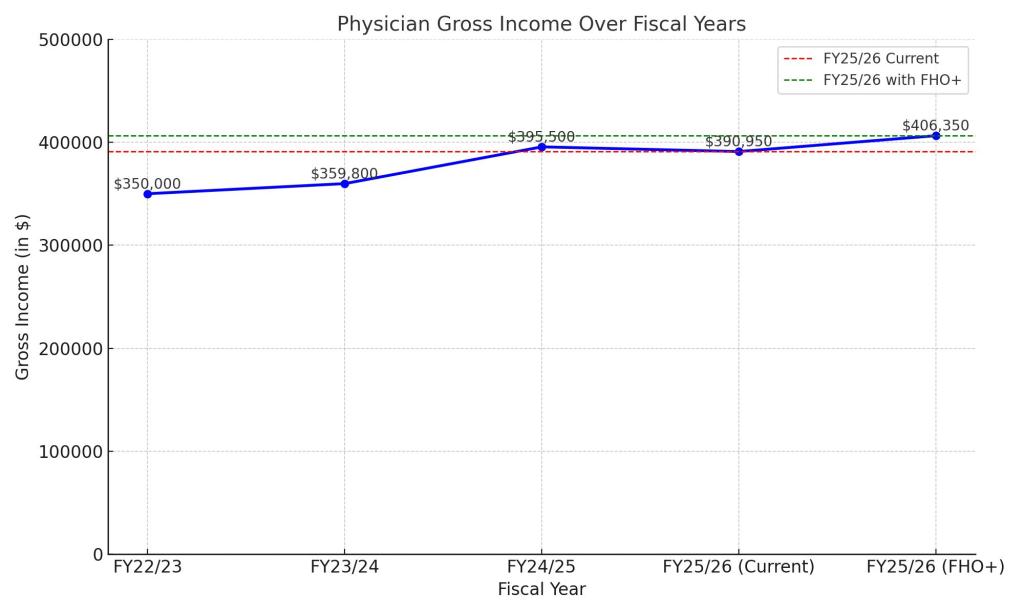
Alright, some more math (my apologies). Let’s use fiscal year 22/23 to start. Let’s assume I grossed $X in that year. For FY 23/24 – that was the last year of the previous PSA and we got a 2.8% increase in fees. So I grossed $1.028X that year. FY24/25 was year I of the current PSA and we were awarded 9.95% by the Arbitrator (compounded to the 2.8%). Because there was no agreement on how to divide it up, it was distributed equally among all docs. So I grossed $1.13X.

Still with me? This year, FY 25/26, by mutual agreement, there was a relativity based increase from the original FY 22/23. FHO docs like me got 11.7% so this year, for now, I will be grossing $1.117X. This is down from last year but may change based on whatever happens in Arbitration.

Based on the OMAs reply, if FY 23/24 is the base year they used in their calculations (when I made $1.028X) then and increase of 13% on that will translate to $1.161X. In essence, if FHO+ goes through, it will mean a 4.4% increase for me next year, compared to this year (1.161-1.117) and a mere 3% more than last fiscal year. Better than nothing? Sure. Is it the major dollar influx needed to save family medicine? I think you know the answer to that.

Graph showing a hypothetical growth in gross income for a category “B” family physician who billed $350,000 in FY 22/23

2. How will rural medicine fare?

One of the things that strikes me about this model is that effectively, rural medicine will not do as well. Now, in fairness, there are attachment bonuses for taking on new patients, and those bonuses are higher in rural areas. So there is that. But my understanding is that rural doctors are working overtime anyway and not really able to take more patients right now.

But what should be noted is that in the OMA calculations, the assumption has been made that doctors are getting at least some access bonus currently. So let’s look at Dr. Rustic and Dr. Metro, a rural and urban doc.

Let’s assume they also fall into category “B” as per the OMAs example. It is well known that urban doctors, despite how hard they work, have challenges getting the access bonus. Dr. Metro currently gets an access bonus of $0 because there are five walk in clinics with 15 minutes of her office. This is despite her group working after hours care. Dr. Rustic on the other hand, gets $25K in access bonus, mostly because his group is the only game in town.

With FHO+ the access bonus gone and repurposed to pay for other items (and that is a very good thing as my friend Dr. Mark Linder pointed out) in effect, Dr. Metro’s raise will be $25k MORE than Dr. Rustic’s. I don’t begrudge Dr. Metro the income, she deserves it. But in order to recruit in rural areas, we’re going to have to find a way to bump Dr. Rustic’s income more.

3. What exactly will the Accountability Metric be?

This is of course, the great unknown. These metrics are often presented as “reasonable” and then governments always find a way to make them unreasonable. We won’t know the answer to that until after Arbitration.

Final Thoughts

At the end of the day, I think family doctors as a whole need to realize that FFS family medicine has gone the way of the Dodo bird (I know this will upset some FFS purists). The government also seems to recognize this and as part of the agreement is increasing the number of FHO+ positions.

Dr. FFS, Family Physician

Despite some of the concerns above, I do think that FHOs should migrate to the new model. It is slightly more money, and I do wonder if by tweaking your practice more – the amount can go up. For example, I have about 200 patients whom I have not rostered because of outside use issues – I would now roster them – and this would increase my income even more. So I suspect there is potential to make more than a 4.4% increase if you manage your roster well. Looking at increased shadow billing rates also offers some potential for more growth.

However, saving family medicine requires a multi-pronged approach that requires a single, unified health information system, family practice teams with physicians clearly placed as the leaders of the teams (with funding for leadership roles) and much more than a 4.4% increase in income. So take the money for now, but don’t in anyway shape or form believe that this in and of itself will fix family medicine.

MOH Pleasantly Surprises (!) and OMA Disappoints in Arbitration Briefs

As I write this, yet another round of Arbitration has begun between the Ministry of Health (MOH) and the Ontario Medical Association (OMA). This time, the goal is to provide a contract for years 2-4 for the Physicians Services Agreement (PSA). As was pointed out to me on social media (thanks Jane and Lisa), year 2 of this current PSA cycle began on April 1, 2025. Yet again, physicians are going to be due retroactive pay for whatever the Arbitrator decides.

Lawyers from both sides have prepared rather thick legal documents called “briefs”. (Proof number 4,638 that lawyers have a rather weird sense of humour). These briefs are public.

I’d be lying if I said that I had thoroughly understood the briefs from both sides. The excruciating agony in trying to parse the language in these things would make having a kidney stone preferable. But these are my humble thoughts from trying to do so….

  1. The MOH team appears to have learned their lesson from last time.

To be abundantly clear right off the bat, the MOH offer for physicians is too low. They are clearly undervaluing doctors in their stance and if the Arbitrator was to accept their position, it would spell further disaster for health care in Ontario.

But….

As I mentioned in my last blog, offering low is what you expect from the other side. It’s part of posturing for the Arbitrator and I’m genuinely not ruffled by it. What would have been unacceptable is they had refused to recognize the severity of the health care crisis like they did last time. Or if they had once again repeated the truly stupid statement that they weren’t concerned about the shortage of comprehensive care family doctors.

Additionally, the MOH has actually agreed to enhance family medicine models through the “FHO+” program, and has agreed to spend a large chunk of the funds on family physicians, an area of the health care system that is dire need. In essence, they admit that there is a problem with a shortage of comprehensive care family doctors. (NB – I will have my thoughts on the FHO+ model sometime early next week).

To re-iterate, there are still a number of problematic issues with their arbitration proposals, including the too low wage increase, the hopelessly complex method of “accountability” in the FHO+ model, a laughable statement that attachment bonuses for Complex patients will begin on July 1, 2025 when the Arbitrator won’t even rule on this until September or October of this year.

But their position is at least not stupid, and certainly not enough to make me go off like last time.

2. The OMA Disappoints With Their Brief

Once again, to be fair, there is a lot to like in the OMA Brief. There is a good analysis of the economic picture in Ontario, a great analysis of the the delays in care, the crisis in family medicine, hard hitting information about the challenges of recruiting and retaining physicians, superb advocating to relieve the admin burden and a clear explanation of why many Alternate Payment Plans are outdated.

Alas, there is once again a “but” here…..

All of the above is what one should expect from a representative organization. One should however, also expect that organization to advocate strongly to make sure their members get their increases in a reasonable time. And it’s here that the OMA falls (badly) flat.

One of (if not THE biggest) issues for physicians these past couple of years has been the constant delays in getting the increases the Arbitrator awarded them in a timely manner. Just recently the MOH unilaterally announced a delay in paying the retroactive funds owed physicians. This is amongst a series of delays all attributed to an ancient and decrepit computer system at the government. (They’ve been making this statement for well over a decade, and very tellingly, have NEVER bothered to upgrade their system).

While the last 4 pages of the OMA Arbitration Brief does a nice job of outlining the issue for the Arbitrator, including the consequences of the MOH incompetence (physicians will simply stop doing certain procedures), the remedy the OMA seeks is milquetoast at best. From the Arbitration brief (edited):

“As a result, the OMA requests, as is normal and customary, that this Board of Arbitration remain seized with respect to any issues arising from the implementation of this Award……….

“….with the OMA reserving its right to seek appropriate remedies (e.g. interest) in the event that the Ministry fails to meet agreed upon or directed implementation dates, particularly where the Ministry is unable to provide justification for any delay, or otherwise where the delay is unreasonable and unwarranted.”

That’s it?? All this means is that WHEN (not if – we all know the MOH can’t get their act together) the next payment delays show up, all that will happen is the OMA will complain to the Arbitrator, then there will be more hearings, and those hearings will go on for months/years and then finally, the Arbitrator MAY announce penalties to the MOH. The only good that will come out of this is that a bunch of lawyers will get rich going to repeated hearings.

What’s worse is the OMA readily admits they know the Arbitrator “favours accountability measures” in their video on the new FHO+ model (around the 3:36 mark). So doctors have to be accountable to follow an agreement, but the MOH can wiggle out and delay? The OMA can’t advocate for accountability to go both ways?

EVEN worse is that in reading the MOH briefs, they actually clearly lay out what accountability measures they want from physicians. Page 92 specifically outlines what accountability they expect from family physicians in the new FHO+ model, and how the penalties will be implemented if physicians don’t meet those accountabilities. No “seizing of the Arbitration Board” or any such thing. Now I disagree wholeheartedly with the MOH stance on this – but at least they clearly outlined what remedies they are seeking without the need for further drawn out processes. The OMA couldn’t have done the same thing??

Overall, this Arbitration hearing appears less contentious than last time, and the gap in asks is smaller overall. Hopefully this means a quicker resolution. But while there is a lot of good stuff in the OMA brief, it’s hard not feel let down by the subservient, almost nonchalant attitude the OMA is taking on payment delays. Sure looks like a golden opportunity to address this was missed.